
A macro studio photo of a vintage snow globe: a tiny winter village with a lit white chapel, snowy timber cottages and frosted firs inside the glass, snowflakes swirling, a turned wooden base with a brass band, warm window glow and string-light bokeh on a dark winter night.
A close-up studio photograph of a vintage glass snow globe on a dark walnut shelf. Inside the clear water-filled dome sits a tiny handmade winter village: a small white chapel with a slim steeple and warm yellow light glowing from its arched windows, a pair of little timber cottages with snow-covered roofs and glowing windows, a few frosted fir trees and a narrow path winding up a snowy hill. Fine white snowflakes swirl gently through the water, a few settling on the roofs.

The globe stands on a turned wooden base with a thin brass band, slightly worn at the edges. Soft curved reflections and a warm highlight bend across the glass; the glowing windows cast a faint golden light into the snow inside. Behind the globe, out of focus, a dark wintry window with blurred warm string-light bokeh. Warm low-key lighting from the side, deep blue and charcoal shadows, a cozy, nostalgic holiday mood.

Macro lens, shallow depth of field with the chapel and cottages tack-sharp through the glass, slight refraction at the dome's edges, rich contrast between warm window light and cool snow. No people, no figures inside the globe, no readable text or logos. Portrait 3:4.
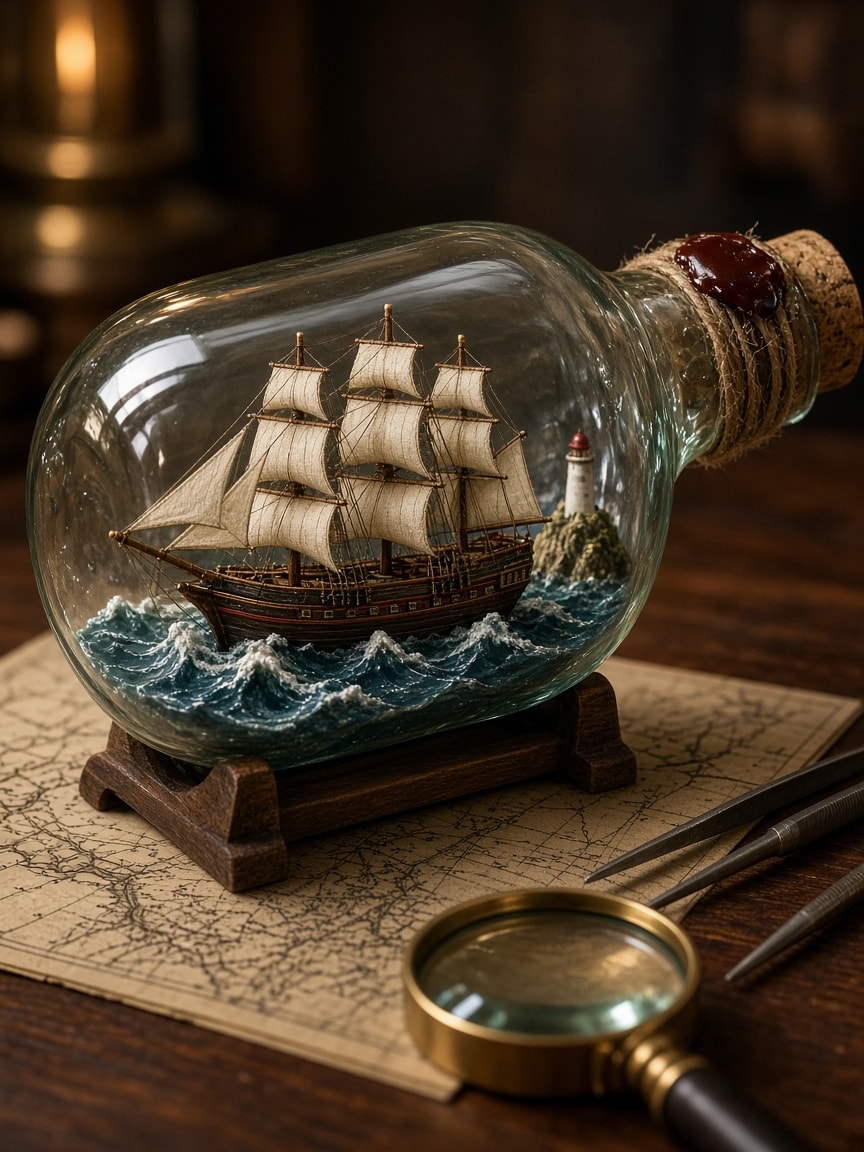
A macro studio photo of a handmade ship in a bottle: a tiny three-masted clipper with linen sails and thread rigging on a carved putty sea beside a little lighthouse, inside old greenish glass with a wax-sealed cork, resting on a sea chart by a brass magnifier in warm lamp light.
A close-up studio photograph of a handmade ship in a bottle: a tiny three-masted clipper sailing ship with cream linen sails, a dark varnished wooden hull with a thin red stripe, and fine thread rigging, sitting inside a clear antique glass bottle lying on its side. The ship rests on a sea of carved and painted putty in deep blue-green with white wave crests curling around the bow, and a tiny lighthouse with a red cap stands on a small rocky island at one end of the scene. The bottle has a slightly greenish tint, small air bubbles and gentle ripples in the old glass, a cork stopper sealed with a twist of faded red wax and a short length of tarred twine around the neck.

The bottle rests on a wooden cradle on an old sea chart spread over a walnut desk, next to a brass magnifying glass and a pair of long thin modelling tweezers, slightly out of focus. Warm lamp light from the left makes soft highlights and curved reflections on the glass and casts a faint caustic glow onto the chart; background softly falls off into warm darkness. Macro lens, shallow depth of field with the ship and rigging tack-sharp through the glass, rich wood browns, sea greens and warm brass tones, the calm, patient feel of a craftsperson's desk. No people, no hands, no readable text or labels on the chart. Portrait 3:4.
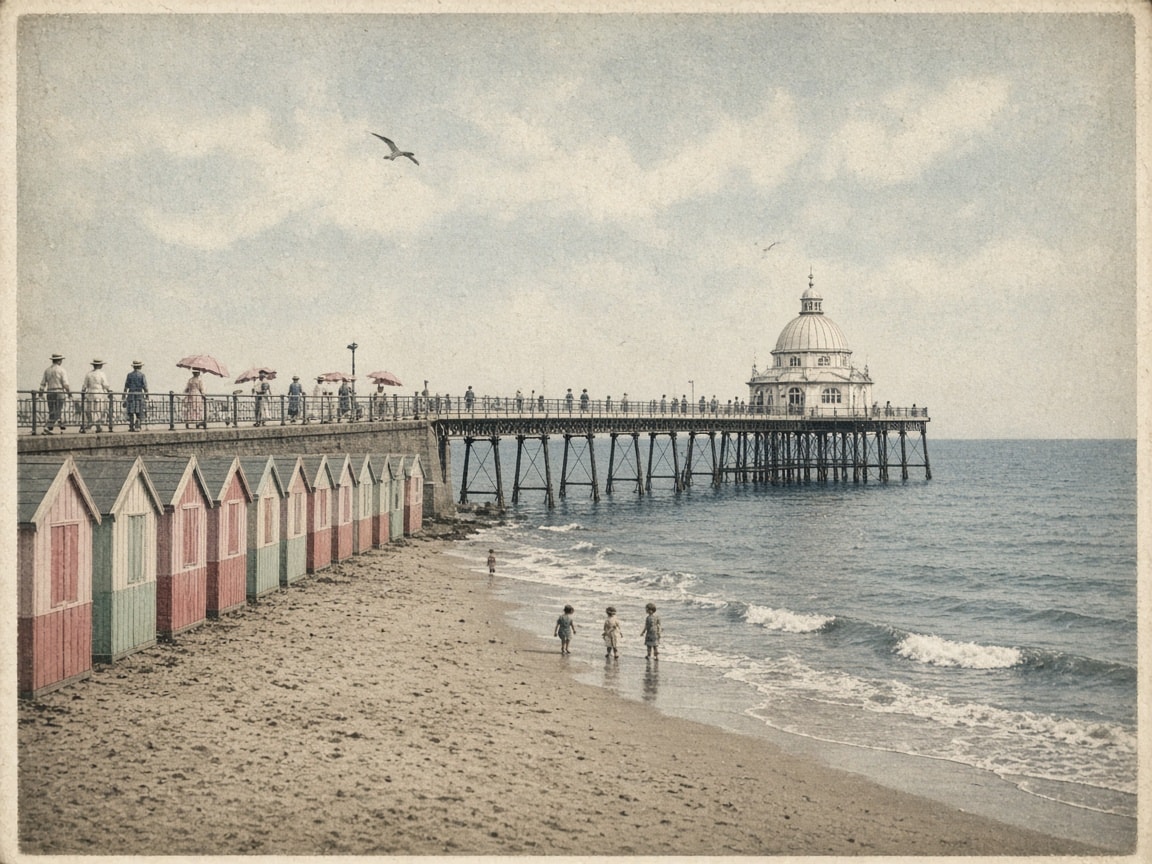
A hand-tinted black-and-white photo in the style of a 1920s seaside postcard: a Victorian pier with a domed pavilion, candy-striped bathing huts on the sand, distant strollers with parasols, with silver grain and soft translucent hand-painted coral, mint and powder-blue washes on aged paper.
A hand-tinted black-and-white photograph in the style of a 1920s seaside postcard: a long Victorian pier with a white domed pavilion stretches out into a calm sea on the right, and along the sandy beach in the foreground stands a row of wooden bathing huts with candy stripes. Small figures seen from a distance stroll along the promenade railing with parasols and straw boater hats, a few children play at the water's edge, and gulls hang in a pale sky with soft streaky clouds.

Render it exactly like an original hand-coloured photo print: fine silver-gelatin grain and soft focus at the edges, a sepia-grey base image with thin, slightly translucent watercolor washes added by hand: faded coral and mint on the huts, powder blue on the sea and sky, pale rose on the parasols, a touch of ochre on the sand. Some colors drift a little outside the edges, as in real hand tinting. Slightly warm, aged paper tone, a narrow white border, very faint scratches and a soft vignette. No modern objects, no readable text or captions, no close-up faces. Landscape 4:3.
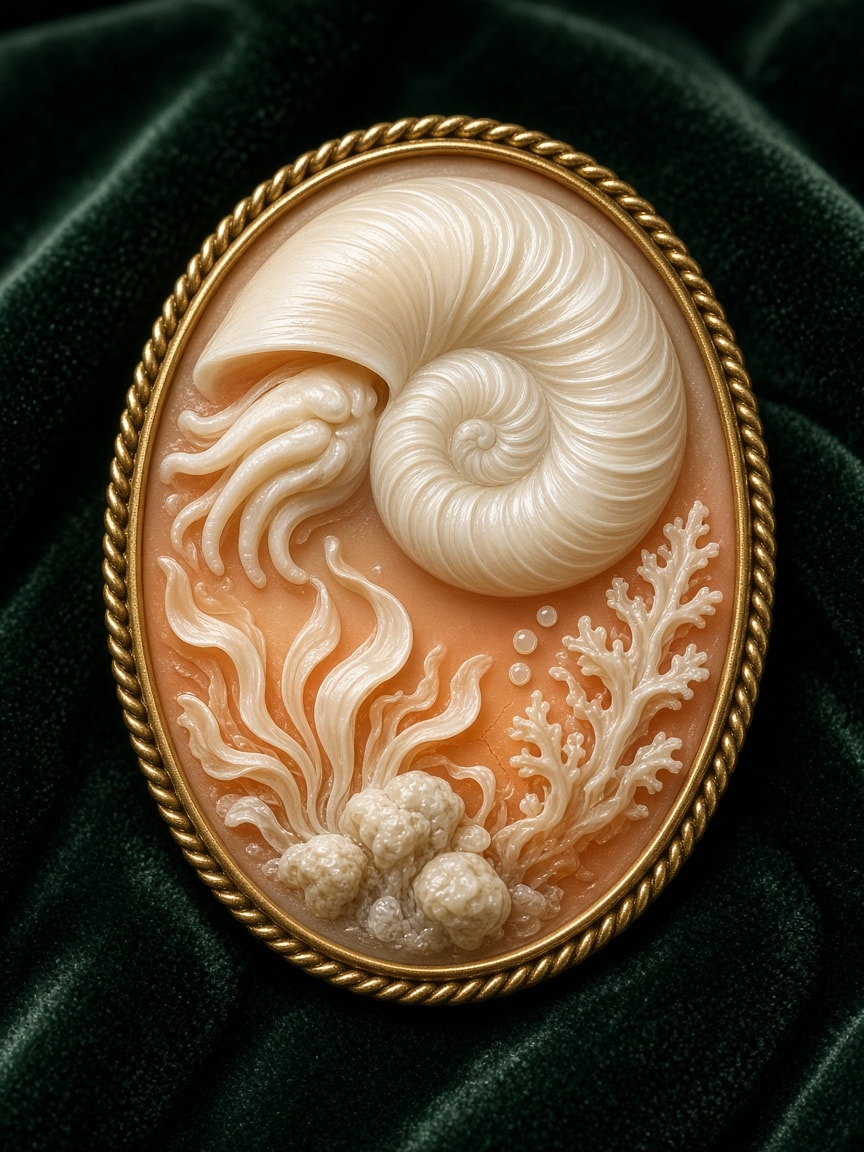
A macro studio photo of a hand-carved Victorian-style shell cameo brooch: a chambered nautilus among kelp and sea lettuce in creamy white relief on glowing peach sardonyx shell, in a slim gold rope bezel on dark green velvet, with chisel marks and raking window light.
A close-up studio photograph of a hand-carved Victorian-style shell cameo brooch showing a chambered nautilus drifting among seaweed, carved in creamy white relief on a warm peach-to-caramel sardonyx shell background. The oval cameo fills most of the portrait frame and sits in a slim antique gold bezel with a fine twisted-rope border and tiny milgrain beading. In the center, the nautilus shell is seen from the side: its smooth spiral with delicate growth lines and the curved stripes of the shell carved as low ridges, the opening at the left with a few short tentacles curling out beneath the hood. Around it, long ribbons of kelp and frilly sea lettuce rise from a small cluster of rocks at the bottom, and three tiny air bubbles float toward the top.

Render it exactly like real shell carving: the white layer is thinnest at the edges, so the background peach color glows through the thin tentacles, seaweed tips and bubble edges; visible fine chisel and burin marks, softly polished high points, slightly uneven hand-cut outlines, and a faint natural crack line in the shell near the lower right. The brooch rests on dark green velvet with visible pile, lit by soft window light from the upper left that rakes across the relief to show its depth, with a small warm highlight on the gold. Macro lens, shallow depth of field, the carving sharp, the velvet falling softly out of focus. No text, no hallmarks, no hands, no people. Portrait 3:4.
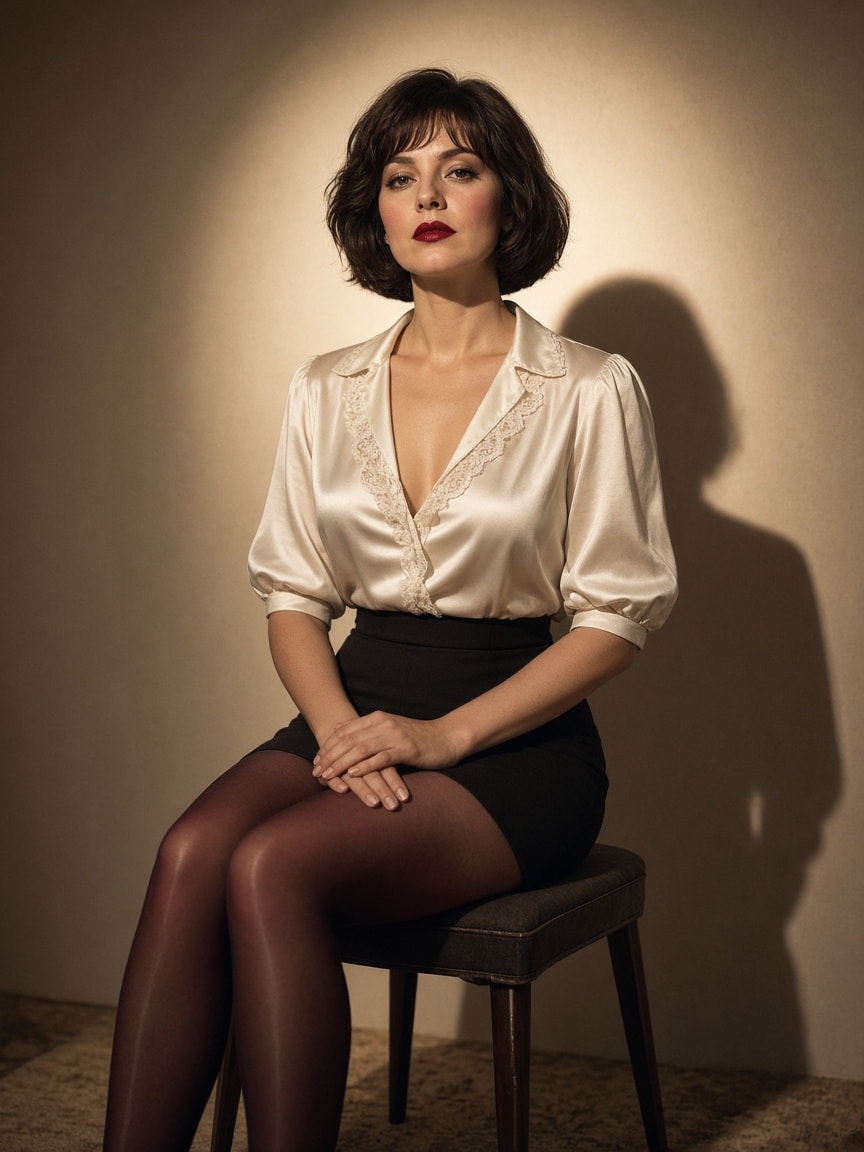
Turns an uploaded photo of a woman into a photorealistic 1970s editorial studio portrait with a crimson lip, ivory satin lace blouse, warm spotlight glow and analog film tones, keeping her exact identity.
Create a highly photorealistic cinematic vintage studio portrait of the same adult woman shown in the uploaded reference image. Preserve her exact facial identity, recognizable features, natural skin tone, face shape, eyes, nose, lips, and facial proportions without beautification or alteration.

Appearance & Makeup:
She has a short, softly tousled dark-brown bob with gentle loose curls framing her cheeks and delicate wispy bangs across her forehead. Her expressive hazel-brown eyes are enhanced with subtle smoky eyeliner, naturally shaped eyebrows, softly flushed cheeks, and elegant deep crimson-red lipstick. Her complexion is warm and luminous, with realistic skin texture and natural details.

Outfit & Styling:
She wears an elegant ivory satin blouse with a modest, softly draped neckline, delicate lace detailing around the collar, and subtle puff sleeves. The blouse is neatly fitted and tucked into a high-waisted black tailored mini skirt with a refined silhouette. Add sheer dark burgundy stockings for a sophisticated vintage-inspired look. The overall styling should feel elegant, tasteful, and timeless rather than revealing.

Pose & Composition:
She sits gracefully on a low vintage studio chair, leaning slightly forward with relaxed shoulders and a confident posture. Her hands rest naturally together on her lap. Her chin is gently raised as she looks directly into the camera with a confident, subtly mysterious expression.

Lighting & Background:
A minimalist warm beige studio wall serves as the background. A strong directional spotlight creates a soft circular glow behind her, accompanied by a beautifully defined shadow falling to one side. Rich warm shadows, gentle highlights across her face, and subtle cinematic contrast create an intimate vintage Hollywood atmosphere.

Photography Style:
Classic 1970s editorial portrait photography, vintage studio glamour, warm analog film tones, authentic skin texture, subtle film grain, sophisticated color grading, professional fashion photography, sharp facial focus, beautifully balanced composition, highly detailed, photorealistic, vertical  portrait.

Maintain the reference woman's exact identity throughout. No cartoon features, no anime aesthetics, no artificial skin smoothing, no exaggerated body proportions, and no changes to her recognizable appearance.
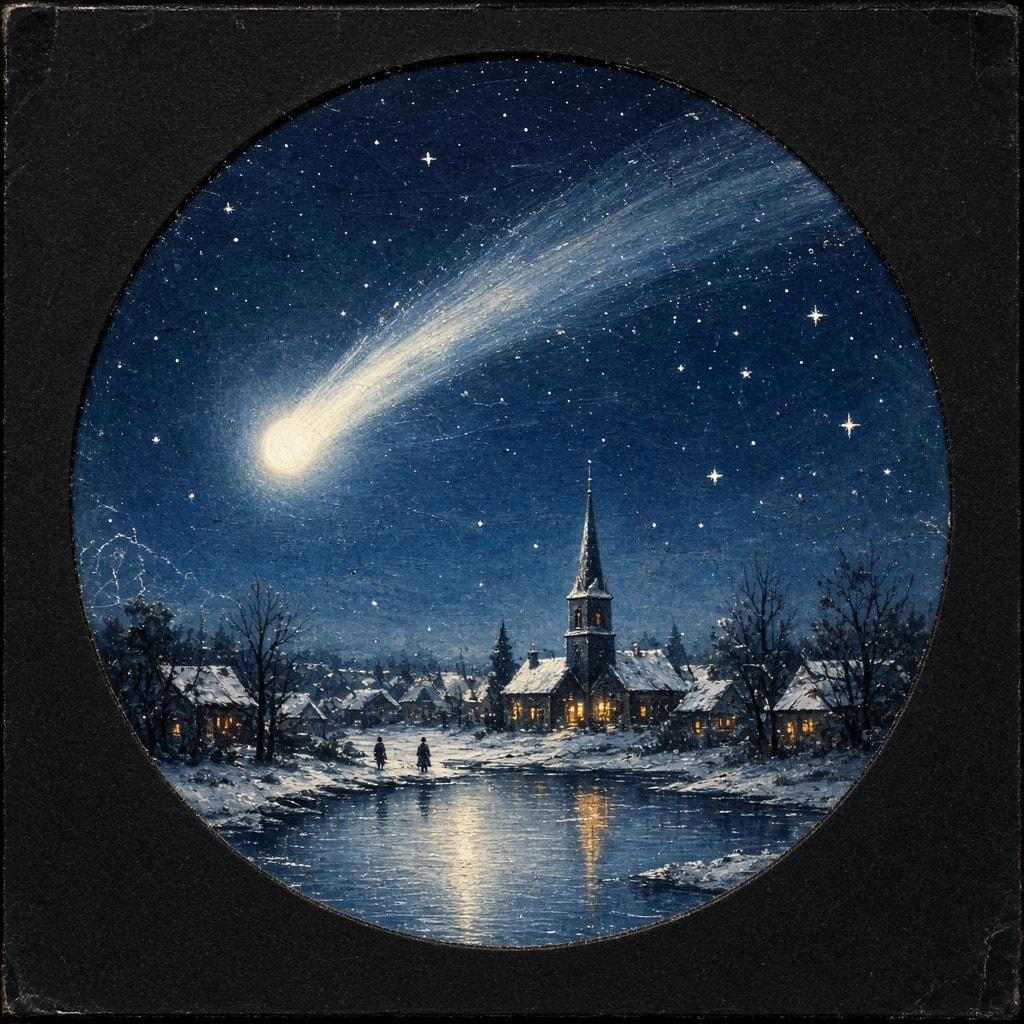
A glowing hand-painted Victorian magic lantern glass slide: a great comet with a long sweeping tail over a snowy village with a church spire, amber windows and a frozen pond, in translucent Prussian blue and amber washes inside a round black mask, with bubbles, dust and hairline scratches.
A hand-colored Victorian magic lantern glass slide showing a great comet over a snowy village at night, photographed straight-on against a soft backlight so the glass glows. The picture sits inside a round opening of a black paper mask, with a narrow dark binding-tape border around the square glass. Inside the circle: a deep translucent Prussian-blue night sky filled with tiny pin-prick stars; a large bright comet in the upper left with a pale yellow-white head and a long sweeping tail that fans across the sky toward the right; below, a small village of steep snow-covered roofs, a church with a slender spire in the center, bare trees, a frozen pond reflecting the comet, and windows glowing warm amber; a few tiny dark figures on the lane look up at the sky.

Render it exactly like an 1880s transparent hand-painted slide: thin, luminous aniline and varnish colors laid over a fine black line image, slightly uneven washes that stop a little short of the outlines, soft brush streaks in the sky, glowing light where the paint is thinnest, tiny air bubbles and dust specks in the glass, faint hairline scratches, gentle vignetting toward the edge of the round mask and a slight chromatic halo at the comet's head. Warm, glowing, nostalgic and magical. No text, no labels, no modern objects. Square 1:1.
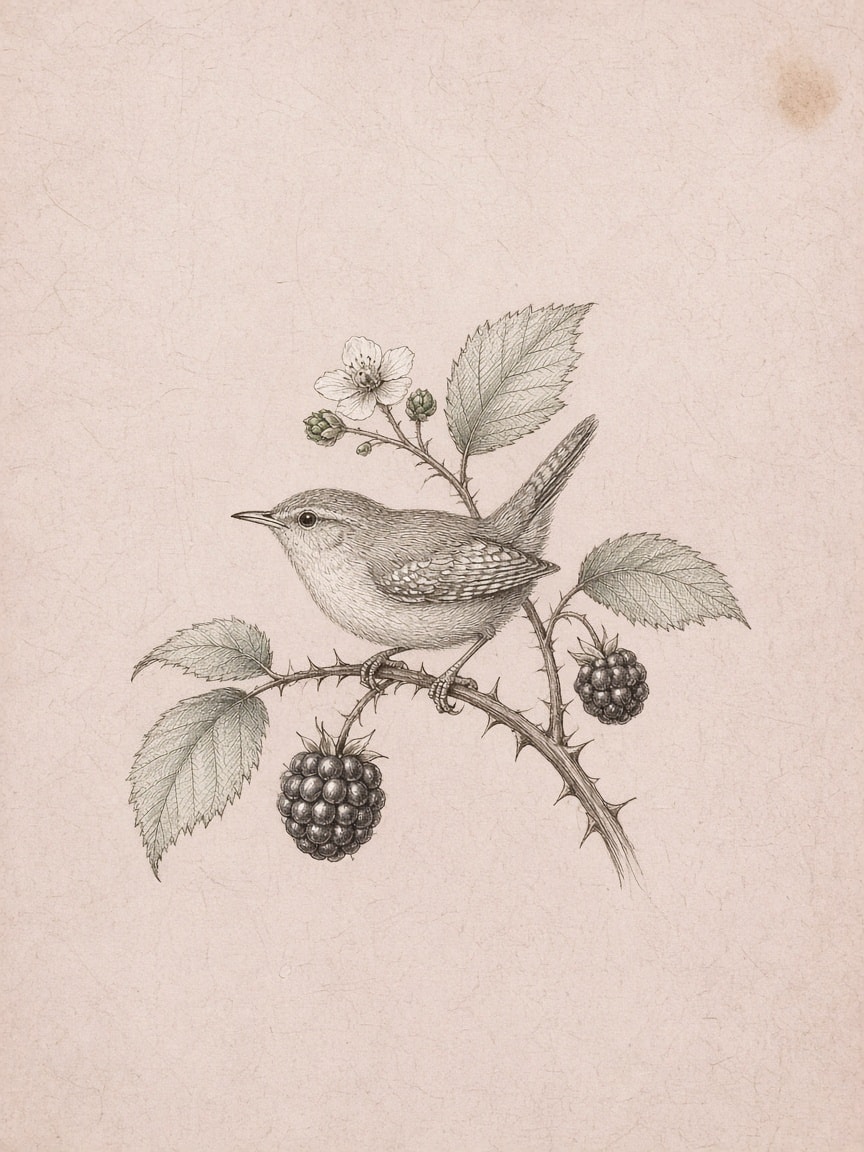
A Renaissance-style silverpoint drawing on warm ivory-pink prepared paper: a wren with a cocked tail on an arching bramble branch with blackberries, thorns and serrated leaves, built only from fine tarnished hatching lines with white chalk highlights and faint construction lines.
A Renaissance-style silverpoint drawing of a small wren perched on an arching bramble branch with ripe and unripe blackberries, drawn on paper coated with a pale warm ivory-pink prepared ground. The wren sits in the upper middle of the sheet facing left, tail cocked upright, its round body built from hundreds of fine parallel hatching lines and soft cross-hatching that describe the barred wing and tail feathers, a bright tiny eye and a thin slightly curved beak. The bramble enters from the lower right and curves up under the bird: thorny stems, three serrated leaves with clear veins, two clusters of blackberries with each round drupelet modeled by tiny curved strokes, a few hard green berries and one small five-petal flower.

Render it exactly like a real metalpoint drawing: only thin, even, delicate grey lines that have aged to a soft warm brown-grey tarnish, no smudging, no thick or black strokes, no solid fills; tone is built only by layered hatching that follows the forms. Add a few faint exploratory construction lines and one lightly corrected wing outline, small white chalk highlights on the eye, the berries and the leaf edges, and plenty of empty toned paper around the subject. Slight fibre texture and a soft foxing spot near one corner. Even, flat museum lighting, straight-on view of the whole sheet. No text, no signature, no frame. Portrait 3:4.
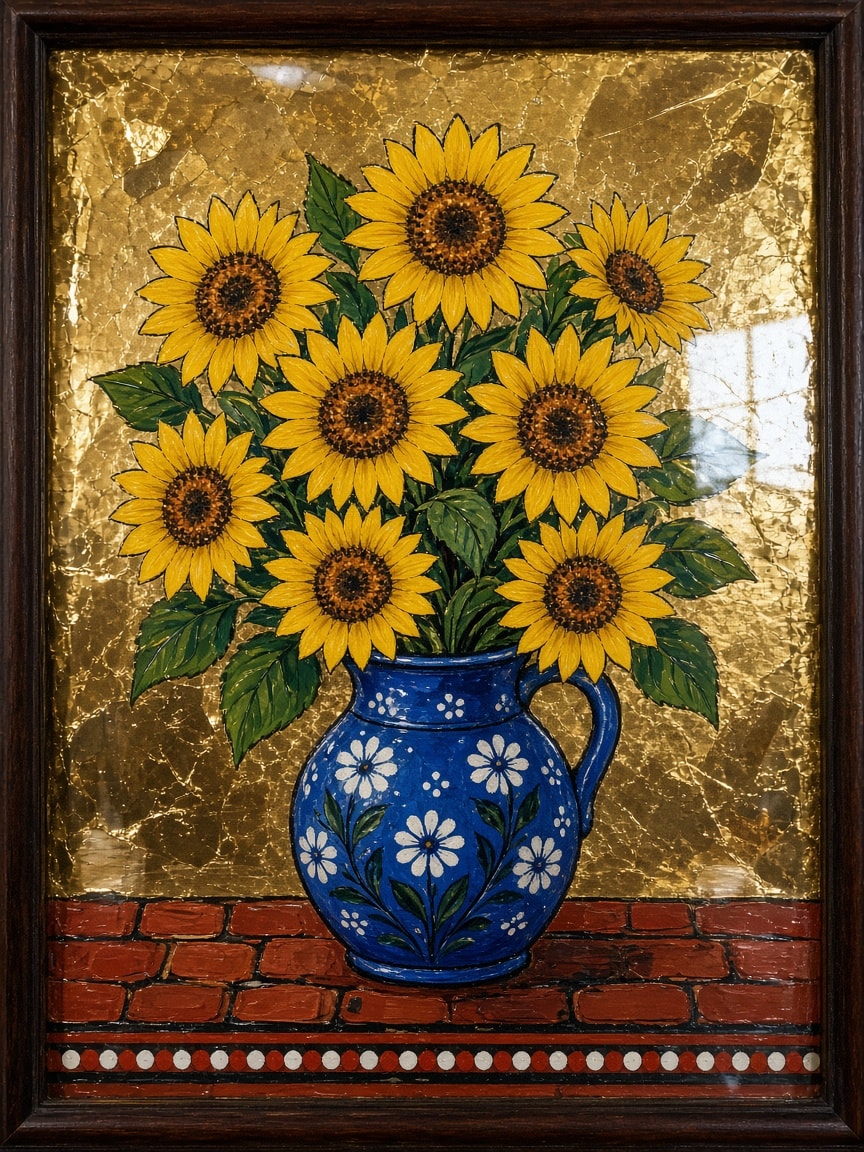
A naive Hinterglasmalerei reverse glass painting: nine chrome-yellow sunflowers in a cobalt-blue jug painted with white daisies, bold black outlines and flat colors behind glossy old glass, a crinkled gold-leaf background, a red-and-white dot border and a dark wooden frame.
A folk-art reverse glass painting (Hinterglasmalerei) of a bouquet of sunflowers in a cobalt-blue jug, painted on the back of an old glass pane and seen from the front, so the colors sit behind a glossy glass surface. Vertical 3:4 composition.

Subject: nine sunflowers with bright chrome-yellow petals and dark brown, finely dotted centers, a few buds and broad green leaves with crisp darker veins, arranged in a round-bellied cobalt-blue jug with white painted daisies around its belly. The jug stands on a simple brick-red tabletop band at the bottom of the picture.

Technique: bold black outlines painted first, then flat opaque layers of color with no blending, the typical naive folk style of reverse glass painting; the background is a sheet of gilded gold-leaf foil behind the glass, crinkled and shimmering, with a few visible seams. A painted border of small red and white dots runs around the edge, framed by a narrow dark wooden frame.

Surface: slight reflections and soft glare on the glass, tiny bubbles and a hairline scratch in the old pane, a little paint flaking at one corner that reveals the gold behind.

Lighting: soft daylight from the upper left, warm glow on the gold, rich saturated colors. No people, no text.
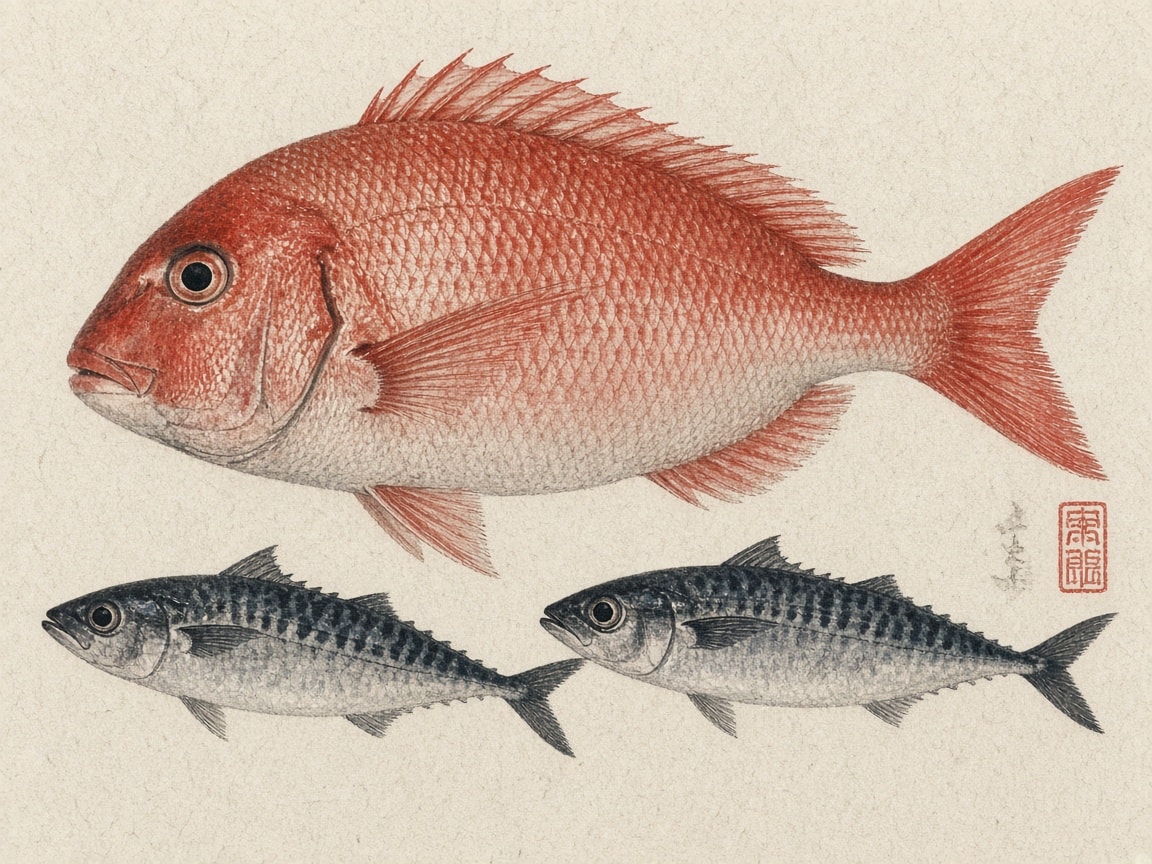
A traditional Japanese gyotaku fish rubbing in sumi ink on fibrous handmade washi: a large red sea bream with a faded vermilion wash above two mackerel, every scale and fin ray pressed in, hand-painted eyes, abstract brush marks and a red seal stamp.
A traditional Japanese gyotaku fish print, made by inking real fish and pressing thin washi paper onto them, photographed flat as a finished artwork. Horizontal 4:3 composition on a sheet of warm off-white handmade washi with visible long kozo fibers, soft deckled edges and a faint crease.

Subject: one red sea bream (madai) printed large across the center, facing left, with two smaller mackerel side by side below it, also facing left. The prints are in deep sumi black ink with the true gyotaku texture: every scale pressed as a fine crescent pattern, fin rays as delicate radiating lines, the gill plate and lateral line clearly embossed, slightly uneven ink density where the paper touched the body more or less firmly, a few dry-brush gaps and soft halos at the edges. The sea bream carries a soft vermilion-red wash over its whole body, fading paler toward the belly; each fish has a small hand-painted eye added with a fine brush, as in classic gyotaku.

Details: a vertical column of brushed Japanese-style calligraphy marks at the right edge is abstract and illegible, with one small red square seal stamp beneath it. Light ink speckles near the fins.

Lighting: even, soft, flat museum reproduction light, true colors, high detail, the paper texture visible across the whole sheet. No frame, no table, no hands, no readable text.

A structured JSON prompt that rebuilds your uploaded photo as a photorealistic portrait assembled from weathered ceramic tiles on a sage plaster wall, with seamless continuity across the grout lines and four handwritten motivational sticky notes around it.
{
  "task": "Transform the uploaded photograph into a cinematic, photorealistic vintage tiled portrait poster.",

  "reference_image": {
    "source": "Use the user's uploaded photograph as the primary identity reference.",
    "identity_preservation": "Preserve the person's exact facial identity, facial structure, skin tone, hairstyle, eye shape, and recognizable features.",
    "gender": "Automatically follow the uploaded subject.",
    "expression": "Maintain the original expression or create a subtle, confident, natural expression."
  },

  "composition": {
    "layout": "Vertical editorial poster.",
    "structure": "A large rectangular portrait assembled from approximately 4 columns and 5 rows of individual square, slightly irregular ceramic or paper tiles.",
    "portrait": "The subject occupies the central majority of the composition, visible from the head to the upper torso.",
    "tile_effect": "Every tile is physically separated by thin, dark, realistic grout lines. Slight variations in alignment, chipped edges, worn corners, and subtle shadows create an authentic handmade tiled-wall appearance.",
    "continuity": "The portrait must align seamlessly across all tiles, with facial features and body details continuing naturally across tile boundaries."
  },

  "environment": {
    "background": "Muted dusty sage-gray textured plaster wall.",
    "surface": "Aged, slightly weathered surface with subtle imperfections.",
    "lighting": "Soft natural diffused daylight with gentle shadows."
  },

  "styling": {
    "clothing": "Automatically create tasteful, sophisticated clothing that complements the subject's appearance. Prefer vintage-inspired casual or smart-casual styling.",
    "aesthetic": "Understated vintage editorial photography.",
    "color_palette": "Muted earthy browns, charcoal, dusty sage, warm beige and subtle faded tones."
  },

  "personalized_details": {
    "sticky_notes": {
      "placement": "Four small yellow handwritten sticky notes positioned around the outer edges of the tiled portrait.",
      "messages": [
        "Trust your instincts",
        "Big decisions",
        "Make it happen",
        "Stay fearless"
      ],
      "style": "Authentic handwritten black ink, slightly imperfect lettering, naturally curled paper corners and realistic shadows."
    },
    "signature": "A tiny handwritten 'prompt by @yourusername' near the bottom-left tile. Omit if no username is supplied."
  },

  "photography": {
    "style": "Ultra-realistic photographic portrait.",
    "lens": "50mm editorial portrait photography.",
    "details": "Natural skin texture, realistic hair strands, detailed fabric textures, subtle film grain and authentic photographic imperfections.",
    "color_grading": "Warm vintage film aesthetic with restrained contrast."
  },

  "quality_control": {
    "priority": [
      "Preserve the uploaded person's identity.",
      "Keep the face realistic and anatomically accurate.",
      "Ensure the tile grid is clearly visible.",
      "Maintain seamless portrait continuity across tiles.",
      "Keep sticky notes outside the main facial area.",
      "Avoid excessive AI beautification."
    ],
    "avoid": [
      "Changing facial identity",
      "Plastic-looking skin",
      "Artificial facial features",
      "Broken tile alignment",
      "Floating tiles",
      "Excessive decorative elements",
      "Cartoon or illustrated appearance",
      "Distorted text",
      "Watermarks"
    ]
  },

  "output": {
    "aspect_ratio": "3:4",
    "resolution": "High resolution",
    "rendering": "Photorealistic vintage editorial poster"
  }
}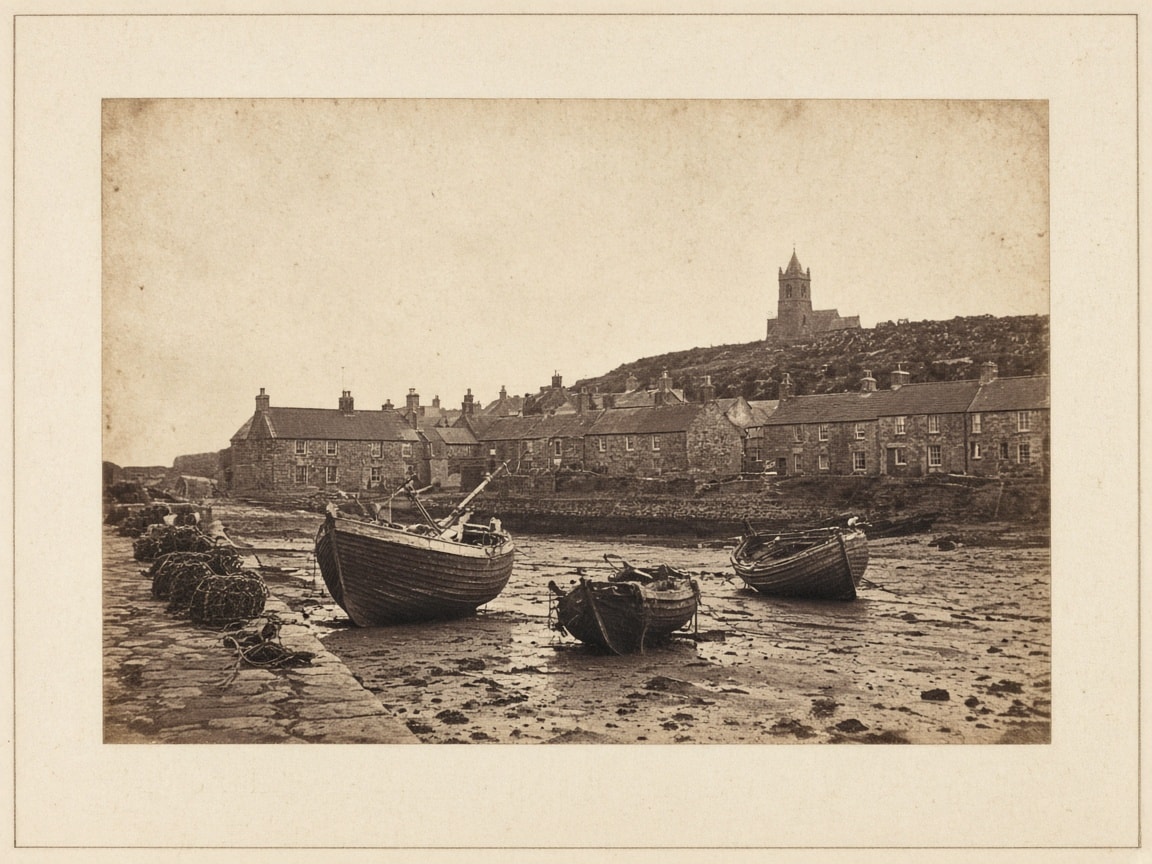
Early calotype-era salted paper photograph: three fishing boats resting on the mud at low tide, lobster pots on a cobbled quay, stone cottages and a church tower on the hill, with a matte image in warm reddish-brown tones, soft paper-negative detail, a pale sky, vignetted edges and foxing.
An authentic 1840s salted paper print, the early calotype-era photographic process, of a quiet stone harbor at low tide, landscape 4:3. Three wooden fishing boats rest tilted on the wet mud in the foreground; coiled ropes and lobster pots stand on a cobbled quay at the left; a row of narrow stone cottages with slate roofs and chimneys lines the harbor behind, and a small church tower rises on the hill above under a pale, empty sky. Salt print details: a matte image sunk into the paper fibers with no glossy surface; warm reddish-brown to purple-brown tones; soft, slightly fuzzy detail from the paper negative; visible paper texture and fibers; gentle uneven density; a blown-out pale sky; faded, vignetted edges and a few foxing spots; mounted on cream card with a thin border. Long-exposure stillness with no motion blur. Quiet, timeless coastal mood. Viewed straight on as a flat print in soft even light. No text, no signature, no frame, no people.
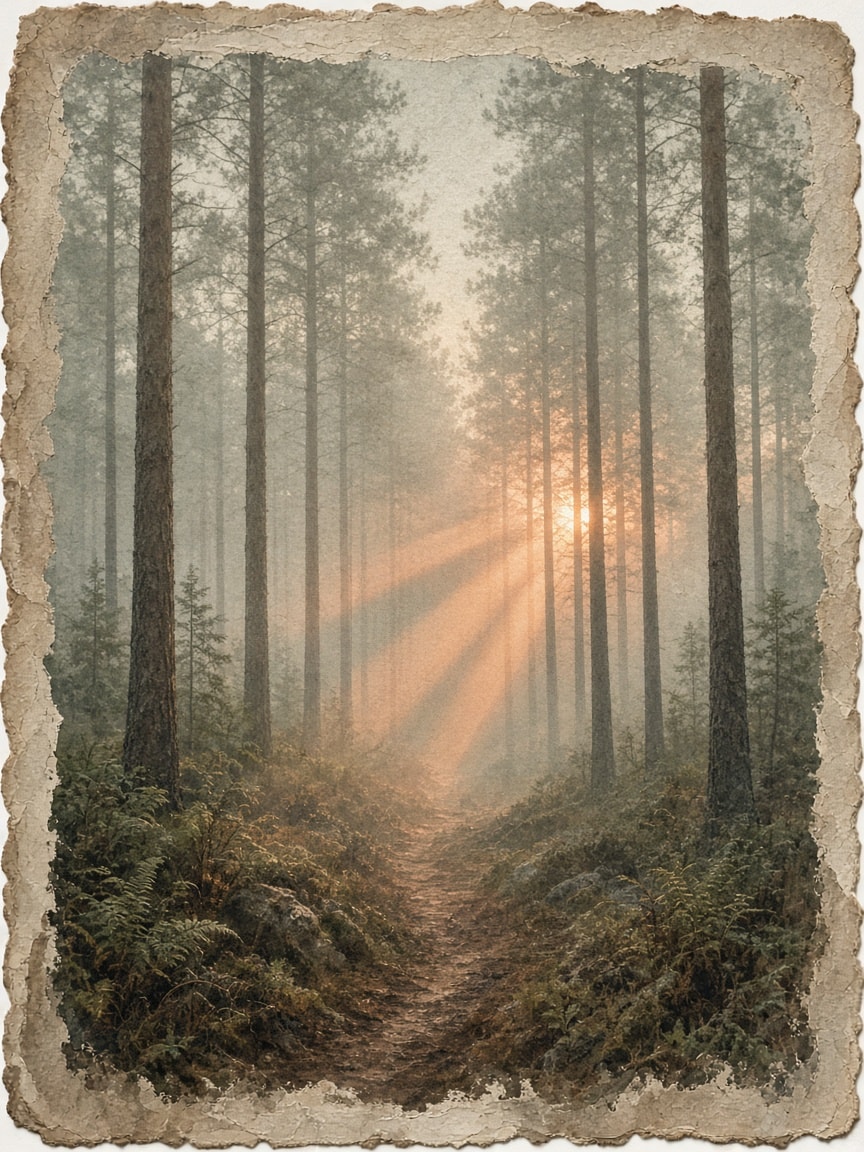
Early 1900s pictorialist gum bichromate photograph: rows of tall pines fade into fog as dawn rays cut through the mist over a needle-covered path, with soft painterly tonal masses, warm peach-gold sun rays, muted grey-green pigment layers and aged paper with rough torn deckled edges.
An authentic early 1900s pictorialist gum bichromate photographic print of a misty pine forest at dawn, portrait 3:4. Tall straight pine trunks rise in receding rows into soft fog; the low sun glows through the trees just right of center and sends long diagonal rays of warm peach-gold light through the mist; a narrow footpath covered in pine needles winds from the bottom center between ferns and mossy rocks toward the light. Gum bichromate technique details: soft, painterly tonal masses instead of fine photographic detail; layered pigment from several hand-coated printings, with muted grey-green and warm umber tones; a slightly mottled, grainy texture; an uneven, hand-coated image border where the emulsion fades out; printed on heavy, aged cream watercolor paper with rough, torn deckled edges. Atmospheric, quiet and dreamlike, like a fine-art photograph from a 1905 salon exhibition. Viewed straight on as a flat print in soft even light. No text, no signature, no frame, no people, no animals.
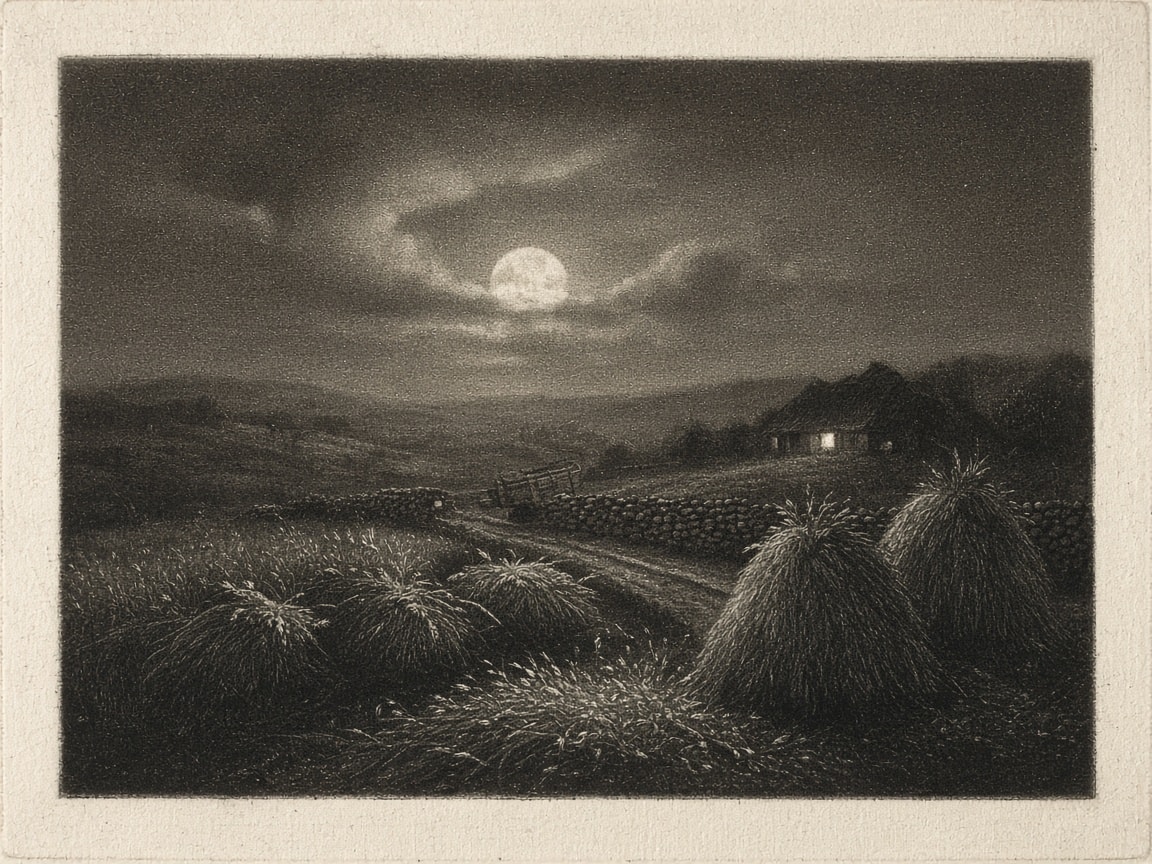
Authentic 18th-century style mezzotint print in warm black-brown ink: tied wheat sheaves and haystacks, a resting hay cart and a thatched farmhouse with one lit window under a veiled full moon, with velvety rocked-grain blacks, softly burnished highlights, smooth tonal gradations and an embossed plate mark.
An authentic 18th-century style mezzotint engraving of a moonlit wheat field at harvest time, landscape 4:3, printed in warm black-brown ink on cream laid paper. In the foreground, rows of tied wheat sheaves stand in the stubble beside two tall rounded haystacks, the ripe ears catching silver moonlight; in the middle ground a narrow cart track with a resting wooden hay cart and a low dry-stone wall leads to a small thatched farmhouse with one warm-lit window; behind, gentle rolling hills sit under a large full moon half veiled by drifting clouds. Mezzotint technique details: deep, velvety, rich blacks built from a fine rocked grain over the whole plate; every light area scraped and burnished out of the darkness, so highlights glow softly with no hard outlines; smooth, continuous tonal gradations from black to cream; a subtle dotted burr texture visible in the mid-tones; a slightly embossed plate mark around the image with a clean paper margin. Quiet, nocturnal, timeless mood. Viewed straight on as a flat print in soft even light. No text, no signature, no frame, no people.
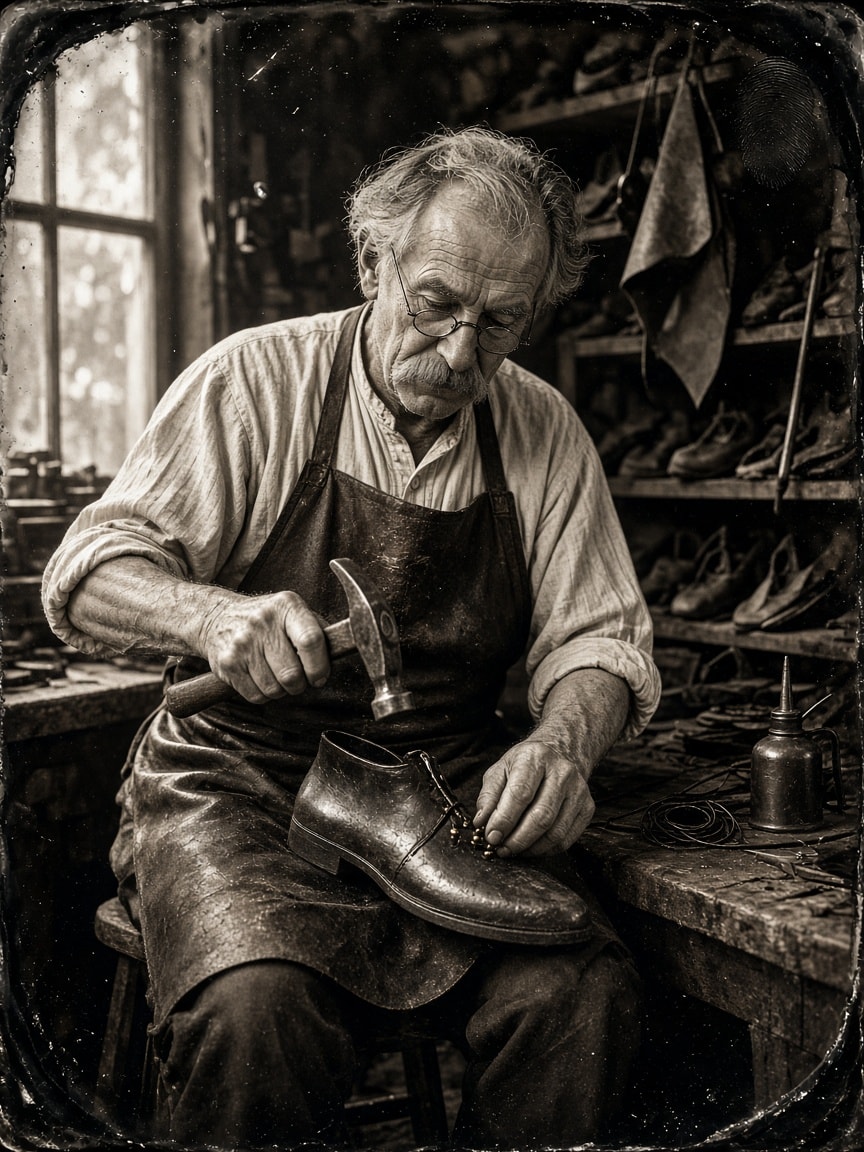
Authentic wet plate collodion tintype portrait: an elderly cobbler in a leather apron and wire spectacles hammers tacks into a boot on an iron last, lit by one window among shelves of shoes, with warm monochrome tones, swirly large-format falloff, pour marks, comet streaks and a black-enameled iron plate.
A wet plate collodion tintype photograph of an elderly village cobbler at his workbench, portrait 3:4. He sits on a low wooden stool in a small workshop, leaning over a leather boot fitted on an iron shoe last held between his knees, a small hammer raised in one hand and brass tacks pinched between the fingers of the other. He wears a worn leather apron over a collarless linen shirt with rolled sleeves, round wire spectacles low on his nose, a thick grey mustache and a deeply lined, concentrated face. Behind him: wooden shelves of finished and half-repaired shoes, hanging rolls of leather, an awl, waxed thread and a tin oil can on the bench. Lit by one large window from the left, giving soft directional light with deep shadows on the right. Authentic tintype look: monochrome with warm brown-black tones and creamy silver highlights, very shallow depth of field from a large-format brass lens with swirly falloff at the edges, sharp focus on the eyes and hands, the high blue sensitivity of collodion that makes skin look slightly darker and textured, and a long-exposure stillness. Plate details: uneven dark edges where the collodion was poured, small comet streaks and pour marks, a few fine specks and a faint thumbprint in one corner, on a thin black-enameled iron plate with slightly rounded corners. No text, no logos, no color, no modern objects.
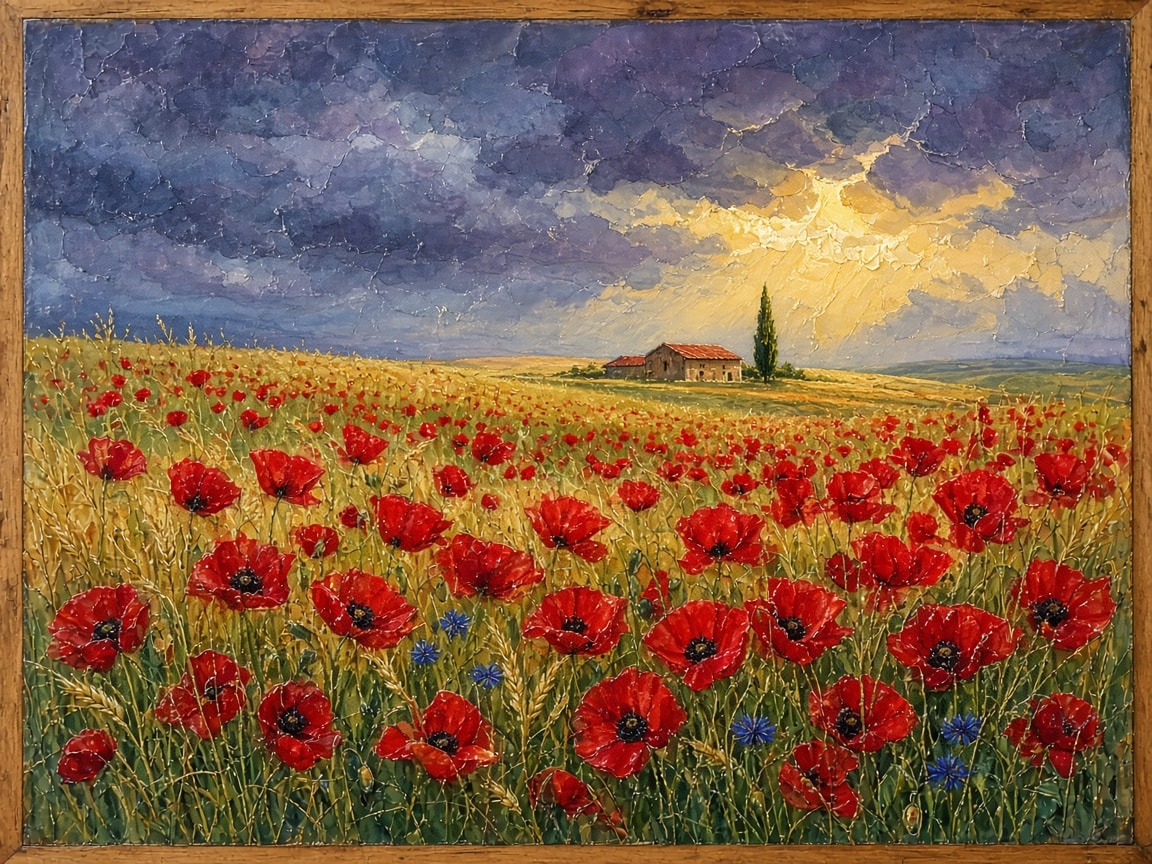
Layered encaustic beeswax painting on a wooden panel: scarlet poppies and cornflowers sway through golden grass toward a red-roofed farmhouse and lone cypress under slate-blue storm clouds with one break of warm light, with translucent wax depth, melted edges, incised lines, drips and a buffed satin sheen.
An encaustic hot wax painting of a wild red poppy field under a dark summer storm sky, landscape 4:3. Built up in many translucent layers of pigmented beeswax fused with heat on a wooden panel: in the foreground, dozens of scarlet poppies with black centers and thin bending green stems sway through tall golden grasses and a few blue cornflowers; in the middle ground the field rolls over a gentle hill toward a lone farmhouse with a red roof and a single tall cypress tree; above, heavy slate-blue and violet storm clouds gather, with one bright break of warm yellow light falling across the field. Encaustic technique details: glossy, semi-translucent wax with visible depth between layers, soft melted edges where colors flow into each other, scraped and incised lines in the grasses, small drips and raised textured ridges of wax, a buffed satin sheen with soft reflections, and a slightly uneven hand-made surface where the wooden panel edge shows at the borders. Rich, saturated colors: scarlet, ochre, sage green, slate blue, violet, warm cream. Viewed straight on as a flat artwork in soft even daylight. No text, no signature, no frame, no people.
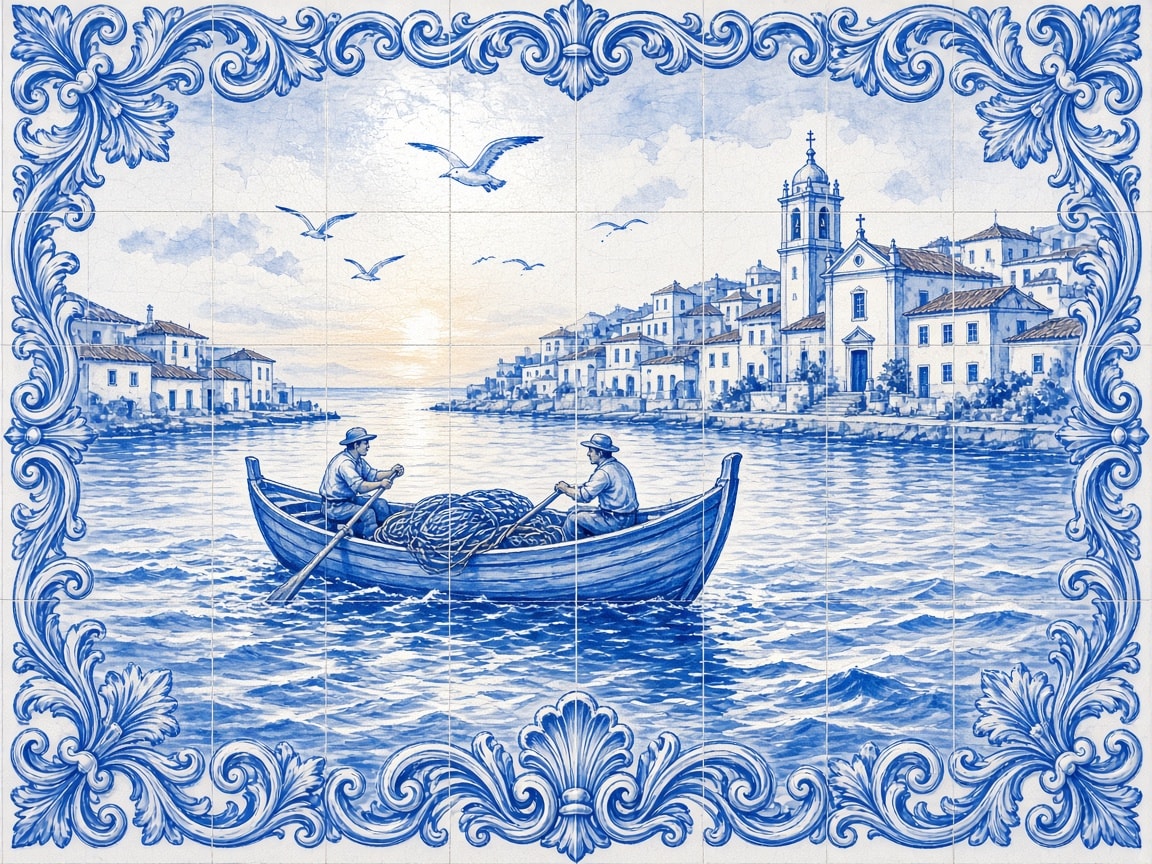
Hand-painted cobalt-blue azulejo tile mural: a wooden sardine fishing boat with a tall prow rows out of a harbor at dawn under seagulls, whitewashed hillside houses and a church tower behind, painted across a visible tile grid with glaze pooling, fine crazing and an ornate baroque scroll border, glossy ceramic sheen.
Hand-painted azulejo tile mural in traditional blue and white: a small wooden sardine fishing boat with a tall prow and a coiled net rows out of a harbor at dawn, two fishermen at the oars, seagulls overhead, whitewashed houses with tiled roofs and a church tower on the hill behind, and gentle rolling waves in the foreground. Painted in cobalt blue glaze on a white tin-glazed ceramic ground, composed across a visible grid of square tiles with thin grout lines, slight glaze pooling, tiny crazing cracks, hand-brushed line work and soft wash shading, framed by an ornate blue baroque scroll border with acanthus leaves. Glossy ceramic sheen with a soft reflected highlight, viewed straight on in even daylight as a wall mural, landscape 4:3. No text, no lettering, no signature, no modern objects.
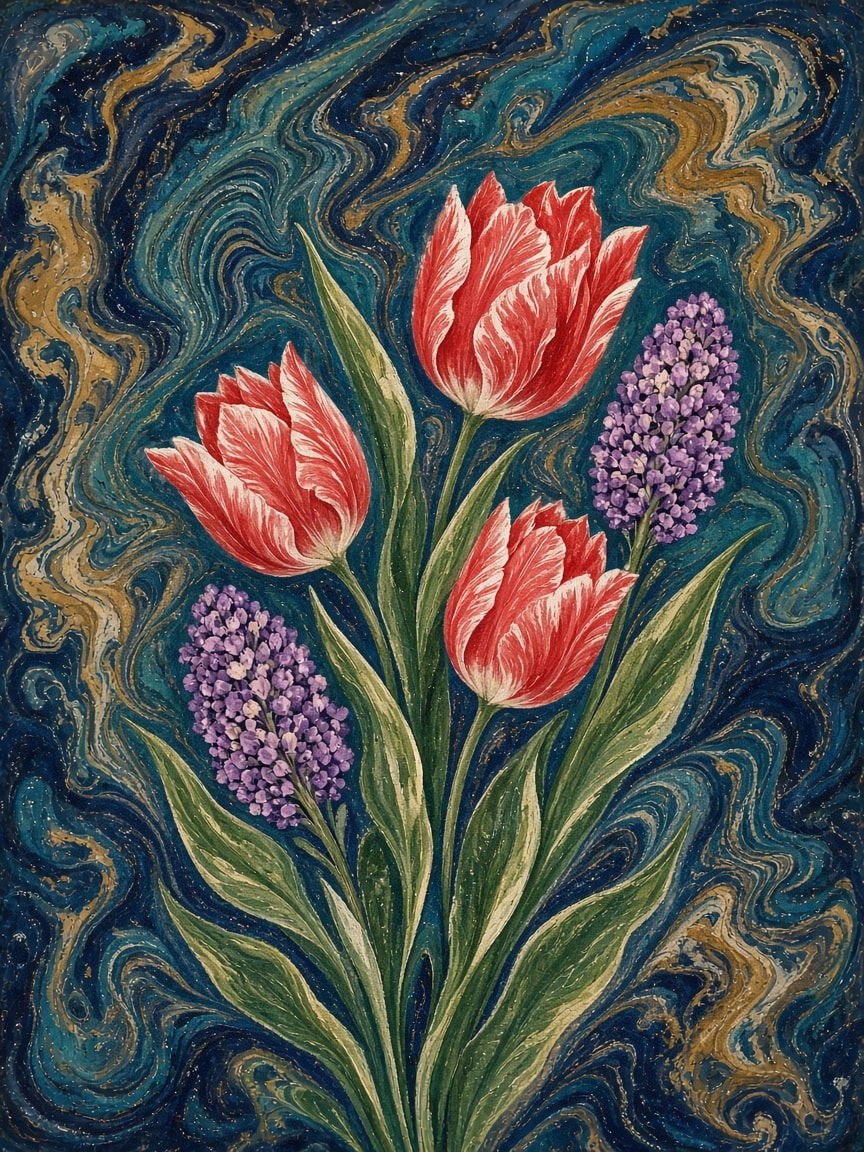
Traditional Turkish ebru paper marbling: red-and-white tulips, purple hyacinths and slender leaves float on a swirled indigo and teal ground with combed battal and gelgit patterns, soft pulled-teardrop petals with fine white veins, lilac dot clusters, tiny paint speckles and a matte hand-made paper texture.
Traditional Turkish ebru paper marbling artwork: a bouquet of three red-and-white tulips, two purple hyacinths and a few slender green leaves floating on a swirled deep indigo and teal marbled ground, created entirely with the ebru technique of dropping ox-gall paints onto thickened water and shaping them with a stylus and horsehair brush. The tulip petals show the characteristic soft-edged, pulled-teardrop shapes of ebru flowers, with fine white veins dragged through the red; the hyacinths are built from clusters of tiny lilac dots; the background shows classic battal and gelgit combed patterns in indigo, teal, ochre and cream, with organic flowing lines and tiny paint speckles. Slightly irregular, hand-made look, matte paper texture visible, soft natural daylight, viewed straight on as a flat artwork filling the frame, portrait 3:4. No text, no signature, no frame, no people, no hands.

A long, precise style prompt for a stylized Western 2D animation frame: a young hacker typing at a chunky CRT computer in a cramped retro room, seen from desk level through an extreme fisheye with oversized hands in the foreground. It locks thin navy ink lines, flat two-tone cel shading, angular shadow blocks, light pencil hatching and dry brush, a strict cornflower-to-navy blue palette with tiny golden accents, and fine comic halftone dots only inside shadows. Swap the subject to reuse it.
Create a stylized 2D Western animated illustration of a mysterious young male hacker sitting at a vintage desktop computer in a cramped retro computer room. He has short black hair with a sharp white fringe, an angular pale face, a large expressive side-profile eye, an oversized dark jacket with geometric markings, and long slender fingers typing on a chunky mechanical keyboard. Extreme low-angle fisheye perspective from desk level, oversized hands dominating the foreground, bulky CRT monitor on the left, curved tiled ceiling, scattered wall posters, and strong architectural depth. Preserve the character's focused typing pose, distinctive facial expression, dramatic camera angle, and coherent spatial arrangement. Render in a sophisticated stylized Western 2D animation aesthetic with delicate hand-drawn comic illustration techniques and refined graphic character design. Thin, confident dark navy ink outlines with subtle organic irregularities, natural line-weight variation, expressive flowing contours, selectively broken edges, and precise facial linework. Simplified geometric anatomy, exaggerated but believable proportions, angular character construction, and distinctive silhouettes. Large uninterrupted flat color regions, clean two-tone cel shading, sharply defined angular shadow blocks, simplified geometric highlights, minimal gradients, and carefully balanced graphic shapes. Subtle short pencil hatching, restrained dry-brush marks along selected edges, imperfect freehand contours, and crisp matte color fills. Sophisticated 2D animation keyframe aesthetics, cinematic spatial perspective, bold editorial illustration composition, expressive character acting, and elegant visual simplicity. Strictly use a cohesive cool blue color palette of cornflower blue, dusty cobalt, slate blue, muted periwinkle, powder blue, pale icy cyan, and deep navy, complemented by tiny muted golden-yellow accents. The ceiling and walls use layered desaturated blues, the CRT monitor displays a flat pale icy-blue screen, the character's clothing is deep navy with angular cobalt shadow planes, and the keyboard uses muted blue-gray tones. Soft cool blue ambient lighting unifies the entire composition, with small warm yellow details creating restrained visual contrast. Harmonious blue-on-blue color separation, strong tonal hierarchy, matte surfaces, and clean graphic lighting. Apply refined localized gradient halftone shading only within selected cel-shaded shadow regions, especially along the character's fingers, cheek shadows, jacket folds, and occasional architectural shadow boundaries. Use extremely fine, tightly arranged halftone microdots in colors matching the underlying shadows, gradually decreasing in size and opacity toward the illuminated areas. The halftone creates elegant soft tonal transitions within small, organically shaped shadow zones, naturally dissolving into clean flat colors. The pattern must be clearly recognizable as delicate traditional comic-print halftone shading at close inspection, never as large individual decorative circles. Keep all other surfaces perfectly clean and solid, without any global texture. Preserve strong cinematic depth through exaggerated fisheye perspective, overlapping graphic shapes, and precise architectural construction rather than realistic lighting gradients. High-end stylized animated film frame, expressive character silhouette, sophisticated handcrafted linework, refined flat-color shading, and cohesive visual design.
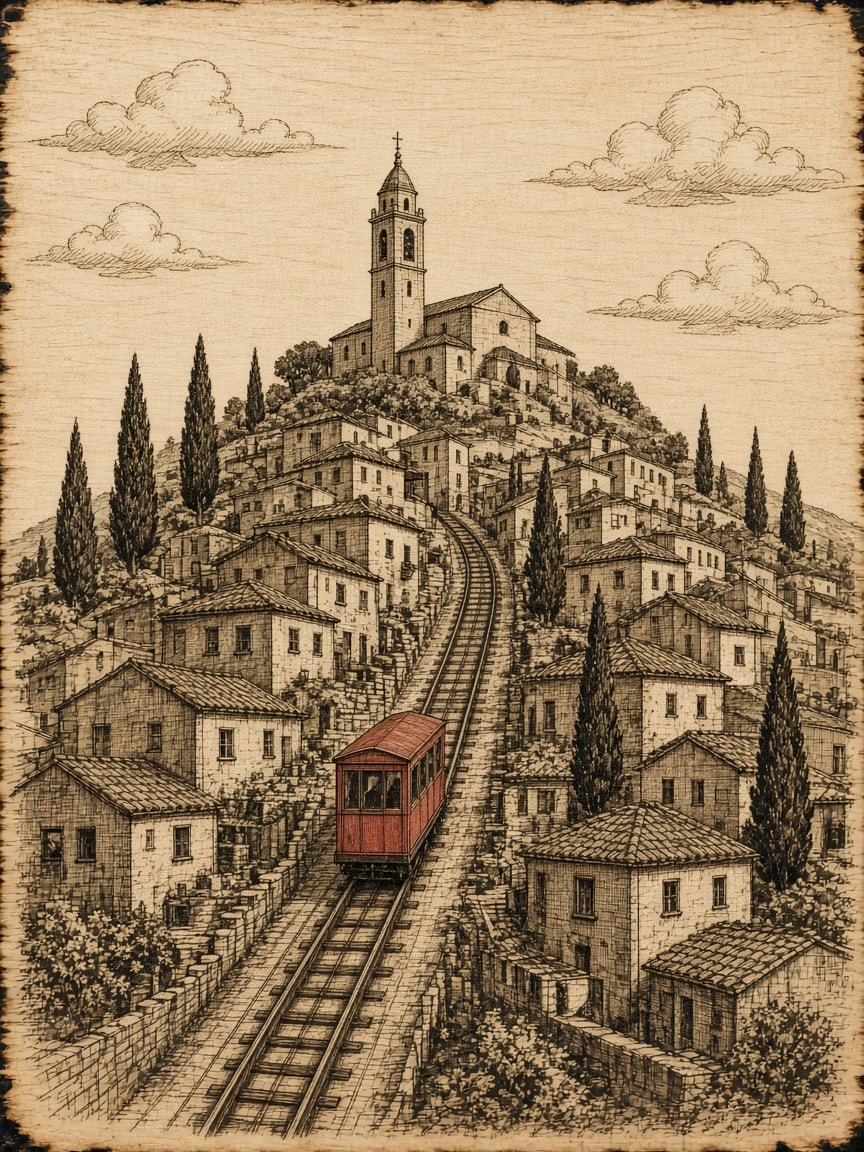
Pyrography artwork burned into a pale birch panel: a small red funicular car climbs a steep diagonal track through a hillside town of terracotta-roofed houses and cypress trees to a bell tower, drawn in sepia and chocolate-brown hatching and stippling with bare wood grain for the sky and a red stain on the car as the only color.
A small red funicular railway car climbing a steep single track up a hillside town of stacked terracotta-roofed houses, cypress trees and a church bell tower at the summit, rendered as pyrography wood-burning art on a pale birch plywood panel.

Technique: every line is burned into the wood in warm sepia and deep chocolate browns. Use fine parallel hatching for the roof tiles, stippled dots for the cypress trees and foliage, darker scorched tones for doorways and shadows, and leave the light natural wood grain bare for the sky and soft clouds. Only the funicular car carries a soft hand-applied wash of red stain, so it is the single color accent.

Details: the track runs diagonally from the lower left to the bell tower at the upper right, with a small station platform at the bottom and narrow stairways between the houses beside the track. Slightly uneven handmade line quality, subtle char marks along the panel edges, visible birch grain throughout.

Presentation: 3:4 portrait framing of the whole panel, viewed straight on under flat, even studio lighting, no glare.

Avoid: text, signatures, people, photographic realism, digital gradients.
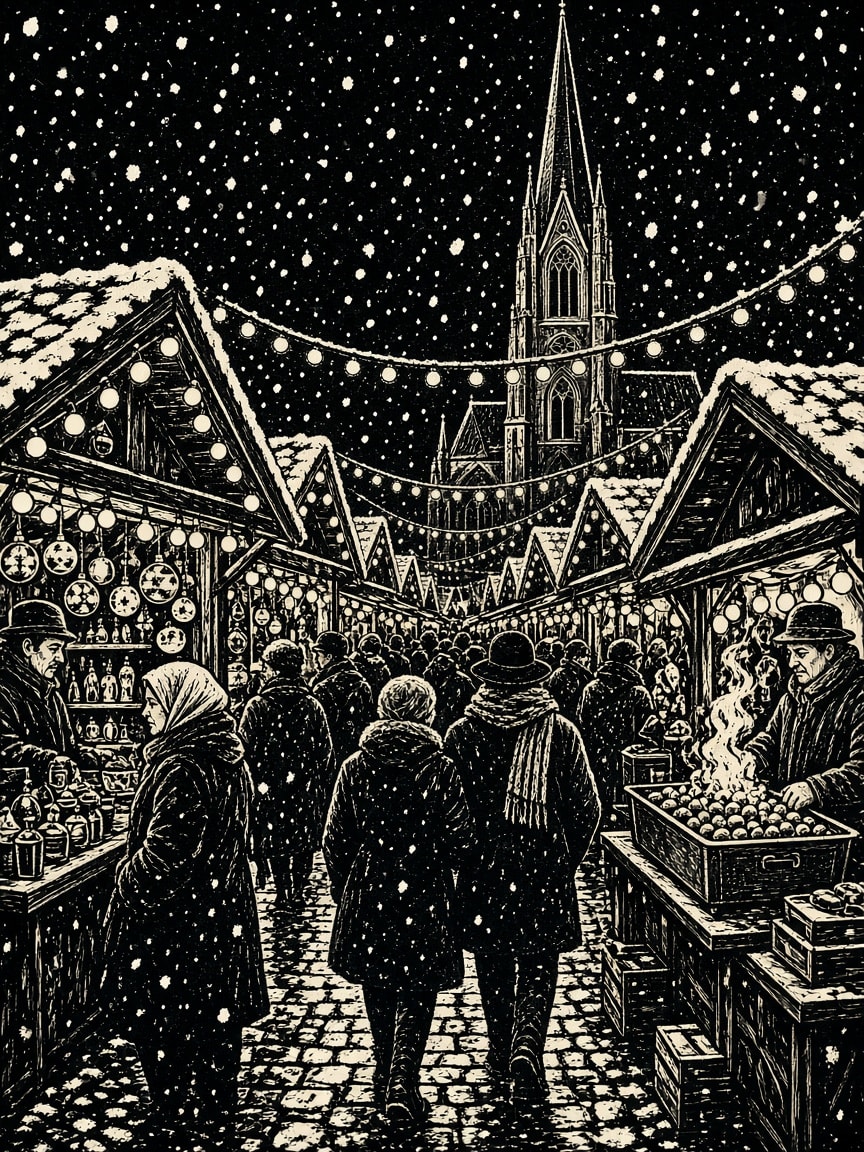
Tall black-and-cream linocut print with no readable text: a crowded European Christmas market lane at night, snow-covered stalls, string lights, falling snow, and a Gothic cathedral spire, high-contrast hand-carved hatching.
A traditional black-and-cream linocut print of a crowded European Christmas market at night, tall portrait 3:4. A narrow cobblestone lane runs between wooden market stalls with peaked snow-covered roofs; a dense crowd in heavy winter coats and hats walks between the stalls. In the background a tall ornate Gothic cathedral spire rises into a solid black sky filled with falling cream snow dots. Three strings of round festival lights swoop across the upper third with soft white halos. Left stall shows jars and hanging ornaments; right stall sends a plume of steam from a tray of roasted chestnuts. High-contrast hand-carved hatching, block-print woodgrain feel, ink-black and cream paper only, lively winter-night mood. No readable shop names, no logos, no watermarks, no modern brand marks.
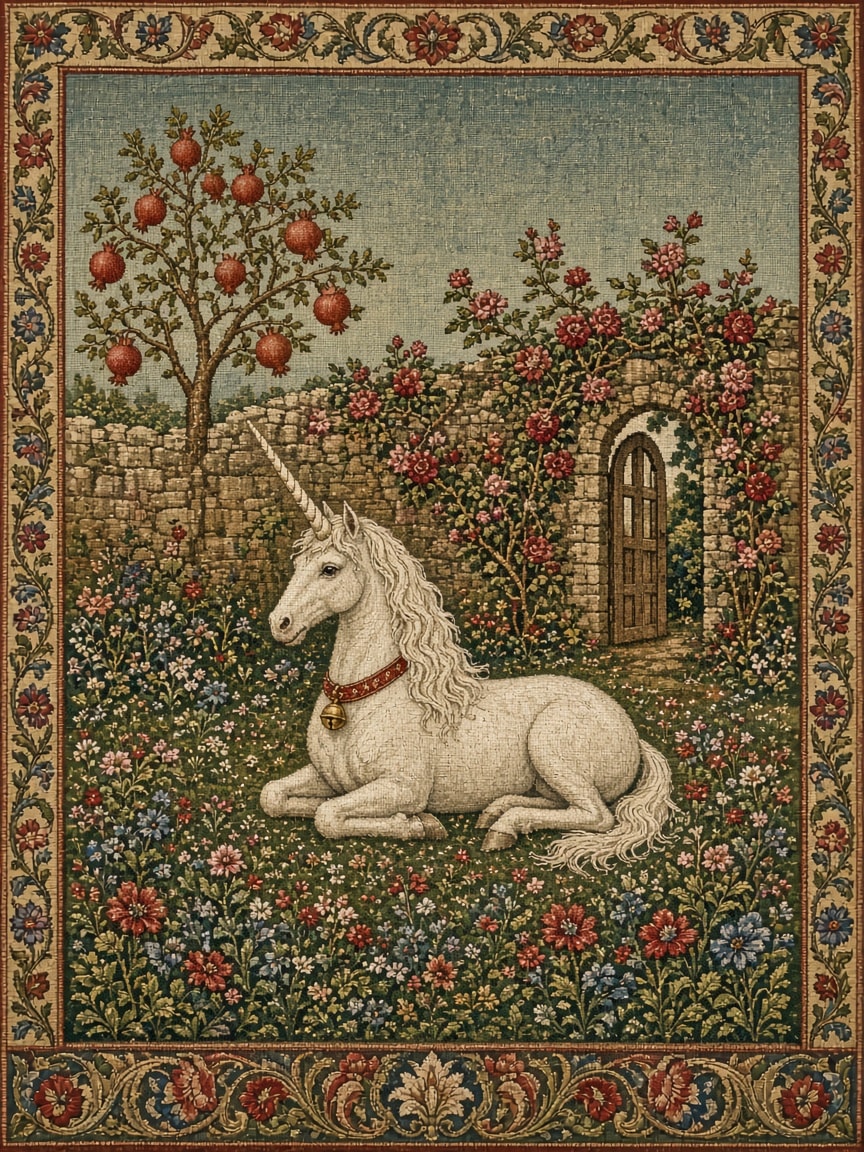
Tall Aubusson-style medieval tapestry of a white unicorn lying in a walled rose garden: creamy mane, slender spiral horn, and a red collar with a gold bell, a pomegranate tree on the left, a rose-covered stone wall with a closed arched wooden door on the right, millefleurs flowers, woven vegetable-dye texture, and an ornate floral border on all four sides.
A tall vertical Aubusson-style medieval tapestry of a white unicorn lying down in the center of a walled rose garden, portrait 3:4. The unicorn rests on a millefleurs meadow of tiny red, blue, pink, and white flowers, with a creamy flowing mane and tail, a slender spiral horn, and a red collar with a small gold bell, facing slightly left. On the LEFT a stylized pomegranate tree bears several ripe red fruits. On the RIGHT a rose-covered stone wall has an arched wooden door that is closed, not wide open, with climbing pink and crimson roses over the arch. Woven tapestry texture with slightly faded vegetable-dye reds, blues, and moss greens, and an ornate floral border on all four sides. No readable text, no people, no logos, no watermarks.
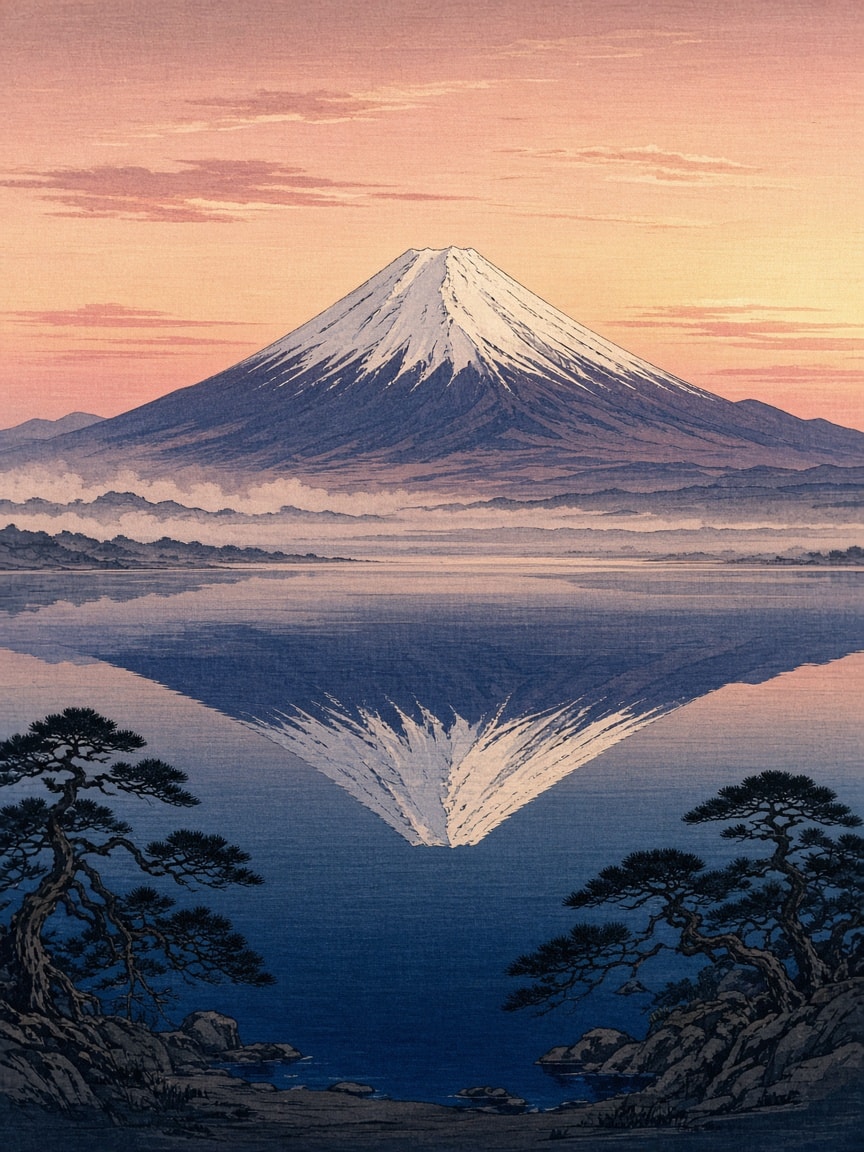
Tall ukiyo-e woodblock print with no text: Mount Fuji as a snow-capped indigo cone reflected in a calm lake at dawn, peach-gold sky, flat layered pink clouds, dark pine silhouettes and a small empty wooden pier in the foreground, visible woodgrain, fine ink outlines, quiet Edo-period print style.
A traditional Japanese ukiyo-e woodblock print of Mount Fuji reflected in a calm lake at dawn, tall portrait 3:4. Mount Fuji rises in the upper half as a simple snow-capped cone with crisp indigo and white slopes, its perfect mirror image filling the still lake below. A pale peach and gold dawn sky washes behind the peak, with a few flat layered clouds in soft pink. Along the near shore, a thin line of dark pine silhouettes and a small empty wooden fishing pier sit low in the foreground; one empty skiff floats near the pier. Flat color blocks, visible woodgrain texture, fine ink outlines, classic Edo-period print style, quiet and balanced composition. No people, no text, no signatures, no seals, no watermarks, no letters.

Pop art comic-style illustration with no text: a gleaming chrome 1950s diner car with warm-yellow lit windows and a red-and-white striped awning, a turquoise finned convertible parked in front, a blank pink neon sign on a pole, a big yellow moon in a purple starry sky, pink desert mountains, saguaro cacti, and a curving desert road, drawn with bold ink outlines and halftone dots.
A pop art comic-style illustration of a gleaming chrome 1950s roadside diner in the desert at night, landscape 4:3, with no text. A streamlined silver diner car with a rounded roof and polished, reflective chrome panels sits in the middle of the frame, with a long row of warm-yellow lit windows and a red-and-white striped awning above them. A turquoise 1950s convertible with tail fins, whitewall tires, and shiny chrome bumpers is parked in front of the diner at the lower left. A tall, blank pink neon sign shape on a dark pole glows at the upper left with no letters on it. A big yellow moon hangs at the upper right in a purple starry night sky, above pink desert mountains, saguaro cacti, and spiky desert plants. A curving desert road with a white edge line sweeps away on the right. Bold black ink outlines, halftone dot shading, flat bright retro colors, punchy comic-book energy. No text, no lettering, no speech bubbles, no logos.
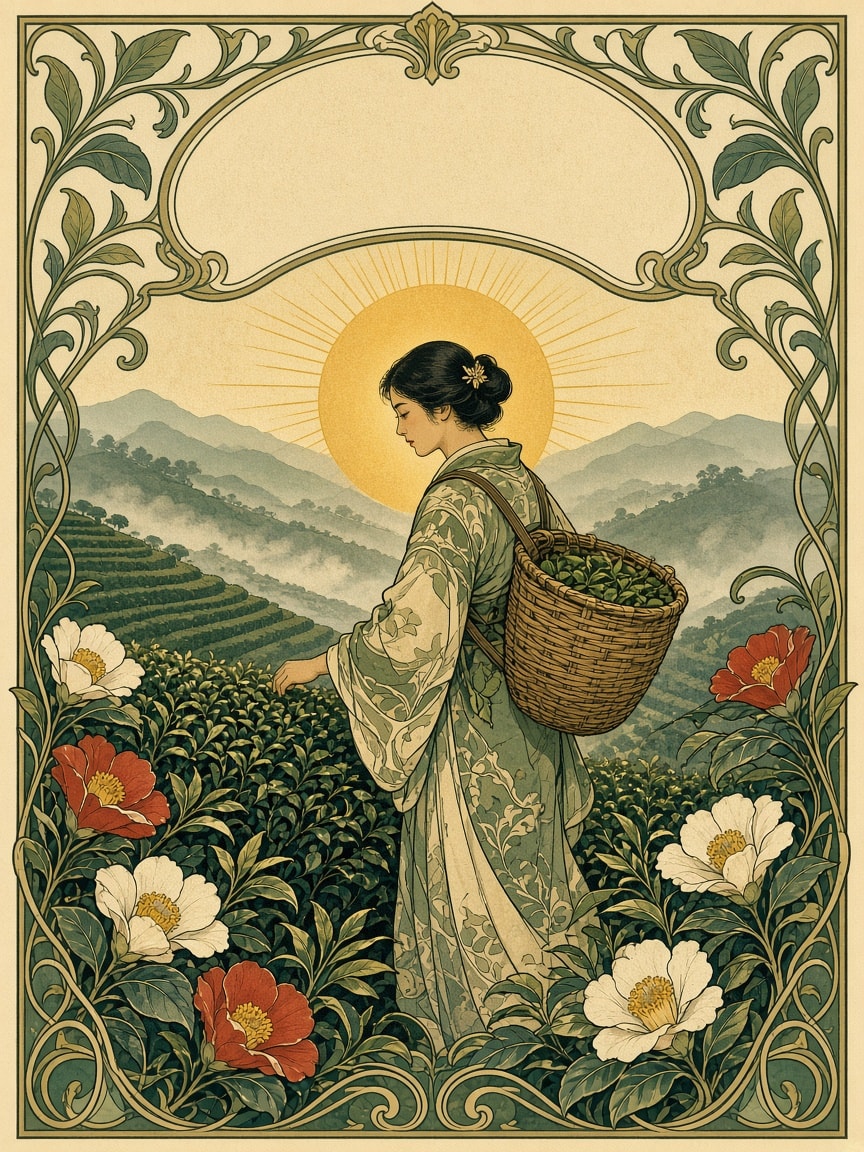
Tall Art Nouveau poster with no text: a tea picker in a pale green patterned robe, seen in profile with a wicker basket of leaves on her back, picks tea in front of a large golden sun, with misty terraced tea hills behind, red and white camellias in the lower corners, a curling vine border, and an empty arched cartouche at the top.
An Art Nouveau poster illustration of a tea picker harvesting leaves on a misty tea plantation, tall portrait 3:4, with no text. A young woman stands in profile facing left in the center, her dark hair in a low bun with a small yellow flower, wearing a long pale green robe-like dress with flowing sleeves and swirling leaf patterns, and carrying a woven wicker basket full of fresh tea leaves on her back by a leather shoulder strap as she reaches out to pick leaves from the bushes. A large golden sun disc with fine radiating rays glows behind her head. Rows of rounded tea bushes fill the foreground, and terraced tea hills and layered blue-green mountains fade into soft mist behind her. Large red and white camellia flowers with golden centers and glossy leaves bloom in both lower corners. An ornate border of curling green vines and leaves frames the whole poster, with a small gilded ornament at the top and an empty arched cartouche across the top. Flat muted greens, cream, gold, and red, fine ink outlines, vintage lithograph paper texture. No text, no lettering, no logos.

