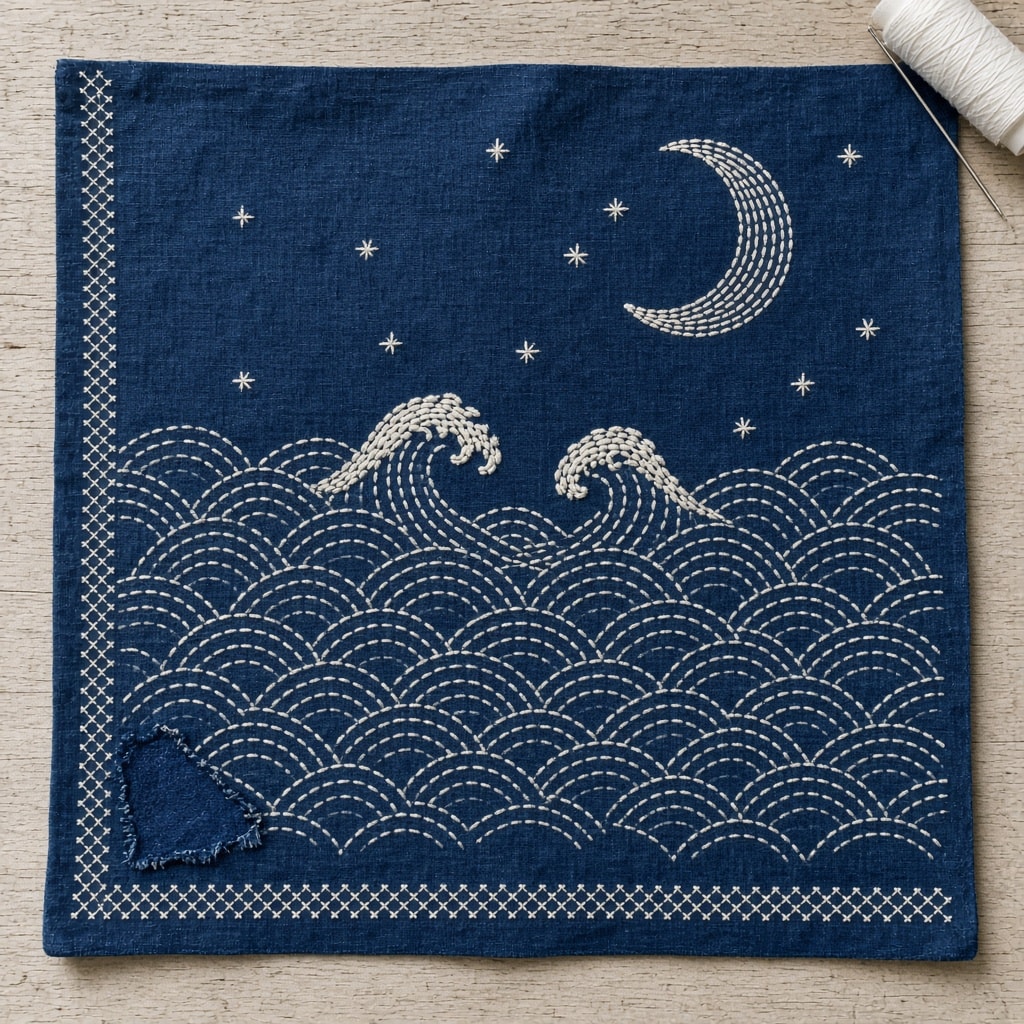
A flat-lay photo of hand-stitched sashiko embroidery on faded indigo cotton: rows of fan-shaped waves and curling crests under a crescent moon and tiny stars, all in raised off-white running stitches, with a grid-stitch border, a small boro patch, a thread spool and a needle.
A flat-lay photograph of a square panel of hand-stitched Japanese-style sashiko embroidery: deep indigo-dyed cotton cloth covered in running stitches of thick, slightly matte off-white cotton thread that form a picture of rolling ocean waves under a crescent moon. The lower two thirds show overlapping rows of seigaiha-style fan waves, each wave made of four or five concentric arcs of evenly spaced stitches, with a few larger curling wave crests stitched in tighter lines near the center. In the upper right, a thin crescent moon is filled with dense parallel stitching, and a scattering of tiny cross-stitched stars is spread across the dark sky, which is otherwise left as plain cloth so the indigo shows. A narrow border of hitomezashi grid stitching frames the whole panel.

Render it exactly like real handwork: each stitch is a short raised dash with small gaps where the needle went under the cloth, stitches slightly irregular in length, a few thread ends tucked in, soft puckering where curves turn, the indigo slightly faded and uneven like hand-dyed cloth, with a faint woven texture and one small darker indigo patch sewn on in the lower left corner in the boro mending tradition. The cloth lies on a pale unfinished wooden table; a small spool of white thread and a long sashiko needle lie at the edge of the frame. Soft, even daylight from above, very shallow shadows, true-to-life color. No text, no people, no hands. Square 1:1.
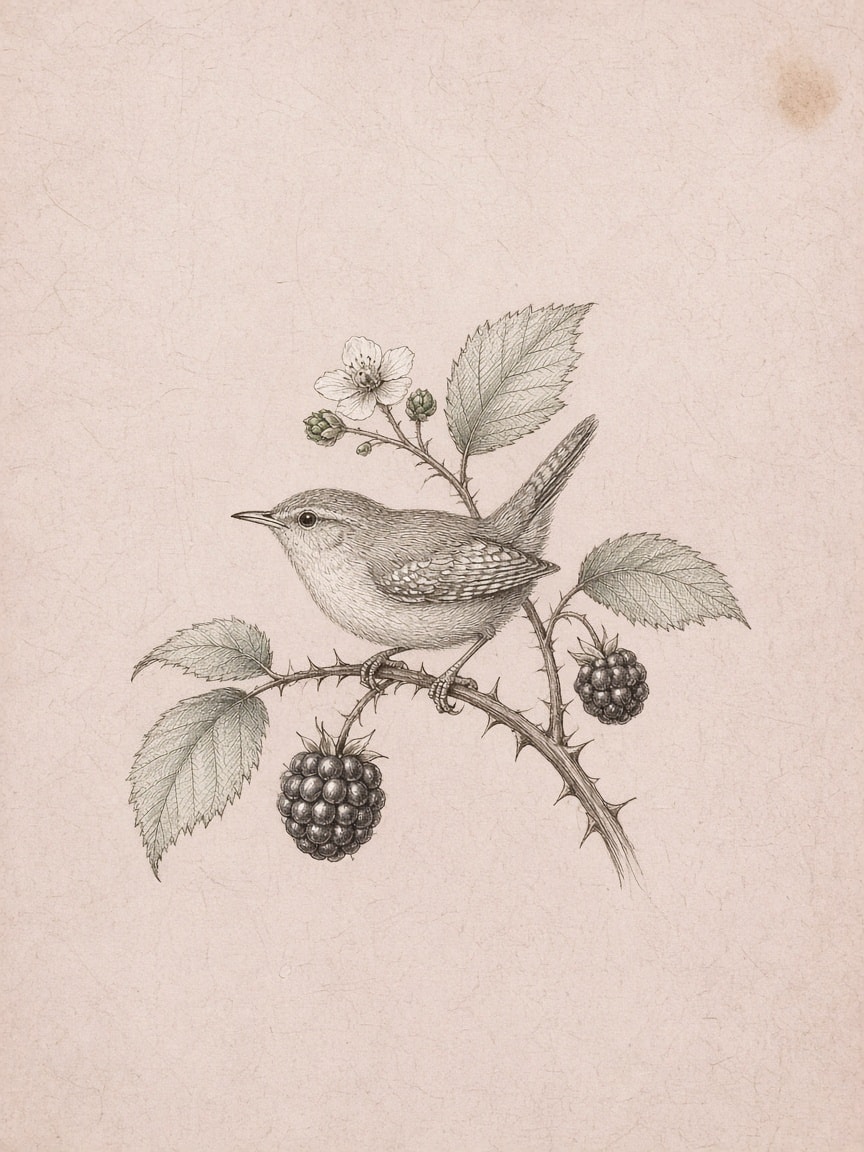
A Renaissance-style silverpoint drawing on warm ivory-pink prepared paper: a wren with a cocked tail on an arching bramble branch with blackberries, thorns and serrated leaves, built only from fine tarnished hatching lines with white chalk highlights and faint construction lines.
A Renaissance-style silverpoint drawing of a small wren perched on an arching bramble branch with ripe and unripe blackberries, drawn on paper coated with a pale warm ivory-pink prepared ground. The wren sits in the upper middle of the sheet facing left, tail cocked upright, its round body built from hundreds of fine parallel hatching lines and soft cross-hatching that describe the barred wing and tail feathers, a bright tiny eye and a thin slightly curved beak. The bramble enters from the lower right and curves up under the bird: thorny stems, three serrated leaves with clear veins, two clusters of blackberries with each round drupelet modeled by tiny curved strokes, a few hard green berries and one small five-petal flower.

Render it exactly like a real metalpoint drawing: only thin, even, delicate grey lines that have aged to a soft warm brown-grey tarnish, no smudging, no thick or black strokes, no solid fills; tone is built only by layered hatching that follows the forms. Add a few faint exploratory construction lines and one lightly corrected wing outline, small white chalk highlights on the eye, the berries and the leaf edges, and plenty of empty toned paper around the subject. Slight fibre texture and a soft foxing spot near one corner. Even, flat museum lighting, straight-on view of the whole sheet. No text, no signature, no frame. Portrait 3:4.
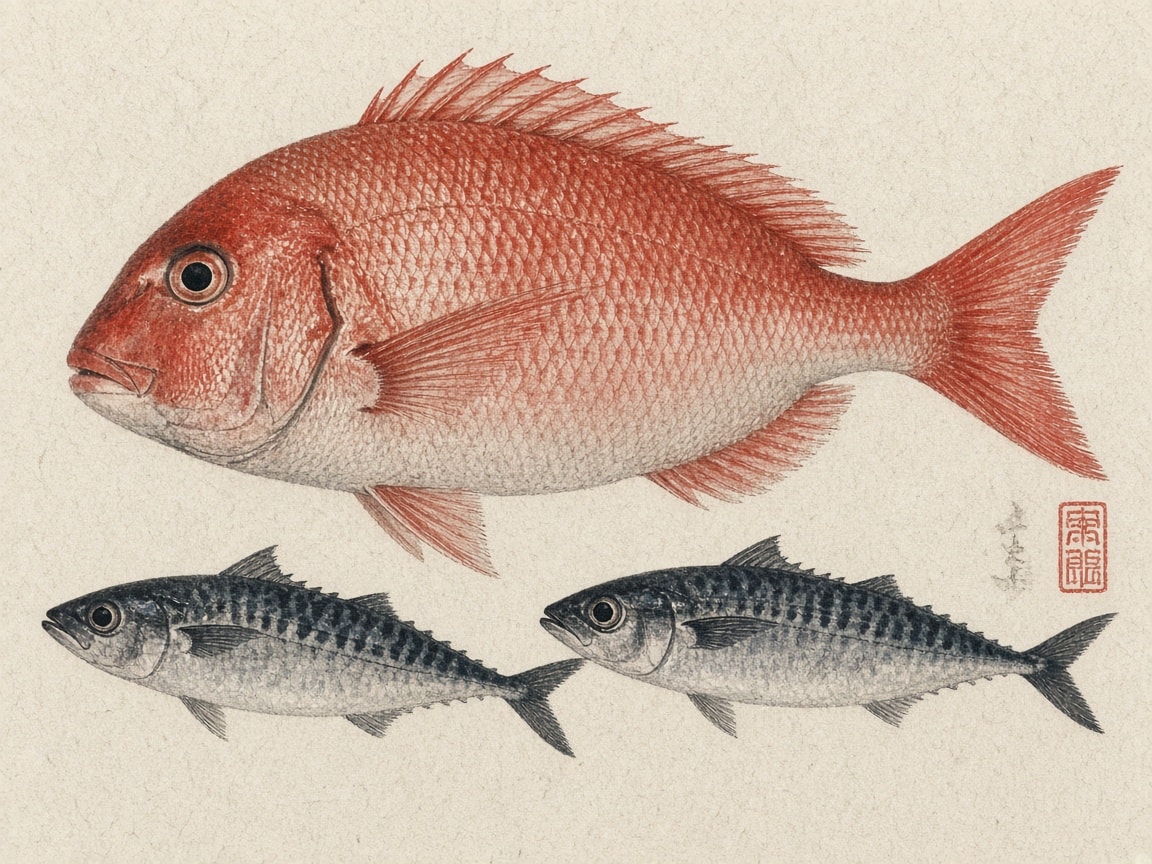
A traditional Japanese gyotaku fish rubbing in sumi ink on fibrous handmade washi: a large red sea bream with a faded vermilion wash above two mackerel, every scale and fin ray pressed in, hand-painted eyes, abstract brush marks and a red seal stamp.
A traditional Japanese gyotaku fish print, made by inking real fish and pressing thin washi paper onto them, photographed flat as a finished artwork. Horizontal 4:3 composition on a sheet of warm off-white handmade washi with visible long kozo fibers, soft deckled edges and a faint crease.

Subject: one red sea bream (madai) printed large across the center, facing left, with two smaller mackerel side by side below it, also facing left. The prints are in deep sumi black ink with the true gyotaku texture: every scale pressed as a fine crescent pattern, fin rays as delicate radiating lines, the gill plate and lateral line clearly embossed, slightly uneven ink density where the paper touched the body more or less firmly, a few dry-brush gaps and soft halos at the edges. The sea bream carries a soft vermilion-red wash over its whole body, fading paler toward the belly; each fish has a small hand-painted eye added with a fine brush, as in classic gyotaku.

Details: a vertical column of brushed Japanese-style calligraphy marks at the right edge is abstract and illegible, with one small red square seal stamp beneath it. Light ink speckles near the fins.

Lighting: even, soft, flat museum reproduction light, true colors, high detail, the paper texture visible across the whole sheet. No frame, no table, no hands, no readable text.
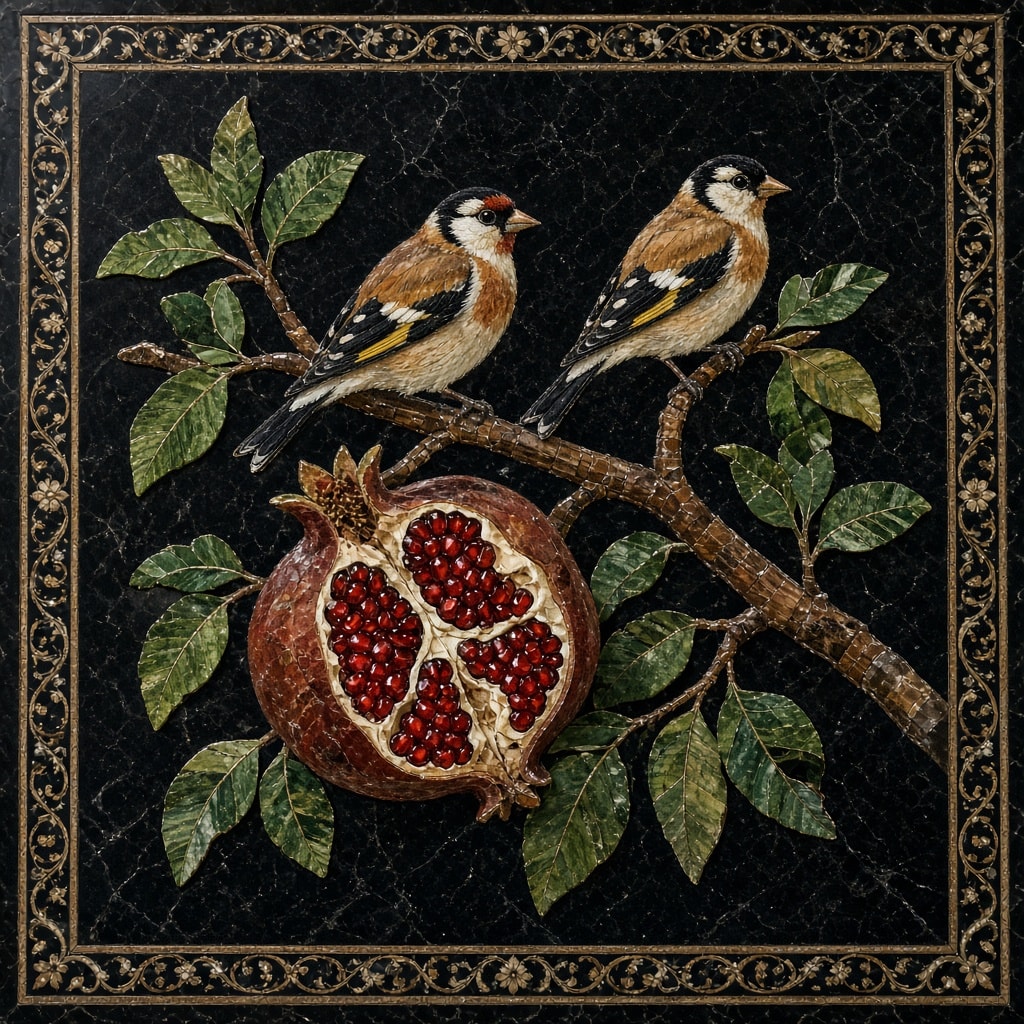
Top-down view of a 17th-century-style Florentine pietra dura panel: two goldfinches on a stone branch above a split pomegranate with glossy red seeds and veined green leaves, all in fitted hardstone pieces on veined black marble, framed by a gold-toned scrolling vine border.
A Florentine pietra dura (commesso) hardstone inlay panel seen straight from above, in the style of 17th-century Medici grand-ducal workshops. The ground is deep black marble crossed by fine white and grey veins. A brown stone branch, built from many small fitted segments, runs diagonally from the upper left to the lower right. Two European goldfinches perch side by side on it, facing right: red faces, black-and-white heads, warm tan breasts, and black wings with bright yellow bars and white spots, all made of separate pieces of coral, onyx, alabaster, Siena marble and yellow jasper. Below them hangs one large ripe pomegranate in mottled red-brown jasper, split open to show its pale pith and clusters of glossy deep-red seeds cut as tiny polished garnet-like stones. Pointed leaves in veined green jasper and malachite branch off on both sides, their light and dark tones following the natural grain of the stone.

Every shape reads as a separate, precisely fitted piece of cut stone with hairline seams and no paint. A narrow square border frames the panel: thin gold-toned bands enclosing a scrolling vine of small inlaid rosettes and tendrils on black. Soft, even museum lighting, rich saturated stone colors, crisp detail. No text, no signature. Square 1:1.
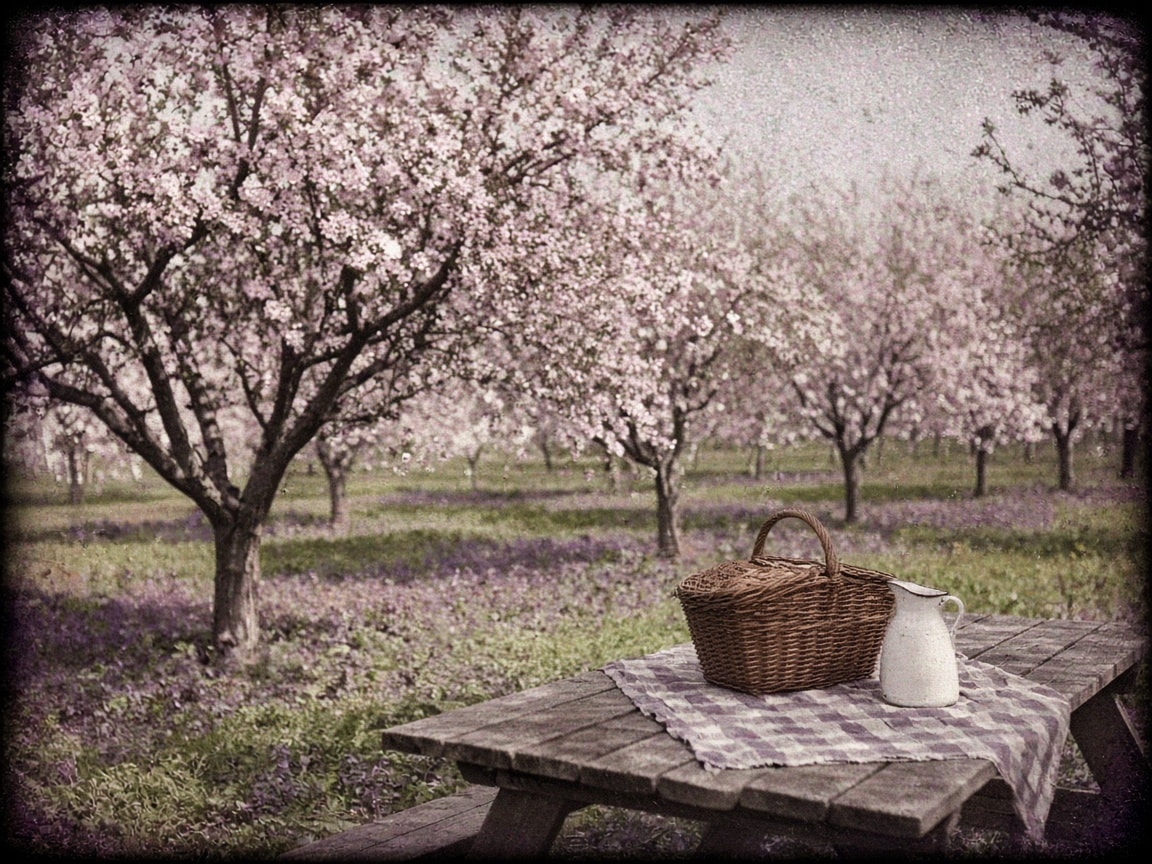
Early color Autochrome Lumière photograph in faded sepia-pastel tones: a weathered picnic table with a purple-and-white gingham cloth, wicker basket and white enamel jug under pale pink blossoming apple trees, violet wildflowers, starch grain, dust specks and a dark vignette.
A 1910s Autochrome Lumière color photograph of an old apple orchard in full blossom on a calm, overcast spring afternoon. In the right foreground stands a weathered wooden picnic table with attached benches, its grey planks cracked and silvered with age. A purple-and-white gingham cloth is draped across it, hanging over the near edge, and on it rest a large woven wicker picnic basket with a looped handle and a plain white enamel jug. Behind and to the left, gnarled apple trees with dark twisting trunks are covered in pale pink and white blossom and recede in soft, even rows into a hazy distance; the grass between them is carpeted with small violet wildflowers.

Render it exactly like a real Autochrome glass plate: muted, faded sepia-pastel colors (dusty pinks, mauve and violet, soft olive and sage greens, warm brown shadows, a pale milky sky), the visible random grain of dyed potato-starch particles that makes every area look softly speckled, fine dust specks across the surface, gentle soft focus from a long exposure, low contrast, and a thick dark vignette with rounded, burnt-looking edges around the whole frame. Diffuse daylight, no harsh shadows. No people, no text, no modern objects. Landscape 4:3.
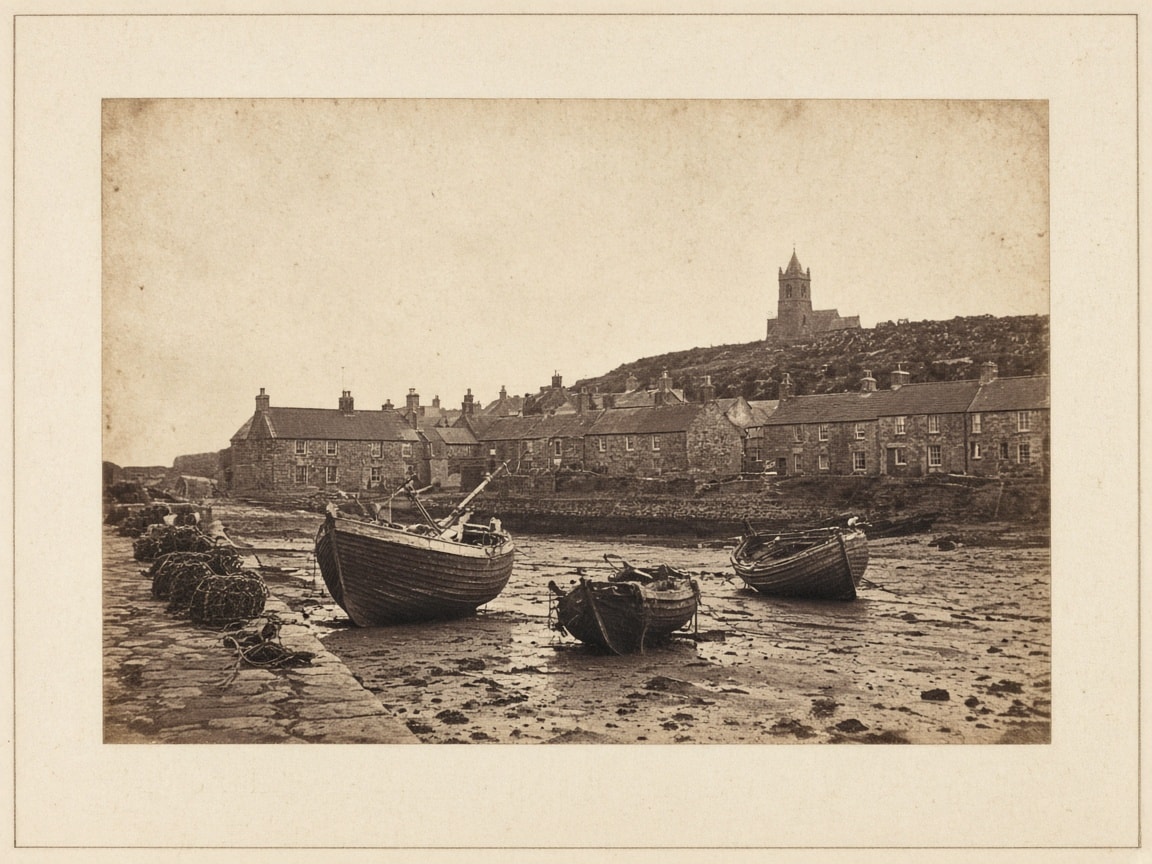
Early calotype-era salted paper photograph: three fishing boats resting on the mud at low tide, lobster pots on a cobbled quay, stone cottages and a church tower on the hill, with a matte image in warm reddish-brown tones, soft paper-negative detail, a pale sky, vignetted edges and foxing.
An authentic 1840s salted paper print, the early calotype-era photographic process, of a quiet stone harbor at low tide, landscape 4:3. Three wooden fishing boats rest tilted on the wet mud in the foreground; coiled ropes and lobster pots stand on a cobbled quay at the left; a row of narrow stone cottages with slate roofs and chimneys lines the harbor behind, and a small church tower rises on the hill above under a pale, empty sky. Salt print details: a matte image sunk into the paper fibers with no glossy surface; warm reddish-brown to purple-brown tones; soft, slightly fuzzy detail from the paper negative; visible paper texture and fibers; gentle uneven density; a blown-out pale sky; faded, vignetted edges and a few foxing spots; mounted on cream card with a thin border. Long-exposure stillness with no motion blur. Quiet, timeless coastal mood. Viewed straight on as a flat print in soft even light. No text, no signature, no frame, no people.
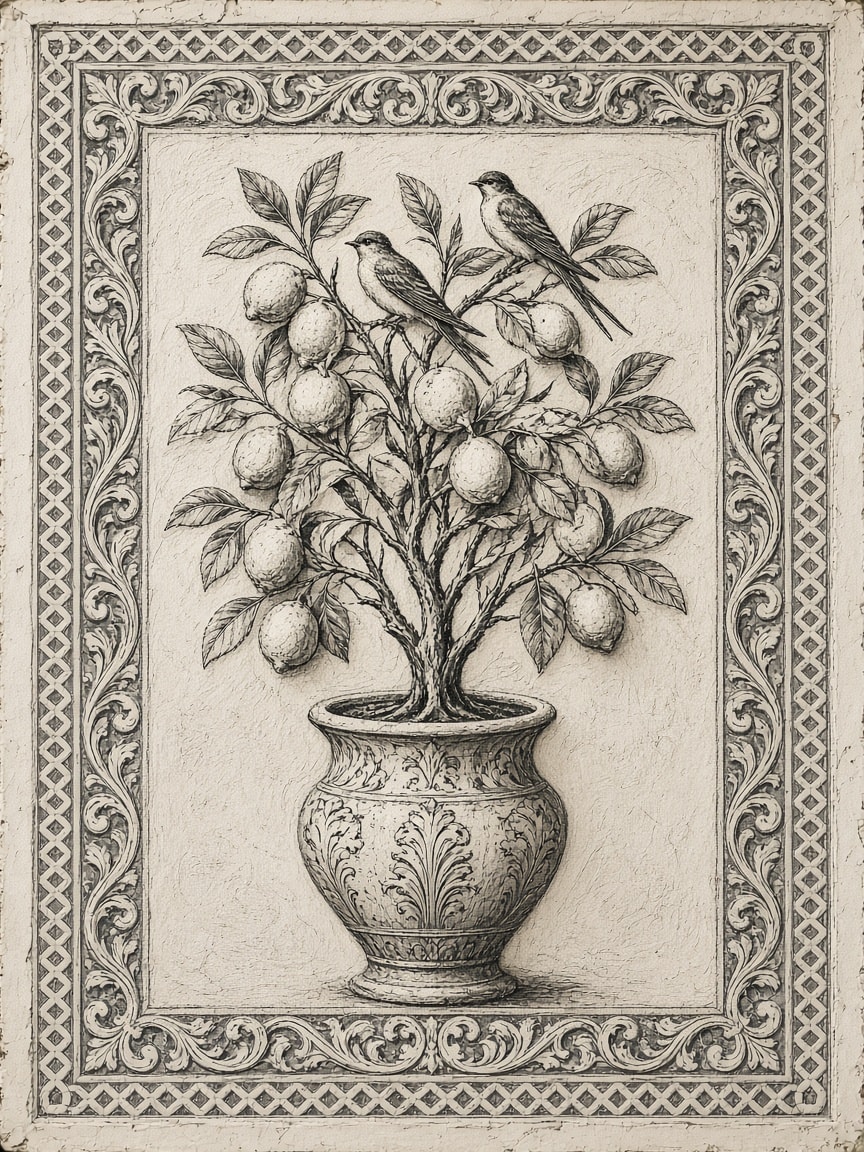
Italian Renaissance-style sgraffito plaster panel in cream and charcoal: a lemon tree heavy with fruit in an ornate urn, two swallows in its branches, framed by scrolling acanthus leaves and a lattice border, with crisp scratched lines, cross-hatched shading, trowel texture and gentle weathering.
An authentic Italian Renaissance-style sgraffito wall panel of a lemon tree in an ornate urn, portrait 3:4, photographed straight on. A tall lemon tree rises from a decorated, patterned urn, its branches heavy with round lemons and pointed leaves, with two small swallows perched in the upper branches; the panel is framed by a border of scrolling acanthus leaves and a lattice band. Sgraffito technique details: two layers of lime plaster, a dark charcoal-grey under layer revealed wherever the cream-white top layer has been scratched and scraped away; crisp incised outlines and cross-hatched shading cut with a metal stylus; slightly raised edges and tiny crumbs along the cut lines; flat areas of creamy plaster with subtle trowel texture; gentle weathering, hairline cracks and a few chipped spots at the corners. Two tones only, cream and charcoal grey, with no paint colors. Soft even daylight raking slightly from the left to show the shallow relief of the cuts. Calm, elegant, Mediterranean mood. No text, no signature, no people, no modern objects.
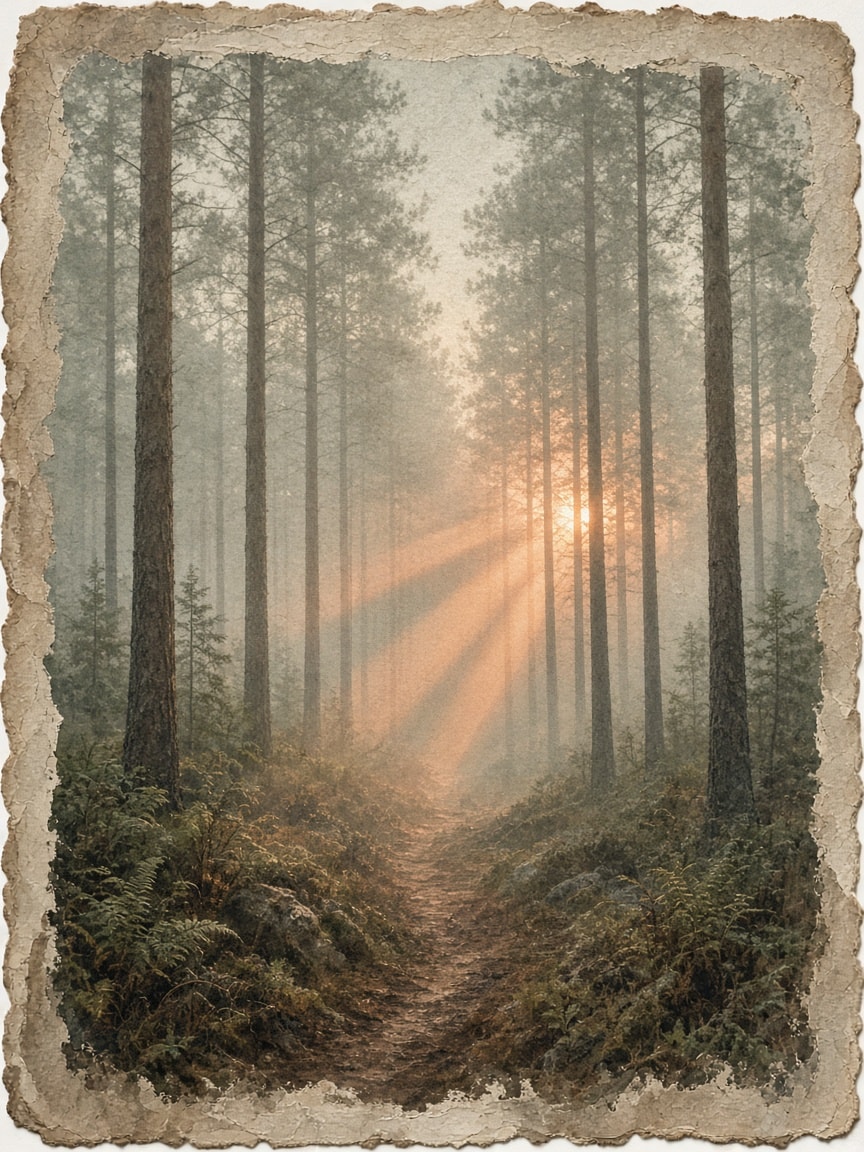
Early 1900s pictorialist gum bichromate photograph: rows of tall pines fade into fog as dawn rays cut through the mist over a needle-covered path, with soft painterly tonal masses, warm peach-gold sun rays, muted grey-green pigment layers and aged paper with rough torn deckled edges.
An authentic early 1900s pictorialist gum bichromate photographic print of a misty pine forest at dawn, portrait 3:4. Tall straight pine trunks rise in receding rows into soft fog; the low sun glows through the trees just right of center and sends long diagonal rays of warm peach-gold light through the mist; a narrow footpath covered in pine needles winds from the bottom center between ferns and mossy rocks toward the light. Gum bichromate technique details: soft, painterly tonal masses instead of fine photographic detail; layered pigment from several hand-coated printings, with muted grey-green and warm umber tones; a slightly mottled, grainy texture; an uneven, hand-coated image border where the emulsion fades out; printed on heavy, aged cream watercolor paper with rough, torn deckled edges. Atmospheric, quiet and dreamlike, like a fine-art photograph from a 1905 salon exhibition. Viewed straight on as a flat print in soft even light. No text, no signature, no frame, no people, no animals.
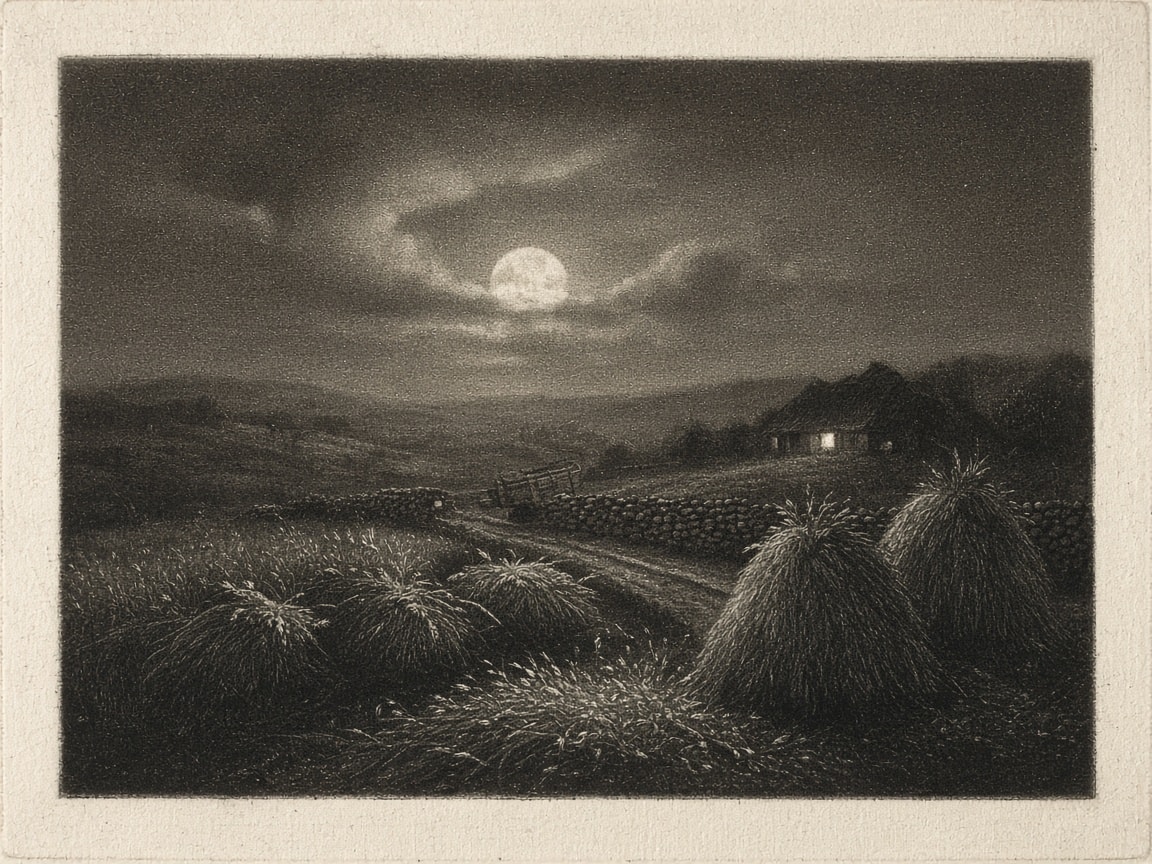
Authentic 18th-century style mezzotint print in warm black-brown ink: tied wheat sheaves and haystacks, a resting hay cart and a thatched farmhouse with one lit window under a veiled full moon, with velvety rocked-grain blacks, softly burnished highlights, smooth tonal gradations and an embossed plate mark.
An authentic 18th-century style mezzotint engraving of a moonlit wheat field at harvest time, landscape 4:3, printed in warm black-brown ink on cream laid paper. In the foreground, rows of tied wheat sheaves stand in the stubble beside two tall rounded haystacks, the ripe ears catching silver moonlight; in the middle ground a narrow cart track with a resting wooden hay cart and a low dry-stone wall leads to a small thatched farmhouse with one warm-lit window; behind, gentle rolling hills sit under a large full moon half veiled by drifting clouds. Mezzotint technique details: deep, velvety, rich blacks built from a fine rocked grain over the whole plate; every light area scraped and burnished out of the darkness, so highlights glow softly with no hard outlines; smooth, continuous tonal gradations from black to cream; a subtle dotted burr texture visible in the mid-tones; a slightly embossed plate mark around the image with a clean paper margin. Quiet, nocturnal, timeless mood. Viewed straight on as a flat print in soft even light. No text, no signature, no frame, no people.
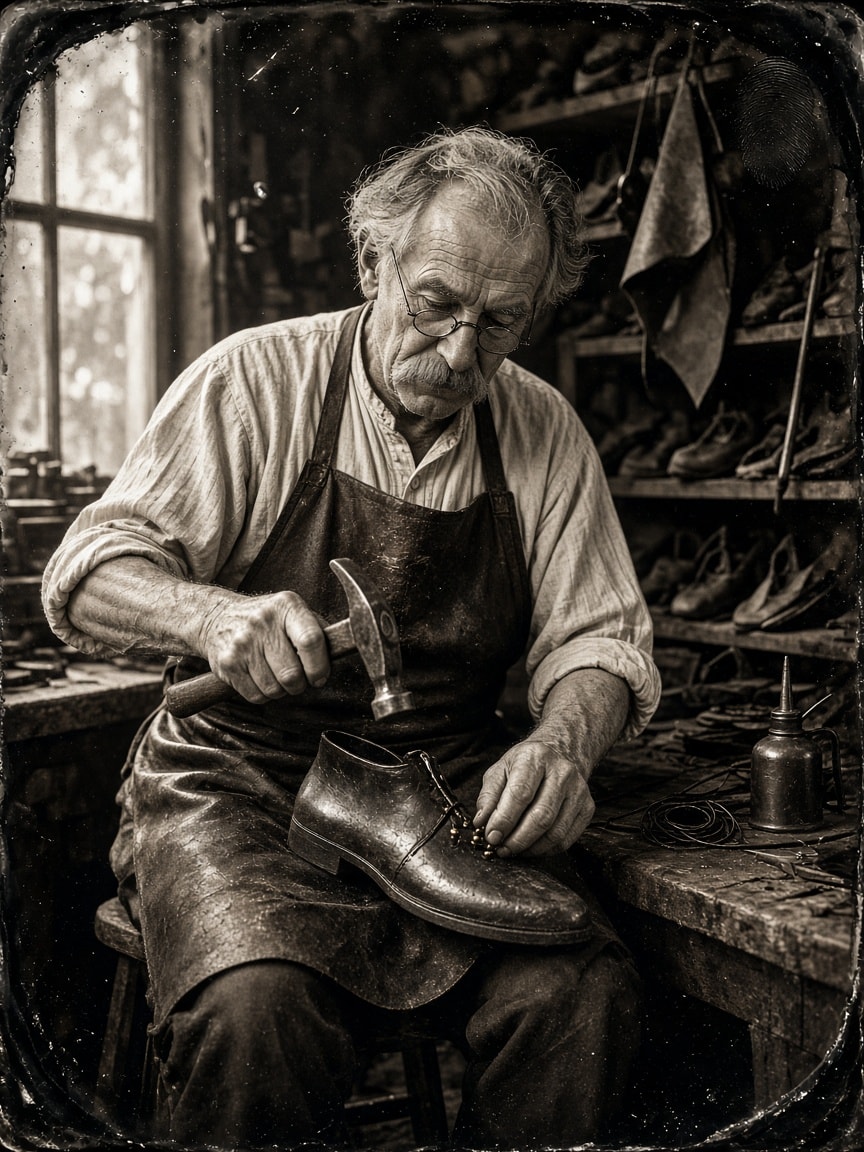
Authentic wet plate collodion tintype portrait: an elderly cobbler in a leather apron and wire spectacles hammers tacks into a boot on an iron last, lit by one window among shelves of shoes, with warm monochrome tones, swirly large-format falloff, pour marks, comet streaks and a black-enameled iron plate.
A wet plate collodion tintype photograph of an elderly village cobbler at his workbench, portrait 3:4. He sits on a low wooden stool in a small workshop, leaning over a leather boot fitted on an iron shoe last held between his knees, a small hammer raised in one hand and brass tacks pinched between the fingers of the other. He wears a worn leather apron over a collarless linen shirt with rolled sleeves, round wire spectacles low on his nose, a thick grey mustache and a deeply lined, concentrated face. Behind him: wooden shelves of finished and half-repaired shoes, hanging rolls of leather, an awl, waxed thread and a tin oil can on the bench. Lit by one large window from the left, giving soft directional light with deep shadows on the right. Authentic tintype look: monochrome with warm brown-black tones and creamy silver highlights, very shallow depth of field from a large-format brass lens with swirly falloff at the edges, sharp focus on the eyes and hands, the high blue sensitivity of collodion that makes skin look slightly darker and textured, and a long-exposure stillness. Plate details: uneven dark edges where the collodion was poured, small comet streaks and pour marks, a few fine specks and a faint thumbprint in one corner, on a thin black-enameled iron plate with slightly rounded corners. No text, no logos, no color, no modern objects.
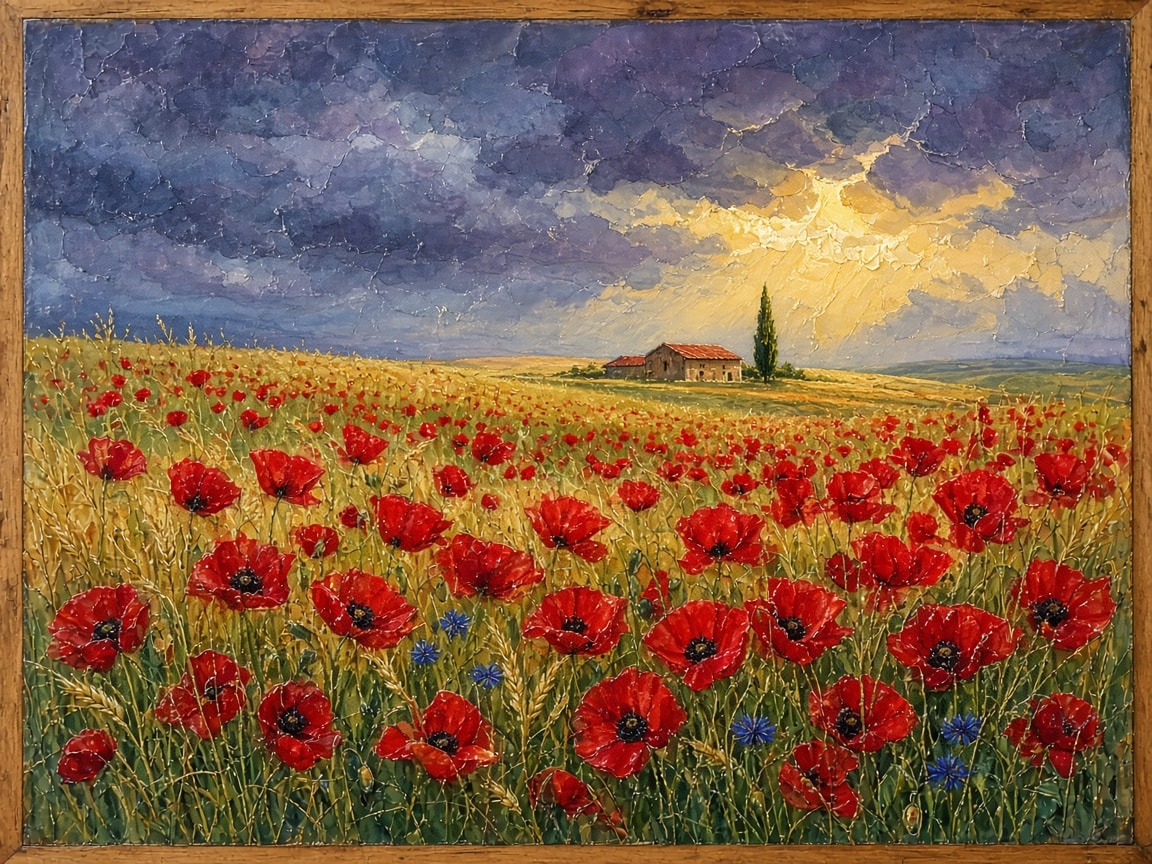
Layered encaustic beeswax painting on a wooden panel: scarlet poppies and cornflowers sway through golden grass toward a red-roofed farmhouse and lone cypress under slate-blue storm clouds with one break of warm light, with translucent wax depth, melted edges, incised lines, drips and a buffed satin sheen.
An encaustic hot wax painting of a wild red poppy field under a dark summer storm sky, landscape 4:3. Built up in many translucent layers of pigmented beeswax fused with heat on a wooden panel: in the foreground, dozens of scarlet poppies with black centers and thin bending green stems sway through tall golden grasses and a few blue cornflowers; in the middle ground the field rolls over a gentle hill toward a lone farmhouse with a red roof and a single tall cypress tree; above, heavy slate-blue and violet storm clouds gather, with one bright break of warm yellow light falling across the field. Encaustic technique details: glossy, semi-translucent wax with visible depth between layers, soft melted edges where colors flow into each other, scraped and incised lines in the grasses, small drips and raised textured ridges of wax, a buffed satin sheen with soft reflections, and a slightly uneven hand-made surface where the wooden panel edge shows at the borders. Rich, saturated colors: scarlet, ochre, sage green, slate blue, violet, warm cream. Viewed straight on as a flat artwork in soft even daylight. No text, no signature, no frame, no people.
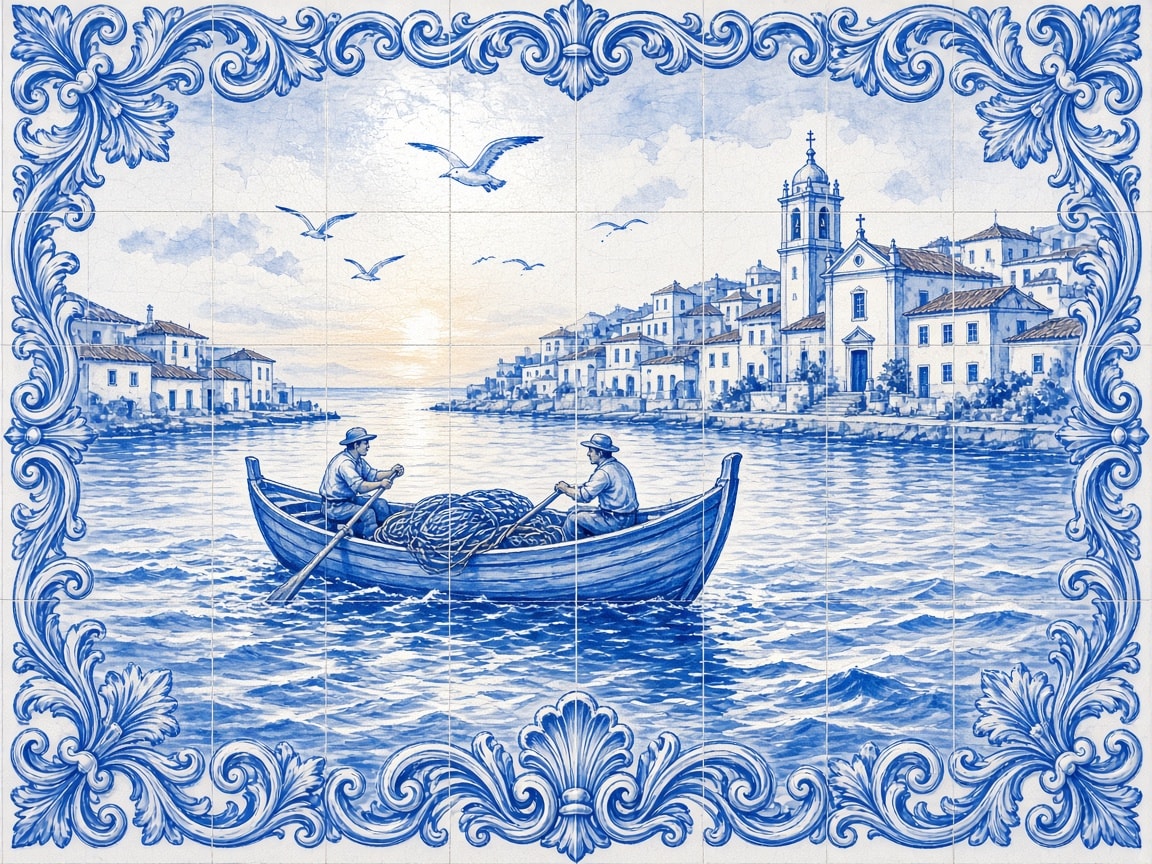
Hand-painted cobalt-blue azulejo tile mural: a wooden sardine fishing boat with a tall prow rows out of a harbor at dawn under seagulls, whitewashed hillside houses and a church tower behind, painted across a visible tile grid with glaze pooling, fine crazing and an ornate baroque scroll border, glossy ceramic sheen.
Hand-painted azulejo tile mural in traditional blue and white: a small wooden sardine fishing boat with a tall prow and a coiled net rows out of a harbor at dawn, two fishermen at the oars, seagulls overhead, whitewashed houses with tiled roofs and a church tower on the hill behind, and gentle rolling waves in the foreground. Painted in cobalt blue glaze on a white tin-glazed ceramic ground, composed across a visible grid of square tiles with thin grout lines, slight glaze pooling, tiny crazing cracks, hand-brushed line work and soft wash shading, framed by an ornate blue baroque scroll border with acanthus leaves. Glossy ceramic sheen with a soft reflected highlight, viewed straight on in even daylight as a wall mural, landscape 4:3. No text, no lettering, no signature, no modern objects.
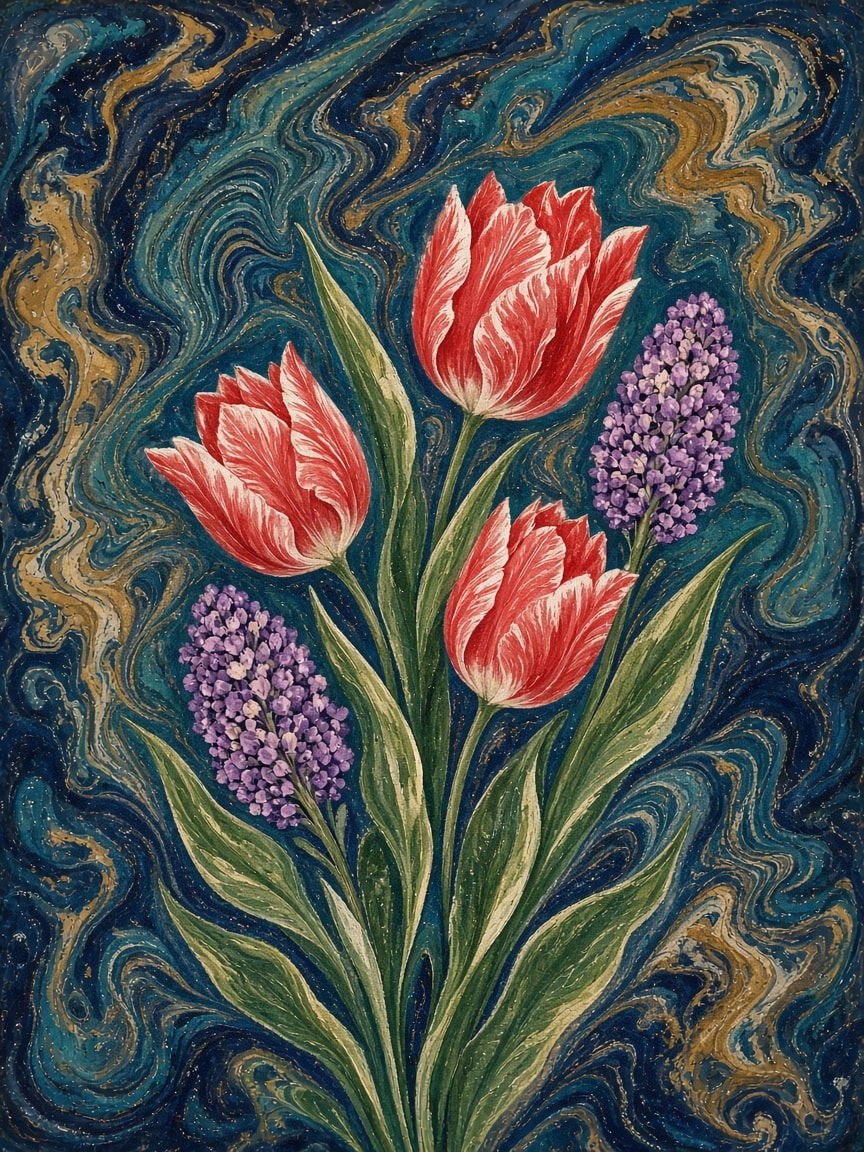
Traditional Turkish ebru paper marbling: red-and-white tulips, purple hyacinths and slender leaves float on a swirled indigo and teal ground with combed battal and gelgit patterns, soft pulled-teardrop petals with fine white veins, lilac dot clusters, tiny paint speckles and a matte hand-made paper texture.
Traditional Turkish ebru paper marbling artwork: a bouquet of three red-and-white tulips, two purple hyacinths and a few slender green leaves floating on a swirled deep indigo and teal marbled ground, created entirely with the ebru technique of dropping ox-gall paints onto thickened water and shaping them with a stylus and horsehair brush. The tulip petals show the characteristic soft-edged, pulled-teardrop shapes of ebru flowers, with fine white veins dragged through the red; the hyacinths are built from clusters of tiny lilac dots; the background shows classic battal and gelgit combed patterns in indigo, teal, ochre and cream, with organic flowing lines and tiny paint speckles. Slightly irregular, hand-made look, matte paper texture visible, soft natural daylight, viewed straight on as a flat artwork filling the frame, portrait 3:4. No text, no signature, no frame, no people, no hands.
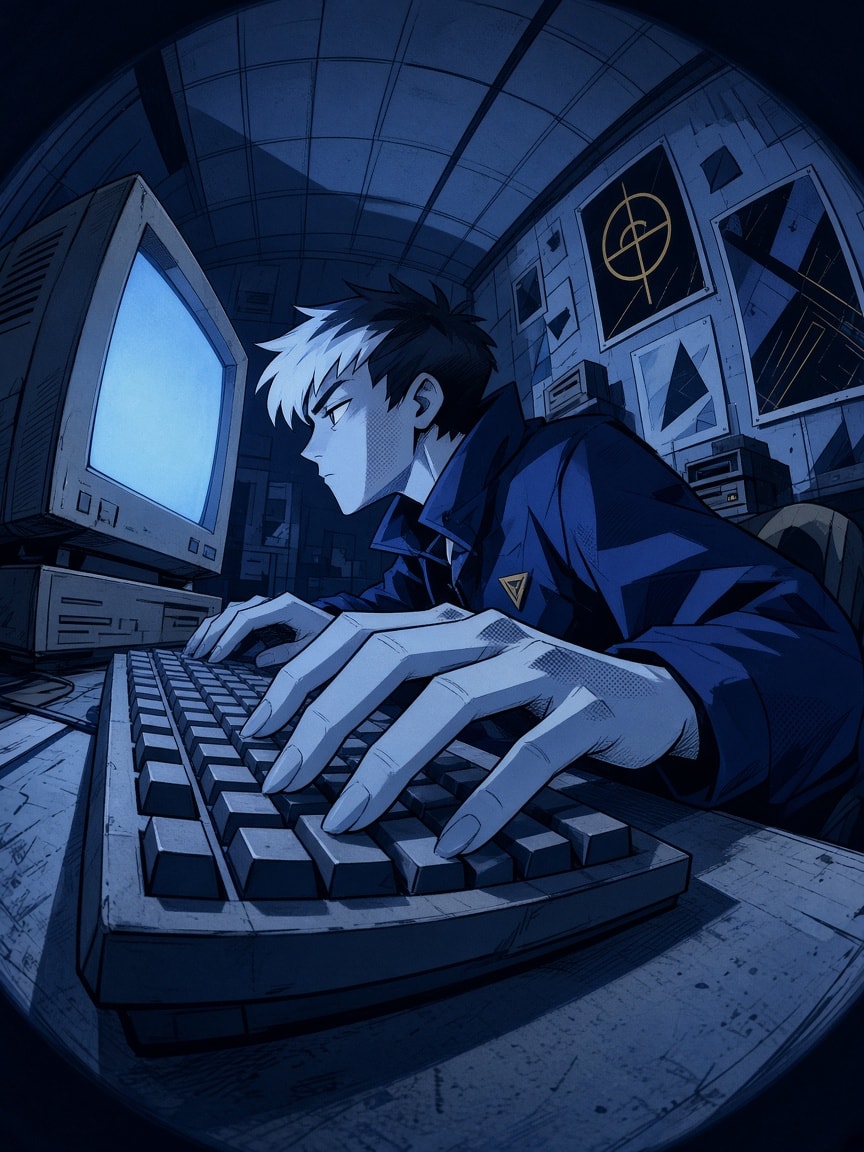
A long, precise style prompt for a stylized Western 2D animation frame: a young hacker typing at a chunky CRT computer in a cramped retro room, seen from desk level through an extreme fisheye with oversized hands in the foreground. It locks thin navy ink lines, flat two-tone cel shading, angular shadow blocks, light pencil hatching and dry brush, a strict cornflower-to-navy blue palette with tiny golden accents, and fine comic halftone dots only inside shadows. Swap the subject to reuse it.
Create a stylized 2D Western animated illustration of a mysterious young male hacker sitting at a vintage desktop computer in a cramped retro computer room. He has short black hair with a sharp white fringe, an angular pale face, a large expressive side-profile eye, an oversized dark jacket with geometric markings, and long slender fingers typing on a chunky mechanical keyboard. Extreme low-angle fisheye perspective from desk level, oversized hands dominating the foreground, bulky CRT monitor on the left, curved tiled ceiling, scattered wall posters, and strong architectural depth. Preserve the character's focused typing pose, distinctive facial expression, dramatic camera angle, and coherent spatial arrangement. Render in a sophisticated stylized Western 2D animation aesthetic with delicate hand-drawn comic illustration techniques and refined graphic character design. Thin, confident dark navy ink outlines with subtle organic irregularities, natural line-weight variation, expressive flowing contours, selectively broken edges, and precise facial linework. Simplified geometric anatomy, exaggerated but believable proportions, angular character construction, and distinctive silhouettes. Large uninterrupted flat color regions, clean two-tone cel shading, sharply defined angular shadow blocks, simplified geometric highlights, minimal gradients, and carefully balanced graphic shapes. Subtle short pencil hatching, restrained dry-brush marks along selected edges, imperfect freehand contours, and crisp matte color fills. Sophisticated 2D animation keyframe aesthetics, cinematic spatial perspective, bold editorial illustration composition, expressive character acting, and elegant visual simplicity. Strictly use a cohesive cool blue color palette of cornflower blue, dusty cobalt, slate blue, muted periwinkle, powder blue, pale icy cyan, and deep navy, complemented by tiny muted golden-yellow accents. The ceiling and walls use layered desaturated blues, the CRT monitor displays a flat pale icy-blue screen, the character's clothing is deep navy with angular cobalt shadow planes, and the keyboard uses muted blue-gray tones. Soft cool blue ambient lighting unifies the entire composition, with small warm yellow details creating restrained visual contrast. Harmonious blue-on-blue color separation, strong tonal hierarchy, matte surfaces, and clean graphic lighting. Apply refined localized gradient halftone shading only within selected cel-shaded shadow regions, especially along the character's fingers, cheek shadows, jacket folds, and occasional architectural shadow boundaries. Use extremely fine, tightly arranged halftone microdots in colors matching the underlying shadows, gradually decreasing in size and opacity toward the illuminated areas. The halftone creates elegant soft tonal transitions within small, organically shaped shadow zones, naturally dissolving into clean flat colors. The pattern must be clearly recognizable as delicate traditional comic-print halftone shading at close inspection, never as large individual decorative circles. Keep all other surfaces perfectly clean and solid, without any global texture. Preserve strong cinematic depth through exaggerated fisheye perspective, overlapping graphic shapes, and precise architectural construction rather than realistic lighting gradients. High-end stylized animated film frame, expressive character silhouette, sophisticated handcrafted linework, refined flat-color shading, and cohesive visual design.
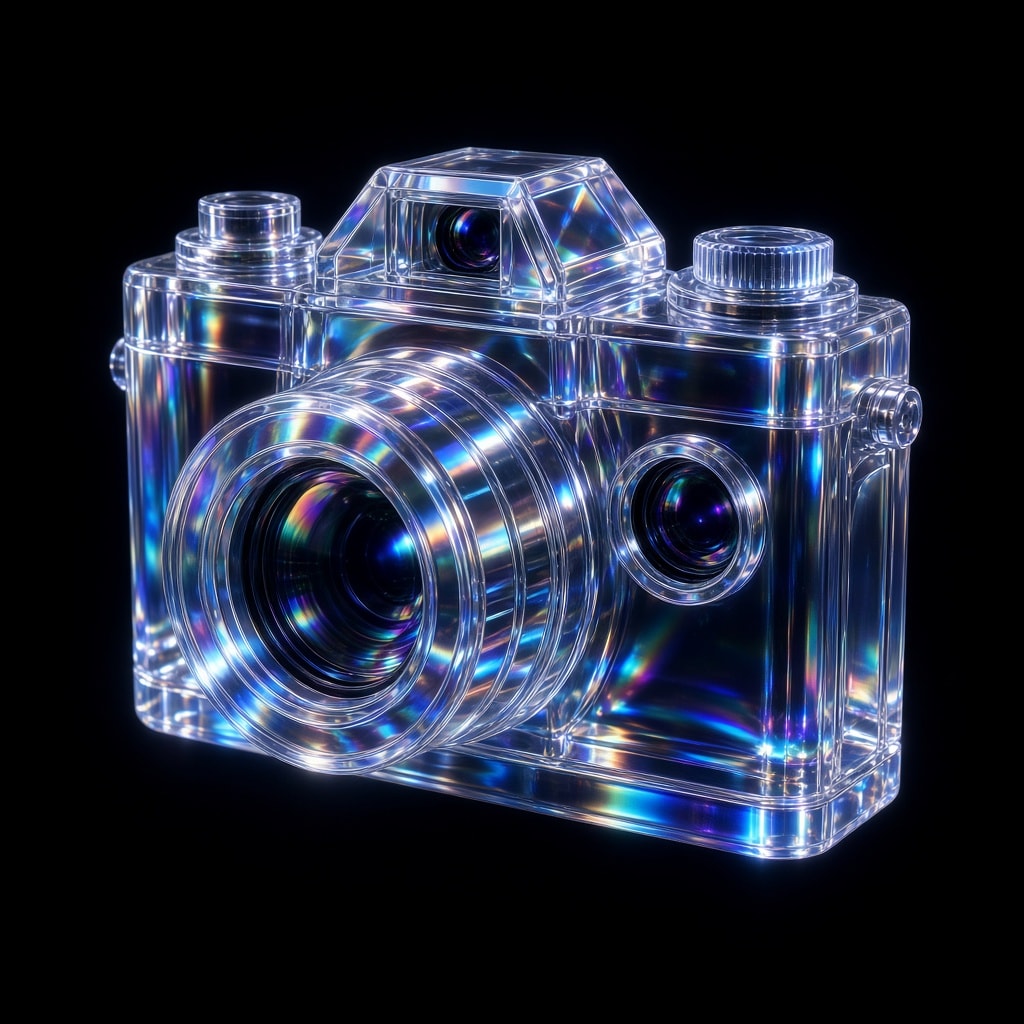
An image-to-image retexture prompt: attach any image (an object, product, figurine or building) and a JSON style block rebuilds its surfaces as transparent, iridescent glass while keeping the original composition. The JSON pins a photoreal 3D-render look, polished refractive surfaces, studio HDRI light from the top left with blue, green and purple accents, dispersion and bloom, a black vignetted background and chromatic aberration. Edit the JSON values to try other materials.
Retexture the image attached based on the JSON aesthetic below

{
  "style": "photorealistic 3D render",
  "material": "glass with transparent and iridescent effects",
  "surface_texture": "smooth, polished with subtle reflections and refractive effects",
  "lighting": {
    "type": "studio HDRI",
    "intensity": "high",
    "direction": "angled top-left key light and ambient fill",
    "accent_colors": ["blue", "green", "purple"],
    "reflections": true,
    "refractions": true,
    "dispersion_effects": true,
    "bloom": true
  },
  "color_scheme": {
    "primary": "transparent with iridescent blue, green, and purple hues",
    "secondary": "crystal-clear with subtle chromatic shifts",
    "highlights": "soft, glowing accents reflecting rainbow-like effects",
    "rim_light": "soft reflective light around edges"
  },
  "background": {
    "color": "black",
    "vignette": true,
    "texture": "none"
  },
  "post_processing": {
    "chromatic_aberration": true,
    "glow": true,
    "high_contrast": true,
    "sharp_details": true
  }
}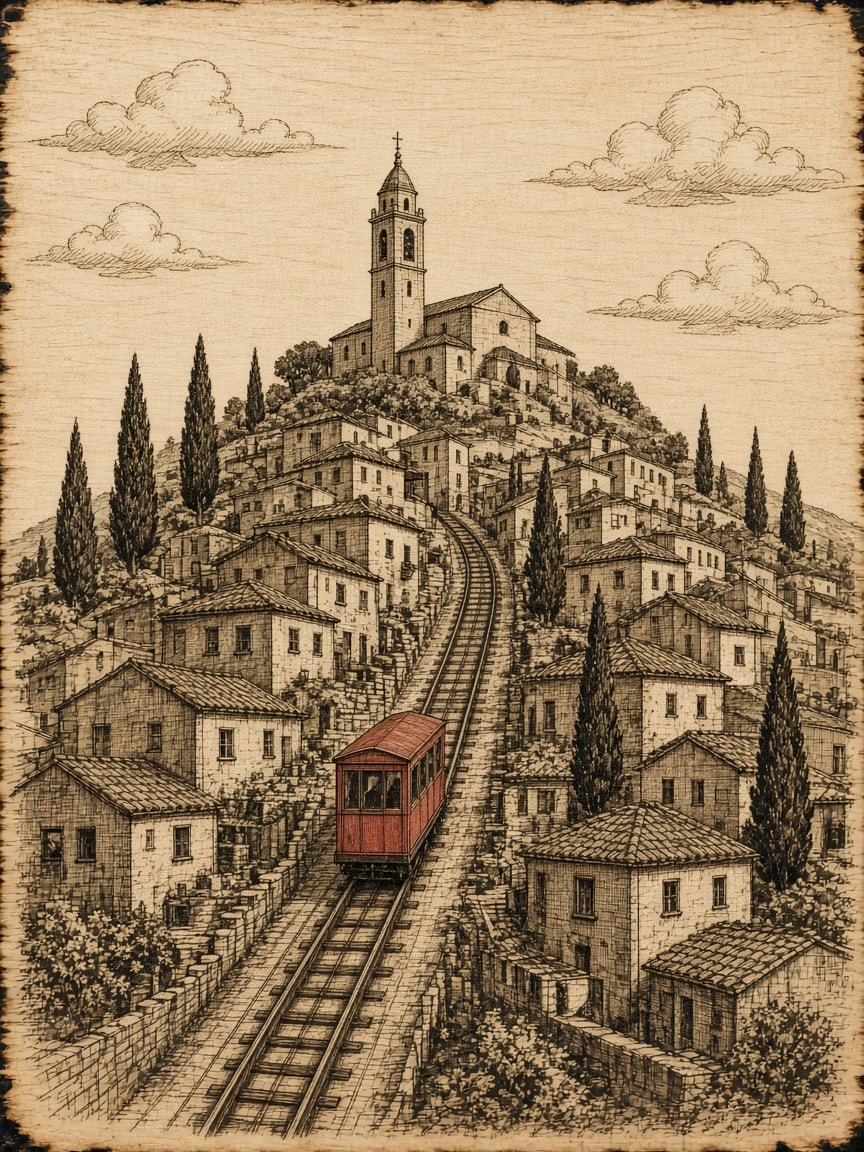
Pyrography artwork burned into a pale birch panel: a small red funicular car climbs a steep diagonal track through a hillside town of terracotta-roofed houses and cypress trees to a bell tower, drawn in sepia and chocolate-brown hatching and stippling with bare wood grain for the sky and a red stain on the car as the only color.
A small red funicular railway car climbing a steep single track up a hillside town of stacked terracotta-roofed houses, cypress trees and a church bell tower at the summit, rendered as pyrography wood-burning art on a pale birch plywood panel.

Technique: every line is burned into the wood in warm sepia and deep chocolate browns. Use fine parallel hatching for the roof tiles, stippled dots for the cypress trees and foliage, darker scorched tones for doorways and shadows, and leave the light natural wood grain bare for the sky and soft clouds. Only the funicular car carries a soft hand-applied wash of red stain, so it is the single color accent.

Details: the track runs diagonally from the lower left to the bell tower at the upper right, with a small station platform at the bottom and narrow stairways between the houses beside the track. Slightly uneven handmade line quality, subtle char marks along the panel edges, visible birch grain throughout.

Presentation: 3:4 portrait framing of the whole panel, viewed straight on under flat, even studio lighting, no glare.

Avoid: text, signatures, people, photographic realism, digital gradients.
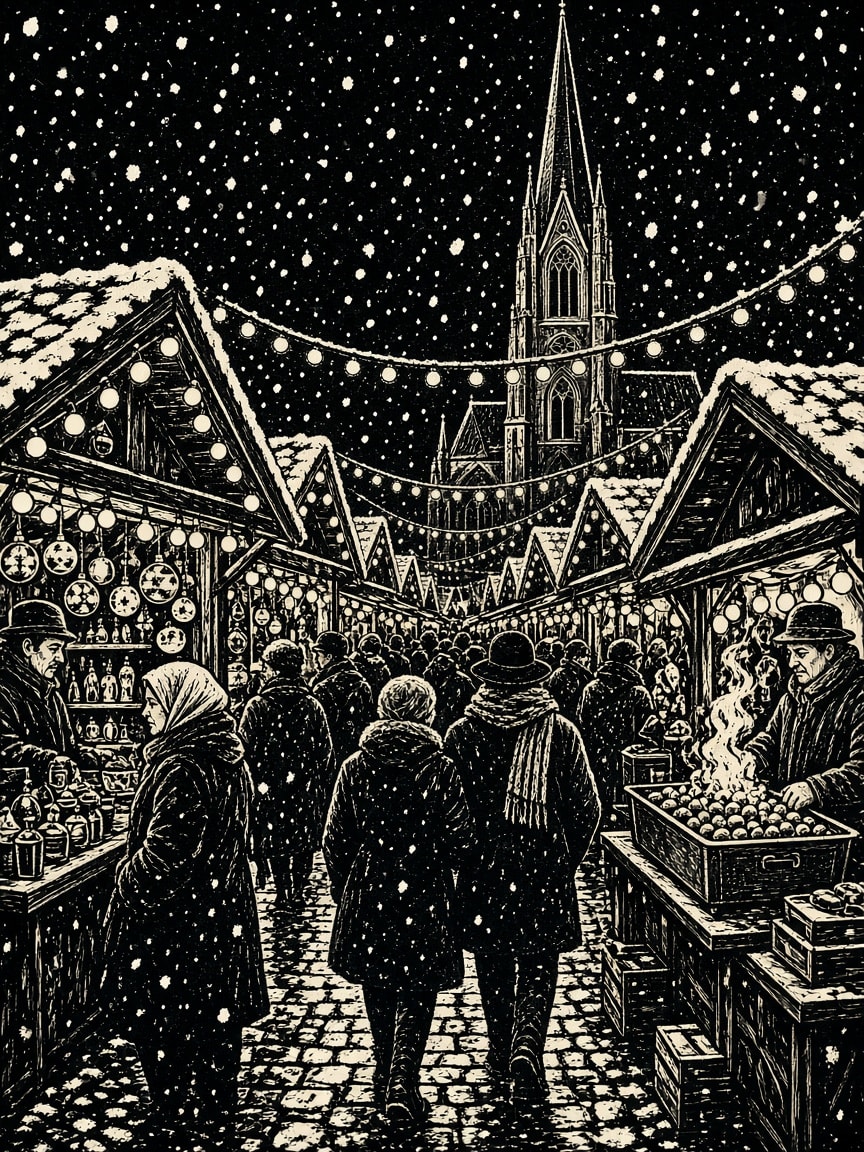
Tall black-and-cream linocut print with no readable text: a crowded European Christmas market lane at night, snow-covered stalls, string lights, falling snow, and a Gothic cathedral spire, high-contrast hand-carved hatching.
A traditional black-and-cream linocut print of a crowded European Christmas market at night, tall portrait 3:4. A narrow cobblestone lane runs between wooden market stalls with peaked snow-covered roofs; a dense crowd in heavy winter coats and hats walks between the stalls. In the background a tall ornate Gothic cathedral spire rises into a solid black sky filled with falling cream snow dots. Three strings of round festival lights swoop across the upper third with soft white halos. Left stall shows jars and hanging ornaments; right stall sends a plume of steam from a tray of roasted chestnuts. High-contrast hand-carved hatching, block-print woodgrain feel, ink-black and cream paper only, lively winter-night mood. No readable shop names, no logos, no watermarks, no modern brand marks.
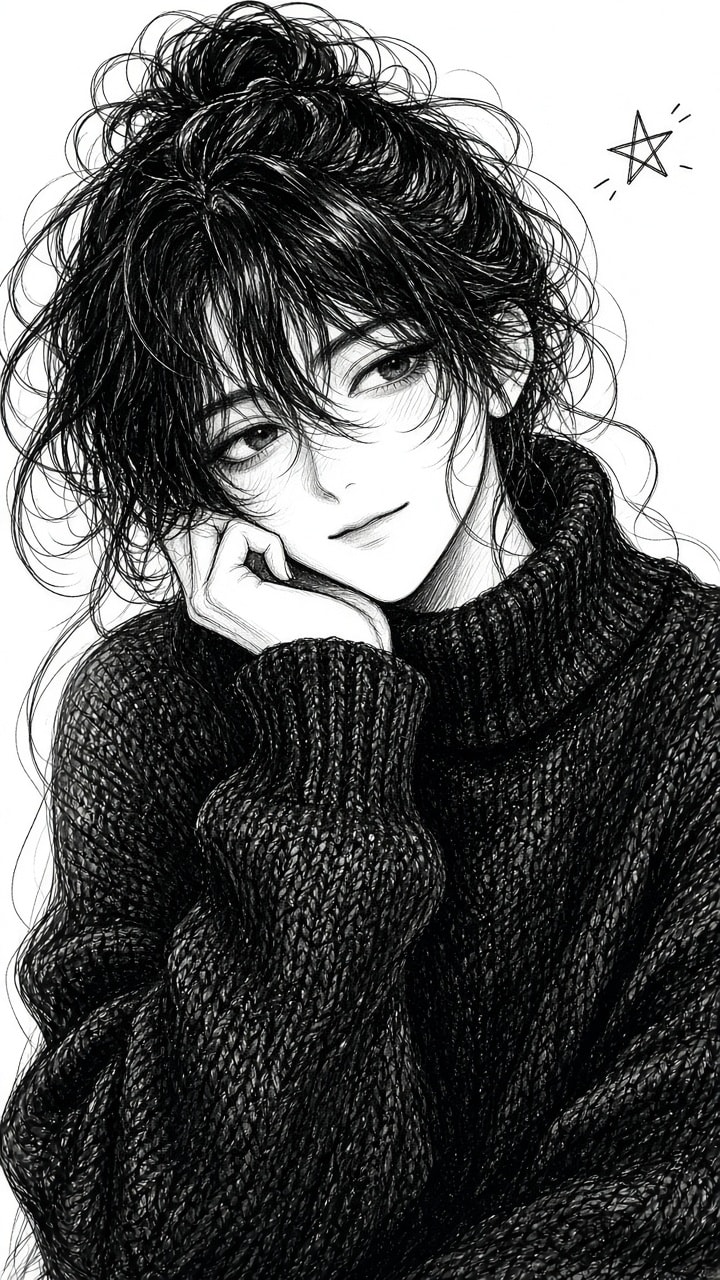
A ready-to-use 9:16 JSON prompt for an authentic black-and-white manga ink portrait: an original anime woman with a voluminous messy high bun rests her cheek on one hand in an oversized black sweater, gazing sideways. It calls for intricate ink linework, fine cross-hatching, soft pencil shading on the face, white-highlighted hair strokes and a pure white paper background with a tiny heart doodle, plus a negative prompt that keeps out color, 3D and photorealism.
{
  "aspect_ratio": "9:16",
  "style": "Black and white manga ink sketch, detailed hand-drawn illustration",

  "prompt": "A beautiful young anime woman with large expressive eyes, long eyelashes, full lips and a dreamy sideways gaze. Extremely voluminous messy black hair tied in a loose high bun, with wispy bangs and wild flowing flyaway strands. Her head is slightly tilted, resting gently on one hand, with naturally curved fingers supporting her cheek. She wears an oversized black sweater with loose sleeves and detailed fabric folds. Medium close-up portrait, head and upper torso visible, centered composition. Intricate black ink linework, fine cross-hatching, delicate pencil shading on the face, dense black hair strokes with white highlights, expressive sketchy outlines. Pure white paper background with a tiny hand-drawn heart doodle in the upper right corner. Strong black and white contrast, authentic manga illustration, elegant, dreamy and playful.",

  "negative_prompt": "Color, 3D, photorealism, watercolor, extra fingers, distorted face, messy background, text, watermark, blurry details"
}
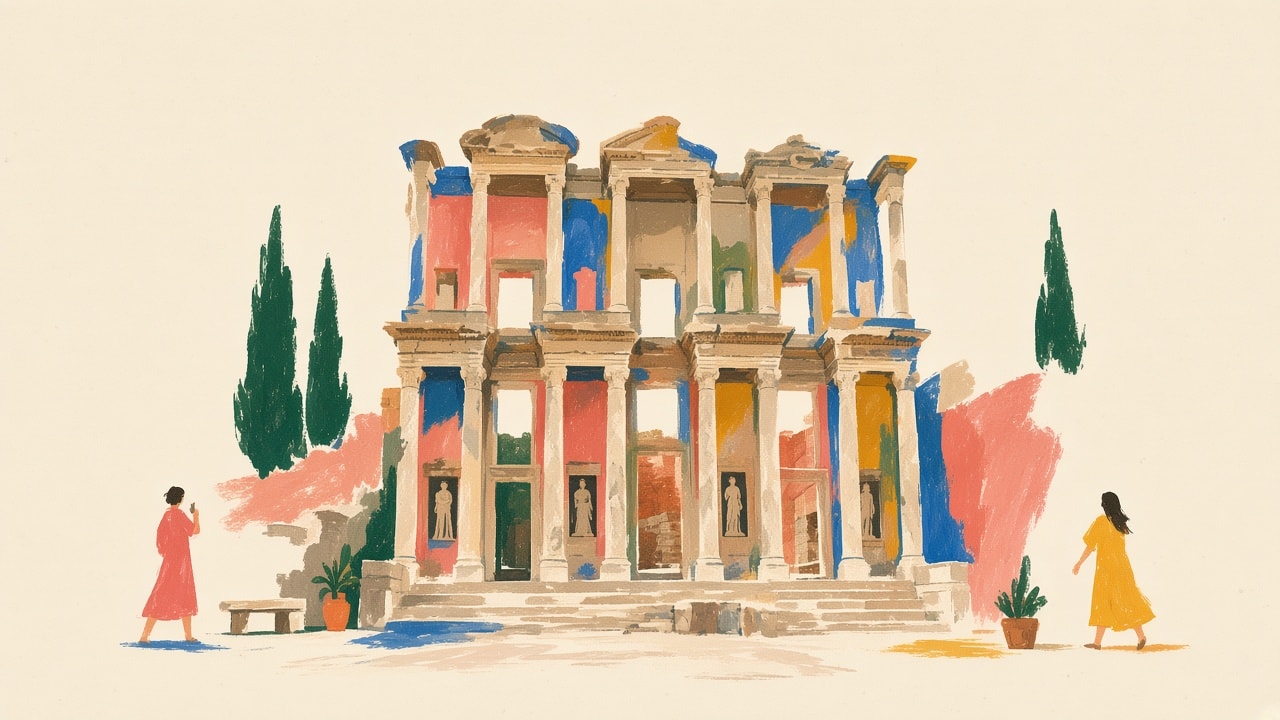
A reusable wide landscape template that turns any landmark into a quiet mid-century travel postcard: the destination sits slightly off-center in loose gouache and pastel marks on a warm cream paper field that fills 40–50% of the canvas. Tiny coral and mustard figures, one small contextual prop and a few natural accents keep the composition sparse and airy. Fill in the landmark, city, architectural features and a short activity for the figures.
A wide horizontal landscape hand-painted illustration of [LANDMARK NAME] in [CITY/COUNTRY] with strong emphasis on negative space and quiet composition.

The image features a warm off-white cream paper background that occupies 40-50% of the total canvas, creating generous blank margins and breathing room.

The [LANDMARK NAME] is positioned slightly off-center as a calm visual anchor, depicted through simplified [KEY ARCHITECTURAL FEATURES - e.g., "towering structures", "iconic silhouette", "distinctive archways"] with loose, expressive brush strokes. The landmark is suggested through minimal rhythmic marks and abstract color blocks in deep teal, cobalt blue, and forest green, rather than drawing every architectural detail precisely.

The composition is sparse and uncluttered: only a few carefully placed elements including 2-3 tiny human figures [DOING TYPICAL ACTIVITY - e.g., "walking", "taking photos", "sitting"] rendered as simple silhouettes in coral red and mustard yellow, one small [CONTEXTUAL ELEMENT - e.g., "cafe table", "bench", "street vendor cart"] with minimal shapes, two or three [NATURAL ELEMENTS - e.g., "potted plants", "trees", "flowers"] in emerald green, and subtle [CULTURAL/ARCHITECTURAL HINTS - e.g., "traditional roof lines", "modern glass panels", "historic columns"].

Large areas of the warm paper background remain completely untouched, especially around the edges and between elements.

The style combines mid-century travel poster aesthetics with contemporary [REGIONAL] editorial illustration: elegant, minimal, warm, cultured, and slightly nostalgic.

The texture shows loose hand-painted gouache and pastel marks with dry brush strokes, pastel smudges, wax-crayon edges, uneven color patches, imperfect handmade edges, and visible gaps between colored areas.

Colors are layered, dry, and tactile with a restrained palette of deep teal, sky blue, coral red, salmon pink, mustard yellow, ochre, terracotta, and small near-black accents, but used sparingly so each color can breathe against the paper.

The overall mood is quiet, spacious, relaxed, refined, like a sophisticated [CITY] cultural postcard or handmade art print suitable for premium lifestyle merchandise.

The landmark remains recognizable through its essential identity—[DEFINING CHARACTERISTICS]—but the drawing stays airy, calm, poetic, and softly abstract.

Strong sense of pause, breath, and refined emptiness with confident use of blank space.

No crowded composition, no full-bleed busy background, no photorealism, no glossy digital rendering, no clean vector art, no 3D rendering, no text, no signage, no logos, no readable text.
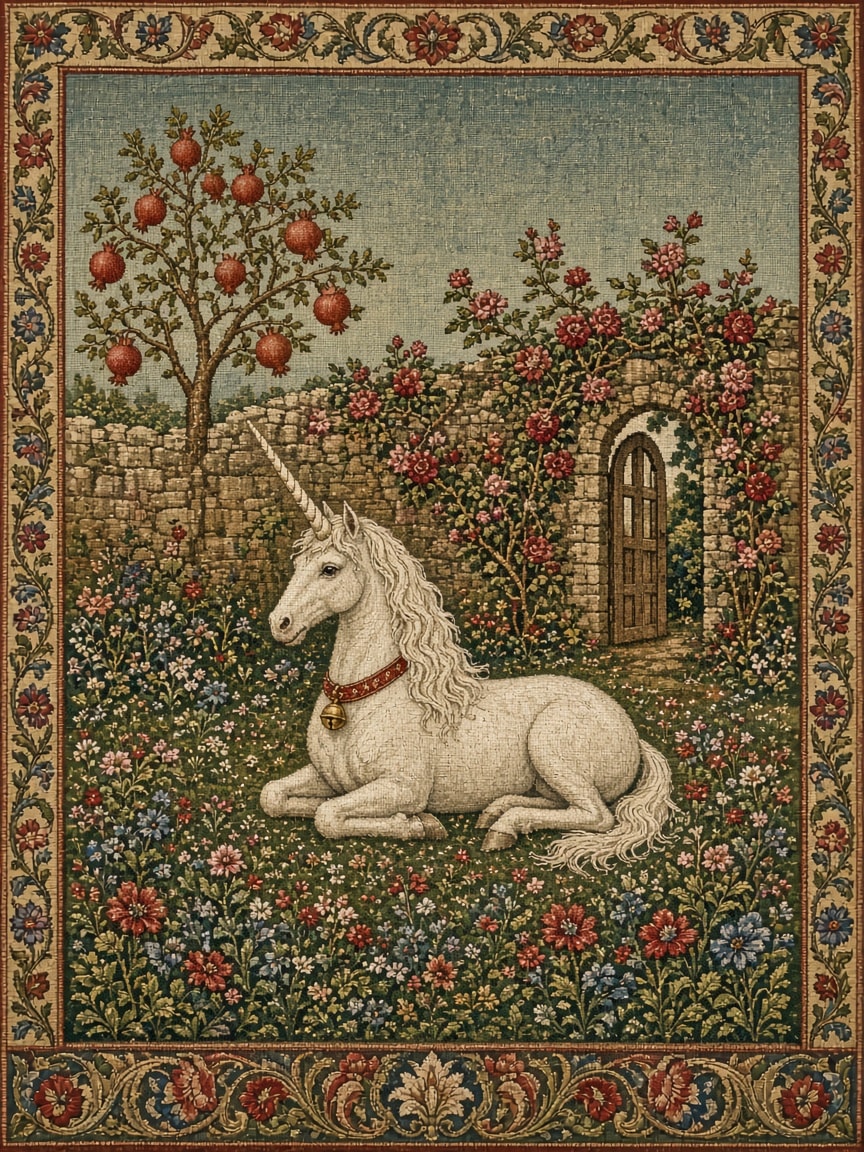
Tall Aubusson-style medieval tapestry of a white unicorn lying in a walled rose garden: creamy mane, slender spiral horn, and a red collar with a gold bell, a pomegranate tree on the left, a rose-covered stone wall with a closed arched wooden door on the right, millefleurs flowers, woven vegetable-dye texture, and an ornate floral border on all four sides.
A tall vertical Aubusson-style medieval tapestry of a white unicorn lying down in the center of a walled rose garden, portrait 3:4. The unicorn rests on a millefleurs meadow of tiny red, blue, pink, and white flowers, with a creamy flowing mane and tail, a slender spiral horn, and a red collar with a small gold bell, facing slightly left. On the LEFT a stylized pomegranate tree bears several ripe red fruits. On the RIGHT a rose-covered stone wall has an arched wooden door that is closed, not wide open, with climbing pink and crimson roses over the arch. Woven tapestry texture with slightly faded vegetable-dye reds, blues, and moss greens, and an ornate floral border on all four sides. No readable text, no people, no logos, no watermarks.
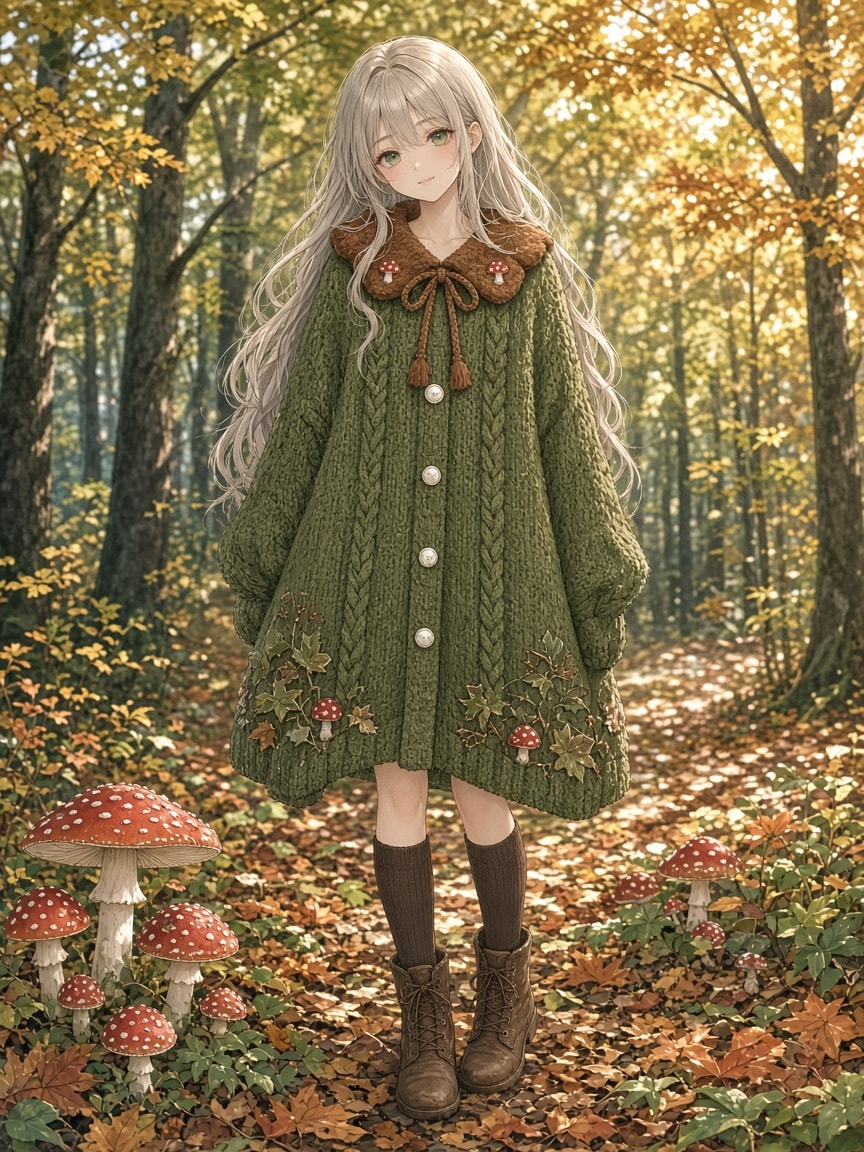
A detailed outfit-only prompt you can drop onto any character: an olive green knitted cape cardigan with a poncho silhouette, a chestnut brown scalloped Peter Pan collar with tiny embroidered red mushrooms, a long knitted cord bow, ivory silver-rimmed buttons, cable-knit columns and mushroom-and-vine embroidery near the hem. Works with anime and illustration models as well as GPT Image, Gemini, Grok and Midjourney; replace [Your character] with your own character description.
[Your character], full-body view, wearing:

olive green knitted cape cardigan, wide flowing poncho silhouette, hip length cape with continuous fabric draping from shoulders to hem, broad sloping sides and loose open lower edges, round neckline with warm chestnut brown knitted Peter Pan collar, two rounded collar lobes with scalloped edges, layered textured brown knitting across collar, small embroidered red mushrooms with white spotted caps and ivory stems on both collar tips, chestnut brown knitted cords tied in a long loose bow at center neckline, long brown cord ends hanging down chest, olive green center front button band, single vertical row of small round ivory buttons with decorative silver rims, two raised olive green cable knit columns flanking button band, dense horizontal knit stitches across cape body, raglan style knitted shoulder lines, scattered red and ivory mushroom embroidery near both lower front sides, dark green embroidered winding stems and tiny leaves, gently flared olive green hem, brown collar and olive green cape body
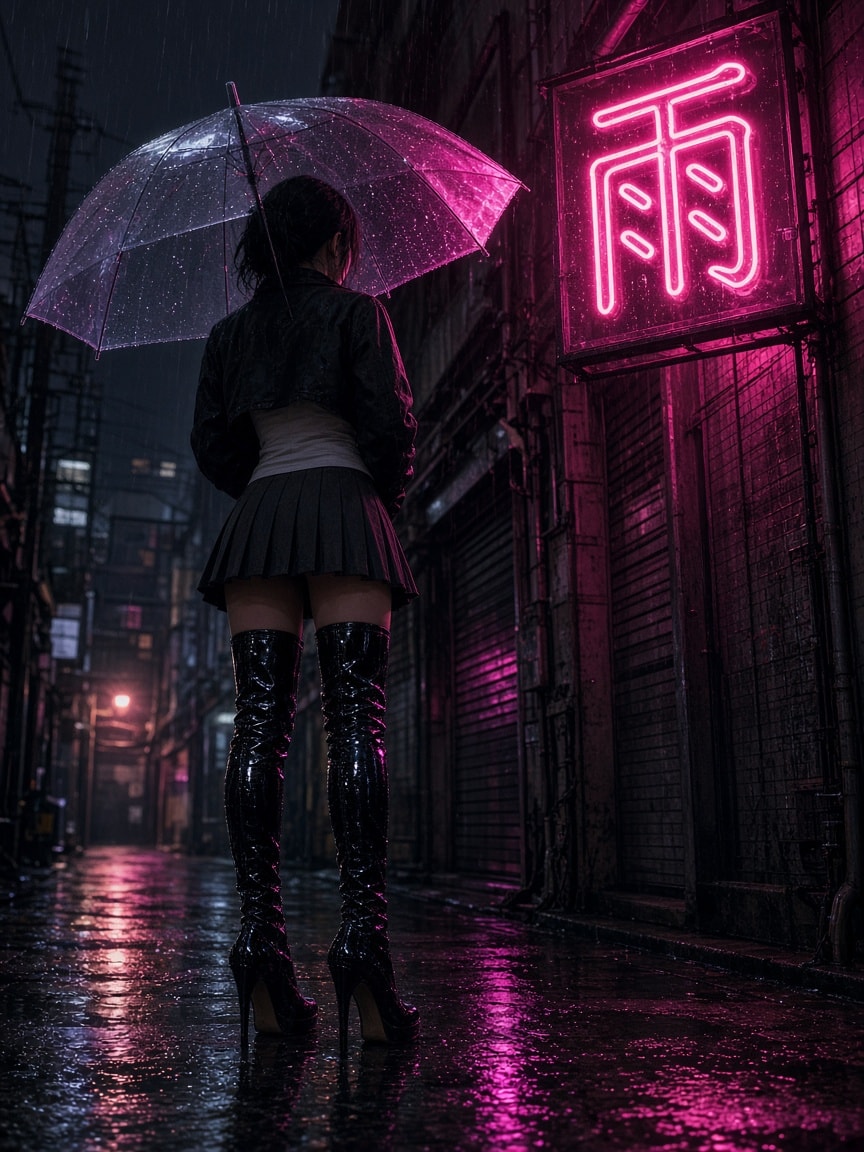
A compact atmospheric image prompt for a rainy Japanese alley at night: a faceless female figure in a cropped jacket, pleated mini-skirt and patent over-the-knee boots stands under a clear umbrella that catches magenta light, beneath a half-dead neon kanji sign. Low camera, soft grain, mood of waiting for a reply that never comes. Optional "Cel Shaded Art," prefix for a sharper comic look.
Rainy alley, one neon kanji sign half-out, female Japanese figure wearing cropped jacket tank top, pleated mini-skirt, patent high-heeled over-the-knee boots, under a clear umbrella that catches magenta light. Camera low. No face shown. Mood: waiting for a reply that isn't coming. Soft grain, no film logo.

Optional prefix for extra punch: Cel Shaded Art,
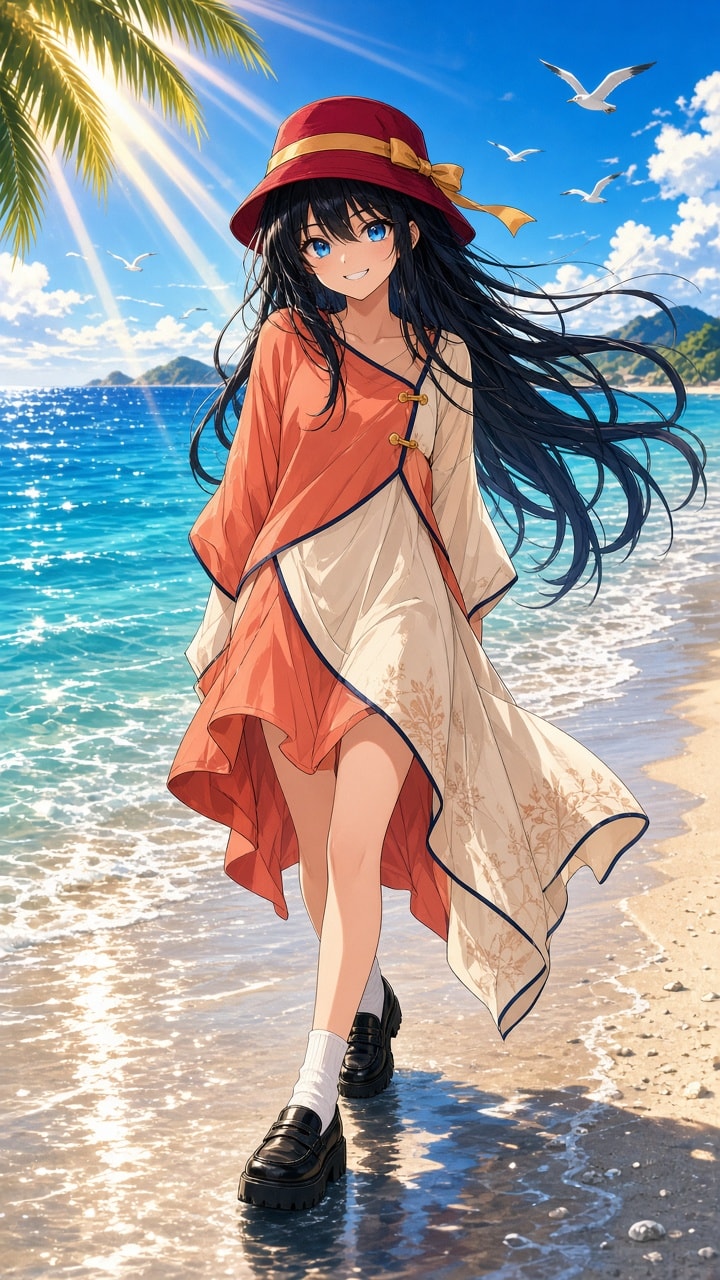
A complete GPT Image–ready JSON prompt for a vibrant Japanese anime summer illustration: an original stylish girl in a coral-orange asymmetric tunic and cherry-red bucket hat walks the wet shoreline of a turquoise tropical beach. It locks warm clothing colors against cool ocean blues, a 9:16 full-body fashion pose, golden sunbeams, seagulls and a strong negative prompt so the outfit never blends into the water.
1{2 "aspect_ratio": "9:16",3 "style": "Premium Japanese anime illustration, vibrant summer movie aesthetic, expressive hand-drawn character art, high-contrast cel shading, brilliant tropical colors",...+3 more lines
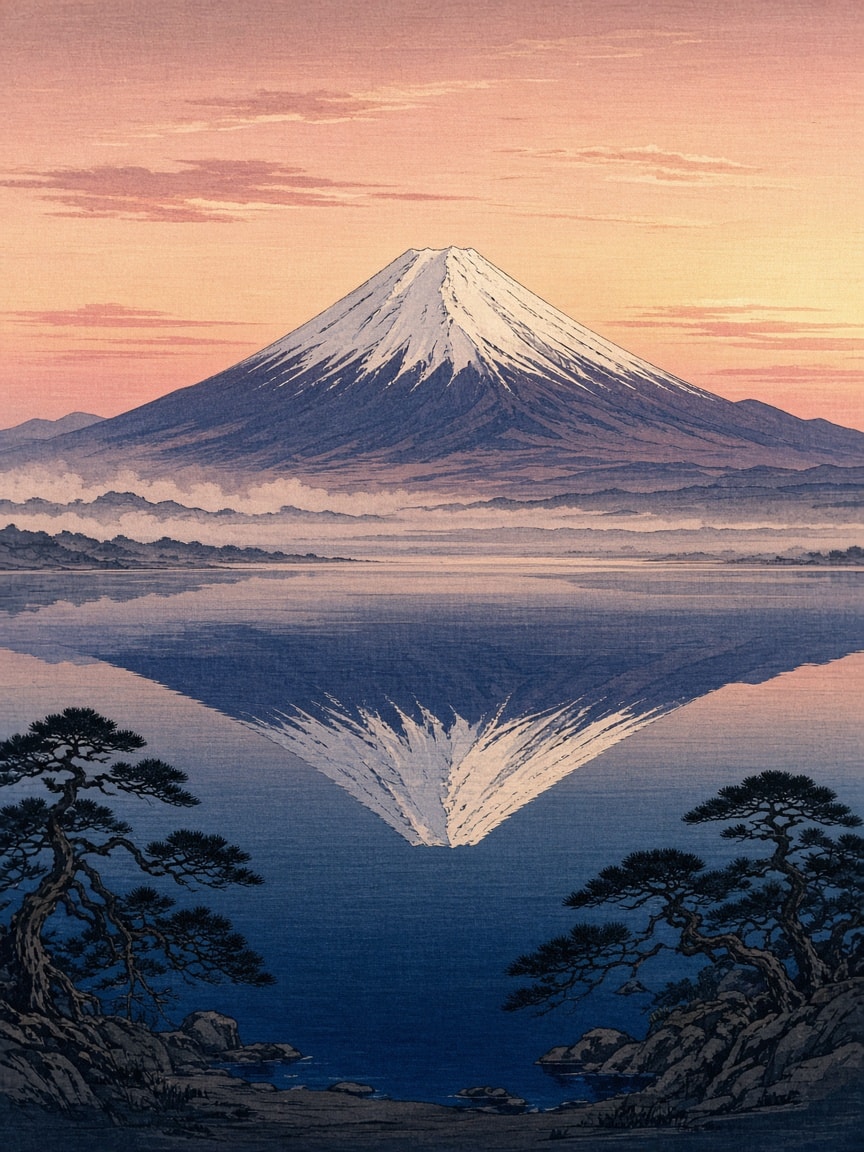
Tall ukiyo-e woodblock print with no text: Mount Fuji as a snow-capped indigo cone reflected in a calm lake at dawn, peach-gold sky, flat layered pink clouds, dark pine silhouettes and a small empty wooden pier in the foreground, visible woodgrain, fine ink outlines, quiet Edo-period print style.
A traditional Japanese ukiyo-e woodblock print of Mount Fuji reflected in a calm lake at dawn, tall portrait 3:4. Mount Fuji rises in the upper half as a simple snow-capped cone with crisp indigo and white slopes, its perfect mirror image filling the still lake below. A pale peach and gold dawn sky washes behind the peak, with a few flat layered clouds in soft pink. Along the near shore, a thin line of dark pine silhouettes and a small empty wooden fishing pier sit low in the foreground; one empty skiff floats near the pier. Flat color blocks, visible woodgrain texture, fine ink outlines, classic Edo-period print style, quiet and balanced composition. No people, no text, no signatures, no seals, no watermarks, no letters.

