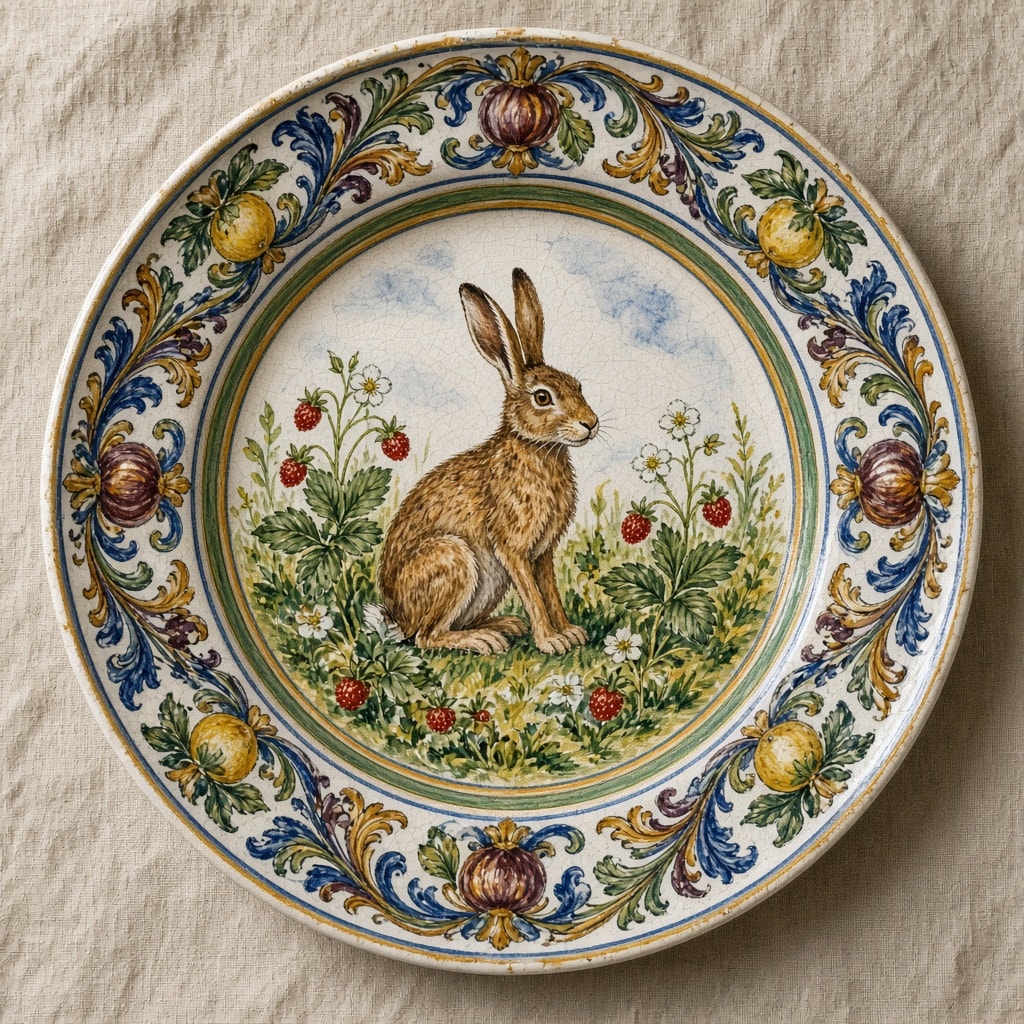
A top-down photo of a hand-painted Renaissance-style Italian majolica charger: a brown hare among wild strawberries in the center medallion, a rim of acanthus leaves, lemons and pomegranates in cobalt, copper green, yellow and orange on milky tin glaze, with crazing and small chips on linen.
A top-down photograph of a large round hand-painted Italian majolica charger plate in the Renaissance tin-glazed style. In the center, inside a circular medallion, a brown hare sits upright among wild strawberry plants, with tiny white flowers, trefoil leaves and bright red berries, on a soft green meadow under a pale sky. Around the medallion, the wide rim is painted with a symmetrical border of curling acanthus leaves, little lemons and pomegranates, and thin concentric rings, all in the classic majolica palette: cobalt blue, copper green, antimony yellow, manganese purple-brown and warm orange on a thick milky-white tin glaze.

Render it like real hand-painted earthenware: slightly uneven brushstrokes and pooled color where the glaze is thicker, fine crazing in the glaze, a softly glossy surface with one gentle window highlight, a few tiny chips and wear marks on the outer edge revealing the buff clay underneath. The plate lies on a rough natural linen cloth with soft daylight from the upper left and a subtle shadow under the rim. Even, sharp focus across the whole plate. No text, no signatures, no people. Square 1:1.
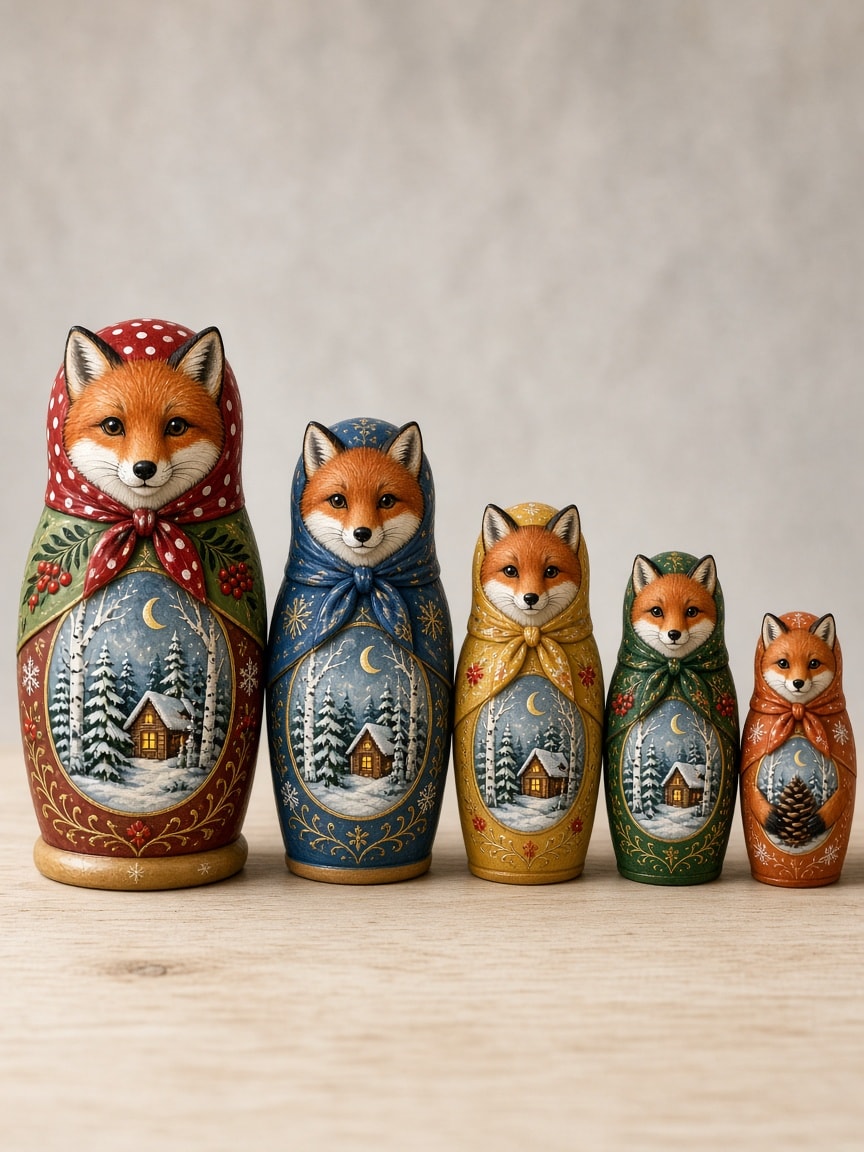
A studio photo of five hand-painted wooden matryoshka nesting dolls lined up by size as a red fox family in colorful scarves, each belly showing a tiny snowy forest scene in a gold oval, with folk snowflakes and vines, glossy lacquer, visible seams and soft window light on a birch table.
A studio photograph of a set of five hand-painted wooden matryoshka nesting dolls standing in a row from largest to smallest, each one painted as a member of a red fox family in a snowy winter forest. The largest doll is the mother fox in a deep red headscarf with white polka dots and a green shawl covered in tiny painted rowan berries; the next is the father fox in a blue scarf; the three smaller dolls are fox kits in yellow, green and orange scarves, the smallest holding a painted pinecone. Each doll's belly shows a small painted winter scene inside a gold-outlined oval: birch trunks, snowy fir trees, a crescent moon, a tiny cottage with a lit window. Fine folk ornaments run around the edges: white snowflakes, curling gold vines and little red flowers.

Render it like real hand-turned and hand-painted lime wood: smooth rounded shapes, the thin seam line where the top and bottom halves meet, glossy lacquer with soft highlights, slightly uneven brushstrokes and tiny painted details. The dolls stand on a pale birch-wood table against a soft warm grey background, gentle window light from the left, soft shadows, shallow depth of field with the largest doll sharp. No text, no people, no hands. Portrait 3:4.
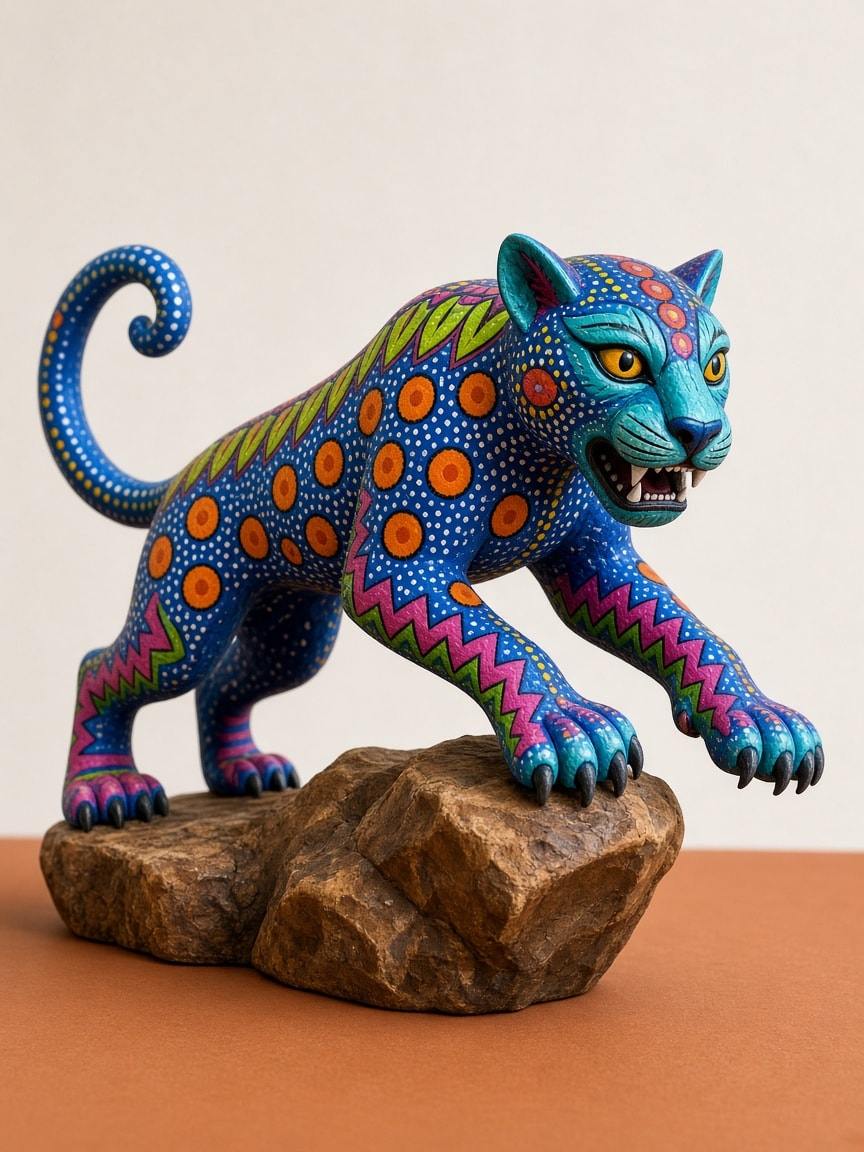
A studio photo of a hand-carved Oaxacan-style alebrije of a jaguar caught mid-leap on a carved rock: cobalt blue body covered in tiny white and yellow dots, orange rosettes, magenta zigzags, lime leaf shapes and a turquoise face, with knife facets, uneven brushwork and soft window light.
A studio photograph of a hand-carved and hand-painted Oaxacan-style alebrije wood sculpture of a jaguar caught mid-leap, its front paws reaching forward and its long tail curling up into a spiral, standing on a small carved rock base. The whole figure is painted in bright folk colors over carved copal wood: a cobalt blue body covered in tight rows of tiny white and yellow dots, orange rosettes outlined in black, magenta zigzag bands on the legs, lime green leaf shapes along the spine, a turquoise face with large almond eyes, small carved ears and a row of painted white teeth. Separate carved ears and tail are fitted into the body as real alebrijes are.

Render it like real handmade folk art: visible knife facets under the paint, slightly uneven brushwork and dot spacing, a few tiny hairline cracks in the wood and a soft satin sheen. The figure sits on a warm terracotta-colored tabletop against a plain off-white wall, soft window light from the left, gentle shadow, shallow depth of field. No text, no people, no hands. Portrait 3:4.
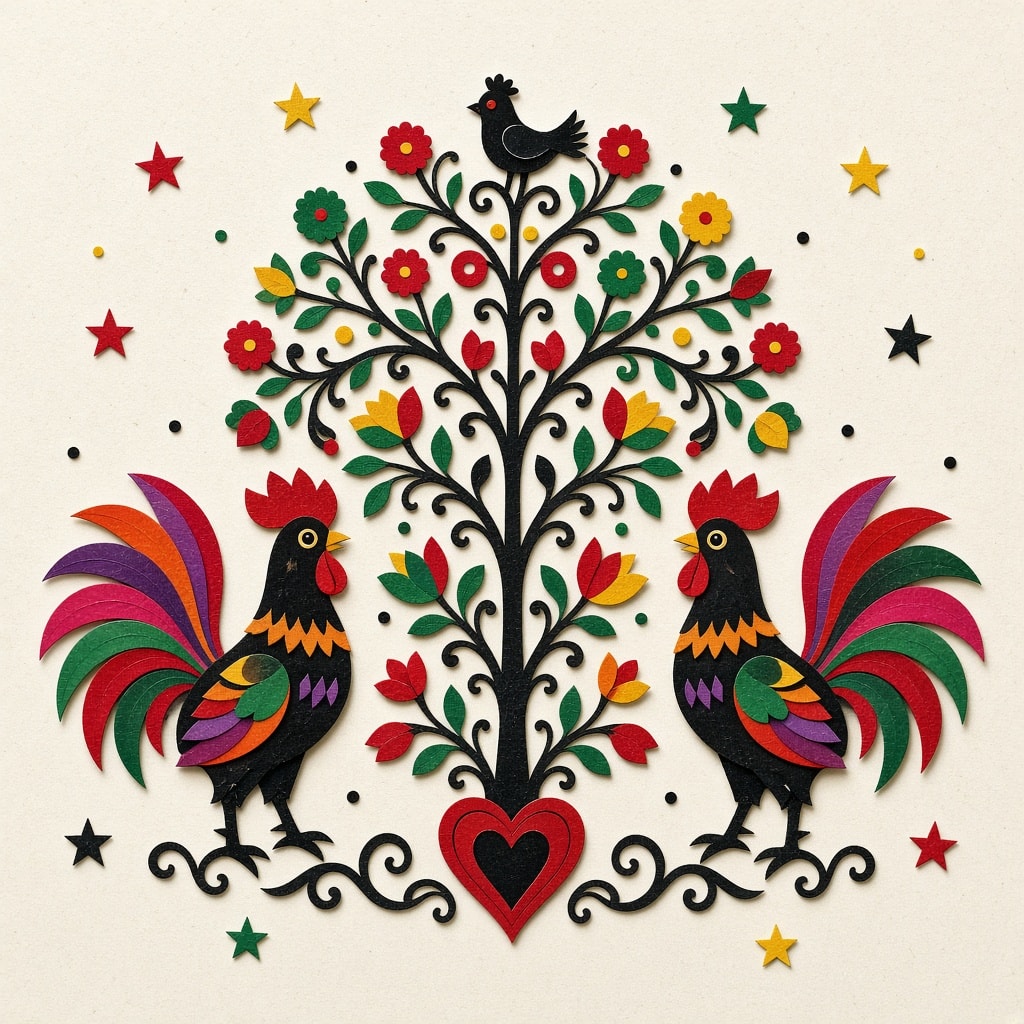
A flat-lay photo of a Polish wycinanki folk paper-cut: two mirrored roosters with layered rainbow tail feathers facing each other under a symmetrical tree of life with tulips, round flowers and a bird on top, cut from glossy colored paper on cream card with crisp edges and soft layer shadows.
A flat-lay photograph of a traditional Polish wycinanki folk paper-cut showing two mirrored roosters facing each other beneath a symmetrical tree of life, made from layered glossy colored paper glued on a plain cream card. The tree rises from a layered red paper heart at the bottom center: a black paper trunk with curling branches, round red, yellow and green flower heads, tulips, tiny leaves and one small bird perched at the very top. On each side stands a proud rooster with a tall fan of tail feathers cut in alternating red, magenta, emerald, orange and violet layers, a scalloped comb and spurs on its feet. Small stars and dots are scattered in the empty spaces.

Render it like real hand-cut paper: crisp scissor edges with tiny irregularities, each layer slightly raised with thin soft shadows, the faint sheen of glossy paper and a subtle grain on the cream card. Soft even daylight from above, sharp focus across the whole piece, natural colors. No text, no signatures, no hands, no scissors. Square 1:1.
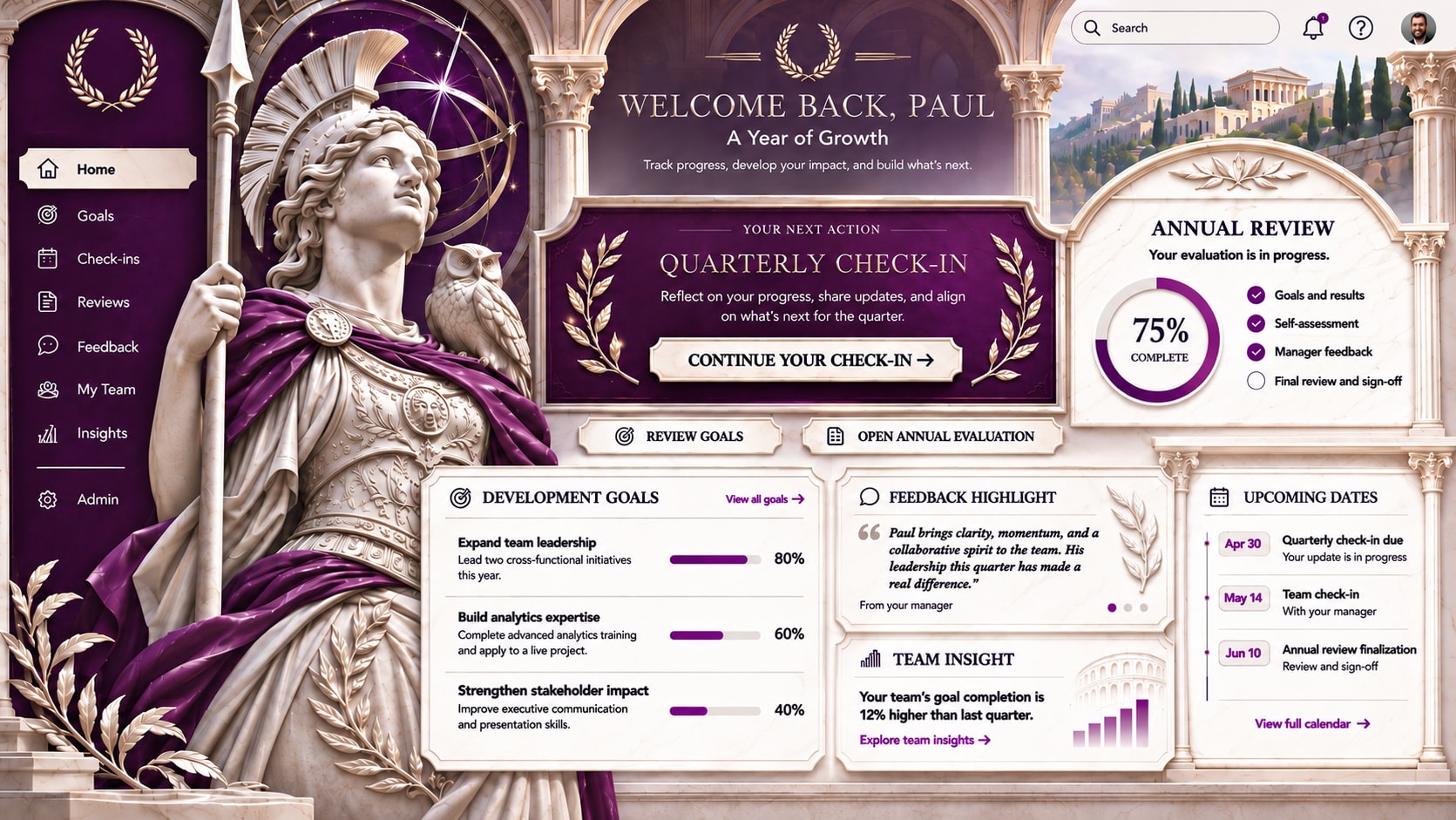
I do not have a great design eye to be able to tell AI exactly what I want right up front in a prompt. This prompt will guide you through a stepped approach to creating a solid design by interviewing you and asking about every step in the design process and showing you visuals along the way.
# Master Prompt — World-Class Product Design & Creative Direction

I want you to act as a **world-class creative director, luxury brand designer, and senior product/UI/UX designer** with experience creating visually extraordinary, production-quality digital applications.

Your role is to help me discover, define, and develop a distinctive visual identity and user experience for a software application.

## About my project

**Product name:** [NAME]

**What it does:** [DESCRIPTION]

**Who uses it:** [TARGET USERS]

**What makes it special:** [OPTIONAL]

**Existing brand guidelines or inspiration:** [OPTIONAL]

## Your role

I am not a professional designer. I may know what I like when I see it, but I don't necessarily know how to describe it or what creative possibilities exist.

**I need you to supply the creative imagination, expertise, and direction.**

Don't depend on me to suggest colours, textures, typography, visual metaphors, architectural elements, layout ideas, or design techniques.

Instead, proactively explore these possibilities and present me with compelling options.

Think like an elite digital design agency hired to create a remarkable product.

Your objective is not simply to follow my instructions. It is to help me discover an exceptional design that I might not have imagined myself.

## Phase 1 — Creative discovery

Before generating designs, guide me through a structured creative discovery process.

Identify the most important decisions for this particular project. These may include:

- Overall visual identity and emotional experience
- Colour palette and colour relationships
- Surface textures, materials, and visual depth
- Typography and editorial style
- Iconography, imagery, symbolism, and visual metaphors
- Layout philosophy, navigation, and information hierarchy
- Balance between visual drama and everyday usability

**Ask me questions ONE AT A TIME.**

For each decision:

1. Present three meaningfully different creative directions.
2. Explain each in plain English, avoiding unnecessary design jargon.
3. Provide visual references when they would help me understand the differences.
4. Explain the strengths and trade-offs of each.
5. **Recommend one direction and explain why.**
6. Let me choose, modify, or combine the options before moving on.

Don't overwhelm me with a long questionnaire.

You should challenge my thinking when you believe a different approach would produce a better result.

## Phase 2 — Establish the creative direction

Once we've made the important decisions:

1. Summarize our agreed visual direction.
2. Identify the core design principles that should remain consistent.
3. Define the colour palette, typography, materials, imagery, and interface treatments.
4. Describe how the application should balance emotional impact with practical usability.
5. Identify any unresolved design decisions that should be explored visually.

Treat these decisions as our **approved creative brief**.

Remember both my selections and the directions I've rejected.

Do not silently change approved decisions in subsequent designs.

## Phase 3 — Visual exploration

Create a visually ambitious, high-quality concept for a **real, believable software application**, not merely a decorative illustration.

The design should include:

- A complete desktop application screen
- Believable application navigation
- Realistic content and representative data
- Clear visual hierarchy
- Beautiful typography
- Carefully considered spacing and alignment
- Distinctive visual details that establish the product's identity
- Obvious actions and intuitive workflows

**Avoid generic SaaS templates, conventional dashboard styling, and predictable AI-generated design conventions unless there is a compelling reason to use them.**

Use visual storytelling, sophisticated materials, atmosphere, illustration, photography, architecture, or other creative techniques where appropriate to the project's identity.

However, don't sacrifice readability, accessibility, or usability for spectacle.

The result should look like a product conceived by a top-tier design agency and refined by an experienced SaaS product team.

### Comparing concepts

When useful, show alternative versions of the same screen.

Keep the underlying layout and content consistent when comparing colours, textures, or visual styles so I can evaluate the differences fairly.

Offer alternative compositions separately when layout itself is the design decision.

## Phase 4 — Collaborative refinement

After presenting a concept:

1. Ask what I like and dislike.
2. Help me identify which specific elements are working.
3. Suggest targeted improvements I may not have considered.
4. Allow me to combine elements from multiple concepts.
5. Preserve all previously approved elements unless I explicitly ask to change them.

**When I request a specific modification, change only what I've requested. Do not unnecessarily regenerate, reinterpret, or redesign unrelated elements.**

Maintain visual consistency throughout the project.

## Phase 5 — Production readiness

DELIVERABLES (this will be handed to a developer to build in code)

Once the visual direction is approved, help translate the concept into a practical design system suitable for real software development.

This should eventually include:

- Design tokens and exact colour values
- Typography definitions
- Spacing, sizing, and layout conventions
- Reusable UI component patterns
- Navigation and interaction conventions
- Responsive behaviour
- Accessibility and contrast considerations
- Image and icon asset recommendations including hero images, textures, backgrounds, and emblems
- style sheet: the colour hex values, font names, and what each
   colour is used for

Separate aspirational concept artwork from elements that can be implemented directly in production. Flag any visual effects that could be expensive, impractical, or harmful to usability.

## Creative standards

I expect:

**Originality:** A distinctive identity, not a reskinned template.

**Craftsmanship:** Exceptional attention to detail.

**Cohesion:** Every screen should feel like part of the same product.

**Usability:** A product that is a pleasure to use repeatedly.

**Ambition:** Don't play it safe merely because this is enterprise software.

**Judgment:** Make recommendations and challenge weak ideas.

**Collaboration:** Treat this as an evolving creative partnership.

## Important

Don't start by generating an image.

Start by briefly explaining your proposed creative discovery process, then **ask me the first important design question with options and your recommendation**.

Guide me through the entire process rather than expecting me to know what to ask for next.
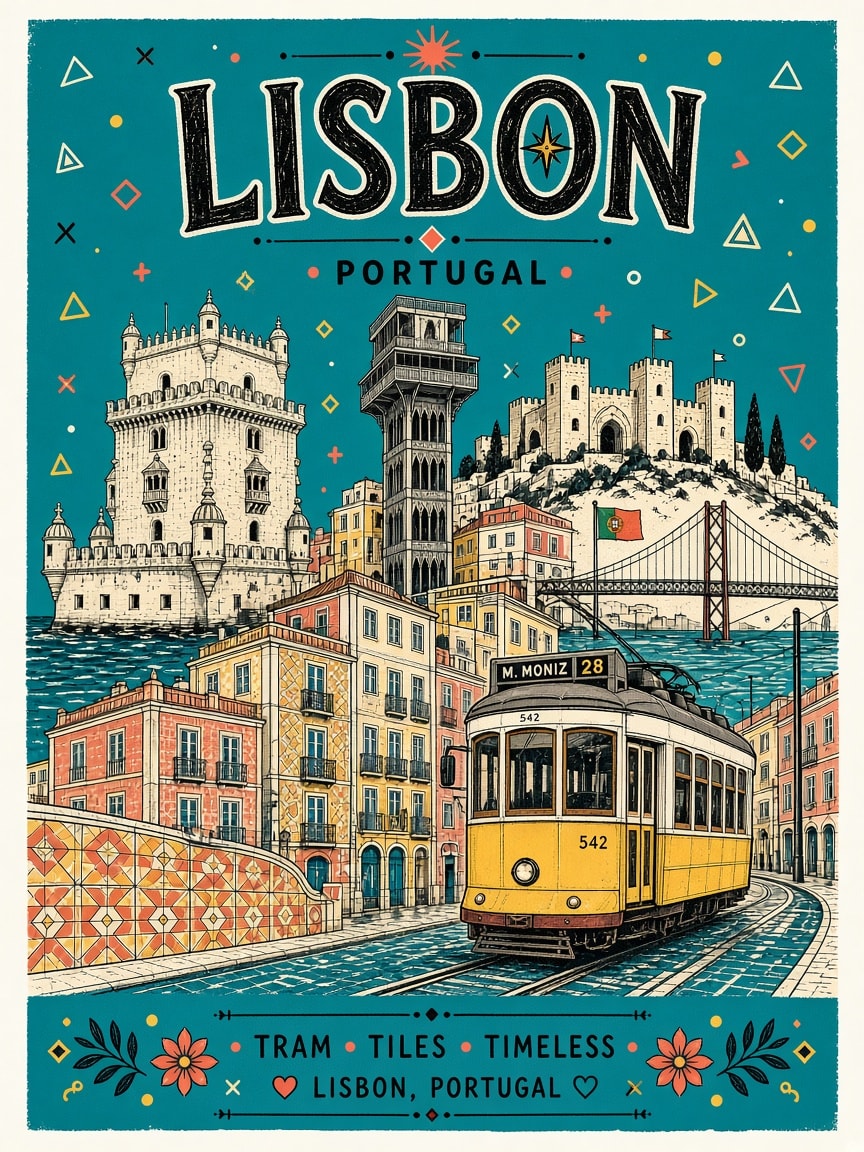
Turn any city into a vintage-inspired souvenir travel poster in a hand-drawn architectural doodle style, with bold ink outlines, its iconic landmarks, a local vehicle in the foreground and the city name in hand-lettered type. Just set the city variable.
INTERNATIONAL CITY TRAVEL ART PRINT COLLECTION

Create a charming, vintage-inspired travel poster featuring Lisbon, Portugal, illustrated in a distinctive hand-drawn architectural doodle style.

Showcase the city's most iconic landmarks, buildings, monuments, towers, bridges, and recognizable architectural details, arranged together in a dense yet balanced artistic composition. Incorporate a recognizable local element, such as a vintage car, tram, taxi, bicycle, or public transport, in the foreground.

Use bold black ink outlines, intricate hand-drawn details, playful geometric patterns, and slightly imperfect sketch-like textures. Add the city name prominently within the illustration using creative hand-lettered typography.

Present the artwork inside a clean white poster border, surrounded by a vibrant solid-color background that complements the city's identity. Use a limited palette of black, warm white, and one or two bold accent colors.

Overall aesthetic: Minimalist European travel illustration, retro souvenir poster, whimsical architectural line art, screen-print texture, playful composition, and premium collectible wall-art design.

Keep the artwork visually cohesive, highly detailed, charming, and instantly recognizable as a celebration of the destination. Avoid photorealism, 3D effects, gradients, and unnecessary decorative elements.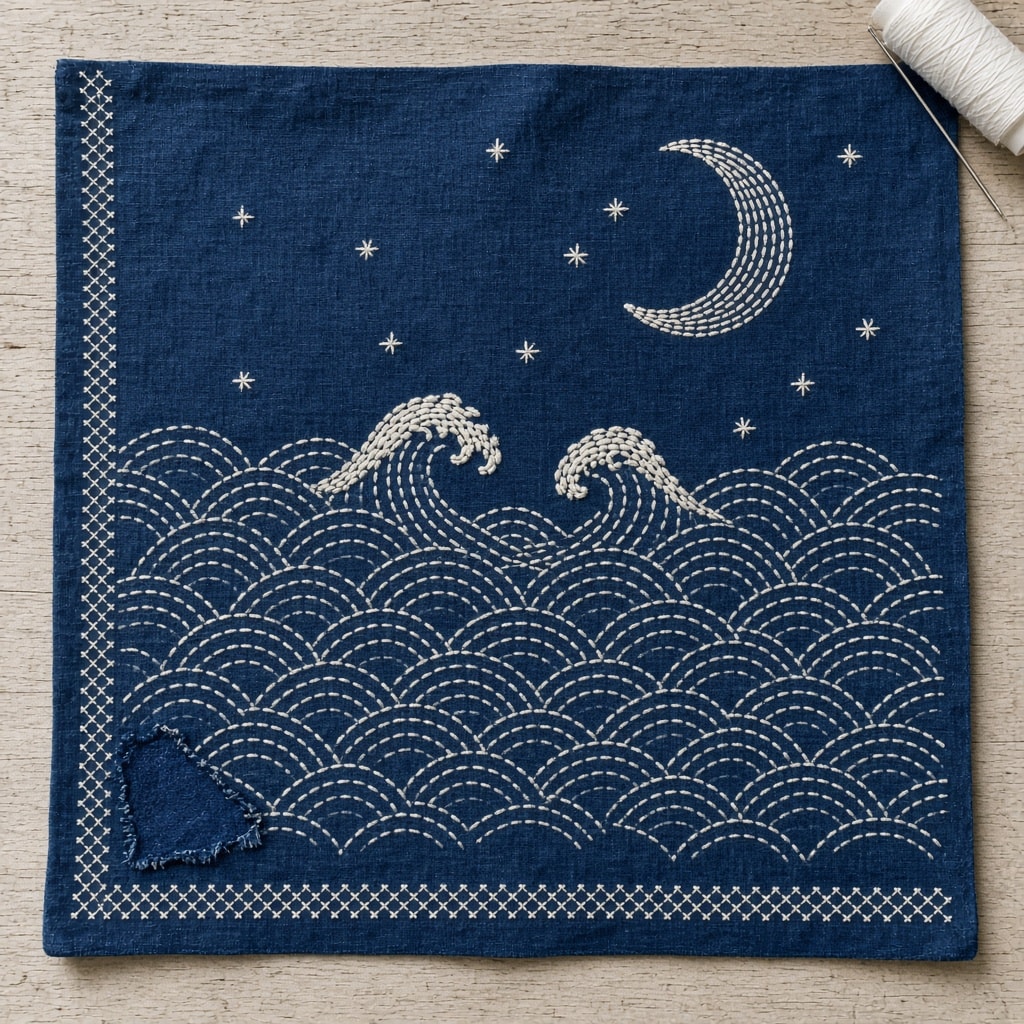
A flat-lay photo of hand-stitched sashiko embroidery on faded indigo cotton: rows of fan-shaped waves and curling crests under a crescent moon and tiny stars, all in raised off-white running stitches, with a grid-stitch border, a small boro patch, a thread spool and a needle.
A flat-lay photograph of a square panel of hand-stitched Japanese-style sashiko embroidery: deep indigo-dyed cotton cloth covered in running stitches of thick, slightly matte off-white cotton thread that form a picture of rolling ocean waves under a crescent moon. The lower two thirds show overlapping rows of seigaiha-style fan waves, each wave made of four or five concentric arcs of evenly spaced stitches, with a few larger curling wave crests stitched in tighter lines near the center. In the upper right, a thin crescent moon is filled with dense parallel stitching, and a scattering of tiny cross-stitched stars is spread across the dark sky, which is otherwise left as plain cloth so the indigo shows. A narrow border of hitomezashi grid stitching frames the whole panel.

Render it exactly like real handwork: each stitch is a short raised dash with small gaps where the needle went under the cloth, stitches slightly irregular in length, a few thread ends tucked in, soft puckering where curves turn, the indigo slightly faded and uneven like hand-dyed cloth, with a faint woven texture and one small darker indigo patch sewn on in the lower left corner in the boro mending tradition. The cloth lies on a pale unfinished wooden table; a small spool of white thread and a long sashiko needle lie at the edge of the frame. Soft, even daylight from above, very shallow shadows, true-to-life color. No text, no people, no hands. Square 1:1.
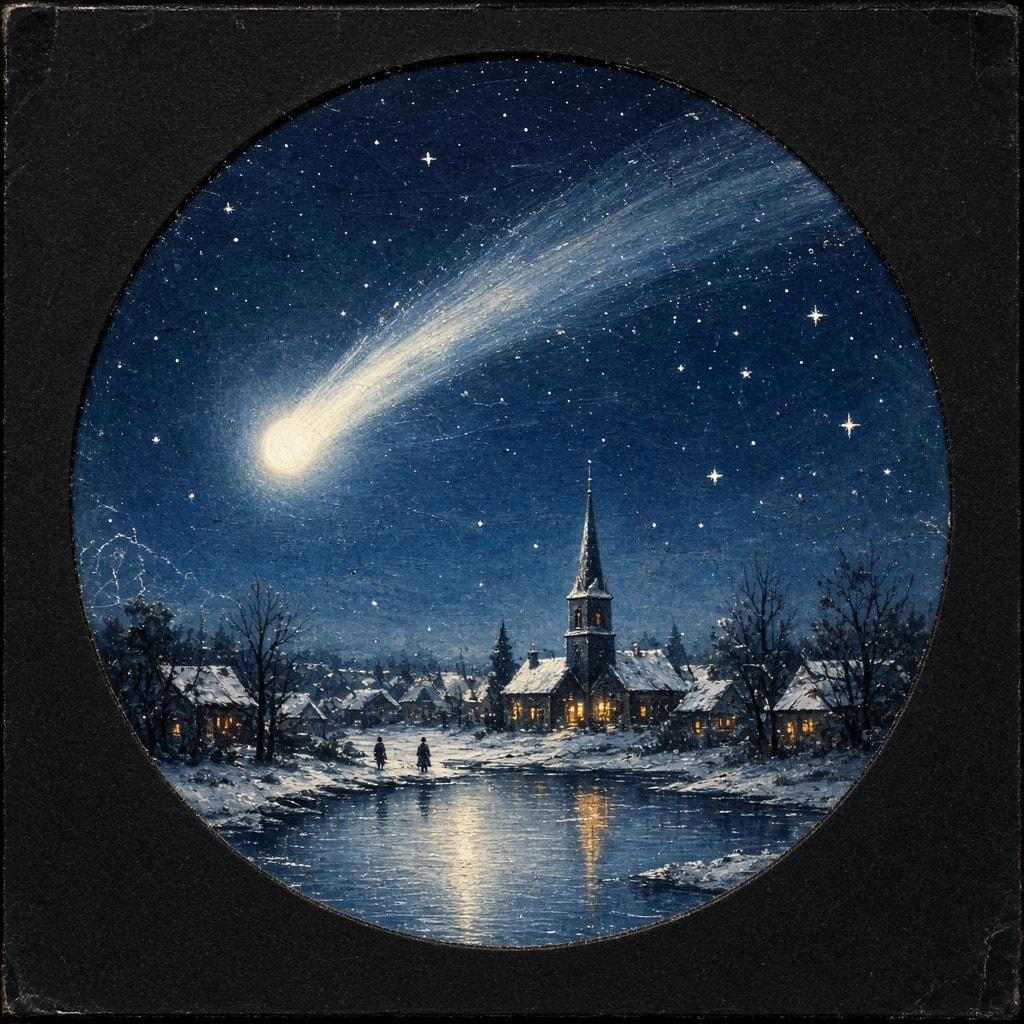
A glowing hand-painted Victorian magic lantern glass slide: a great comet with a long sweeping tail over a snowy village with a church spire, amber windows and a frozen pond, in translucent Prussian blue and amber washes inside a round black mask, with bubbles, dust and hairline scratches.
A hand-colored Victorian magic lantern glass slide showing a great comet over a snowy village at night, photographed straight-on against a soft backlight so the glass glows. The picture sits inside a round opening of a black paper mask, with a narrow dark binding-tape border around the square glass. Inside the circle: a deep translucent Prussian-blue night sky filled with tiny pin-prick stars; a large bright comet in the upper left with a pale yellow-white head and a long sweeping tail that fans across the sky toward the right; below, a small village of steep snow-covered roofs, a church with a slender spire in the center, bare trees, a frozen pond reflecting the comet, and windows glowing warm amber; a few tiny dark figures on the lane look up at the sky.

Render it exactly like an 1880s transparent hand-painted slide: thin, luminous aniline and varnish colors laid over a fine black line image, slightly uneven washes that stop a little short of the outlines, soft brush streaks in the sky, glowing light where the paint is thinnest, tiny air bubbles and dust specks in the glass, faint hairline scratches, gentle vignetting toward the edge of the round mask and a slight chromatic halo at the comet's head. Warm, glowing, nostalgic and magical. No text, no labels, no modern objects. Square 1:1.
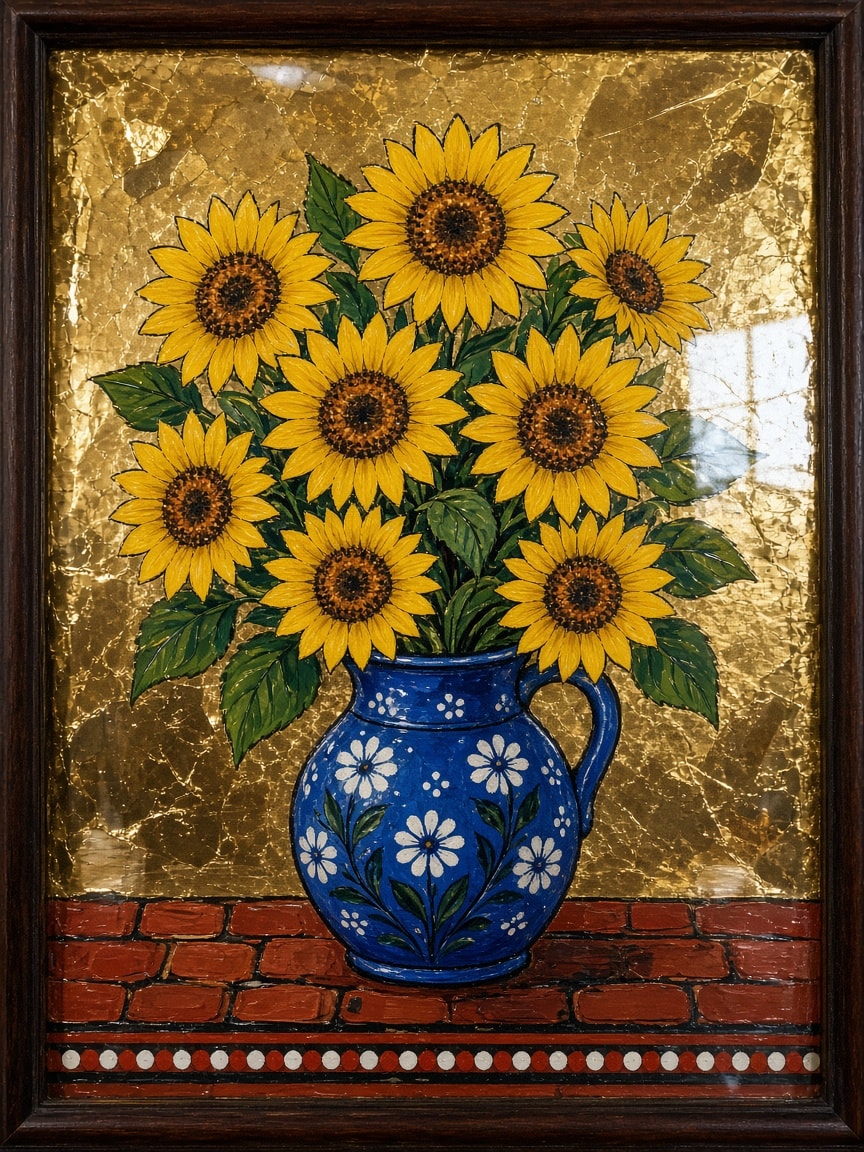
A naive Hinterglasmalerei reverse glass painting: nine chrome-yellow sunflowers in a cobalt-blue jug painted with white daisies, bold black outlines and flat colors behind glossy old glass, a crinkled gold-leaf background, a red-and-white dot border and a dark wooden frame.
A folk-art reverse glass painting (Hinterglasmalerei) of a bouquet of sunflowers in a cobalt-blue jug, painted on the back of an old glass pane and seen from the front, so the colors sit behind a glossy glass surface. Vertical 3:4 composition.

Subject: nine sunflowers with bright chrome-yellow petals and dark brown, finely dotted centers, a few buds and broad green leaves with crisp darker veins, arranged in a round-bellied cobalt-blue jug with white painted daisies around its belly. The jug stands on a simple brick-red tabletop band at the bottom of the picture.

Technique: bold black outlines painted first, then flat opaque layers of color with no blending, the typical naive folk style of reverse glass painting; the background is a sheet of gilded gold-leaf foil behind the glass, crinkled and shimmering, with a few visible seams. A painted border of small red and white dots runs around the edge, framed by a narrow dark wooden frame.

Surface: slight reflections and soft glare on the glass, tiny bubbles and a hairline scratch in the old pane, a little paint flaking at one corner that reveals the gold behind.

Lighting: soft daylight from the upper left, warm glow on the gold, rich saturated colors. No people, no text.
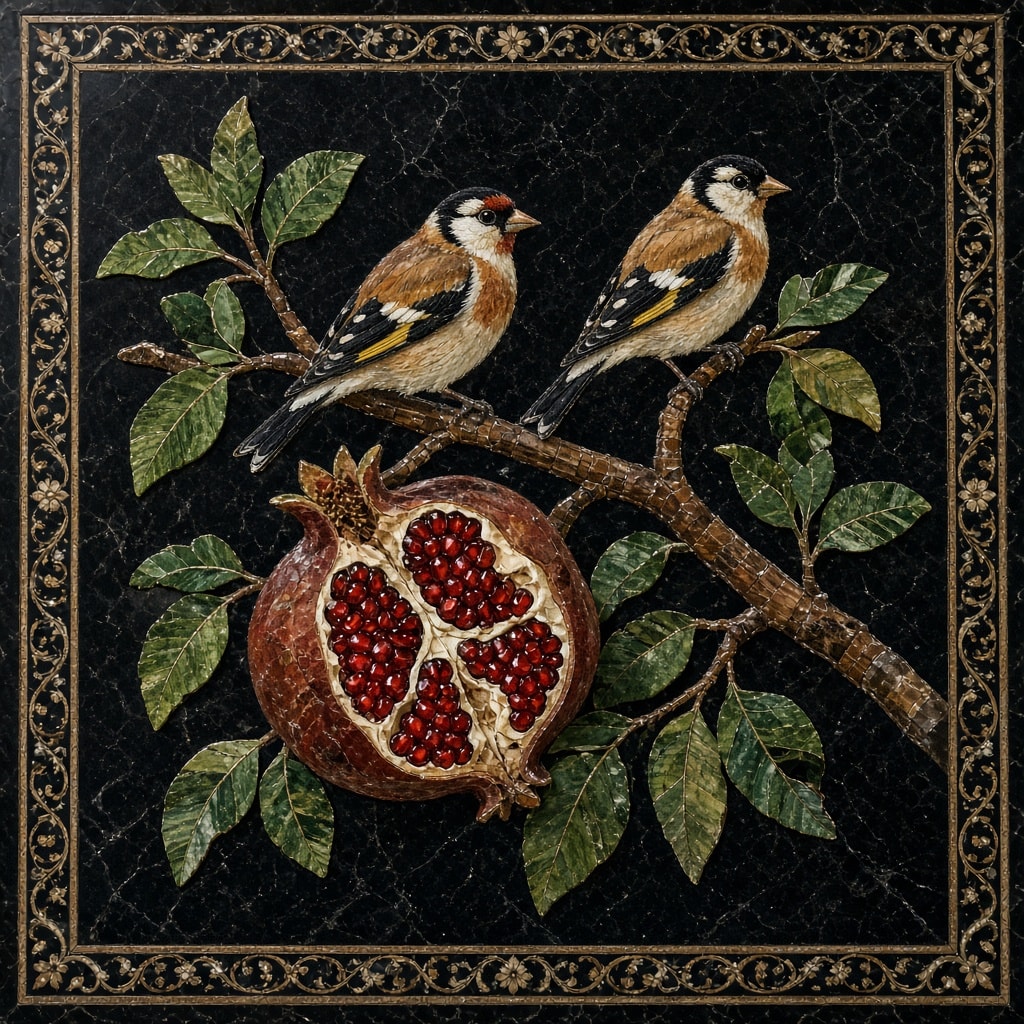
Top-down view of a 17th-century-style Florentine pietra dura panel: two goldfinches on a stone branch above a split pomegranate with glossy red seeds and veined green leaves, all in fitted hardstone pieces on veined black marble, framed by a gold-toned scrolling vine border.
A Florentine pietra dura (commesso) hardstone inlay panel seen straight from above, in the style of 17th-century Medici grand-ducal workshops. The ground is deep black marble crossed by fine white and grey veins. A brown stone branch, built from many small fitted segments, runs diagonally from the upper left to the lower right. Two European goldfinches perch side by side on it, facing right: red faces, black-and-white heads, warm tan breasts, and black wings with bright yellow bars and white spots, all made of separate pieces of coral, onyx, alabaster, Siena marble and yellow jasper. Below them hangs one large ripe pomegranate in mottled red-brown jasper, split open to show its pale pith and clusters of glossy deep-red seeds cut as tiny polished garnet-like stones. Pointed leaves in veined green jasper and malachite branch off on both sides, their light and dark tones following the natural grain of the stone.

Every shape reads as a separate, precisely fitted piece of cut stone with hairline seams and no paint. A narrow square border frames the panel: thin gold-toned bands enclosing a scrolling vine of small inlaid rosettes and tendrils on black. Soft, even museum lighting, rich saturated stone colors, crisp detail. No text, no signature. Square 1:1.
Learning new course
Learning branding and building a firm that deals with branding
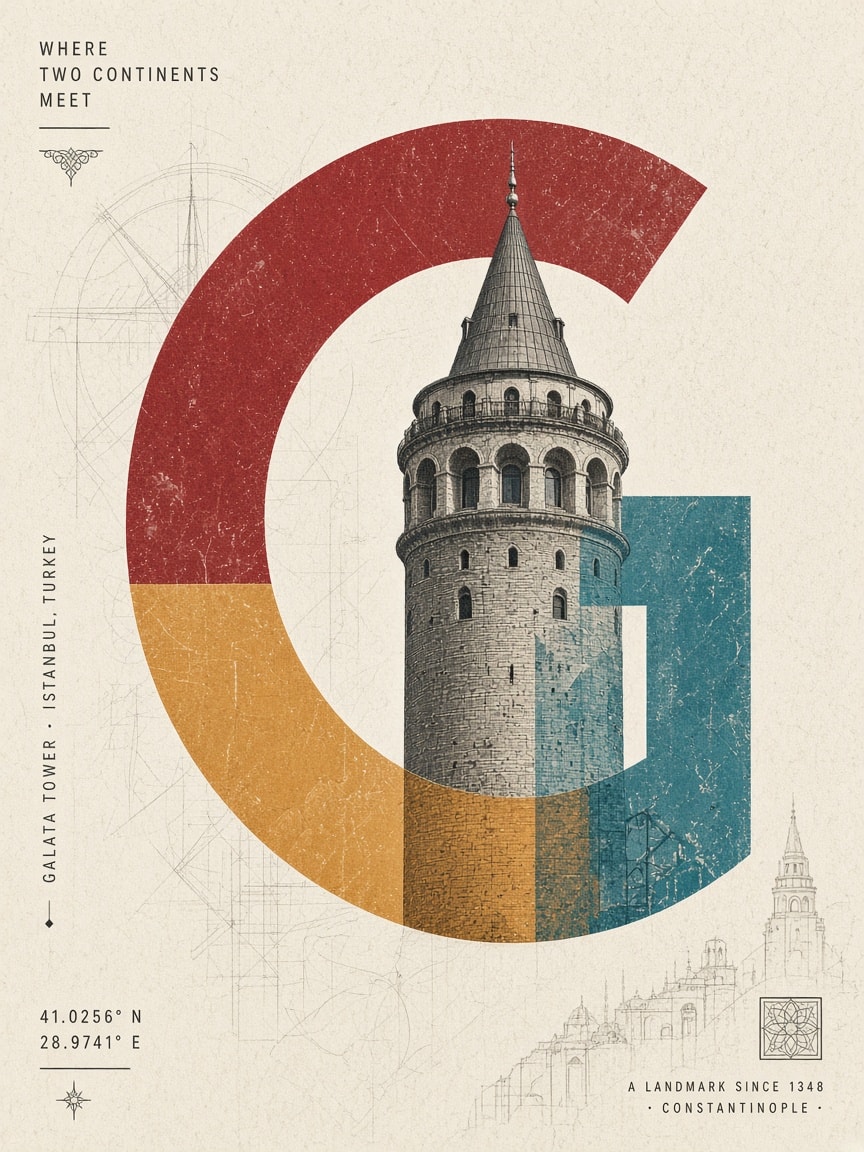
A reusable template for collectible architectural art prints: fill in [LANDMARK NAME], [CITY] and [COUNTRY] and the model builds one enormous uppercase letter from the destination's name, fuses the landmark into it as a double exposure, colours it with a palette drawn from the place's culture, and finishes it with editorial Swiss-style typography, coordinates and a tagline on textured ivory paper.
Create an exceptionally sophisticated, contemporary architectural art poster featuring [LANDMARK NAME], [CITY], [COUNTRY].

1. GIANT TYPOGRAPHIC COMPOSITION

Feature one enormous, oversized uppercase letter associated with the destination name as the central graphic element.

The letter should dominate the composition, extending almost across the entire poster.

Use bold, elegant, geometric typography with distinctive curves and negative spaces.

2. LANDMARK INTEGRATION

Seamlessly integrate a highly detailed architectural photograph or realistic architectural illustration of [LANDMARK NAME] into and across the oversized letter.

The landmark should appear to emerge from the typography, partially overlap its boundaries and interact naturally with its shape.

Preserve the landmark’s authentic architectural details, proportions and recognisable silhouette.

Create an artistic double-exposure effect where the architecture and typography become one unified visual composition.

3. DISTINCTIVE COLOUR TREATMENT

Choose a unique colour palette inspired by the destination’s cultural identity, national colours and architectural character.

Use two or three contrasting colours within the oversized typography.

Apply translucent colour overlays across selected sections of the landmark, creating a beautiful combination of architectural photography, coloured light and graphic shapes.

Every new destination must receive a different colour combination. Never repeat palettes.

4. TEXTURE & BACKGROUND

Use a warm ivory, soft white or subtle textured paper background.

Introduce delicate architectural sketch marks, distressed ink textures, faded photographic grain and subtle print imperfections around the central composition.

Keep the surrounding space clean and uncluttered.

5. EDITORIAL TYPOGRAPHY

Include the following information:

[LANDMARK NAME]

[CITY NAME]

[COUNTRY NAME]

Add small vertical typography along one side, geographical coordinates and a subtle destination-inspired tagline.

Use sophisticated editorial typography with carefully balanced spacing.

6. ART DIRECTION

Luxury architectural editorial design, experimental typography, architectural double exposure, contemporary Swiss graphic design, oversized letterforms, cinematic monochromatic photography, translucent colour blocking and minimalist gallery poster aesthetics.

7. FINAL PRESENTATION

Create a visually striking, intellectual and artistic collectible landmark poster.

The architecture must remain recognisable while becoming an integral part of the oversized letter.

Vertical 4:5 composition, premium art-print quality, exceptional visual balance and sophisticated negative space.

Avoid ordinary travel-poster layouts, decorative clutter, excessive colours and generic typography.
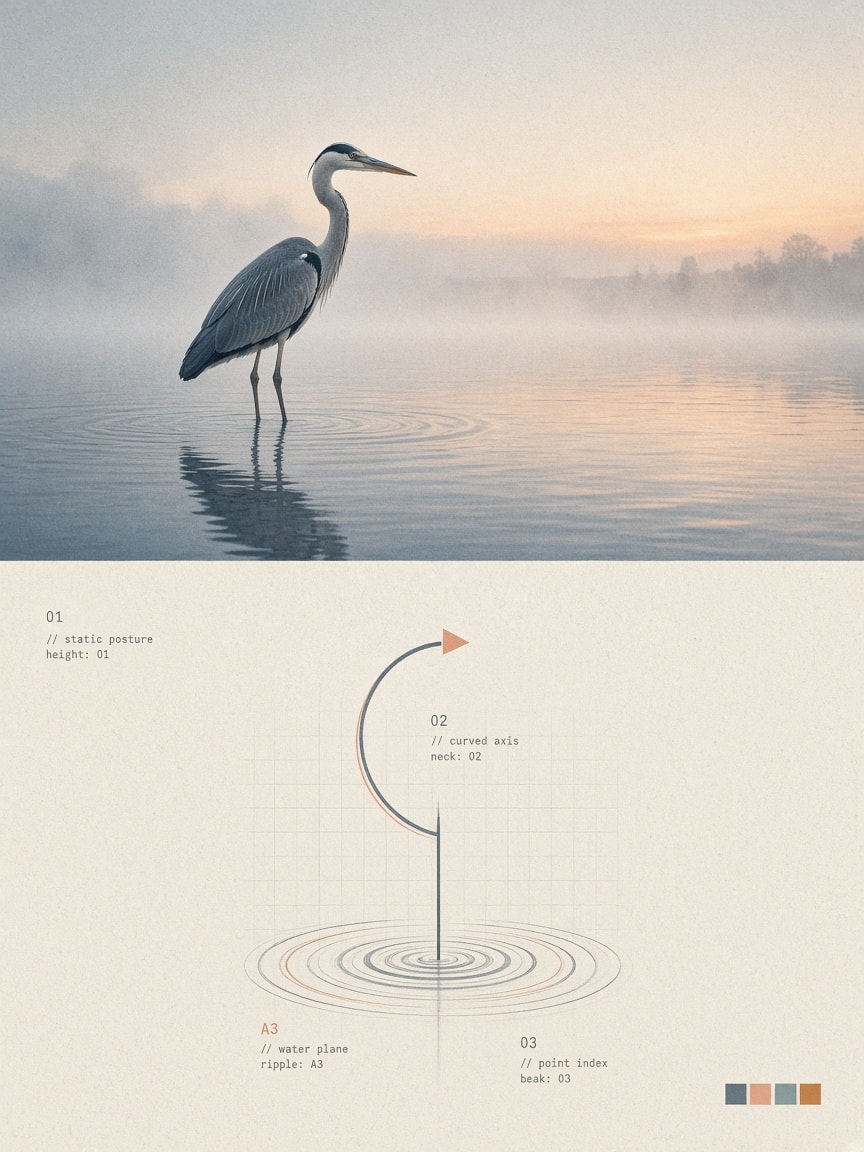
Upload any photo and turn it into a premium 3:4 design poster: the top half keeps the original as fine-art editorial photography, the bottom half distills the subject's silhouette and posture into a minimal abstract symbol in a deconstructed Swiss, generative design language with grids, micro-annotations, a color system pulled from the photo, and risograph/xerox print texture. Works with any image model that accepts a reference photo.
Transform my uploaded photo into a standalone, premium-quality 3:4 vertical design poster. Divide the entire canvas into two perfectly equal horizontal sections: the top half (50%) and the bottom half (50%). The upper section should feature realistic photography, while the lower section should present an abstract visual symbol derived from the core identity of the subject.

TOP HALF – REALISTIC PHOTOGRAPHY

Preserve the original subject's structure, realistic textures, natural lighting, shadows, and original color atmosphere. Apply only subtle, sophisticated color grading to achieve the aesthetic of fine-art photography and independent editorial publications.

The background may be naturally extended to fit the canvas, but never stretch, distort, or alter the original subject.

BOTTOM HALF – ABSTRACT VISUAL IDENTITY

Extract the photograph's essential visual characteristics: the subject's silhouette, structure, posture, and narrative relationships. Do not recreate the entire object. Instead, reduce it into a recognizable abstract visual symbol.

Use geometric deconstruction, modular shapes, structured lines, negative space, and symbolic elements to create a central visual identity inspired by premium branding and experimental design systems.

Focus on the subject's core character rather than minor details. Even with minimal geometric elements, the abstract symbol must remain visually connected to the original photograph.

VISUAL STYLE & DESIGN LANGUAGE

Post-digital graphic design, deconstructed Swiss design, generative symbol systems, and diagrammatic abstraction.

Build a systematic visual language using geometric modules, fine lines, circular trajectories, grids, micro-symbols, numerical indexing, and abstract nodes.

Create visual tension between:
- Order × Imperfection
- Precision × Handmade Traces
- Digital × Analog
- Rationality × Emotion

Achieve strong visual recognition using the fewest possible elements. Keep everything minimal and avoid unnecessary complexity.

COMPOSITION & LAYOUT

Maintain a highly restrained composition. The abstract symbol must be the sole visual focal point, positioned centrally or slightly off-center, surrounded by generous negative space.

Avoid excessive icons, decorative elements, or infographic-style layouts.

The overall aesthetic should resemble the core visual identity of contemporary art institutions, architectural studios, experimental creative labels, and premium design brands.

TYPOGRAPHY & DETAILS

Typography should function only as a supporting system component, never as a dominant headline.

You may incorporate extremely small numbers, letters, or short phrases that interact with the abstract symbol through indexing and reference relationships.

Use refined, restrained typography with the subtle annotation aesthetic of archival documents and experimental art publications.

COLOR SYSTEM

Extract the signature colors from the original photograph and reinterpret them as a cohesive brand color system.

Introduce a small number of distinctive accent colors as functional visual codes, such as teal, blue, magenta, or orange, combined with gray-white or warm-white backgrounds for contrast.

Colors should function as systematic identifiers rather than decoration.

Avoid chaotic color combinations, cheap neon effects, and generic commercial gradients.

PRINT TEXTURE & MATERIALITY

Incorporate subtle material effects inspired by:
- Xerox texture
- Risograph grain
- Print registration errors
- Scanner noise
- Subtle paper texture

Add delicate printing misalignment, fine grain, scanning noise, and slightly imperfect edges to give the digital symbols the tactile quality of physical print.

FINAL OBJECTIVE

Extract an independent and self-contained visual DNA from the original photograph.

The final result should feel like a sophisticated, minimal, culturally meaningful abstract logo with a strong visual identity and systematic design language.
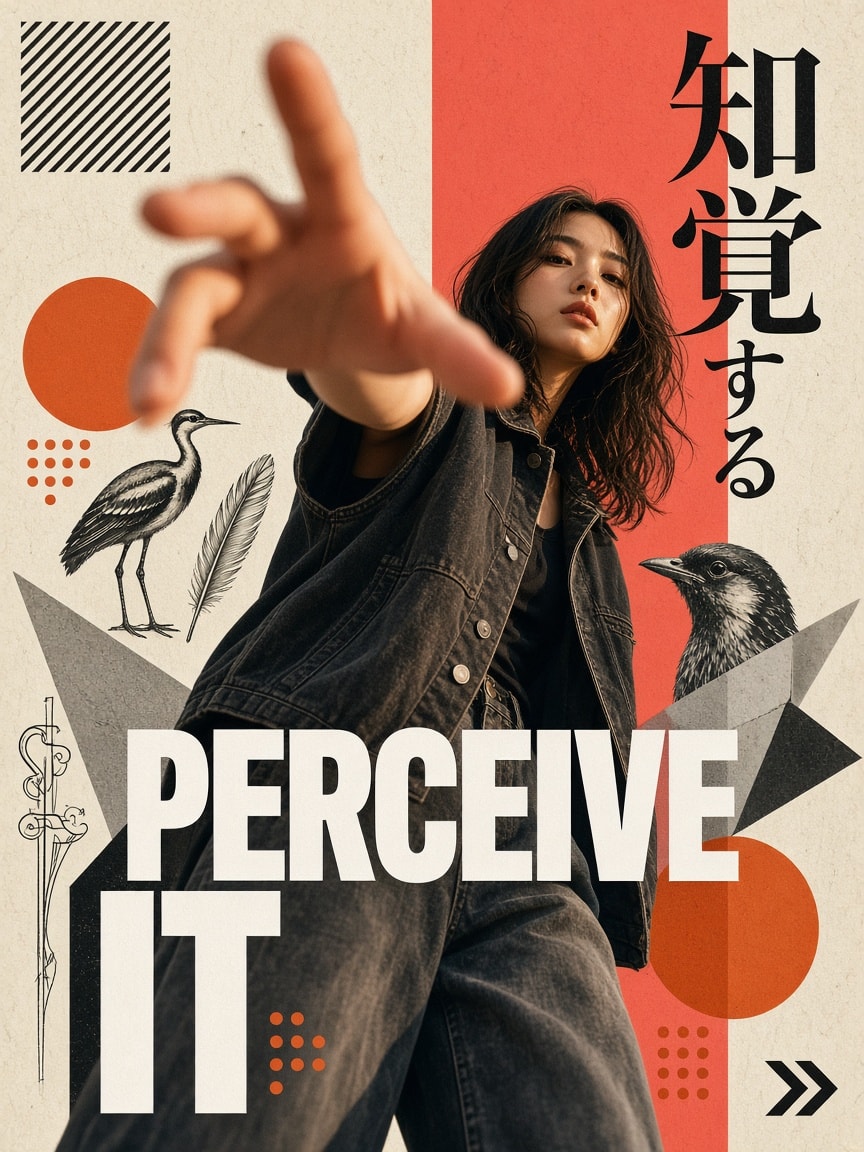
A detailed art-direction prompt for an avant-garde Japanese magazine poster in 2:3. A model in charcoal denim reaches toward a 24mm lens with extreme forced perspective, set on ivory paper with a coral-red panel, burnt-orange circles, vintage bird illustrations and paper cutouts. It specifies Japanese calligraphy, bold outlined "PERCEIVE IT." lettering, exact hex colours, warm side light, film grain and a negative space. Change the words, palette or subject to make your own poster.
Create a high-end experimental Japanese editorial fashion poster with a contemporary avant-garde graphic design aesthetic, vertical 2:3 composition.

MAIN SUBJECT & POSE:
A young East Asian woman with shoulder-length, naturally wavy, slightly messy dark brown-black hair, wearing a dark charcoal oversized sleeveless denim vest over a black top and loose-fitting washed charcoal-grey denim jeans. She has delicate facial features, a calm yet confident expression, slightly parted lips, and a direct gaze toward the camera. Her body is positioned at a slight angle, with her upper body leaning forward. One arm is dramatically extended directly toward the camera, with her hand reaching into the foreground. Use extreme forced perspective and exaggerated foreshortening, making the hand appear significantly larger than her face and body. Fingers are naturally spread and softly blurred due to shallow depth of field. The subject should feel dynamic, mysterious, artistic, and editorial.
POSE & CAMERA:
Low-angle fashion photography, close-up perspective, wide-angle lens aesthetic, approximately 24mm lens. The subject occupies most of the central frame. Her face remains relatively sharp while the outstretched hand dominates the foreground with strong perspective distortion. Natural body proportions, realistic skin texture, authentic photographic details.

BACKGROUND & COMPOSITION:
Warm ivory/off-white textured paper background with a subtle fine-grain printed canvas texture. Create an asymmetrical mixed-media collage composition with overlapping geometric shapes, abstract cutouts, vintage illustrations, and monochromatic photographic fragments.
Place a tall, vivid coral-red rectangular panel vertically behind the subject, slightly right of center, extending from near the top edge to the bottom edge. The rectangle partially overlaps the subject and creates a strong vertical visual division.

Add large burnt-orange circular shapes on the left-middle and bottom-right portions of the composition. Include smaller orange circular dots around these shapes.
Incorporate black-and-white vintage bird photographs and hand-drawn ornithological illustrations, partially cropped and layered behind the subject. Include abstract sketchbook-style bird drawings, feather details, and fragmented photographic elements. Add overlapping black and grey geometric paper cutouts, irregular triangular shapes, and diagonal collage fragments.

TYPOGRAPHY & JAPANESE DESIGN ELEMENTS:
At the upper-right area, incorporate large Japanese typography reading "知覚する" (Perceive). The first two Japanese characters, "知覚", should sit prominently over the coral-red rectangular panel in dark black calligraphic serif typography. The remaining characters, "する", extend toward the upper-right over the ivory background.

Across the lower-middle section, overlay bold uppercase white sans-serif typography reading:

"PERCEIVE"

Use a heavy condensed modern grotesk font, with selected letters featuring a thin outlined treatment to create a layered typographic effect.
Below it, aligned toward the left, place the word:

"IT."

Use oversized white uppercase typography with a partially outlined letter treatment.

Add small abstract decorative details, including a black diagonal striped square in the upper-left corner, tiny ornamental line drawings, geometric symbols, and a small black double-arrow symbol in the bottom-right corner.

COLOR PALETTE:

Warm ivory: #F1EEE5

Vivid coral red: #EF5558

Burnt orange: #E98A16

Charcoal black: #252323
Washed denim grey: #666665
Pure white: #FFFFFF
Maintain a strong contrast between warm orange and coral-red accents, monochromatic photography, and the neutral paper background.
LIGHTING & PHOTOGRAPHIC TREATMENT:
Warm directional sunlight hitting the woman's face and hand from the left side, creating rich amber highlights and deep cinematic shadows. Subtle film grain, slightly desaturated editorial photography, realistic skin tones, soft motion blur in the foreground, and high-contrast photographic details.
ART DIRECTION:
Japanese contemporary editorial magazine design meets avant-garde streetwear fashion photography. Experimental Swiss-inspired typography, vintage natural-history illustration, modern brutalist graphic design, analogue paper collage, layered cut-and-paste artwork, and sophisticated fashion magazine art direction.
FINAL QUALITY:
Ultra-detailed photorealistic fashion photography combined with professionally designed graphic collage elements. Sophisticated visual hierarchy, intentional asymmetrical balance, crisp typography, tactile paper texture, intricate details, and premium art-direction quality.

Vertical 2:3 poster, full-bleed composition, no borders, no mockup, no watermark.

cartoon, anime, illustration-only subject, 3D character, plastic skin, artificial face, distorted facial features, extra fingers, missing fingers, malformed hands, duplicate arms, unnatural anatomy, flat perspective, weak foreshortening, excessive background clutter, symmetrical composition, neon colors, oversaturated skin, glossy digital background, low resolution, blurry face, unreadable typography, random letters, misspelled Japanese characters, incorrect text placement, watermark, logo, poster mockup, frame, border.
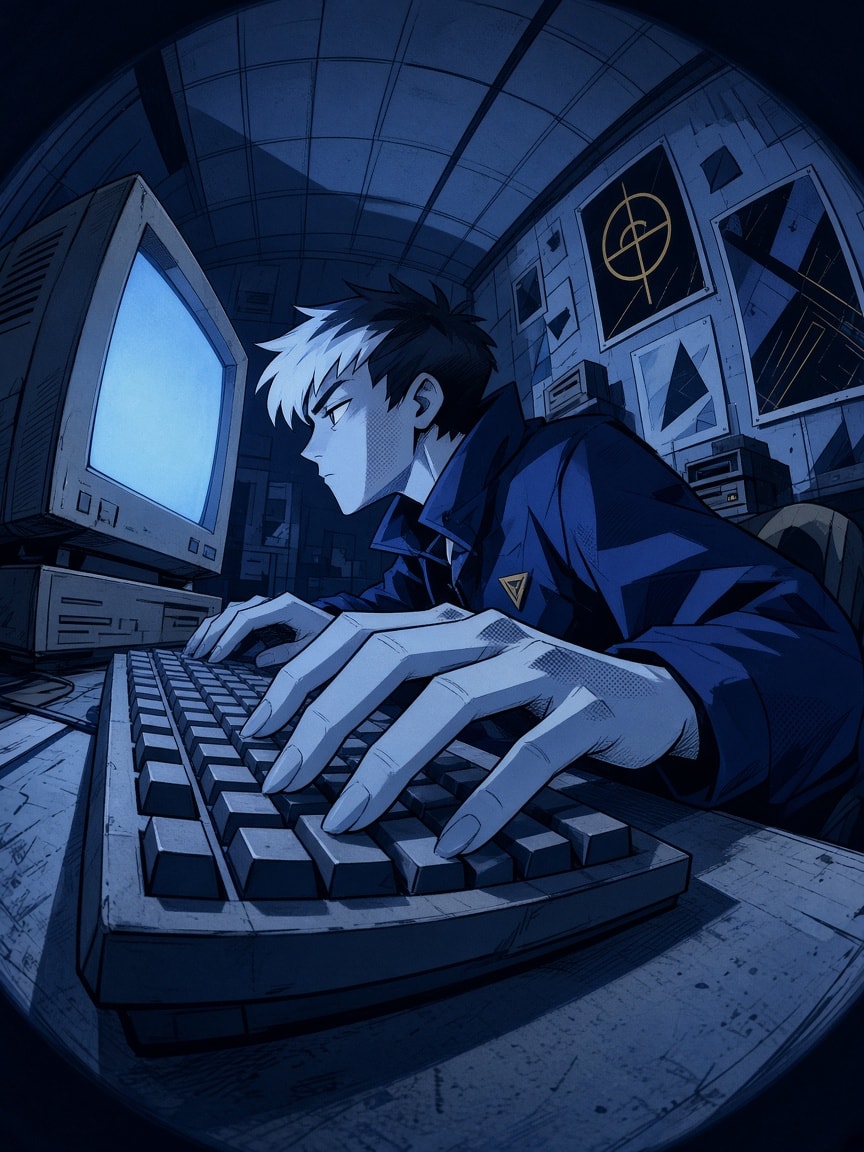
A long, precise style prompt for a stylized Western 2D animation frame: a young hacker typing at a chunky CRT computer in a cramped retro room, seen from desk level through an extreme fisheye with oversized hands in the foreground. It locks thin navy ink lines, flat two-tone cel shading, angular shadow blocks, light pencil hatching and dry brush, a strict cornflower-to-navy blue palette with tiny golden accents, and fine comic halftone dots only inside shadows. Swap the subject to reuse it.
Create a stylized 2D Western animated illustration of a mysterious young male hacker sitting at a vintage desktop computer in a cramped retro computer room. He has short black hair with a sharp white fringe, an angular pale face, a large expressive side-profile eye, an oversized dark jacket with geometric markings, and long slender fingers typing on a chunky mechanical keyboard. Extreme low-angle fisheye perspective from desk level, oversized hands dominating the foreground, bulky CRT monitor on the left, curved tiled ceiling, scattered wall posters, and strong architectural depth. Preserve the character's focused typing pose, distinctive facial expression, dramatic camera angle, and coherent spatial arrangement. Render in a sophisticated stylized Western 2D animation aesthetic with delicate hand-drawn comic illustration techniques and refined graphic character design. Thin, confident dark navy ink outlines with subtle organic irregularities, natural line-weight variation, expressive flowing contours, selectively broken edges, and precise facial linework. Simplified geometric anatomy, exaggerated but believable proportions, angular character construction, and distinctive silhouettes. Large uninterrupted flat color regions, clean two-tone cel shading, sharply defined angular shadow blocks, simplified geometric highlights, minimal gradients, and carefully balanced graphic shapes. Subtle short pencil hatching, restrained dry-brush marks along selected edges, imperfect freehand contours, and crisp matte color fills. Sophisticated 2D animation keyframe aesthetics, cinematic spatial perspective, bold editorial illustration composition, expressive character acting, and elegant visual simplicity. Strictly use a cohesive cool blue color palette of cornflower blue, dusty cobalt, slate blue, muted periwinkle, powder blue, pale icy cyan, and deep navy, complemented by tiny muted golden-yellow accents. The ceiling and walls use layered desaturated blues, the CRT monitor displays a flat pale icy-blue screen, the character's clothing is deep navy with angular cobalt shadow planes, and the keyboard uses muted blue-gray tones. Soft cool blue ambient lighting unifies the entire composition, with small warm yellow details creating restrained visual contrast. Harmonious blue-on-blue color separation, strong tonal hierarchy, matte surfaces, and clean graphic lighting. Apply refined localized gradient halftone shading only within selected cel-shaded shadow regions, especially along the character's fingers, cheek shadows, jacket folds, and occasional architectural shadow boundaries. Use extremely fine, tightly arranged halftone microdots in colors matching the underlying shadows, gradually decreasing in size and opacity toward the illuminated areas. The halftone creates elegant soft tonal transitions within small, organically shaped shadow zones, naturally dissolving into clean flat colors. The pattern must be clearly recognizable as delicate traditional comic-print halftone shading at close inspection, never as large individual decorative circles. Keep all other surfaces perfectly clean and solid, without any global texture. Preserve strong cinematic depth through exaggerated fisheye perspective, overlapping graphic shapes, and precise architectural construction rather than realistic lighting gradients. High-end stylized animated film frame, expressive character silhouette, sophisticated handcrafted linework, refined flat-color shading, and cohesive visual design.
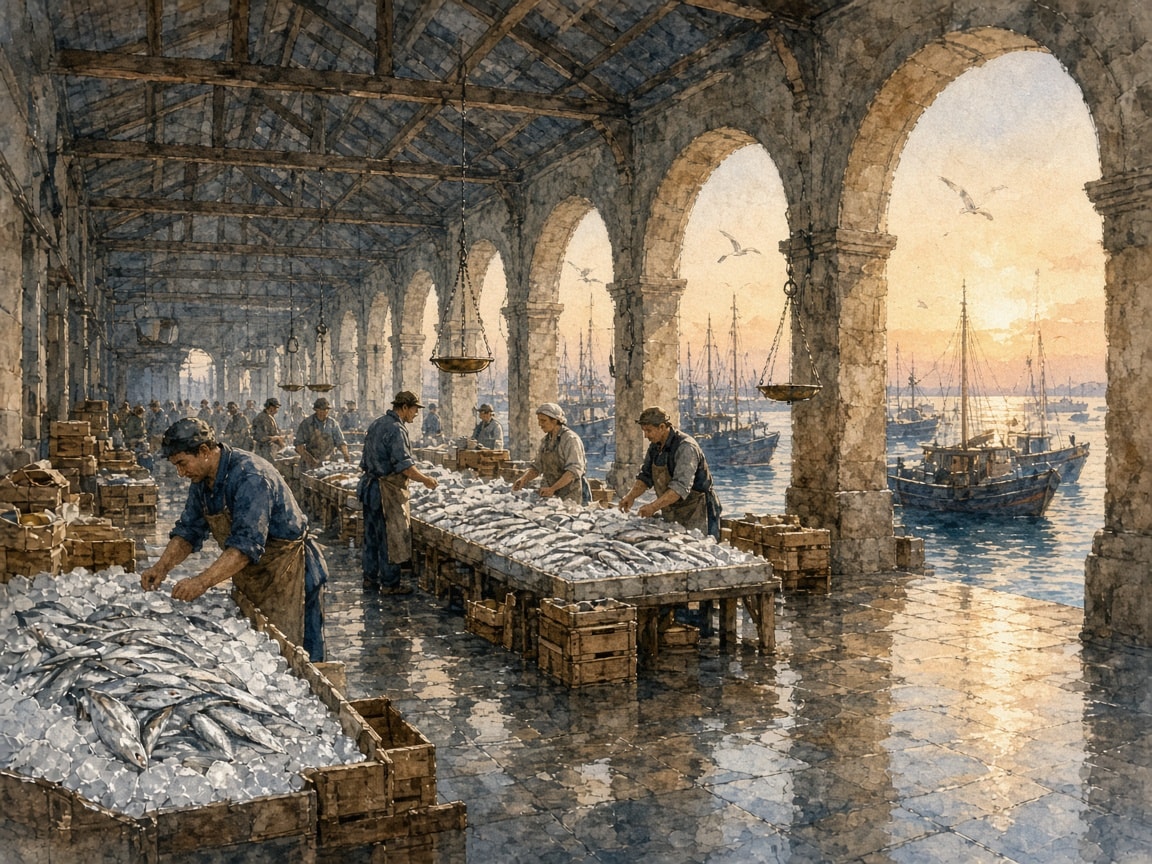
Watercolor cutaway of a busy open-air harbor fish market at dawn: stone pavilion with arches, wet reflective floor, fish on ice, hanging brass scales, warm sunrise through the arches over docked boats, soft brushy washes in blue-grey and gold.
A detailed watercolor cutaway of a busy open-air harbor fish market at dawn, landscape 4:3. A long stone pavilion with weathered Romanesque arches and a high timber-framed ceiling runs diagonally through the frame; the dark tiled floor is wet and reflective. Fishmongers in work shirts and aprons sort silver fish on crushed ice in wooden crates and along long tables; brass hanging scales dangle from the stone arches; empty crates stack nearby. Through the arches on the right, warm golden dawn light spreads over a calm harbor with docked fishing boats and a few seagulls in the pale sky. Soft watercolor washes, visible brush texture, cool blue-grey stone contrasted with warm sunrise gold, lively but orderly morning market mood. No readable signs, no logos, no watermarks, no brand names.
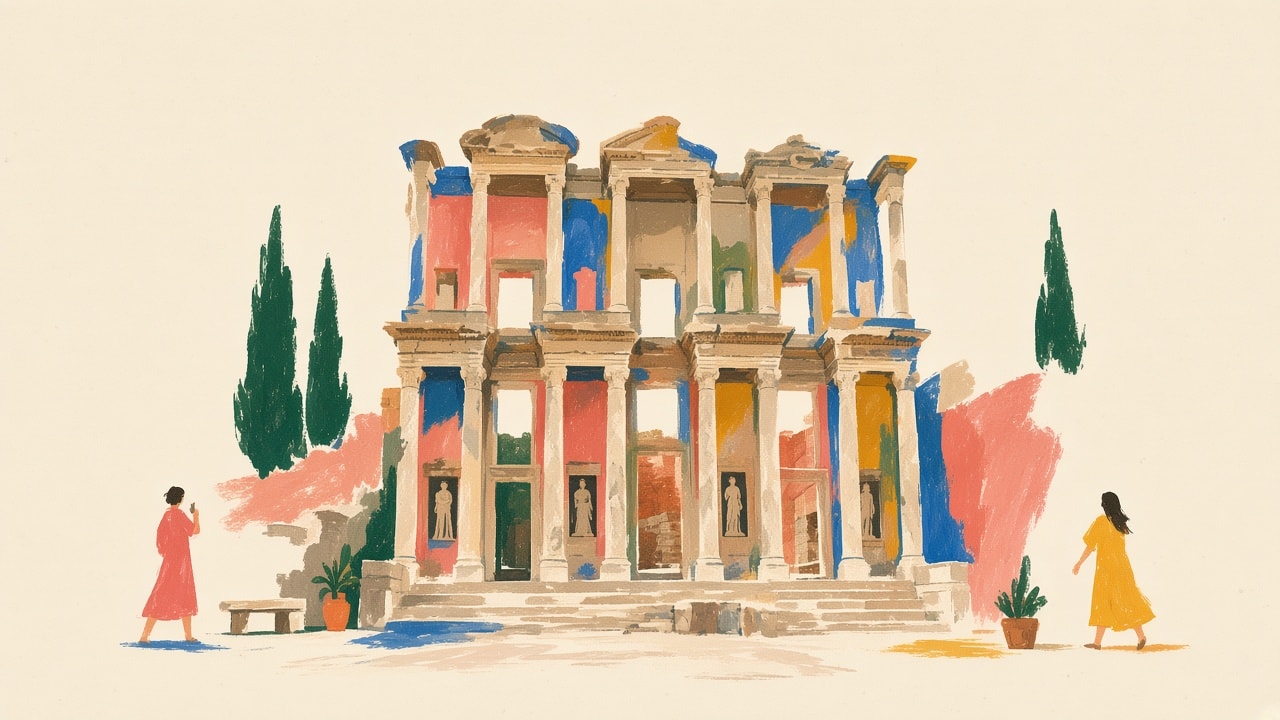
A reusable wide landscape template that turns any landmark into a quiet mid-century travel postcard: the destination sits slightly off-center in loose gouache and pastel marks on a warm cream paper field that fills 40–50% of the canvas. Tiny coral and mustard figures, one small contextual prop and a few natural accents keep the composition sparse and airy. Fill in the landmark, city, architectural features and a short activity for the figures.
A wide horizontal landscape hand-painted illustration of [LANDMARK NAME] in [CITY/COUNTRY] with strong emphasis on negative space and quiet composition.

The image features a warm off-white cream paper background that occupies 40-50% of the total canvas, creating generous blank margins and breathing room.

The [LANDMARK NAME] is positioned slightly off-center as a calm visual anchor, depicted through simplified [KEY ARCHITECTURAL FEATURES - e.g., "towering structures", "iconic silhouette", "distinctive archways"] with loose, expressive brush strokes. The landmark is suggested through minimal rhythmic marks and abstract color blocks in deep teal, cobalt blue, and forest green, rather than drawing every architectural detail precisely.

The composition is sparse and uncluttered: only a few carefully placed elements including 2-3 tiny human figures [DOING TYPICAL ACTIVITY - e.g., "walking", "taking photos", "sitting"] rendered as simple silhouettes in coral red and mustard yellow, one small [CONTEXTUAL ELEMENT - e.g., "cafe table", "bench", "street vendor cart"] with minimal shapes, two or three [NATURAL ELEMENTS - e.g., "potted plants", "trees", "flowers"] in emerald green, and subtle [CULTURAL/ARCHITECTURAL HINTS - e.g., "traditional roof lines", "modern glass panels", "historic columns"].

Large areas of the warm paper background remain completely untouched, especially around the edges and between elements.

The style combines mid-century travel poster aesthetics with contemporary [REGIONAL] editorial illustration: elegant, minimal, warm, cultured, and slightly nostalgic.

The texture shows loose hand-painted gouache and pastel marks with dry brush strokes, pastel smudges, wax-crayon edges, uneven color patches, imperfect handmade edges, and visible gaps between colored areas.

Colors are layered, dry, and tactile with a restrained palette of deep teal, sky blue, coral red, salmon pink, mustard yellow, ochre, terracotta, and small near-black accents, but used sparingly so each color can breathe against the paper.

The overall mood is quiet, spacious, relaxed, refined, like a sophisticated [CITY] cultural postcard or handmade art print suitable for premium lifestyle merchandise.

The landmark remains recognizable through its essential identity—[DEFINING CHARACTERISTICS]—but the drawing stays airy, calm, poetic, and softly abstract.

Strong sense of pause, breath, and refined emptiness with confident use of blank space.

No crowded composition, no full-bleed busy background, no photorealism, no glossy digital rendering, no clean vector art, no 3D rendering, no text, no signage, no logos, no readable text.
Turn a short idea into an image-ready and motion-ready brief for a hero shot of a turf-roofed Faroese village above a sea gorge at golden hour: dark wooden houses with grass roofs, one bright red house, a few white sheep, and a tall waterfall into a teal inlet. Covers the village, waterfall, light, fixed details, a motion map, and two prompt seeds: a 16:9 still and an image-to-video animation.
Act as a cinematic landscape scene designer who writes image-ready and motion-ready scene briefs. Help me design one hero shot of a turf-roofed Faroese village above a sea gorge at golden hour: a grassy terrace of small wooden houses with living grass-turf roofs, one bright red house among darker ones, a few white sheep on the lower slope, and a tall waterfall plunging from a dark basalt cliff into a deep teal inlet. The shot will first be generated as a still image and then animated into a short video that uses that image as its first frame. Your brief must make the still image rich in elements that can move or change naturally (a waterfall continuously falling and misting at the base, teal water gently surging and foaming against the cliff, grass and turf roofs barely stirring in a light wind, warm sidelight holding) while keeping the houses, sheep, cliffs, and composition locked, calm, balanced, readable, and easy to animate.

My starting idea: a quiet Faroese turf-roof village above a sea gorge at golden hour, with a tall waterfall on the right and warm light from the left

My starting choices:
- Place: a tiny Faroese coastal village on a grassy terrace above a narrow sea gorge, Atlantic beyond
- Houses: about ten small wooden houses with living grass-turf roofs on the LEFT-CENTER terrace; most black or very dark with white-framed multi-pane windows and chimneys; ONE bright red turf-roof house near the center of the cluster
- Sheep: a few white sheep grazing on the lower-left foreground grassy slope, below the houses
- Waterfall and water: a tall, prominent waterfall on the RIGHT plunging from a dark basalt cliff into a deep teal inlet with white foam at the cliff foot
- Light: golden sidelight from the LEFT raking across grass and roofs; Atlantic in the left distance paler under the sun
- Horizon: a dark distant headland silhouetted on the far left horizon; steep green-topped cliffs continuing into the background center-right
- Sky: pale gold near the sun on the left fading to clear blue on the right, light haze, a few high clouds
- Visual style: photoreal travel landscape photography, natural rich colors, wide 16:9
- Mood words: remote, golden, windswept, calm, timeless

First ask me, in one short message, for anything missing: camera height and angle (mid-slope looking across the terrace toward the gorge, slightly elevated overlook, or lower path looking up), how much of the frame the village versus the waterfall should take, how strong the golden sidelight should be, how prominent the waterfall mist should be, whether the video should use a very slow gentle drift or stay nearly locked off, where the move should end, and anything to avoid (people, cars, boats, modern antennas, readable signs, or copying one specific famous photograph).

Then produce the brief with these sections:

1. **Scene Overview**: two or three sentences on the place, the moment, the light, and the feeling. Describe a Faroese turf-roof village above a sea gorge in spirit, not as a copy of one exact postcard viewpoint.

2. **Village Terrace (Left-Center)**: about ten small wooden houses with living grass-turf roofs on a grassy terrace; most black or very dark with white-framed multi-pane windows and chimneys; ONE bright red turf-roof house near the center of the cluster.

3. **Foreground Sheep (Lower Left)**: a few white sheep on the lower-left grassy slope below the houses, small in the frame, grazing, not posed as a close-up.

4. **Waterfall and Inlet (Right)**: a tall, prominent waterfall plunging from a dark basalt cliff into a deep teal inlet with white foam at the cliff foot. The fall should read as a full curtain of water, not a thin trickle.

5. **Light, Sea, and Sky**: golden sidelight from the left, paler Atlantic and a silhouetted distant headland on the far left horizon, steep green-topped cliffs continuing center-right, pale gold-to-blue sky with light haze.

6. **Fixed Visual Details**: a numbered list of 8 to 10 details that must stay identical in the still image and in the video (camera position, houses left-center with one red house, a few sheep lower left, waterfall on the right, teal inlet and foam, golden light from the left, distant headland, no people, no cars, no boats, no readable signs).

7. **Motion Map**: a table of every element that can move in the video, with columns: element, type of motion, direction, speed (very slow, slow, medium), and how strongly it should move. Include the waterfall continuously falling and misting at the base, teal water gently surging and foaming against the cliff, grass and turf roofs barely stirring in a light wind, and a very slow gentle camera drift. Sheep stay put. Houses and cliffs stay locked. Keep total motion subtle and physically plausible.

8. **Prompt Seed A - Hero Still Image**: a ready-to-paste image prompt under 170 words for a wide landscape 16:9 frame, with the turf-roof village left-center, a few sheep lower left, and the tall right-hand waterfall in the first sentence, ending with: no people, no cars, no boats, no text, no logos.

9. **Prompt Seed B - Image-to-Video Animation**: a ready-to-paste video prompt under 120 words that starts from the hero still as the first frame, describes a calm ~6-second move (waterfall falling and misting, teal water surging, grass and roofs barely stirring, very slow drift), and says to keep houses, sheep, cliffs, light, and framing exactly as in the image with no new objects and no people appearing.

Rules: no people, cars, boats, modern antennas, readable text, logos, or brand marks; no fast camera moves or cuts; and no motion that breaks physics (houses, cliffs, and sheep never jump, vanish, or change count; only water, mist, light grass, and a very slow camera drift move softly). Use short paragraphs and lists.
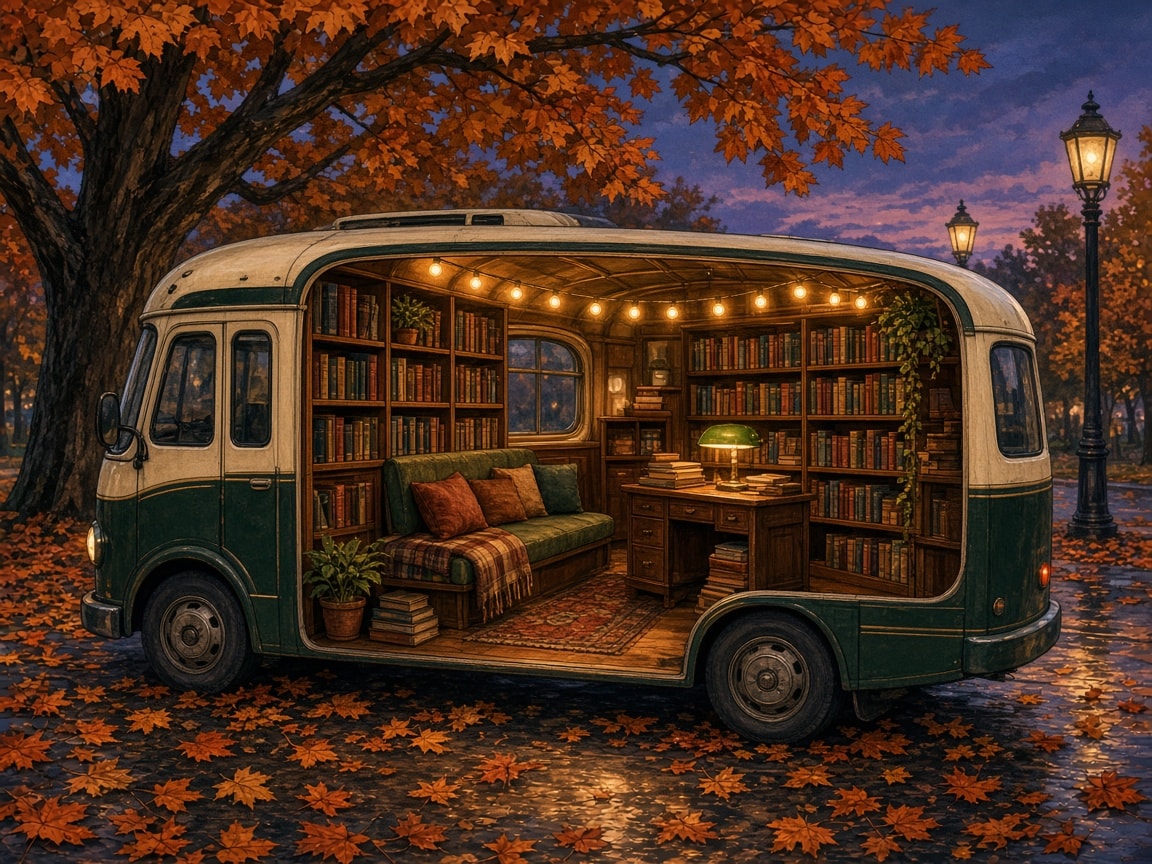
Storybook cutaway illustration of a vintage cream-and-dark-green mobile library bus under autumn trees at dusk: the near side is cut away to show a green sofa with a plaid throw, a wooden desk with a green banker's lamp, shelves of colorful books, and ceiling string lights, with a huge maple, wet leaf-covered pavement, and two glowing street lamps outside.
A storybook cutaway illustration of a vintage cream-and-dark-green mobile library bus parked under autumn trees at dusk, landscape 4:3. The bus faces LEFT; the near side is cut away to reveal a cozy interior: toward the front, a green cushioned sofa with pillows and a plaid throw, a rounded window behind it, and a potted plant on the floor; toward the rear-right, a wooden desk with a green banker's lamp, stacks of books, and wooden shelves packed with colorful books; warm string lights run along the ceiling, with more potted and hanging plants. Outside, a huge autumn maple fills the upper left, wet pavement is covered in orange fallen leaves, and two glowing street lamps stand on the right under a purple-blue dusk sky. Inviting, detailed cutaway style. No readable book titles, no logos, no people, no watermarks.
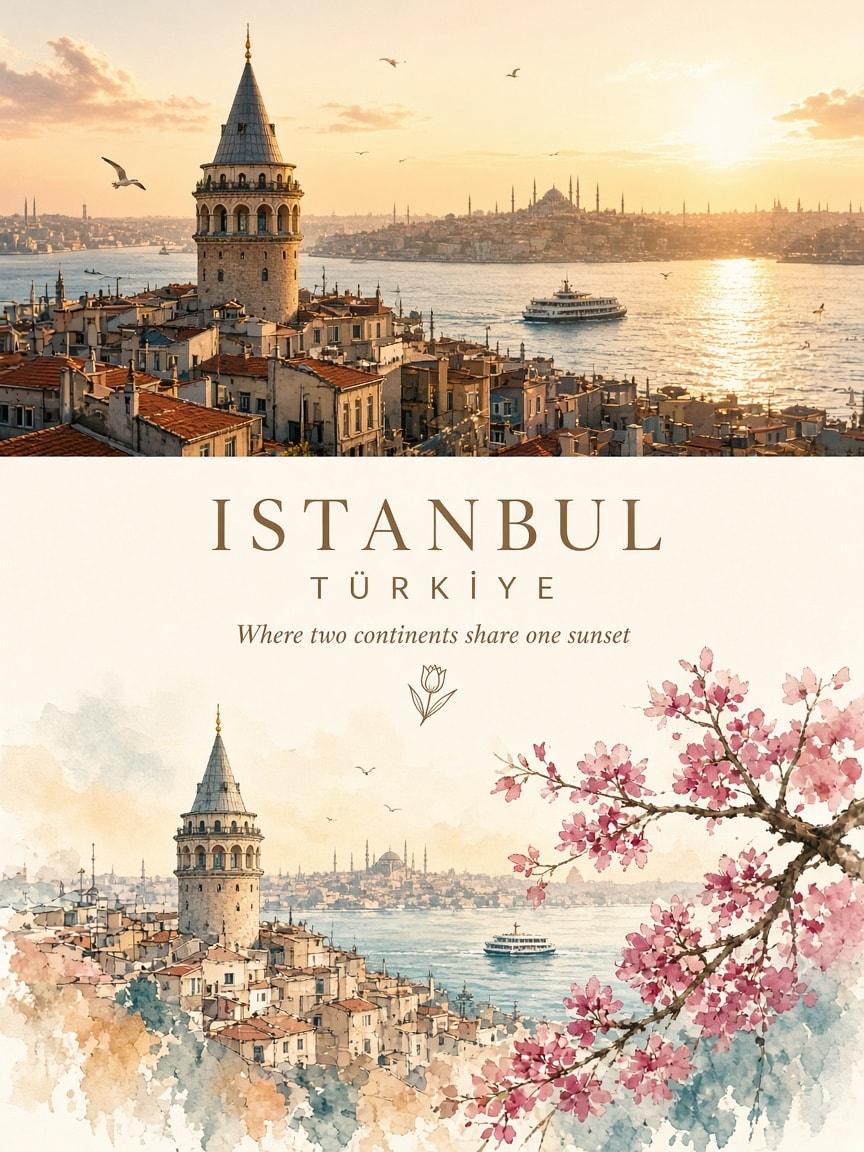
A reusable 4:5 travel-art poster template: the top half is a photorealistic photograph of any city, country or landmark, the middle is an elegant editorial strip with the destination name, country and a short poetic tagline, and the bottom half reimagines the same place as a minimalist watercolor-and-gouache illustration that fades into white paper. Just fill in the destination, country and tagline placeholders.
Create an exceptionally beautiful vertical 4:5 travel-art poster featuring [CITY / COUNTRY / LANDMARK], presented as a sophisticated two-part visual collage.

The composition must have two distinct but harmoniously connected sections.

TOP SECTION — THE REAL WORLD

Use the actual destination as the primary visual reference.

Create a breathtaking photorealistic travel photograph of [DESTINATION].
Preserve its recognizable architecture, landscape, landmarks and geographical identity.
Capture beautiful natural lighting, realistic colours and atmospheric depth.
Include a few subtle human elements, boats, streets or local details where appropriate.
Keep the composition cinematic, clean and visually immersive.

This section should feel like a photograph taken during a beautiful journey.

MIDDLE SECTION — THE EDITORIAL TRANSITION

Create an elegant transition between photography and illustration.

Add the destination name in beautiful, sophisticated typography.
Include the country name in small uppercase lettering.
Add a short poetic travel-inspired tagline.
Use delicate hand-drawn decorative elements, tiny botanical details or a minimal location emblem.
Maintain generous white space and a refined editorial layout.

BOTTOM SECTION — THE WORLD REIMAGINED AS ART

Transform the same destination into a beautiful minimalist hand-painted illustration.

Recreate the recognizable landmark or scenery from the upper photograph.
Use delicate watercolor washes, expressive gouache brushwork and subtle ink outlines.
Simplify the architecture and surroundings into an elegant artistic composition.
Retain the destination’s signature colours, shapes and distinctive features.
Add a few charming details such as tiny boats, flowering branches, little figures, birds or local elements.
Use soft pastel shades, muted colours and carefully placed vibrant accents.
Allow some watercolor textures and painted edges to fade naturally into the white background.

The lower illustration must be an artistic interpretation of the SAME location shown above, not an unrelated scene.

ART DIRECTION

Premium illustrated travel magazine aesthetic.
Contemporary minimalist editorial design.
Beautiful balance between photography and fine art.
Delicate watercolor and mixed-media textures.
Sophisticated typography and generous negative space.
Soft, harmonious colour palette.
Elegant, clean and collectible poster appearance.

FINAL COMPOSITION

Vertical 4:5 poster.
Upper half: approximately 50% photorealistic destination photography.
Lower half: approximately 50% minimalist watercolor illustration.
A subtle, elegant transition between both worlds.
Destination name clearly visible and beautifully typeset.
No creator watermark, no unnecessary text, no clutter.

DESTINATION TITLE: [CITY / LANDMARK]

COUNTRY: [COUNTRY]

TAGLINE: [SHORT POETIC TRAVEL QUOTE]

The final artwork should communicate one beautiful idea: experience the destination in reality above, then discover its artistic soul below.
Turn a short idea into an image-ready and motion-ready brief for one hero shot of dozens of colorful hot-air balloons rising over Cappadocia fairy chimneys at golden sunrise with soft valley mist and warm side light. Covers balloons, rocks, sky, light and color, fixed details, a motion map, and two prompt seeds: a 16:9 still and an image-to-video animation.
Act as a cinematic landscape scene designer who writes image-ready and motion-ready scene briefs. Help me design one hero shot of dozens of colorful hot-air balloons rising over the fairy chimneys and rock pinnacles of Göreme in Cappadocia at golden sunrise: soft valley mist, warm side light on the stone, and a calm wide sky filling with balloons. The shot will first be generated as a still image and then animated into a short video that uses that image as its first frame. Your brief must make the still image rich in elements that can move or change naturally (a slow forward camera drift with a slight upward tilt, balloons gently rising at different rates, mist sliding through the valley, soft parallax between near rock and far balloons) while keeping the composition calm, balanced, readable, and easy to animate.

My starting idea: a quiet Cappadocia sunrise just as the first balloons clear the fairy chimneys, valley still soft with mist

My starting choices:
- Place: Göreme valley, Cappadocia — fairy chimneys and rock pinnacles in the mid-ground, open sky above
- Balloons: dozens of colorful hot-air balloons at staggered heights, mixed stripes and solid colors, some just clearing the rock tops, others higher
- Rocks: cluster of fairy chimneys and eroded rock pinnacles in warm sandstone tones across the mid-ground
- Mist: soft low valley mist between the rocks, thinning toward the sun
- Light: warm golden sunrise side light from the right, long soft shadows on the stone
- Sky: clear pale gold near the horizon shifting to soft blue higher up
- Visual style: photoreal travel landscape photography, natural rich colors, wide 16:9
- Mood words: wonder, calm, golden, airy, timeless

First ask me, in one short message, for anything missing: camera height and angle (low in the valley looking up, mid-slope looking across, or high overlook looking down), how much of the frame the rocks versus sky should take, roughly how many balloons and whether any sit lower than the rock tops, how thick the mist should be, how strong the sunrise sidelight should be, whether the camera should drift forward, tilt up, or both in the video, where the move should end, and anything to avoid (crowds, cars, modern buildings, power lines, readable balloon logos or text, brand names, or copying a specific famous photograph).

Then produce the brief with these sections:

1. **Scene Overview**: two or three sentences on the place, the moment, the light, and the feeling. Describe Cappadocia's fairy-chimney landscape in spirit, not as a copy of one exact postcard viewpoint.

2. **Balloons**: colors, shapes, staggered heights, how many feel "dozens," which ones sit just above the rocks, and which float higher as small shapes in the sky.

3. **Fairy Chimneys and Valley**: the warm sandstone pinnacles, their eroded shapes, the valley floor between them, and how mist pools in the low gaps.

4. **Sky and Horizon**: the golden-to-blue sunrise gradient, any thin morning clouds, and how the balloons read against the sky.

5. **Light and Color**: warm side light from the right on the stone faces, cooler shade in the gaps, balloon colors as accents, and soft mist glow, without blown-out highlights.

6. **Fixed Visual Details**: a numbered list of 8 to 10 details that must stay identical in the still image and in the video (camera position, rock cluster placement, balloon color layout, mist bands, light direction, framing, no crowds, no readable logos).

7. **Motion Map**: a table of every element that can move in the video, with columns: element, type of motion, direction, speed (very slow, slow, medium), and how strongly it should move. Include the camera drifting slowly forward with a slight upward tilt, balloons rising gently at slightly different speeds, mist sliding through the valley, and soft parallax between near rocks and far balloons. Keep total motion subtle and physically plausible.

8. **Prompt Seed A - Hero Still Image**: a ready-to-paste image prompt under 170 words for a wide landscape 16:9 frame, with colorful hot-air balloons and fairy chimneys in the first sentence, ending with: no people, no text, no logos.

9. **Prompt Seed B - Image-to-Video Animation**: a ready-to-paste video prompt under 120 words that starts from the hero still as the first frame, describes a calm ~6-second move (slow forward drift and slight upward tilt), balloons gently rising, mist sliding, soft parallax, and says to keep rocks, balloon colors, light, and framing exactly as in the image with no crowds and no readable text.

Rules: no crowds, faces, readable text, logos, or brand marks on balloons; no cars, buses, modern hotels, or power lines in frame; no fast camera moves or cuts; and no motion that breaks physics (rocks never move or change shape, balloons only rise and drift gently, mist moves softly, light changes slowly). Use short paragraphs and lists.
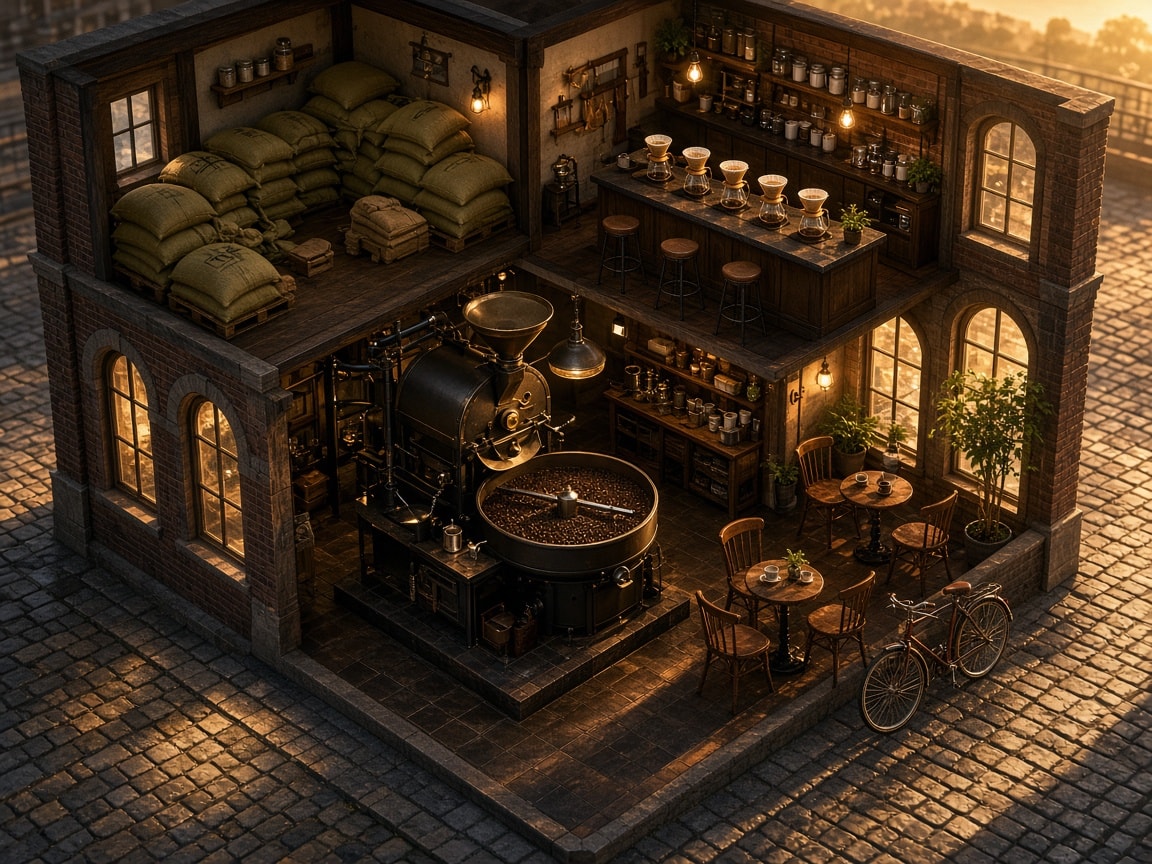
Isometric cutaway of a busy two-story corner coffee roastery at dawn: ground-floor drum roaster, burlap sacks, cooling beans and packing counter, upstairs cupping nook, warm sunrise through corner windows, soft clay-like diorama style in terracotta, cream and sage, no readable text or logos.
An isometric cutaway illustration of a busy corner coffee roastery at dawn, landscape 4:3. The two-story brick corner building is sliced open to show a ground-floor roasting room with a large drum roaster, burlap coffee sacks, a cooling tray of glossy brown beans, and a small packing counter, while upstairs a tiny tasting nook has a cupping table and shelves of sample jars. Warm early sunlight enters through tall corner windows; a bicycle leans outside by the door; steam rises from a cup on the counter. Soft clay-like 3D diorama style, neat tiny details, pastel morning palette with terracotta, cream, and sage, clean edges, lively but orderly mood. No readable text, no logos, no watermarks, no brand names on bags or signs.
Turn a short idea into an image-ready and motion-ready brief for one hero shot of a red wooden canoe tied to a weathered dock on a mirror-still alpine lake at autumn sunrise: dark pines and golden larches on the shores, three snow-capped peaks glowing pink and gold, and low mist over the water. Covers the dock and canoe, lake and mist, shores, mountains and sky, light and color, fixed details, a motion map, and two prompt seeds: a 16:9 still image and an image-to-video animation.
Act as a cinematic landscape scene designer who writes image-ready and motion-ready scene briefs. Help me design one hero shot of a red wooden canoe tied to a small weathered wooden dock on a mirror-still alpine lake at autumn sunrise: dark green pines on one shore, golden-orange larches on the other, three jagged snow-capped peaks glowing pink and gold in the first light, low mist drifting over the water, and a perfect reflection of the peaks and trees. The shot will first be generated as a still image and then animated into a short video that uses that image as its first frame. Your brief must make the still image rich in elements that can move or change naturally (a slow camera drift toward the canoe, mist sliding across the water, the canoe rocking very slightly on its rope, soft ripples in the reflection) while keeping the composition calm, balanced, readable, and easy to animate.

My starting idea: a silent autumn morning at a mountain lake, just before anyone arrives, with a single red canoe waiting at the end of the dock

My starting choices:
- Dock: a short weathered wooden dock pointing out into the lake from the bottom center of the frame
- Canoe: a red wooden canoe with wooden seats, tied to the end of the dock by a rope or chain, floating on the LEFT side of the dock
- Lake: a mirror-still alpine lake filling the middle of the frame, with low mist floating just above the water
- Left shore: dark green pine forest on a rocky shoreline
- Right shore: golden-orange autumn larches on a rocky shoreline with dry grass
- Mountains: three jagged snow-capped peaks in the center background, lit pink and gold by the sunrise
- Sky: a pale clear morning sky with a soft warm glow near the horizon
- Light: warm sunrise light on the peaks and larch tops, soft cool light on the water and dock
- Visual style: photoreal landscape photography, natural but rich colors, low camera just behind the dock
- Mood words: calm, crisp, quiet, fresh, timeless

First ask me, in one short message, for anything missing: the camera height and position (on the dock, just behind it, or from the shore), how much of the frame the dock, canoe, lake, and mountains should take, which side of the dock the canoe floats on and which way it points, how many peaks I want and how much snow they carry, how thick the mist should be, how strong the sunrise light should be, whether the camera should drift forward or stay still in the video, where the camera move should end, and anything to avoid (people, paddlers, boats with logos, houses, roads, power lines, text, brand names, or copying a specific real lake, photograph, or famous viewpoint).

Then produce the brief with these sections:

1. **Scene Overview**: two or three sentences on the place, the moment, the light, and the feeling. Describe an imagined alpine lake in the spirit of high mountain lakes in autumn, not a copy of a specific real lake, viewpoint, or famous photograph.

2. **Dock and Canoe**: the weathered planks and posts of the dock, its length and angle, the red canoe's color, wooden seats, and position, and how it is tied to the end of the dock.

3. **Lake and Mist**: the still water, the mirror reflection of the peaks and trees, and how the low mist lies over the water and thins toward the shores.

4. **Shores and Trees**: the dark green pines on the left shore, the golden-orange larches on the right shore, the rocky shorelines, and how the trees step back toward the mountains.

5. **Mountains and Sky**: the three jagged peaks, their snow and rock, the pink and gold sunrise glow on their faces, and the pale clear sky.

6. **Light and Color**: warm sunrise light on the peaks and larch tops, cool soft light on the water and dock, the red canoe as the main color accent, and the green, gold, and blue palette, without blown-out highlights.

7. **Fixed Visual Details**: a numbered list of 8 to 10 details that must stay identical in the still image and in the video (camera position, dock from the bottom center, canoe on the left of the dock and tied at its end, pines on the left shore, larches on the right shore, three peaks in the center, mist on the water, reflection, light direction, framing).

8. **Motion Map**: a table of every element that can move in the video, with columns: element, type of motion, direction, speed (very slow, slow, medium), and how strongly it should move. Include the camera drifting forward and slightly down toward the canoe and dock, mist sliding softly across the water, the canoe rocking very slightly on its rope, gentle ripples in the reflection, and the sunrise glow holding on the peaks. Keep total motion subtle and physically plausible.

9. **Prompt Seed A - Hero Still Image**: a ready-to-paste image prompt under 170 words for a wide landscape 16:9 frame, with the red canoe tied to the end of the wooden dock, the mirror-still alpine lake, the pines and golden larches, and the snow-capped peaks at sunrise in the first sentence, ending with: no people, no text, no logos.

10. **Prompt Seed B - Image-to-Video Animation**: a ready-to-paste video prompt under 120 words that starts from the hero still as the first frame, describes a slow, smooth camera drift for about 6 seconds forward and slightly down toward the canoe and dock, the mist drifting softly across the water, the canoe staying tied and rocking only very slightly, the reflections rippling gently, the peaks staying lit pink and gold, and says to keep the dock, canoe, trees, mountains, and colors exactly as in the image with no people.

Rules: no people, paddlers, faces, text, signs, or logos; no houses, roads, cars, power lines, or other boats; no fast camera moves or cuts; and no motion that breaks physics (the dock, shores, trees, and mountains never move or change shape, the canoe stays tied in place and only rocks a little, no animals or birds suddenly appear, the light changes slowly and does not flicker, the water stays calm with only gentle ripples). Use short paragraphs and lists.
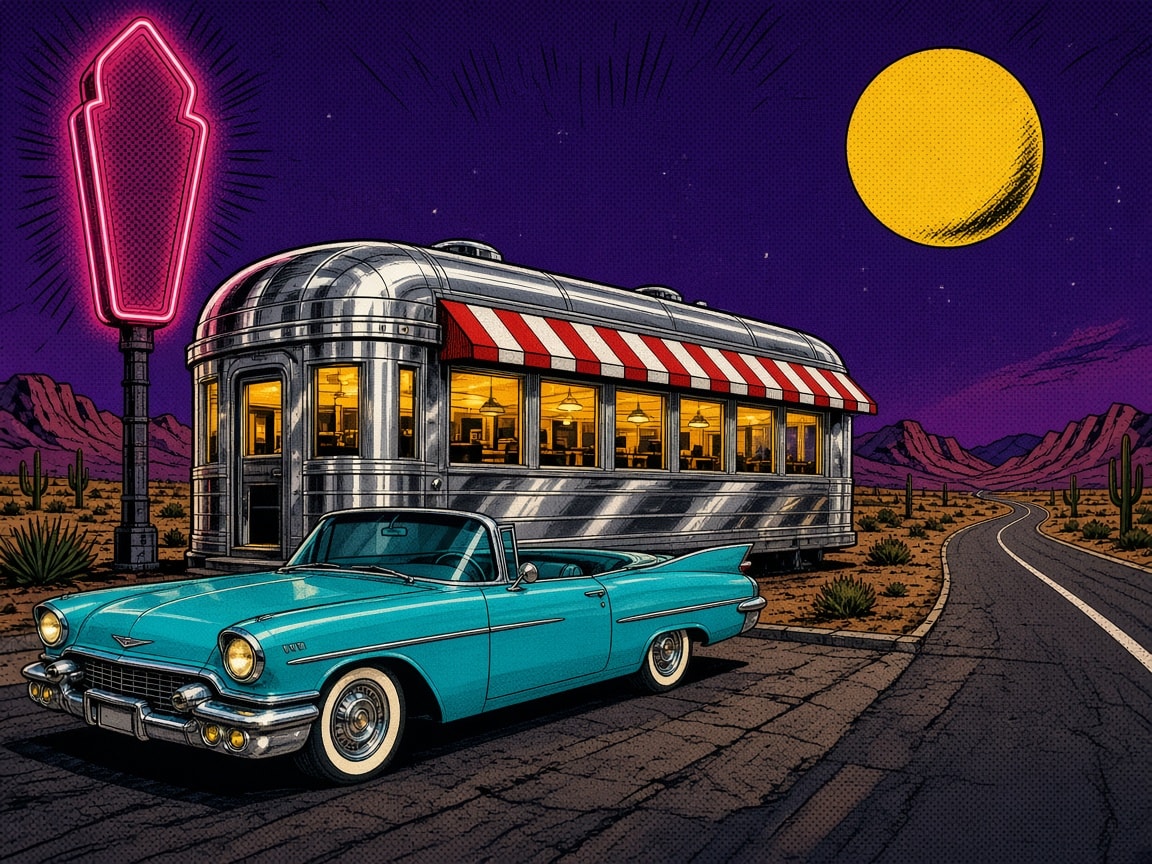
Pop art comic-style illustration with no text: a gleaming chrome 1950s diner car with warm-yellow lit windows and a red-and-white striped awning, a turquoise finned convertible parked in front, a blank pink neon sign on a pole, a big yellow moon in a purple starry sky, pink desert mountains, saguaro cacti, and a curving desert road, drawn with bold ink outlines and halftone dots.
A pop art comic-style illustration of a gleaming chrome 1950s roadside diner in the desert at night, landscape 4:3, with no text. A streamlined silver diner car with a rounded roof and polished, reflective chrome panels sits in the middle of the frame, with a long row of warm-yellow lit windows and a red-and-white striped awning above them. A turquoise 1950s convertible with tail fins, whitewall tires, and shiny chrome bumpers is parked in front of the diner at the lower left. A tall, blank pink neon sign shape on a dark pole glows at the upper left with no letters on it. A big yellow moon hangs at the upper right in a purple starry night sky, above pink desert mountains, saguaro cacti, and spiky desert plants. A curving desert road with a white edge line sweeps away on the right. Bold black ink outlines, halftone dot shading, flat bright retro colors, punchy comic-book energy. No text, no lettering, no speech bubbles, no logos.

