Animate the step 1 rainy café still as the first frame into an 8-second shot: steam curls up from the tea, raindrops run and merge down the window, street bokeh shimmers through the wet glass and the camera pushes in very slowly. Step 2 of the Rainy Café Window workflow.
Use the attached still (step 1: a photorealistic close-up inside a quiet café at dusk, a clear glass cup of amber tea with a thin ribbon of steam on a wooden window ledge beside a closed book and a small sugar jar, a rain-covered window behind it and a blurred blue-hour street with warm bokeh lights outside) as the exact first frame and animate it into an 8-second, 16:9 cinematic shot. Keep every element as it is in the still: the cup, the saucer, the book, the jar, the window frame, the lamp light and the colors.

Motion (0-8 s):
- 0-3 s: the thin steam rises slowly from the tea and curls gently in the warm air; two or three larger raindrops start to run down the glass, leaving thin wavy trails.
- 3-6 s: new small drops land softly on the outside of the pane; a drop merges with another and slides down faster; the bokeh lights of the street shimmer slightly through the wet glass as a distant car's lights pass by, still fully blurred.
- 6-8 s: the steam keeps drifting upward, a last drop traces a slow path down the glass, and the scene settles into calm.

Camera: locked-off tripod shot with a very slow, subtle push in toward the cup (about 3 percent); no cuts, no fast moves; the cup, ledge, book and window frame stay solid and still.

Ambient motion: faint flicker of the street lights through the rain, tiny sparkles on the drops, the surface of the tea almost still.

Lighting and mood: warm tungsten light inside, cool blue dusk outside, cozy and quiet.

Sound: off (silent clip).

Avoid: people, hands, animals, the cup moving or changing shape, tea spilling, steam turning into smoke clouds, raindrops running upward, the window fogging over completely, readable text, sudden light changes, time-lapse.
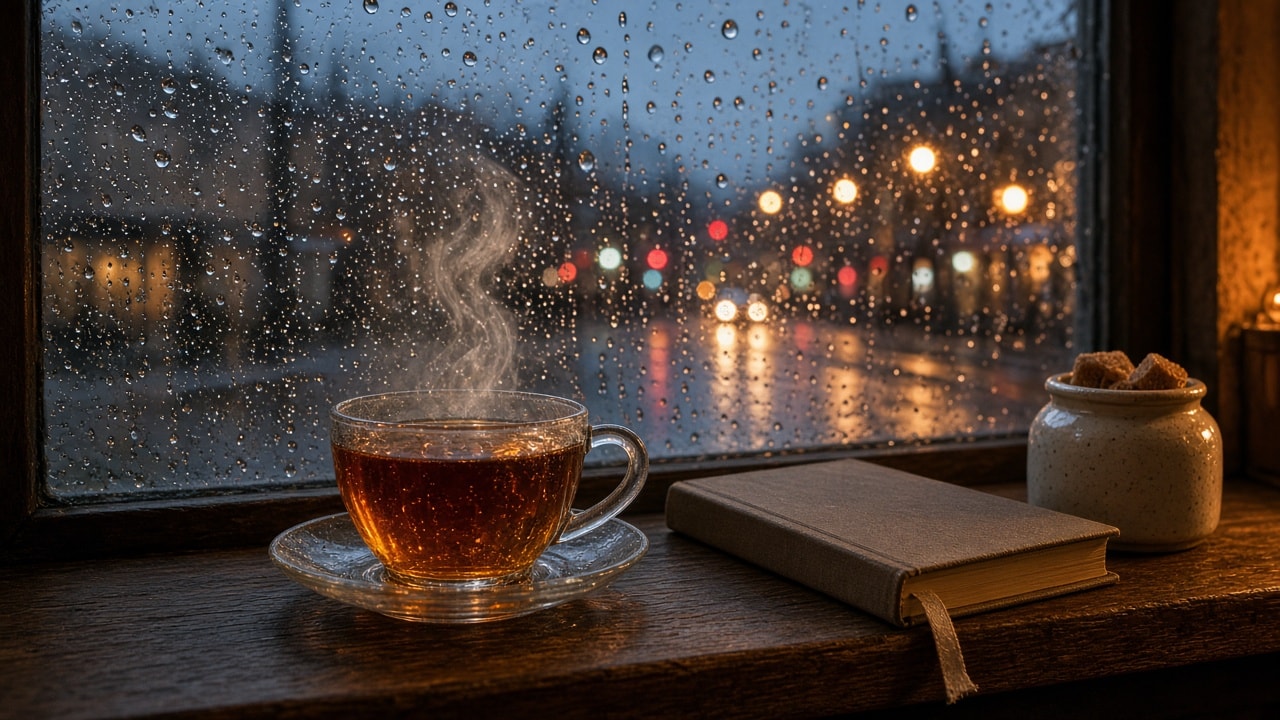
Photoreal cozy dusk inside a quiet café: a glass of amber tea with a thin ribbon of steam on a wooden window ledge beside a book, raindrops running down the pane and a blurred blue-hour street glowing with warm bokeh. Step 1 of the Rainy Café Window workflow.
A photorealistic close-up photograph taken inside a quiet café at dusk, looking out through a large rain-covered window. On the wooden window ledge in the foreground stands a clear glass cup of amber black tea on a small saucer, with a thin ribbon of steam rising from it, next to a closed hardcover book with a linen bookmark and a small ceramic jar of sugar cubes.

The window glass is covered in raindrops of many sizes; several larger drops leave thin wavy trails as they run down the pane. Outside, softly out of focus, an empty evening street glows in blue-hour light, with warm round bokeh from street lamps, shop signs blurred beyond recognition and the faint red and white lights of distant traffic. Inside, warm tungsten light from a lamp to the right falls on the cup and the ledge, making the tea glow and the drops on the glass sparkle.

50 mm lens at table height, shallow depth of field: the cup, the steam and the nearest raindrops tack-sharp, the street a dreamy blur of warm and cool lights. A calm, cozy, reflective mood, contrast between the cold blue evening outside and the warm interior. No people, no animals, no readable text or logos. Widescreen 16:9.

A macro studio photo of a vintage snow globe: a tiny winter village with a lit white chapel, snowy timber cottages and frosted firs inside the glass, snowflakes swirling, a turned wooden base with a brass band, warm window glow and string-light bokeh on a dark winter night.
A close-up studio photograph of a vintage glass snow globe on a dark walnut shelf. Inside the clear water-filled dome sits a tiny handmade winter village: a small white chapel with a slim steeple and warm yellow light glowing from its arched windows, a pair of little timber cottages with snow-covered roofs and glowing windows, a few frosted fir trees and a narrow path winding up a snowy hill. Fine white snowflakes swirl gently through the water, a few settling on the roofs.

The globe stands on a turned wooden base with a thin brass band, slightly worn at the edges. Soft curved reflections and a warm highlight bend across the glass; the glowing windows cast a faint golden light into the snow inside. Behind the globe, out of focus, a dark wintry window with blurred warm string-light bokeh. Warm low-key lighting from the side, deep blue and charcoal shadows, a cozy, nostalgic holiday mood.

Macro lens, shallow depth of field with the chapel and cottages tack-sharp through the glass, slight refraction at the dome's edges, rich contrast between warm window light and cool snow. No people, no figures inside the globe, no readable text or logos. Portrait 3:4.
Animate the step 1 autumn stream still as the first frame into an 8-second shot: water flows over the mossy stones, floating maple leaves drift and turn on the pool, a few red leaves spiral down, mist moves and the camera pushes in slowly. Step 2 of the Autumn Mountain Stream workflow.
Use the attached still (step 1: a photorealistic photograph of a clear mountain stream in an autumn forest, water flowing over mossy stones into a quiet pool, red maple leaves floating on the dark water and a few falling, crimson and gold trees leaning over the banks, thin mist and soft sun rays in the background) as the exact first frame and animate it into an 8-second, 16:9 cinematic shot. Keep every element as it is in the still: the stones and moss, the shape of the stream and the small cascades, the trees, the mist and the light.

Motion (0-8 s):
- 0-3 s: the water flows naturally over the stones and down the small cascades; the floating maple leaves on the pool drift slowly and turn gently with the current; soft ripples spread where the cascade meets the pool.
- 3-6 s: a light breeze moves the branches overhead; three or four red leaves detach and spiral down slowly, one landing on the pool and starting to drift; the sun rays brighten slightly as the mist moves.
- 6-8 s: the breeze calms, the leaves keep drifting downstream past the mossy stones, a last leaf twirls down into the frame.

Camera: locked-off tripod shot with a very slow, subtle push in toward the pool (about 3 percent); no cuts, no fast moves; the stones, trunks and banks stay solid and still.

Ambient motion: thin mist drifting slowly between the trunks, tiny sparkles of light on the moving water, a few leaves trembling on the branches.

Lighting and mood: soft, cool morning light with warm autumn colors, calm and meditative.

Sound: off (silent clip).

Avoid: people, animals, leaves changing color or multiplying, leaves falling like a storm, water freezing or flowing backwards, stones moving or morphing, sudden light changes, time-lapse, text.
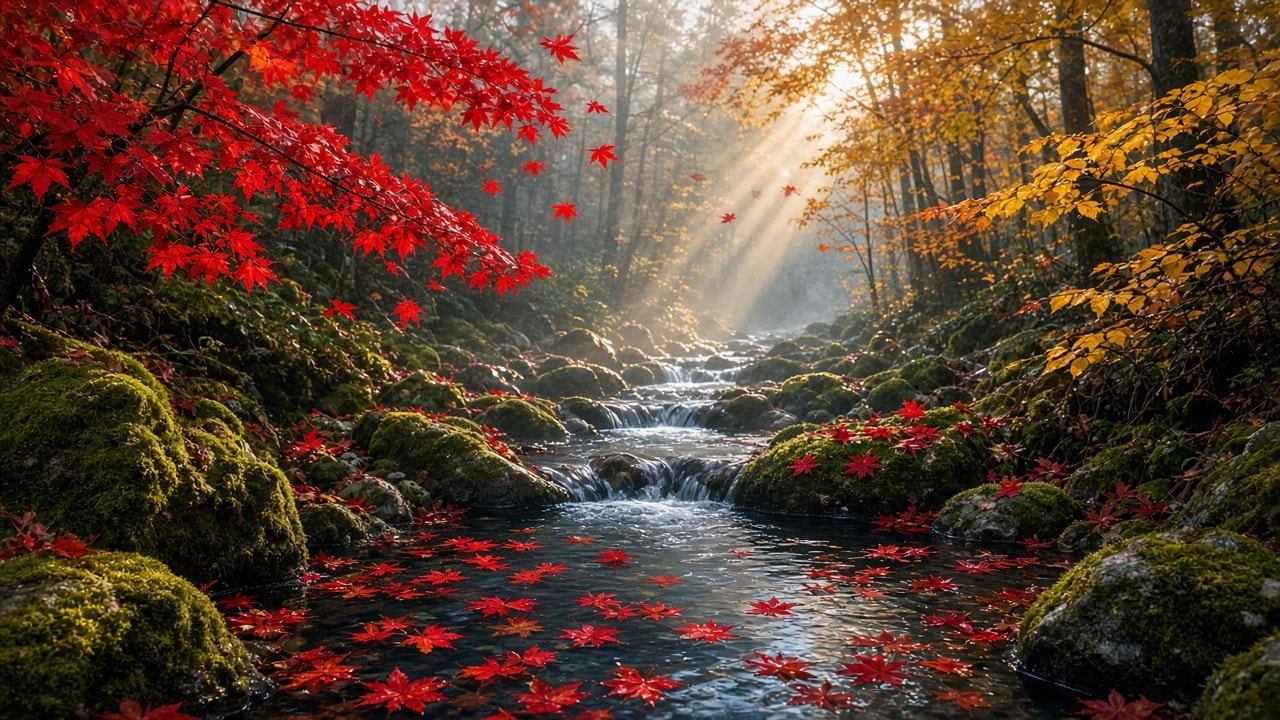
Photoreal misty autumn morning at a clear mountain stream: water slips over mossy stones into a quiet pool where red maple leaves float, crimson and gold maples lean over the banks and soft sun rays break through the mist. Step 1 of the Autumn Mountain Stream workflow.
A photorealistic photograph of a small, clear mountain stream flowing through an autumn forest on a calm, misty morning. The water runs gently over smooth grey stones covered with bright green moss and cascades down a few low steps, forming small white ribbons of water and a quiet pool in the foreground. Japanese maple and beech trees lean over the stream from both banks, their leaves in glowing crimson, scarlet, orange and gold. Dozens of red maple leaves float on the dark surface of the pool, a few are caught against the mossy stones, and a few are falling through the air. Thin morning mist hangs between the trunks in the background, and soft rays of sunlight break through the canopy and touch the water.

Shot like a professional nature photograph: 24 mm lens low near the water at the edge of the pool, looking upstream, strong depth with the stream leading back into the misty forest, sharp foreground stones and floating leaves, slightly softer background, rich red and gold against deep green moss and dark water, gentle natural light. No people, no animals, no buildings, no text. Landscape 16:9.
Animate the step 1 wisteria tunnel still as the first frame into an 8-second shot: a soft spring breeze sways the hanging flower clusters, petals float down through the sunbeams, light shifts on the path and the camera dollies slowly forward. Step 2 of the Wisteria Tunnel in Spring workflow.
Use the attached still (step 1: a photorealistic wide photograph looking down a long wisteria tunnel in full bloom, hanging lavender and violet flower clusters on both sides, a pale gravel path leading to a bright sunny opening at the far end, dappled sunlight on the path and a few fallen petals) as the exact first frame and animate it into an 8-second, 16:9 cinematic shot. Keep every element as it is in the still: the shape of the arch and trunks, the position of the flower clusters, the path and the bright opening.

Motion (0-8 s):
- 0-3 s: a soft spring breeze starts; the long hanging flower clusters sway gently back and forth, the ones nearest to the camera moving a little more; the bumblebees hover and drift slowly between the clusters.
- 3-6 s: a slightly stronger, still gentle gust loosens a few petals that float down slowly through the sunbeams and settle on the gravel; the dappled light patches on the path shift as the leaves move.
- 6-8 s: the breeze calms, the clusters slow to a light sway, a few last petals spin down in the light.

Camera: very slow, smooth dolly forward along the path (about 3-4 percent), no cuts, no fast moves; the trunks and the iron arch stay solid and still.

Ambient motion: tiny specks of pollen glinting in the sunbeams, distant leaves at the bright opening moving slightly.

Lighting and mood: warm late spring afternoon light, purple and green tones, calm, dreamy and quiet.

Sound: off (silent clip).

Avoid: people, birds, flowers changing color or shape, clusters merging or melting, petals falling too fast or like snow, the tunnel bending, sudden light changes, time-lapse, text.
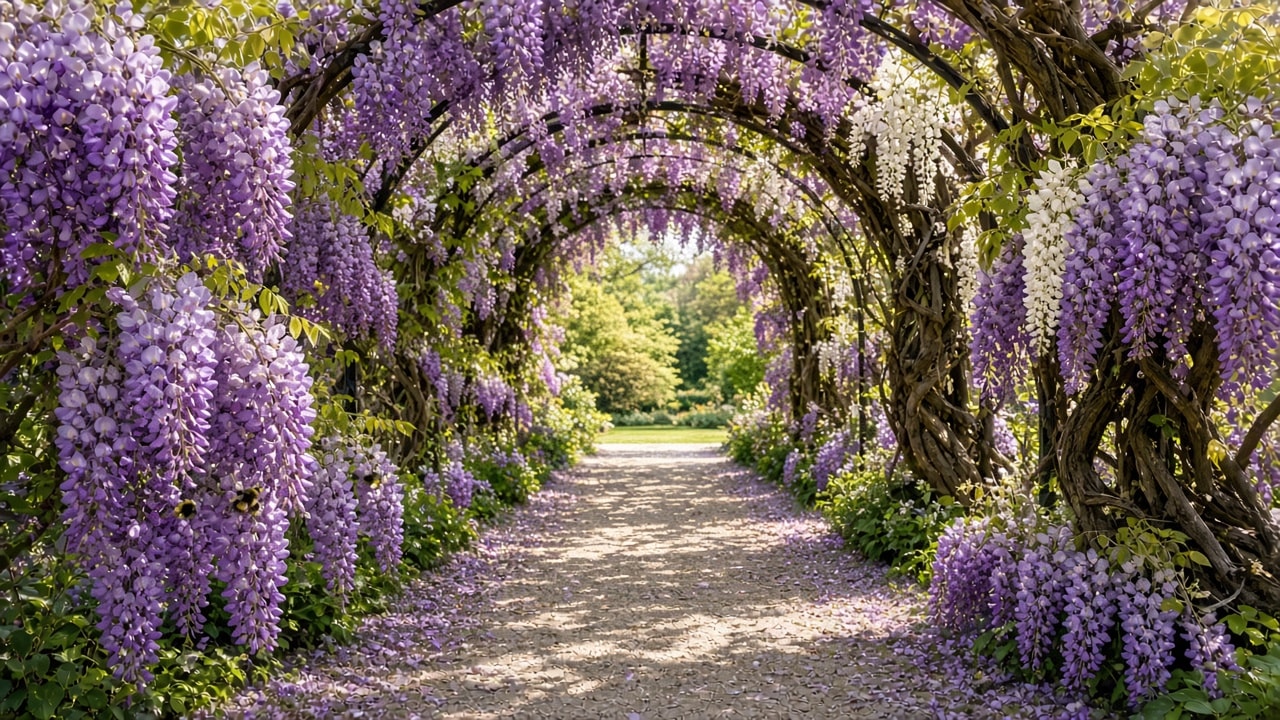
Photoreal spring afternoon in a long wisteria tunnel: thousands of lavender and violet flower clusters hang from an old iron arch over a gravel path that leads to a bright sunny opening, with dappled light, fallen petals and two bumblebees. Step 1 of the Wisteria Tunnel in Spring workflow.
A photorealistic wide photograph looking down a long garden tunnel of wisteria in full bloom on a calm, sunny spring afternoon. Old twisted wisteria trunks climb a dark iron arch on both sides, and thousands of long hanging clusters of lavender, violet and a few white flowers drape from the roof of the tunnel, some almost touching the ground. A pale gravel path runs through the center toward a bright opening at the far end where soft green lawn and trees glow in the sun. Sunlight filters through the blossoms and leaves, making warm dappled patches of light on the path, and a scattering of fallen petals lies on the gravel. A few petals are caught in the air, and two bumblebees hover near the clusters in the foreground.

Shot like a professional garden photograph: 35 mm lens from the middle of the path at eye level, strong depth with the tunnel leading to the bright opening, sharp near flower clusters, slightly softer far end, rich purple against fresh green and warm light. No people, no buildings, no text. Landscape 16:9.
Animate the step 1 monarch forest still as the first frame into an 8-second shot: wings open and close in the warming sun, small groups lift off the near fir branch and flutter up through the sunbeams while the camera slowly pushes in. Step 2 of the Monarch Butterflies on Sunlit Fir Trees workflow.
Use the attached still (step 1: a photorealistic wide photograph of thousands of monarch butterflies clustered on fir branches in a high mountain forest, a heavy cluster on a big branch in the right foreground, more clusters on hazy firs behind, low sunbeams from the upper left and a few dozen butterflies already flying in the light) as the exact first frame and animate it into an 8-second, 16:9 cinematic shot. Keep every element as it is in the still: the shape of the trees and branches, the position of the clusters, the sunbeams and the haze.

Motion (0-8 s):
- 0-3 s: as the sun warms the cluster in the right foreground, many butterflies slowly open and close their wings, showing flashes of bright orange; the flying butterflies in the sunbeams flutter and drift lazily.
- 3-6 s: small groups lift off the near branch one after another and flutter up into the light, joining the others; the branch rises very slightly as the weight leaves it.
- 6-8 s: dozens of monarchs float through the sunbeams in soft, natural, irregular flight paths, some crossing close to the camera slightly out of focus; the clusters on the far trees shimmer as wings open.

Camera: very slow, smooth push-in toward the sunlit gap (about 3 percent), no cuts, no fast moves; the tree trunks stay solid and still.

Ambient motion: faint drifting haze in the sunbeams, tiny specks of dust glinting, fir needles barely moving.

Lighting and mood: early winter sunlight, warm orange wings against cool blue-green shadows; calm, magical and quiet.

Sound: off (silent clip).

Avoid: people, birds, butterflies merging or changing species, extra wings or legs, wings flapping too fast like insects in a time-lapse, trees bending or melting, sudden light changes, text.
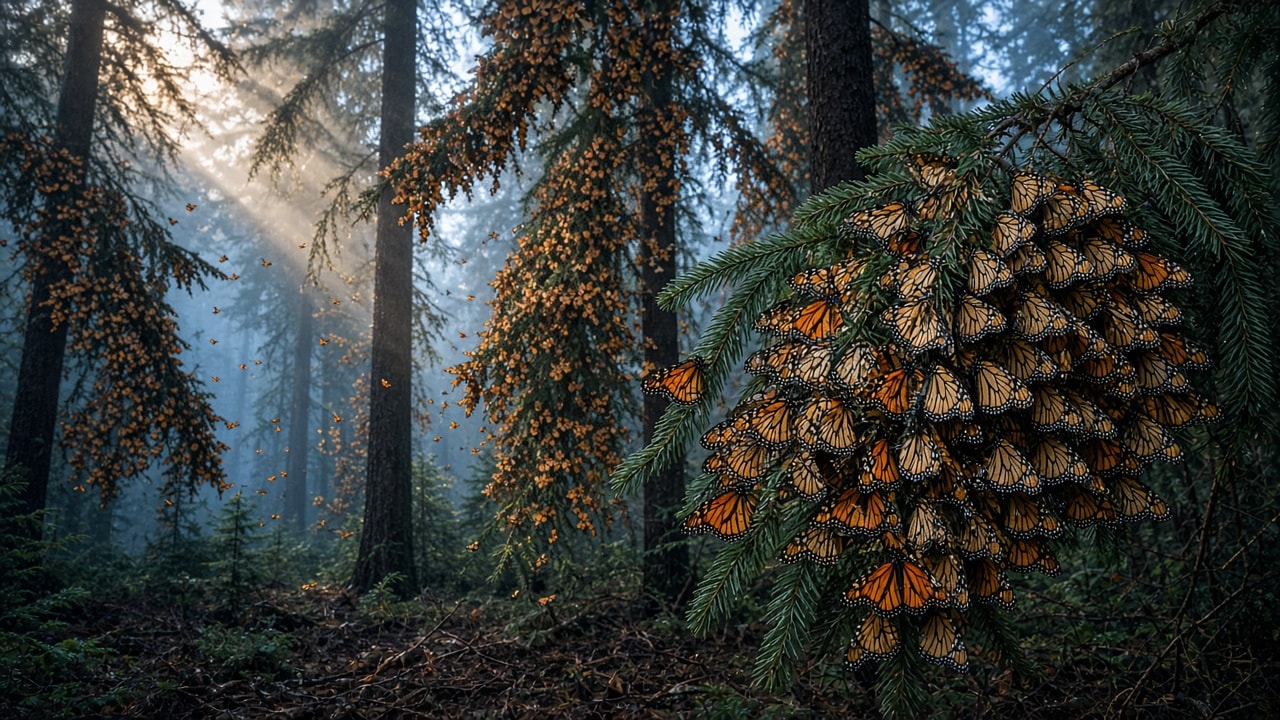
Photoreal winter morning in a high mountain forest: thousands of monarch butterflies cluster on sagging fir branches, a few dozen already flying through hazy sunbeams from the upper left, warm orange wings against cool blue-green shade. Step 1 of the Monarch Butterflies on Sunlit Fir Trees workflow.
A photorealistic wide photograph of thousands of orange-and-black monarch butterflies clustered on the branches of tall fir trees in a high mountain forest on a cool winter morning. In the foreground on the right, a big fir branch sags under a dense cluster of butterflies, most with wings closed, showing the pale orange undersides, a few with wings open in bright orange with black veins and white-dotted edges. Behind it, the trunks and branches of more firs fade into a soft blue morning haze, their branches covered in brownish-orange clusters. Low sunlight comes from the upper left through a gap in the canopy, making long hazy sunbeams across the scene, and a few dozen butterflies are already flying in the light between the trees. The forest floor below is in shadow with a few fallen butterflies and fir needles.

Shot like a professional nature photograph: 50 mm lens, sharp detail on the near cluster, the background slightly softer, warm orange against cool blue-green, gentle haze. No people, no buildings, no text. Landscape 16:9.
Animate the step 1 sea of clouds still as the first frame into an 8-second shot: the cloud sea flows slowly like a calm tide, the cloud waterfall pours over the saddle, wisps curl up and the camera drifts gently right. Step 2 of the Sea of Clouds Flowing Over a Mountain Ridge workflow.
Use the attached still (step 1: a photorealistic sunrise photograph of a sea of clouds filling the valleys below a rocky granite ridge with a few wind-bent pines at the right, a "cloud waterfall" spilling over a low saddle in the middle of the ridge, distant peaks rising like islands and the sun just above the horizon at the upper left) as the exact first frame and animate it into an 8-second, 16:9 cinematic shot. Keep every element as it is in the still: the shape of the ridge, the pines, the saddle, the distant peaks and the position of the sun.

Motion (0-8 s):
- 0-3 s: the cloud sea starts to move slowly from left to right like a calm tide; soft billows on its surface roll and change shape gently; the cloud waterfall at the saddle begins to pour down the far side in slow, flowing streams.
- 3-6 s: the flow over the saddle continues and thin wisps break off and curl up in the light; shadows between the billows shift; the gold light on the cloud tops grows a little warmer as the sun rises very slightly.
- 6-8 s: a thin veil of mist drifts across the lower edge of the ridge and fades; the pines sway very slightly in a light breeze; the cloud sea keeps flowing steadily.

Camera: very slow, smooth lateral drift to the right (dolly-like, about 3 percent of the frame), no zoom, no cuts; the ridge and the peaks stay solid and still.

Ambient motion: faint sparkle of frost on the rocks, small changes in the sun flare, a gentle real-time feel (not a fast time-lapse).

Lighting and mood: early sunrise, warm gold and peach on the cloud tops, cool lavender-blue in the shadows; calm, wide and quiet.

Sound: off (silent clip).

Avoid: people, birds, aircraft, buildings, the mountains moving or melting, the trees bending strongly, the sun jumping position, sudden day-to-night changes, fast time-lapse flicker, text.
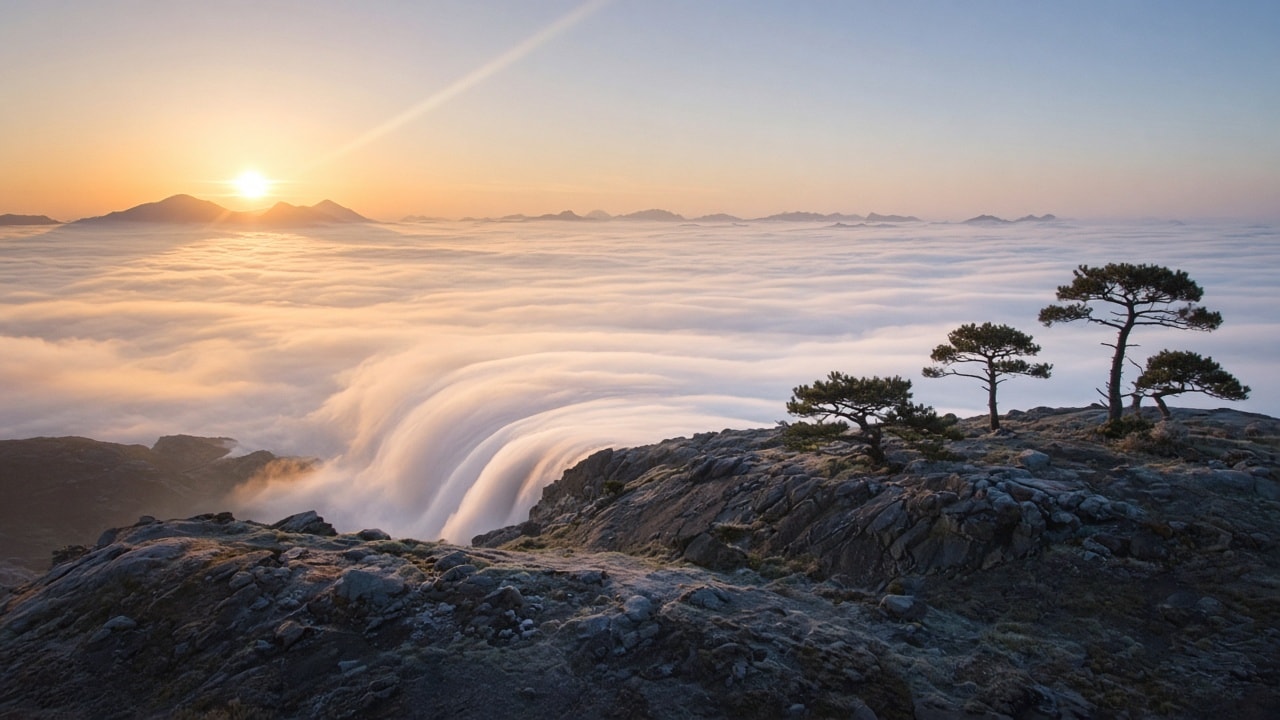
Photoreal sunrise landscape of a sea of clouds filling the valleys below a frosty granite ridge with a few wind-bent pines, a cloud waterfall spilling over a low saddle and distant peaks rising like islands in gold light. Step 1 of the Sea of Clouds Flowing Over a Mountain Ridge workflow.
A photorealistic wide landscape photograph of a sea of clouds (a temperature inversion) filling the valleys below a rocky mountain ridge at sunrise. In the foreground, a dark granite ridge with patches of frost and low alpine grass runs from the lower left to the middle right, with a small group of wind-bent pine trees standing on it at the right. Beyond the ridge, a smooth, dense white cloud layer fills the whole valley like a calm ocean; at a low saddle in the middle of the ridge the cloud spills over the edge in a soft, slow "cloud waterfall" pouring down into the next valley. Distant blue-grey mountain peaks rise out of the cloud sea like islands, layer after layer toward the horizon. The sun has just cleared the horizon at the upper left, painting the top of the clouds gold and peach and leaving the shadowed sides pale lavender-blue; the sky fades from warm orange near the sun to clear soft blue above.

Shot like a professional landscape photograph: 35 mm lens from a high viewpoint on the ridge, deep focus from the frosty rocks to the far peaks, gentle sun flare at the upper left, natural colors, fine detail in the cloud texture and the pine needles. No people, no buildings, no roads, no birds, no text. Landscape 16:9.
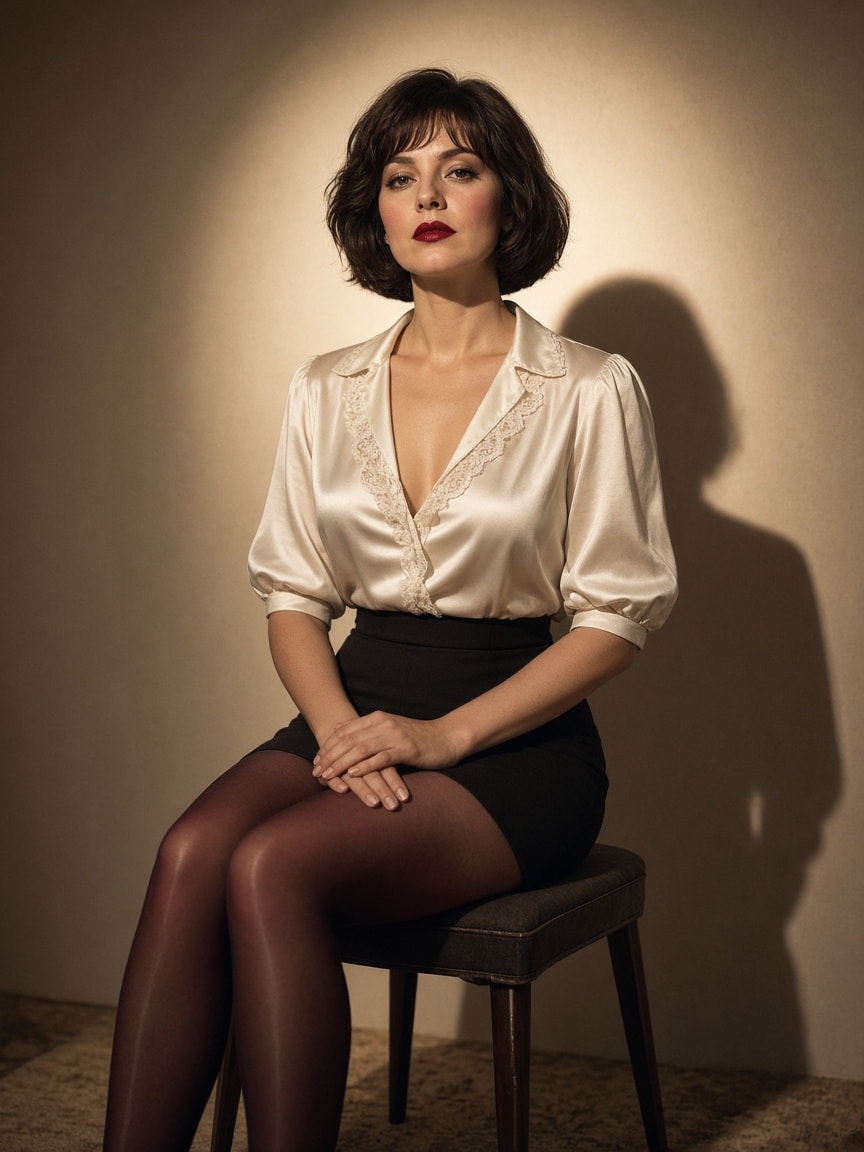
Turns an uploaded photo of a woman into a photorealistic 1970s editorial studio portrait with a crimson lip, ivory satin lace blouse, warm spotlight glow and analog film tones, keeping her exact identity.
Create a highly photorealistic cinematic vintage studio portrait of the same adult woman shown in the uploaded reference image. Preserve her exact facial identity, recognizable features, natural skin tone, face shape, eyes, nose, lips, and facial proportions without beautification or alteration.

Appearance & Makeup:
She has a short, softly tousled dark-brown bob with gentle loose curls framing her cheeks and delicate wispy bangs across her forehead. Her expressive hazel-brown eyes are enhanced with subtle smoky eyeliner, naturally shaped eyebrows, softly flushed cheeks, and elegant deep crimson-red lipstick. Her complexion is warm and luminous, with realistic skin texture and natural details.

Outfit & Styling:
She wears an elegant ivory satin blouse with a modest, softly draped neckline, delicate lace detailing around the collar, and subtle puff sleeves. The blouse is neatly fitted and tucked into a high-waisted black tailored mini skirt with a refined silhouette. Add sheer dark burgundy stockings for a sophisticated vintage-inspired look. The overall styling should feel elegant, tasteful, and timeless rather than revealing.

Pose & Composition:
She sits gracefully on a low vintage studio chair, leaning slightly forward with relaxed shoulders and a confident posture. Her hands rest naturally together on her lap. Her chin is gently raised as she looks directly into the camera with a confident, subtly mysterious expression.

Lighting & Background:
A minimalist warm beige studio wall serves as the background. A strong directional spotlight creates a soft circular glow behind her, accompanied by a beautifully defined shadow falling to one side. Rich warm shadows, gentle highlights across her face, and subtle cinematic contrast create an intimate vintage Hollywood atmosphere.

Photography Style:
Classic 1970s editorial portrait photography, vintage studio glamour, warm analog film tones, authentic skin texture, subtle film grain, sophisticated color grading, professional fashion photography, sharp facial focus, beautifully balanced composition, highly detailed, photorealistic, vertical  portrait.

Maintain the reference woman's exact identity throughout. No cartoon features, no anime aesthetics, no artificial skin smoothing, no exaggerated body proportions, and no changes to her recognizable appearance.
Animate the step 1 penguin huddle still as the first frame into an 8-second shot: gusts drive snow across the frame while the huddle shuffles and slowly rolls, edge birds move to shelter and a chick peeks out. Step 2 of the Emperor Penguins Huddling Through an Antarctic Blizzard workflow.
Use the attached still (step 1: a photorealistic telephoto photograph of about forty emperor penguins pressed into a dense huddle on Antarctic sea ice in a blizzard, two grey chicks on their parents' feet at the left, snow streaking from right to left in blue polar twilight) as the exact first frame and animate it into an 8-second, 16:9 cinematic shot. Keep every element as it is in the still: the size and shape of the huddle, the two chicks at the left, the faint ice cliffs, the pink-violet glow on the far left horizon and the cold blue light.

Motion (0-8 s):
- 0-3 s: the frozen snow starts moving; gusts drive fine snow from right to left across the frame; penguins in the huddle shuffle in tiny steps, heads shifting and shoulders pressing closer.
- 3-6 s: the slow rolling movement of a real huddle: birds on the windward right edge waddle a few steps along the side toward the sheltered left side; frost on their backs glints; one chick lifts its head, blinks and settles back against its parent.
- 6-8 s: a stronger gust sweeps a wave of blowing snow over the huddle, the birds lower their heads, and the group stays tight together as the snow thins slightly.

Camera: locked-off telephoto shot with a very slow push-in (about 5 percent), subtle wind shake only; focus stays on the front row; no cuts, no zoom jumps.

Ambient motion: drifting spindrift low over the ice, snow building on backs and heads, faint movement of the haze in the background.

Lighting and mood: constant soft blue polar twilight with the faint pink glow on the left; quiet, harsh and tender at the same time.

Sound: off (silent clip).

Avoid: people, vehicles, penguins flying or swimming, birds merging or morphing, extra heads or wings, penguins walking out of the huddle across the frame, sudden daylight, text.
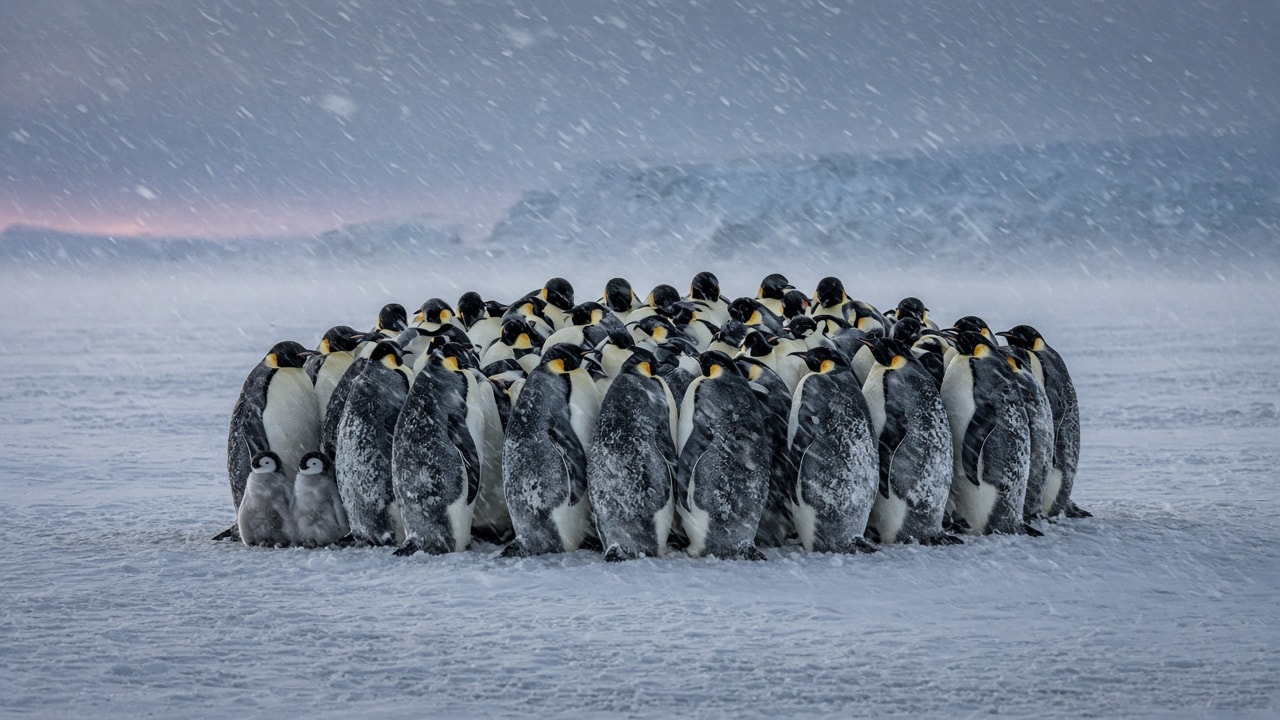
Photoreal telephoto photograph of about forty emperor penguins pressed into a frosted huddle on Antarctic sea ice in a blizzard, two grey chicks on their parents' feet, snow streaking sideways in blue polar twilight. Step 1 of the Emperor Penguins Huddling Through an Antarctic Blizzard workflow.
A photorealistic wide telephoto photograph of an emperor penguin colony huddling together on the Antarctic sea ice during a blizzard in the soft blue light of the polar winter twilight. About forty adult emperor penguins stand pressed tightly in a dense, rounded huddle that fills the middle of the frame, their backs and heads dusted with snow and frost, black backs and the bright golden-yellow ear patches showing between them; a few birds on the windward right edge stand with heads tucked down against the wind. In the left foreground, two fluffy grey chicks stand on the feet of their parents, half hidden in the brood pouch. Wind-driven snow streaks horizontally from right to left across the whole scene, softening the background into a pale blue-grey haze where a faint line of ice cliffs is barely visible. The low sun is hidden behind the storm, giving a faint pink-violet glow on the horizon at the far left.

Shot like a National Geographic wildlife photograph: 600 mm telephoto compression, crisp detail on the feathers and frost in the front row, natural cold color balance, fine blowing-snow motion streaks, realistic textures of wind-packed snow at their feet. No people, no buildings, no text. Landscape 16:9.
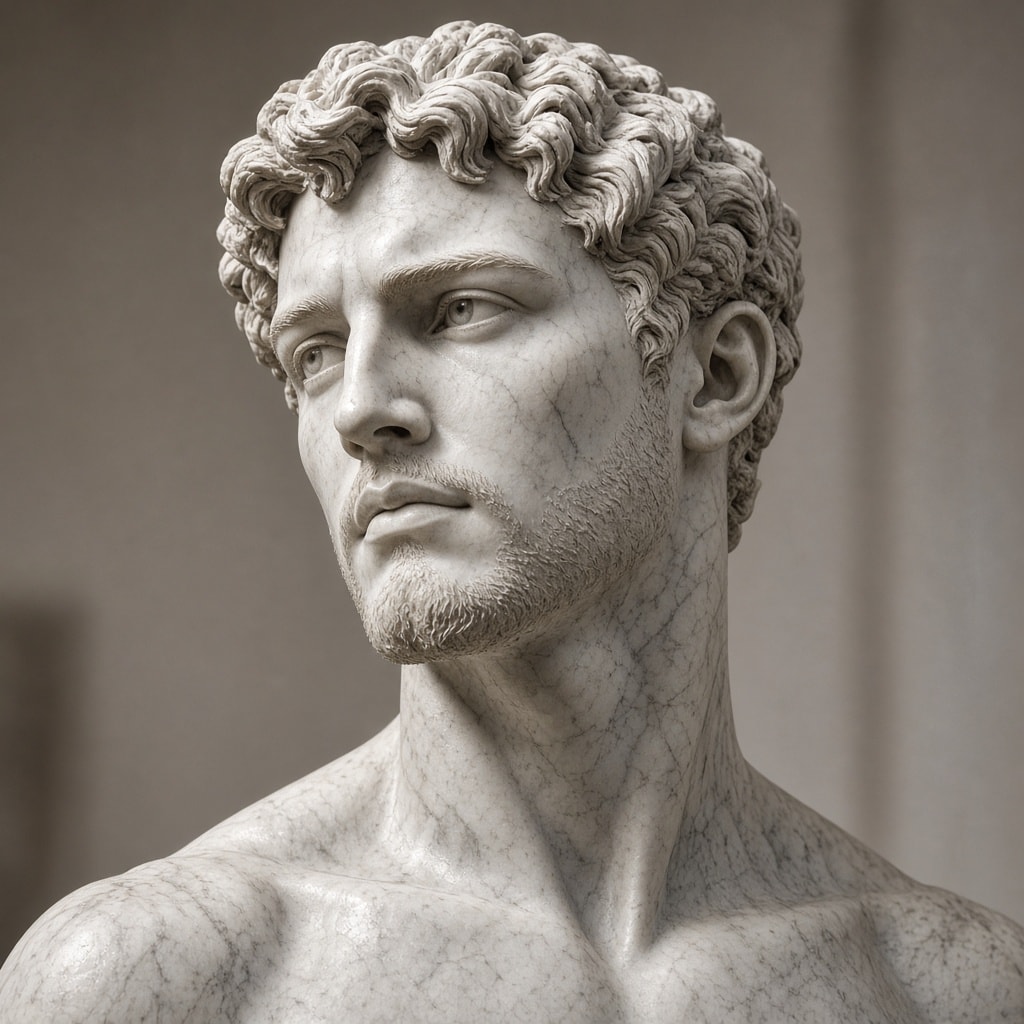
Turns any uploaded portrait photo into a museum-grade classical marble statue bust with chiseled features, natural stone veins, sculpting marks and soft gallery lighting.
Turn the uploaded photo into a hyper-realistic marble sculpture avatar in classical Greco-Roman statue style. Precisely chiseled facial features with subtle imperfections, visible stone veins, and natural marble grain texture. Smooth yet slightly weathered surface, realistic sculpting marks, and refined anatomy. Soft museum-style directional lighting casting gentle shadows to enhance depth and contours. Neutral gallery background with shallow depth of field, elegant fine-art atmosphere, timeless aesthetic, ultra-high resolution, cinematic realism, 1:1 aspect ratio, premium statue portrait quality.
Animate the step 1 murmuration still as the first frame into an 8-second shot: the flock ripples, folds and rolls across the sunset sky in fluid waves while the reeds sway and the water mirrors it. Step 2 of the Starling Murmuration over a Winter Reed Bed at Sunset workflow.
Use the attached still (step 1: a photorealistic sunset photograph of a huge starling murmuration shaped like a twisting ribbon in the upper center of the sky, above a flat winter reed bed with a winding mirror-like water channel, a glowing orange band at the right horizon and bare trees on the far left) as the exact first frame and animate it into an 8-second, 16:9 cinematic shot. Keep every element as it is in the still: the reed bed, the channel and its reflections, the tree line, the sunset colors and the position of the flock.

Motion (0-8 s):
- 0-3 s: the frozen murmuration comes alive; the ribbon of birds slowly ripples and folds, dark waves of density pulsing through the flock as thousands of starlings turn together.
- 3-6 s: the flock stretches into a long arc, then curls into a rounded wave that rolls across the sky from right to left, edges thinning and thickening in a fluid, liquid way; its dark reflection moves across the water channel.
- 6-8 s: the cloud of birds tightens into a dense swirling ball and begins to drift lower toward the reeds, still in the upper half of the frame.

Camera: locked-off tripod shot with a very slow push-in; no cuts, no shake, no zoom jumps.

Ambient motion: reed tops and seed heads sway gently in a light breeze; faint ripples on the water; thin clouds drift slowly.

Lighting and mood: constant warm sunset glow fading very slightly; peaceful, hypnotic and wild.

Sound: off (silent clip).

Avoid: individual birds growing large, birds flying into the camera, the flock splitting into unrelated groups, birds morphing into shapes or letters, people, buildings, sudden lighting changes, text.
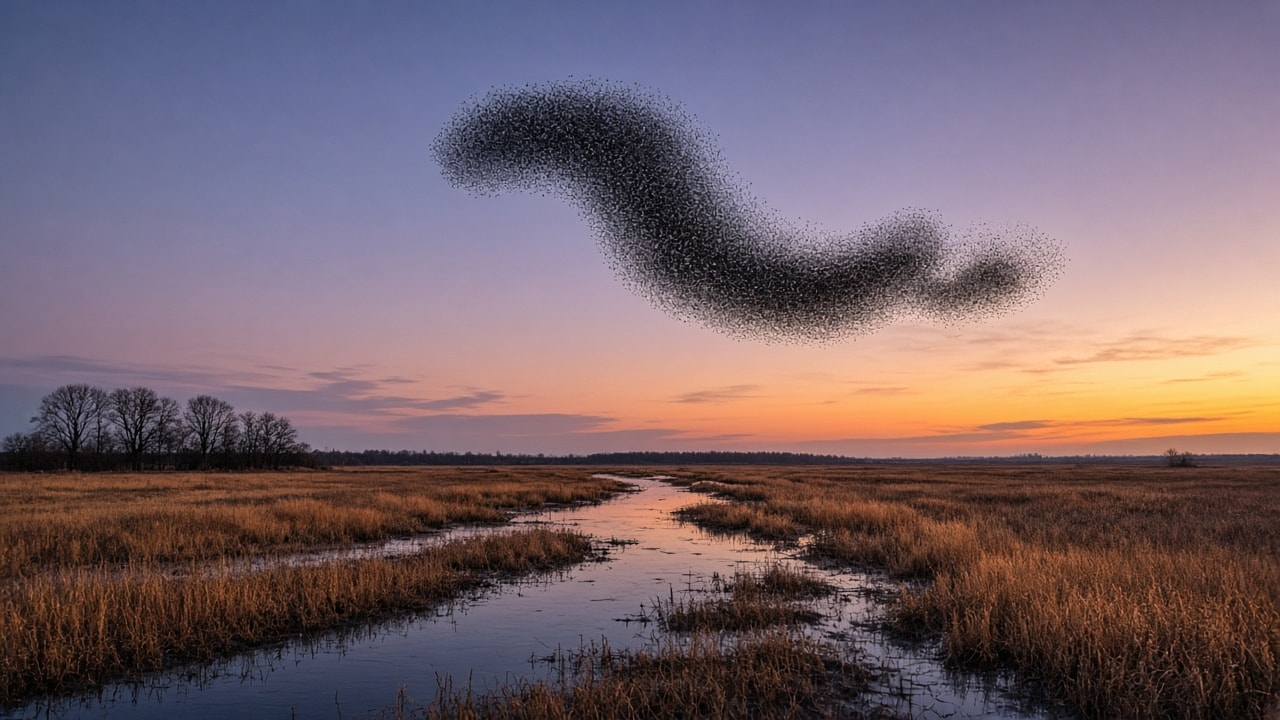
Photoreal wide sunset landscape of a vast starling murmuration twisting like a ribbon above a golden winter reed bed and a winding mirror-like water channel, with a glowing orange horizon and bare trees. Step 1 of the Starling Murmuration over a Winter Reed Bed at Sunset workflow.
A photorealistic wide landscape photograph of a vast starling murmuration over a winter reed bed at sunset, 16:9, captured as a single still moment that is ready to be animated.

Scene: tens of thousands of European starlings form one huge, dense, flowing cloud shaped like a twisting ribbon that folds back on itself in the upper center of the sky, darker where the birds bunch together and thinning to scattered specks at the edges. Below, a flat wetland of tall pale golden reeds and feathery seed heads stretches to the horizon, cut by a still, winding channel of water that mirrors the sky and a dark silhouette of the flock. A line of bare winter trees stands on the far left of the horizon.

Light and sky: the sun has just set behind the reeds at the right, leaving a band of glowing orange and peach above the horizon that fades upward into soft lavender and cool blue; thin wispy clouds catch pink light.

Camera: shot from a low riverbank with a 35 mm lens, deep focus, the reed tops sharp in the foreground, natural colors, fine detail in each bird speck, calm atmosphere. No people, no buildings, no text.

A detailed realism prompt for an unedited, straight-out-of-camera phone selfie: a curly-haired man in his twenties reclining on a sofa in a lived-in room, with visible pores, warm household light and none of the plastic, over-retouched AI look.
Candid phone snapshot, shot with front phone camera, real phone photo of an attractive adult man in his early-to-mid 20s, an unedited camera photo, SOOC. He has thick, voluminous dark brown curly hair with naturally defined loose ringlets, styled in a slightly messy shape with several prominent curls falling across his forehead. His hair has natural volume, subtle shine, and individual flyaway strands. He has light olive skin, blue-grey eyes, thick dark eyebrows, a straight nose with a small silver nose stud, naturally full pink lips, and a defined jawline. He has a neatly trimmed dark mustache and a distinctive short, fuller goatee concentrated around his chin. Small sparkling silver diamond-style stud earrings are visible in both ears.

He is wearing a relaxed white cotton graphic T-shirt with oversized green and purple printed lettering across the front. The shirt has a slightly loose fit, natural fabric creases, and a simple rounded neckline.
He is reclining comfortably against a sofa or bed, holding his iPhone slightly above his face to take a close-up front-facing selfie. His head rests naturally against the surface behind him, shoulders relaxed. He looks directly into the camera with a subtle, confident half-smile and a calm, relaxed expression. His face is the main focal point.

The framing is vertical 9:16 portrait, close-up selfie from the upper chest upward, shot with front phone camera at a slightly elevated angle. His face is centered, with his voluminous curly hairstyle occupying much of the upper frame and his white graphic T-shirt visible across the lower foreground. Candid phone shot, spontaneous and slightly imperfect, like a casual selfie taken while relaxing at home.

The environment is a cozy, ordinary bedroom or living space. Behind him is a light cream-colored wall with a subtle textured painted finish. A large black flat-screen television is partially visible on the upper-left side of the background. On the right side, a dark black backpack or soft travel bag hangs casually near the wall, with realistic fabric folds and straps visible. A small section of light beige furniture or bedding is visible behind his shoulders.

Lighting is warm, soft indoor household lighting, creating natural illumination across his face with gentle shadows beneath his curls, nose, and chin. His skin has natural highlights, and the white shirt retains visible cotton texture without appearing overexposed.
Real photo look, IG phone snapshot: visible pores, natural skin-tone variation, under-eye texture, subtle freckles and facial imperfections, individual defined hair curls, natural catchlights in the eyes, accurate facial proportions, natural mustache and goatee texture, visible cotton weave. Natural colors, authentic handheld perspective.

Avoid the look of modern high-definition digital fashion photography. No plastic skin, no excessive smoothing, no beauty retouching, no sharp digital look, no cinematic lighting, no dramatic color grading, no filters, no distorted anatomy, no extra fingers, no watermarks or added text overlays. Strictly vertical 9:16 portrait orientation.
Animate the step 1 wild horses still as the first frame into an 8-second shot: the herd keeps galloping left to right through the surf, throwing glowing spray, as the camera tracks alongside in warm sunrise light. Step 2 of the Wild Horses Galloping Through Shallow Surf at Dawn workflow.
Use the attached still (step 1: a sunrise telephoto photograph of nine wild horses, mostly black and dark brown with three dappled greys, galloping left to right through shallow surf on an empty beach, spray glowing in the backlight, the sun low at the far left) as the exact first frame and animate it into an 8-second, 16:9 cinematic shot. Keep every element as it is in the still: the nine horses, their coat colors and order, the lone horse running behind on the right, the sun position, the mist band and the reflections on the wet sand.

Motion (0-8 s):
- 0-3 s: the frozen spray falls and the herd continues its gallop in smooth, natural motion; manes and tails stream back, legs reach and land with a correct galloping gait.
- 3-6 s: hooves keep striking the shallow water and throwing fresh arcs of glowing spray; the horses shift slightly in the group, heads bobbing with each stride; their dark reflections move across the wet sand.
- 6-8 s: the herd keeps galloping left to right through the surf in the same tight group, the lone horse still following behind, spray and mist hanging in the warm light.

Camera: smooth tracking shot moving alongside the herd at sand level, keeping the horses roughly in the same place in the frame while the beach and water slide past; telephoto compression; focus stays on the herd; no cuts, no zoom jumps.

Ambient motion: small waves rolling in and sliding up the sand, sea mist drifting, sparkles on the water.

Lighting and mood: constant warm sunrise light from the low sun at the left; calm, powerful and free.

Sound: off (silent clip).

Avoid: people, riders, saddles, horses taking off or leaving the group, extra horses appearing, horses merging or morphing, extra or missing legs, unnatural gait, sudden lighting changes, text.
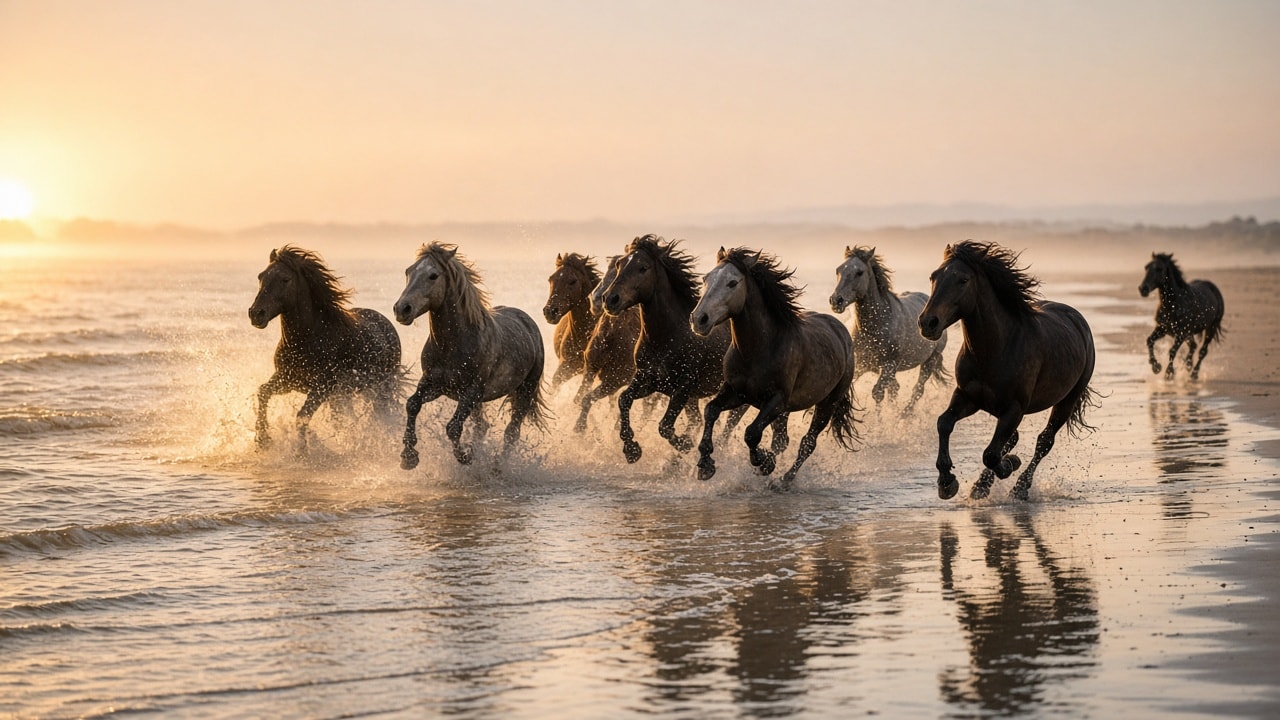
Photoreal sunrise telephoto photograph of nine wild horses, mostly black and dark brown with three greys, galloping through shallow surf on an empty beach, with backlit spray, a low sun at the left and wet-sand reflections. Step 1 of the Wild Horses Galloping Through Shallow Surf at Dawn workflow.
Photorealistic wide wildlife photograph at sunrise of a herd of nine wild horses galloping through shallow surf along an empty, wide sandy beach. Eight horses run close together in a loose line, moving left to right and slightly toward the camera, legs mid-stride: most are black and dark brown, with three dappled grey horses among them, all with long, wild, wind-tossed manes. A ninth dark horse runs alone a little further back on the right. Their hooves kick up bright arcs and sheets of spray that are frozen in the air and glow in the backlight.

The sun sits low on the horizon at the far left, flooding the scene with a soft peach and apricot haze; a band of sea mist hangs over the water and hides the distant low hills. Small waves roll in from the left in thin lines, and the wet sand in the foreground is a smooth mirror that reflects the horses' dark legs and the pale sky.

Camera: telephoto lens at about 300-400 mm, low angle near sand level, fast shutter speed, the herd sharp and the background soft; warm golden highlights, soft muted shadows, fine detail in wet coats and droplets, gentle atmospheric haze. Peaceful but powerful mood. No people, no riders, no saddles or tack, no fences, no buildings, no text. Landscape 16:9.

A structured JSON prompt that rebuilds your uploaded photo as a photorealistic portrait assembled from weathered ceramic tiles on a sage plaster wall, with seamless continuity across the grout lines and four handwritten motivational sticky notes around it.
{
  "task": "Transform the uploaded photograph into a cinematic, photorealistic vintage tiled portrait poster.",

  "reference_image": {
    "source": "Use the user's uploaded photograph as the primary identity reference.",
    "identity_preservation": "Preserve the person's exact facial identity, facial structure, skin tone, hairstyle, eye shape, and recognizable features.",
    "gender": "Automatically follow the uploaded subject.",
    "expression": "Maintain the original expression or create a subtle, confident, natural expression."
  },

  "composition": {
    "layout": "Vertical editorial poster.",
    "structure": "A large rectangular portrait assembled from approximately 4 columns and 5 rows of individual square, slightly irregular ceramic or paper tiles.",
    "portrait": "The subject occupies the central majority of the composition, visible from the head to the upper torso.",
    "tile_effect": "Every tile is physically separated by thin, dark, realistic grout lines. Slight variations in alignment, chipped edges, worn corners, and subtle shadows create an authentic handmade tiled-wall appearance.",
    "continuity": "The portrait must align seamlessly across all tiles, with facial features and body details continuing naturally across tile boundaries."
  },

  "environment": {
    "background": "Muted dusty sage-gray textured plaster wall.",
    "surface": "Aged, slightly weathered surface with subtle imperfections.",
    "lighting": "Soft natural diffused daylight with gentle shadows."
  },

  "styling": {
    "clothing": "Automatically create tasteful, sophisticated clothing that complements the subject's appearance. Prefer vintage-inspired casual or smart-casual styling.",
    "aesthetic": "Understated vintage editorial photography.",
    "color_palette": "Muted earthy browns, charcoal, dusty sage, warm beige and subtle faded tones."
  },

  "personalized_details": {
    "sticky_notes": {
      "placement": "Four small yellow handwritten sticky notes positioned around the outer edges of the tiled portrait.",
      "messages": [
        "Trust your instincts",
        "Big decisions",
        "Make it happen",
        "Stay fearless"
      ],
      "style": "Authentic handwritten black ink, slightly imperfect lettering, naturally curled paper corners and realistic shadows."
    },
    "signature": "A tiny handwritten 'prompt by @yourusername' near the bottom-left tile. Omit if no username is supplied."
  },

  "photography": {
    "style": "Ultra-realistic photographic portrait.",
    "lens": "50mm editorial portrait photography.",
    "details": "Natural skin texture, realistic hair strands, detailed fabric textures, subtle film grain and authentic photographic imperfections.",
    "color_grading": "Warm vintage film aesthetic with restrained contrast."
  },

  "quality_control": {
    "priority": [
      "Preserve the uploaded person's identity.",
      "Keep the face realistic and anatomically accurate.",
      "Ensure the tile grid is clearly visible.",
      "Maintain seamless portrait continuity across tiles.",
      "Keep sticky notes outside the main facial area.",
      "Avoid excessive AI beautification."
    ],
    "avoid": [
      "Changing facial identity",
      "Plastic-looking skin",
      "Artificial facial features",
      "Broken tile alignment",
      "Floating tiles",
      "Excessive decorative elements",
      "Cartoon or illustrated appearance",
      "Distorted text",
      "Watermarks"
    ]
  },

  "output": {
    "aspect_ratio": "3:4",
    "resolution": "High resolution",
    "rendering": "Photorealistic vintage editorial poster"
  }
}Animate the step 1 flamingo still as the first frame into a 7-second shot: the center bird beats its wings, then the flock runs and flaps across the shallow lagoon, splashing and breaking up its reflections, with a locked-off telephoto camera, slow pan and constant golden-hour light. Step 2 of the Greater Flamingo Flock on a Golden-Hour Salt Lagoon workflow.
Use the attached still (step 1: a water-level photograph of about twenty greater flamingos standing in a line across a shallow salt lagoon at golden hour, one in the center with its wings raised) as the exact first frame and animate it into a 7-second, 16:9 cinematic shot. Keep every element where it is in the still: the flamingos and their positions in the line, the raised wings of the center bird, the mirror reflections, the hazy hills, the apricot sky and the soft sun glow at the upper left.

Motion (0-7 s):
- 0-2 s: the center flamingo beats its raised wings; the birds around it lift their heads, open their wings and start stepping forward, sending ripples across the reflections.
- 2-5 s: the whole line breaks into a running display across the shallow water, long legs pattering on the surface and kicking up small splashes, wings flapping wide to show coral-pink and black flight feathers, necks stretched forward.
- 5-7 s: the flock keeps running and flapping from left to right, most birds leaving the frame on the right and a few lifting just above the water, while their reflections break into rippling pink streaks; the last few birds follow them out.

Camera: locked-off telephoto framing at water level with a very slow pan to the right; focus stays on the flock; no cuts.

Lighting and mood: constant warm golden-hour light, apricot sky and soft glints on the water; peaceful, graceful, natural.

Audio (if supported): splashing footsteps, wingbeats, soft honking calls, a light breeze; no music, no voices.

Avoid: people, boats, extra flamingos appearing from nowhere, birds merging or morphing, broken or extra legs and wings, sudden lighting changes, unnatural fast motion, text.
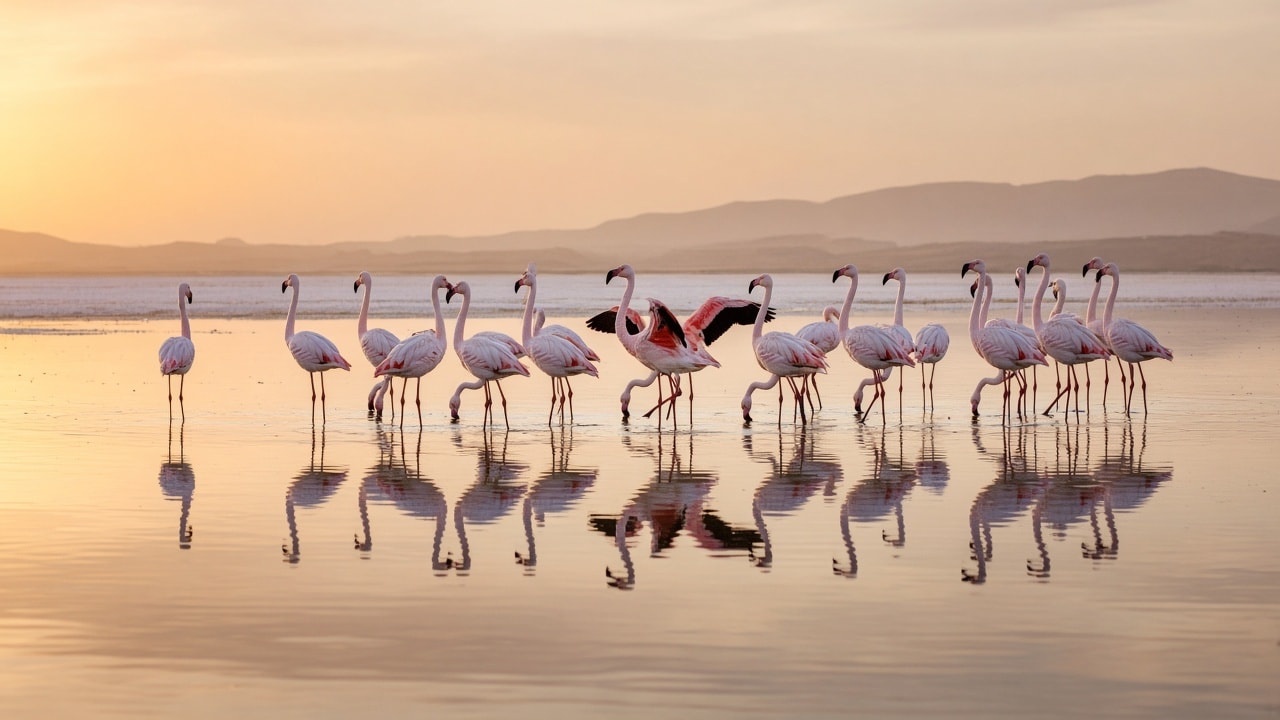
Photoreal water-level golden-hour photograph of about twenty greater flamingos standing in a line across a still salt lagoon, one in the center raising its coral and black wings, with mirror reflections, hazy hills and an apricot sky. Step 1 of the Greater Flamingo Flock on a Golden-Hour Salt Lagoon workflow.
Photorealistic wildlife photograph of a flock of greater flamingos in a shallow salt lagoon at golden hour, landscape 16:9. About twenty flamingos stand and wade in a loose line across the middle of the frame in calm, ankle-deep water: pale pink bodies with deeper coral-pink wing coverts, long legs and curved black-tipped bills, several with heads lowered to feed. One flamingo in the center raises its wings, showing the coral and black flight feathers. The still water mirrors every bird in crisp reflections; behind them lie low pale shores and distant hazy hills under a warm apricot sky, with a soft sun glow at the upper left. Camera at water level, 400 mm telephoto at f/5.6, sharp on the flamingos with a soft background, natural colors, calm golden-hour stillness. No people, no boats, no text.
Animate the step 1 hatchling still as the first frame into a 6-second shot: the ten hatchlings crawl toward the sea, a foamy wave rolls up the sand, reaches the leading ones and recedes, with a locked-off low camera, slow push-in and constant sunrise light. Step 2 of the Loggerhead Sea Turtle Hatchlings Racing to the Surf at Sunrise workflow.
Use the attached still (step 1: a low photograph of ten loggerhead sea turtle hatchlings crawling across wet sand toward the sea at sunrise) as the exact first frame and animate it into a 6-second, 16:9 cinematic shot. Keep every element where it is in the still: the ten hatchlings and their positions on the sand, the open nest hollow at the lower left, the foamy wave edge from the top center to the right, the low sun on the horizon at the right and the pink and orange sky.

Motion (0-6 s):
- 0-1.5 s: the hatchlings begin to move, flippers pushing in small alternating strokes as they crawl diagonally toward the upper right; light glints on the wet sand.
- 1.5-4 s: the hatchlings keep scrambling toward the water at a natural, slightly clumsy pace, leaving fresh flipper tracks, while a foamy wave rolls up the beach from the right and spreads over the sand toward them.
- 4-6 s: the wave's foam edge reaches the leading hatchlings and washes around their flippers, then slowly recedes, leaving a glossy reflective sheen and small bubbles on the sand as the group keeps crawling seaward.

Camera: locked-off low framing just above the sand with a very slow, slight push-in; focus stays on the nearest hatchlings; no cuts.

Lighting and mood: constant soft sunrise light, warm pink and orange reflections and a sun glint on the water; hopeful, calm, natural.

Audio (if supported): gentle surf, the soft hiss of foam on the sand, a light breeze; no music, no voices.

Avoid: people, hands, birds, extra or duplicated turtles appearing, turtles morphing or walking upright, sudden lighting changes, unnatural fast motion, text.

