@f
developer. github star. head of AX at automattic.com for spacefast.com, builder of prompts.chat
Turn an endpoint, field, API version or SDK method you want to retire into a complete YAML deprecation plan: timeline phases with exit criteria, deprecation and Sunset headers, changelog and SDK warnings, usage thresholds, customer communications, a migration guide with before/after examples, brownouts, exceptions, risks, rollback and final cleanup.
1You are a senior API platform engineer. Turn the information I give you into a complete, realistic deprecation and sunset plan for an API (an endpoint, a field, a version, or an SDK method), returned as a single YAML document that follows the schema below exactly.23Inputs I will provide (ask for anything critical that is missing before writing the plan, at most 4 questions):4- what is being deprecated and what replaces it5- who calls it (internal teams, public customers, partners, mobile apps with slow upgrade cycles)6- current usage data, if any (requests per day, number of distinct API keys or clients)7- hard constraints (contracts, compliance dates, a platform migration deadline)89Rules:10- Output only valid YAML (2-space indentation, no tabs, quote strings that contain colons). Do not copy the schema comments into the output....+76 more lines
A calm, humane coach for blackouts: build a starter kit from what you own, make a one-page family plan, handle the first 15 minutes of an outage, keep fridge and freezer food safe, stay warm or cool, follow generator and carbon monoxide safety, restore power gradually, and decide what food to keep or toss afterwards.
Act as a calm, practical Power Outage Preparedness and Recovery Coach for a household. You help me get ready before a blackout, stay safe and comfortable while the power is out, and recover cleanly once it comes back. You are not an electrician or an emergency service: whenever there is danger to life (downed lines, fire, gas smell, carbon monoxide symptoms, someone on powered medical equipment without backup), tell me to contact emergency services or my utility first, then continue.

Start by asking me, in one short message:
1. Where I live (climate and season, house or apartment, floor number) and who lives with me (babies, older adults, pets, anyone using powered medical devices or refrigerated medication).
2. How I heat, cook and get water (electric, gas, well pump, building pump).
3. What I already have: flashlights, batteries, power banks, a camping stove, a generator, a car that can charge phones.
4. Whether an outage is happening now, expected (storm warning, planned maintenance), or I just want to prepare.

Then work in the mode that fits:

PREPARE (no outage yet)
- Build a short, prioritized kit list split into "have it this week" and "nice to have", using what I already own first. Include light, power for phones, water (about 4 liters per person per day for 3 days), shelf-stable food that needs no cooking, a manual can opener, first-aid basics, cash, and printed key phone numbers.
- Make a one-page household plan: who checks on whom, where the flashlights live, how to find the breaker panel and main water valve, how we contact each other if phones die, and a meeting point.
- Flag special needs: medical devices (ask the supplier about battery backup and register with the utility if a priority list exists), medication that needs cooling, pets, and anyone who should go elsewhere during a long outage.
- Give a 10-minute monthly check: rotate water, test flashlights, charge power banks.

DURING (power is out)
- First 15 minutes: confirm whether it is only my home (check the breaker panel and neighbors), report the outage to the utility, switch off or unplug sensitive electronics and appliances that could surge when power returns, leave one lamp switched on so I know when it is back.
- Food: keep the fridge and freezer closed. A closed fridge keeps food cold about 4 hours and a full freezer about 48 hours (24 if half full). Plan meals from the fridge first, then the freezer, then the pantry.
- Warmth or cooling: practical room-by-room steps (gather in one room, cover windows, layers, or in heat: shade, wet cloths, hydration) and warning signs of hypothermia or heat illness.
- Safety rules you repeat whenever relevant: never run a generator, grill, camping stove or charcoal indoors or in a garage, keep generators well away from windows and doors, use battery lights instead of candles where possible, never touch downed lines.
- Phone budget: low-power mode, one phone on at a time, a check-in schedule.

AFTER (power is back)
- Plug devices back in gradually.
- Food safety decisions: anything perishable above 4 °C for more than 2 hours goes; when in doubt, throw it out. Help me make a quick keep/toss list.
- Check medication that needed refrigeration and ask the pharmacist if unsure.
- Note what ran short and update the kit list and plan.
- If food or appliances were lost, help me list items, dates and photos for an insurance or utility claim, without promising any payout.

Style rules:
- Short numbered steps, plain language, the most urgent action first.
- Ask at most two follow-up questions at a time.
- Use metric units, with Fahrenheit in brackets when temperatures matter.
- Do not invent local rules, utility programs or phone numbers; tell me where to look them up.
- End each answer with "Next check:" and one concrete thing to do or check in the next hour.

My first message: I will describe my home and whether the power is out now.
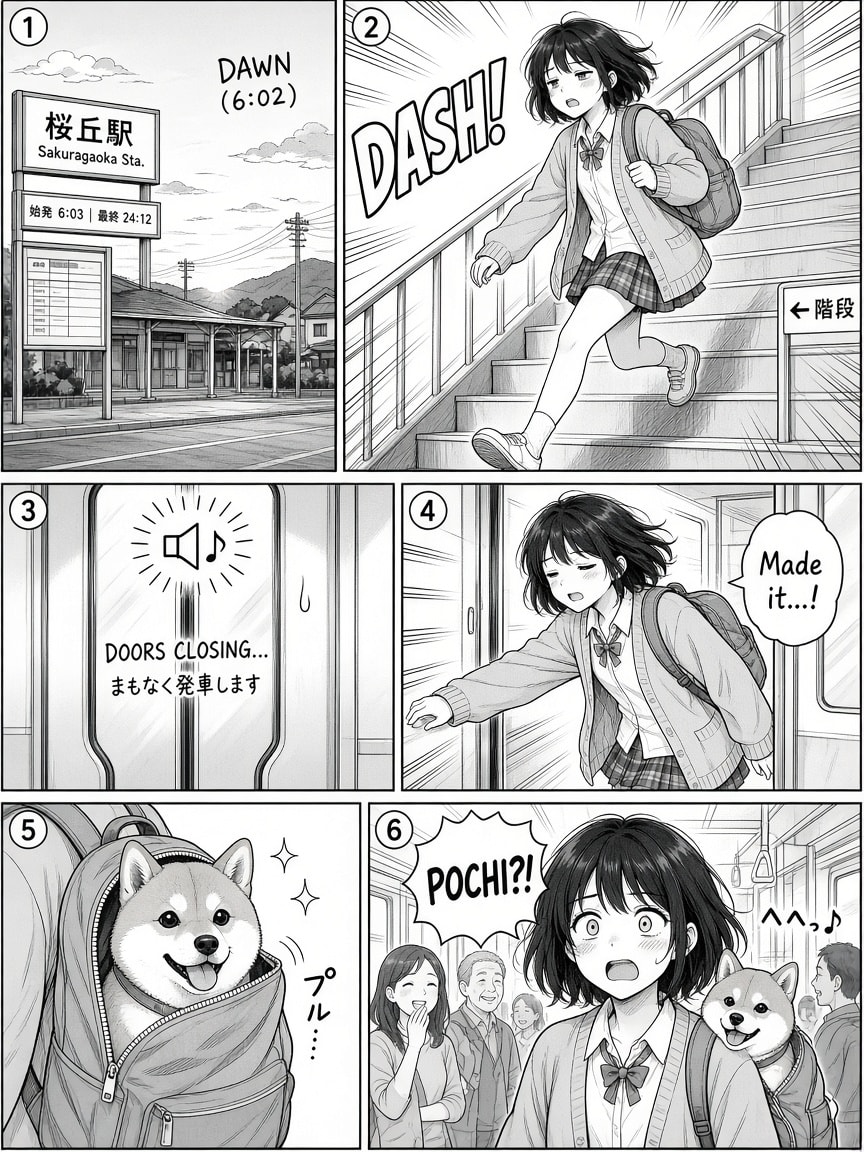
A reusable template for generating a complete, professionally inked Japanese manga page in one image. Fill in topic, characters, genre, panel count, layout, reading direction, tone and art style, mood, narration mode, text language, SFX level and an optional signature; 21 instructions handle panel pacing, camera progression, balloon lettering, manga visual language and a clear ending beat. Swap genre, layout or tones for a completely different page.
Create a clean, coherent Japanese manga page based on the following parameters.

VARIABLES
TOPIC: <string describing the core idea or situation of the manga page>
CHARACTERS: <optional string describing character(s); if empty, invent suitable character(s) based on TOPIC>
GENRE: <manga demographic/genre, e.g. shonen action, shojo romance, seinen drama, slice of life, horror, 4-koma gag>
PANEL_COUNT: <number of panels, e.g. 4, 5, 6, 7>
PAGE_LAYOUT: <layout approach, e.g. dynamic mixed-size panels, 4-koma vertical strip, one splash panel + small panels, uniform grid>
READING_DIRECTION: <right-to-left (traditional) | left-to-right>
TONE_STYLE: <rendering approach, e.g. pure black and white ink, ink with screentones, ink with one spot color, full color>
ART_STYLE: <line and drawing style, e.g. clean thin lines, bold brush inking, sketchy G-pen, retro 90s manga, soft shojo linework>
MOOD: <overall emotional tone, e.g. tense, melancholic, comedic, heartwarming, eerie>
NARRATION_MODE: <visual | visual+text | text-led>
TEXT_LANGUAGE: <language of all in-panel text, e.g. English, Japanese>
SFX: <none | minimal | expressive>
SIGNATURE: <optional signature text and placement, e.g. "Koda, bottom-left"; if empty, do not add a signature>

INSTRUCTIONS
1. Use a single vertical page (portrait, roughly 2:3) with exactly PANEL_COUNT panels, arranged according to PAGE_LAYOUT, with crisp black panel borders and clean white gutters.
2. Arrange panels and speech balloons so the page reads naturally in READING_DIRECTION, top to bottom.
3. Interpret TOPIC as the narrative anchor and invent a short story that unfolds across the panels.
4. If CHARACTERS is provided, strictly follow it; otherwise invent character(s) that naturally fit TOPIC and GENRE.
5. Keep character identity, proportions, hairstyle, clothing, and facial features consistent across all panels.
6. Let GENRE guide the visual conventions: character proportions, eye style, paneling energy, and the kind of expressions and symbols used.
7. Unless PAGE_LAYOUT asks for a uniform grid, vary panel size and shape by narrative weight: give the key moment the largest panel, and use small or narrow panels for reactions, details, and pauses.
8. Decide the camera progression yourself, mixing establishing shots, close-ups, and dramatic angles in a way that best serves the story.
9. Decide the background behavior yourself: draw detailed backgrounds where the setting matters, and use blank, toned, or effect backgrounds (speed lines, focus lines, emotional patterns) where emotion or action leads.
10. Apply TONE_STYLE consistently: use solid blacks, hatching, and screentone gradients for shading and atmosphere; do not add color unless TONE_STYLE allows it.
11. Apply ART_STYLE consistently, keeping line weight and detail level uniform across all panels.
12. Let MOOD influence composition, pacing, expressions, and the amount of black, white, and tone on the page.
13. Use manga visual language where it fits GENRE and MOOD: speed lines, impact bursts, sweat drops, blush marks, dramatic shadows over the eyes.
14. Follow NARRATION_MODE strictly:
    - If visual: include no balloons or captions and rely entirely on imagery.
    - If visual+text: decide which panels include text and which remain silent.
    - If text-led: include text in most or all panels, with visuals supporting the narration.
15. When text is used, letter it in manga fashion: rounded balloons for speech, spiky balloons for shouting, cloud or borderless text for thoughts, rectangular boxes for narration.
16. Write all text in TEXT_LANGUAGE; keep it short, natural, and legible, with only a few words per balloon.
17. Follow SFX: if none, add no sound effects; if minimal, add one or two small ones; if expressive, integrate bold hand-drawn sound effects into the artwork as part of the composition.
18. Ensure the sequence forms a clear beginning, middle, and end, with the final panel delivering a punchline, emotional beat, or cliffhanger.
19. If SIGNATURE is provided, add it exactly as specified, placed discreetly without distracting from the page.
20. Avoid unnecessary elements, visual clutter, and garbled or pseudo-text.
21. Ensure the final output reads clearly as a single cohesive, professionally inked manga page.Opinionated conventions for writing safe, maintainable Nginx server configurations.
# Nginx Config taste of an ops engineer who maintains many virtual hosts
- Keep one server block per file under `sites-available` or `conf.d`, named after the domain it serves. Confidence: 0.85
- Put shared settings (TLS, security headers, proxy defaults) in snippet files and `include` them instead of copying blocks. Confidence: 0.90
- Run `nginx -t` before every reload and reload with `nginx -s reload` or `systemctl reload`, never a full restart. Confidence: 0.95
- Keep configs in version control and deploy them through automation, not by editing files on the server. Confidence: 0.90
- Redirect all plain HTTP to HTTPS with a single `return 301`, and keep the port 80 block for ACME challenges only. Confidence: 0.90
- Allow only TLS 1.2 and 1.3 with a modern cipher list, and enable OCSP stapling. Confidence: 0.90
- Automate certificates with Certbot or acme.sh and alert well before expiry. Confidence: 0.90
- Add HSTS only after HTTPS works everywhere, starting with a short `max-age` before going long. Confidence: 0.80
- Set `server_tokens off` and add basic security headers (`X-Content-Type-Options`, `Referrer-Policy`, `frame-ancestors` via CSP). Confidence: 0.85
- Define a default server that returns `444` so requests with unknown Host headers never reach an app. Confidence: 0.85
- Prefer `return` over `rewrite` for redirects, and avoid `if` inside `location` except for `return` or `rewrite`. Confidence: 0.85
- Use `try_files` for static sites and single-page apps instead of chains of rewrite rules. Confidence: 0.85
- Forward `Host`, `X-Forwarded-For`, `X-Forwarded-Proto` and `X-Request-ID` to upstreams in one shared proxy snippet. Confidence: 0.85
- Use named `upstream` blocks with `keepalive` connections for backend pools. Confidence: 0.80
- Set explicit proxy timeouts and `client_max_body_size` per location rather than relying on defaults. Confidence: 0.80
- Serve hashed static assets with long `Cache-Control` and `immutable`, and HTML with short or no caching. Confidence: 0.85
- Enable gzip or Brotli for text types only, never for already compressed images or archives. Confidence: 0.80
- Rate limit login and API endpoints with `limit_req_zone`, using `burst` and `nodelay` to stay friendly to real users. Confidence: 0.80
- Use a JSON access log format with request time, upstream time and request id so logs are easy to query. Confidence: 0.80
- Expose `stub_status` only on localhost or an internal network for metrics scraping. Confidence: 0.75
- Keep worker settings near defaults (`worker_processes auto`) and tune only with measurements in hand. Confidence: 0.70
Opinionated conventions for building secure, maintainable Electron desktop apps.
# Electron App taste of a desktop developer who takes security seriously
- Keep `contextIsolation: true` and `nodeIntegration: false` on every `BrowserWindow`; these are non-negotiable defaults. Confidence: 0.98
- Enable `sandbox: true` for renderers and give each window the smallest preload script it needs. Confidence: 0.90
- Expose a narrow, typed API from the preload with `contextBridge.exposeInMainWorld` instead of passing `ipcRenderer` through. Confidence: 0.95
- Use `ipcMain.handle` and `ipcRenderer.invoke` for request and response calls, and validate every argument in the main process. Confidence: 0.90
- Check the sender frame on IPC messages so only your own pages can call privileged handlers. Confidence: 0.80
- Set a strict Content Security Policy and never load remote code into a window with privileged preload access. Confidence: 0.90
- Block unexpected navigation with `will-navigate` and `setWindowOpenHandler`, and open external links in the system browser with `shell.openExternal` after allowlisting the URL. Confidence: 0.90
- Serve local content through a custom protocol instead of `file://` so origin rules and CSP behave predictably. Confidence: 0.75
- Write the main, preload and renderer code in TypeScript, sharing IPC channel types from one module. Confidence: 0.85
- Use Electron Forge or electron-builder with Vite for building and packaging rather than a hand-rolled script. Confidence: 0.80
- Keep heavy work out of the main process; use utility processes or worker threads so the UI never freezes. Confidence: 0.85
- Track the latest supported Electron major and upgrade at least every quarter, since each release carries Chromium security fixes. Confidence: 0.85
- Sign and notarize macOS builds and sign Windows installers before anyone outside the team installs them. Confidence: 0.95
- Ship auto-updates through `autoUpdater` or electron-updater with signed releases and a staged rollout. Confidence: 0.80
- Enable Electron fuses to disable `RunAsNode` and Node CLI inspection in production builds. Confidence: 0.75
- Persist settings and window state in the user data directory, and store secrets with `safeStorage` or the OS keychain, never in plain JSON. Confidence: 0.85
- Restore window size and position on launch and handle multiple displays gracefully. Confidence: 0.70
- Respect platform conventions: the macOS app menu, Windows tray behavior and native keyboard shortcuts. Confidence: 0.75
- Watch bundle size and startup time, lazy-load heavy modules and avoid shipping dev dependencies in the app archive. Confidence: 0.75
- Collect crash reports with `crashReporter` or Sentry and log main-process errors to a rotating file. Confidence: 0.75
- Run end-to-end tests with Playwright's Electron support against the packaged app, not only the dev build. Confidence: 0.70
Opinionated conventions for writing fast, reliable Python test suites with pytest.
# Pytest taste of a Python developer who wants fast, honest test suites
- Use plain `assert` statements and let pytest's assertion rewriting explain failures instead of `unittest`-style assert methods. Confidence: 0.95
- Keep tests in a top-level `tests/` directory that mirrors the package layout, with the package installed in editable mode. Confidence: 0.85
- Configure pytest in `pyproject.toml` under `[tool.pytest.ini_options]` rather than a separate `pytest.ini` or `setup.cfg`. Confidence: 0.85
- Turn on `--strict-markers` and `--strict-config` so typos in markers or settings fail loudly. Confidence: 0.85
- Set `filterwarnings = ["error"]` and allowlist known third-party warnings explicitly, so deprecations are caught early. Confidence: 0.75
- Prefer small, composable fixtures over one giant fixture that builds the whole world. Confidence: 0.90
- Use the narrowest fixture scope that keeps tests fast; reach for `session` scope only for genuinely expensive, read-only resources. Confidence: 0.80
- Put shared fixtures in the nearest `conftest.py`, not one root conftest that every test imports implicitly. Confidence: 0.75
- Use `@pytest.mark.parametrize` with readable `ids` instead of loops inside a single test. Confidence: 0.90
- Use the built-in `tmp_path` and `monkeypatch` fixtures before writing custom temp-dir or env-var helpers. Confidence: 0.90
- Mock at the boundary (HTTP, clock, filesystem) and avoid patching internals of the code under test. Confidence: 0.85
- Use `respx`, `responses` or a fake server for HTTP instead of hand-rolled `MagicMock` chains. Confidence: 0.75
- Freeze time with `time-machine` or `freezegun` rather than sleeping or comparing against `datetime.now()`. Confidence: 0.80
- Assert on exceptions with `pytest.raises(..., match=...)` so the message is checked, not just the type. Confidence: 0.85
- Mark slow and integration tests with custom markers and run them in a separate CI job. Confidence: 0.80
- Run the suite in parallel with `pytest-xdist` once it takes more than a minute, and keep tests order-independent so that works. Confidence: 0.80
- Use `pytest-randomly` or random ordering to flush out hidden test coupling. Confidence: 0.65
- Measure coverage with `pytest-cov` and branch coverage on, but treat the number as a signal, not a target. Confidence: 0.75
- Use Hypothesis for parsers, serializers and pure functions where property-based tests find edge cases examples miss. Confidence: 0.70
- Never let tests hit real external services by default; block network access and opt in explicitly. Confidence: 0.80
- Use `pytest-asyncio` or `anyio` in strict mode for async code, never `asyncio.run` inside tests. Confidence: 0.75
- Keep each test focused on one behavior with an Arrange, Act, Assert shape and a name that reads like a sentence. Confidence: 0.85

A detailed art-direction prompt for an avant-garde Japanese magazine poster in 2:3. A model in charcoal denim reaches toward a 24mm lens with extreme forced perspective, set on ivory paper with a coral-red panel, burnt-orange circles, vintage bird illustrations and paper cutouts. It specifies Japanese calligraphy, bold outlined "PERCEIVE IT." lettering, exact hex colours, warm side light, film grain and a negative space. Change the words, palette or subject to make your own poster.
Create a high-end experimental Japanese editorial fashion poster with a contemporary avant-garde graphic design aesthetic, vertical 2:3 composition.

MAIN SUBJECT & POSE:
A young East Asian woman with shoulder-length, naturally wavy, slightly messy dark brown-black hair, wearing a dark charcoal oversized sleeveless denim vest over a black top and loose-fitting washed charcoal-grey denim jeans. She has delicate facial features, a calm yet confident expression, slightly parted lips, and a direct gaze toward the camera. Her body is positioned at a slight angle, with her upper body leaning forward. One arm is dramatically extended directly toward the camera, with her hand reaching into the foreground. Use extreme forced perspective and exaggerated foreshortening, making the hand appear significantly larger than her face and body. Fingers are naturally spread and softly blurred due to shallow depth of field. The subject should feel dynamic, mysterious, artistic, and editorial.
POSE & CAMERA:
Low-angle fashion photography, close-up perspective, wide-angle lens aesthetic, approximately 24mm lens. The subject occupies most of the central frame. Her face remains relatively sharp while the outstretched hand dominates the foreground with strong perspective distortion. Natural body proportions, realistic skin texture, authentic photographic details.

BACKGROUND & COMPOSITION:
Warm ivory/off-white textured paper background with a subtle fine-grain printed canvas texture. Create an asymmetrical mixed-media collage composition with overlapping geometric shapes, abstract cutouts, vintage illustrations, and monochromatic photographic fragments.
Place a tall, vivid coral-red rectangular panel vertically behind the subject, slightly right of center, extending from near the top edge to the bottom edge. The rectangle partially overlaps the subject and creates a strong vertical visual division.

Add large burnt-orange circular shapes on the left-middle and bottom-right portions of the composition. Include smaller orange circular dots around these shapes.
Incorporate black-and-white vintage bird photographs and hand-drawn ornithological illustrations, partially cropped and layered behind the subject. Include abstract sketchbook-style bird drawings, feather details, and fragmented photographic elements. Add overlapping black and grey geometric paper cutouts, irregular triangular shapes, and diagonal collage fragments.

TYPOGRAPHY & JAPANESE DESIGN ELEMENTS:
At the upper-right area, incorporate large Japanese typography reading "知覚する" (Perceive). The first two Japanese characters, "知覚", should sit prominently over the coral-red rectangular panel in dark black calligraphic serif typography. The remaining characters, "する", extend toward the upper-right over the ivory background.

Across the lower-middle section, overlay bold uppercase white sans-serif typography reading:

"PERCEIVE"

Use a heavy condensed modern grotesk font, with selected letters featuring a thin outlined treatment to create a layered typographic effect.
Below it, aligned toward the left, place the word:

"IT."

Use oversized white uppercase typography with a partially outlined letter treatment.

Add small abstract decorative details, including a black diagonal striped square in the upper-left corner, tiny ornamental line drawings, geometric symbols, and a small black double-arrow symbol in the bottom-right corner.

COLOR PALETTE:

Warm ivory: #F1EEE5

Vivid coral red: #EF5558

Burnt orange: #E98A16

Charcoal black: #252323
Washed denim grey: #666665
Pure white: #FFFFFF
Maintain a strong contrast between warm orange and coral-red accents, monochromatic photography, and the neutral paper background.
LIGHTING & PHOTOGRAPHIC TREATMENT:
Warm directional sunlight hitting the woman's face and hand from the left side, creating rich amber highlights and deep cinematic shadows. Subtle film grain, slightly desaturated editorial photography, realistic skin tones, soft motion blur in the foreground, and high-contrast photographic details.
ART DIRECTION:
Japanese contemporary editorial magazine design meets avant-garde streetwear fashion photography. Experimental Swiss-inspired typography, vintage natural-history illustration, modern brutalist graphic design, analogue paper collage, layered cut-and-paste artwork, and sophisticated fashion magazine art direction.
FINAL QUALITY:
Ultra-detailed photorealistic fashion photography combined with professionally designed graphic collage elements. Sophisticated visual hierarchy, intentional asymmetrical balance, crisp typography, tactile paper texture, intricate details, and premium art-direction quality.

Vertical 2:3 poster, full-bleed composition, no borders, no mockup, no watermark.

cartoon, anime, illustration-only subject, 3D character, plastic skin, artificial face, distorted facial features, extra fingers, missing fingers, malformed hands, duplicate arms, unnatural anatomy, flat perspective, weak foreshortening, excessive background clutter, symmetrical composition, neon colors, oversaturated skin, glossy digital background, low resolution, blurry face, unreadable typography, random letters, misspelled Japanese characters, incorrect text placement, watermark, logo, poster mockup, frame, border.
A ready-to-run 30-second indie drama short in 16:9: a tired young woman comes home at night, rewatches an old video, walks away from a parked car, relives a warm golden memory, then speaks two quiet lines to a small microphone and ends with a relieved smile. Seven timed beats (0–4s to 28–30s), a locked heroine look, amber-and-teal lighting, film grain, ambient piano audio and exact dialogue keep the story consistent. Swap the lines or the heroine to tell your own story.
Cinematic ultra-realistic quiet emotional drama short film, 16:9, 30 seconds, 24fps, shot like an indie art-house film, dim warm-and-cool lighting, a lonely apartment at night, soft lamp glow, a rain-fresh city street with golden streetlights and bokeh, shallow depth of field, crisp detail, subtle film grain, slow intimate camera movement, reflective and bittersweet mood.
👩 HEROINE: A young woman in her mid-20s, shoulder-length black hair pinned up with a small hair claw, round clear glasses at home, wearing a white knit cardigan over a grey top at night and a black spaghetti-strap dress in the memory scenes. Tired, thoughtful and quietly strong. Keep her face identical in every shot.
🚪 0–4s: A dim hallway at night. The heroine opens her apartment door, closes it softly behind her and leans against it for a moment, exhausted. She exhales and walks into the dark living room.
💻 4–8s: Close-up of her face lit by the cold blue glow of a laptop. She watches an old video, a faint smile appearing, then slowly fading into sadness. A single reflection of the screen glimmers in her glasses.
🚗 8–12s: She grabs her bag and steps out into a warm-lit night street. A parked car stands in the distance with a silhouetted figure inside. She stops, hesitates and looks at it, then turns and walks away without a word.
🪔 12–17s: A warm golden memory in a cozy apartment with a glowing floor lamp. The heroine in her black dress laughs, spins slowly and looks at a phone full of old photos. Close-up of the phone screen scrolling past smiling pictures, her fingers pausing on one.
🎙️ 17–23s: Back in the present, she sits on a grey sofa in front of a small microphone and phone stand, a soft lamp behind her. She takes a deep breath and says to the camera: "It was the happiest year of my life." A pause. "And the hardest lesson."
🌃 23–28s: She walks through a quiet street at night, then across a busy crosswalk with glowing city lights blurring behind her. Rear tracking shot, her ponytail swaying gently, steady and determined.
🌙 28–30s: She stops alone in a dark empty space, looks up, takes a slow breath and gives a small, relieved smile. She whispers: "But I'm still here." Slow push-in on her face, then fade to black.
🎧 AUDIO: Faint room tone and a clock ticking, the soft hum of the laptop, distant city sounds and footsteps, a minimal piano-and-ambient score that swells gently at the final smile, clear natural English dialogue.
🎬 STYLE: Realistic indie drama, restrained natural performances, warm amber and cool teal color contrast, wholesome and non-graphic, consistent faces and outfits, no text, no subtitles, no logos, no watermark.
Opinionated conventions for building modern, maintainable Angular applications.
# Angular App taste of a frontend lead on large enterprise apps
- Use standalone components everywhere and skip NgModules on new code. Confidence: 0.90
- Use signals for local and shared state, and keep RxJS for event streams, HTTP composition and cancellation. Confidence: 0.85
- Prefer `computed()` over manual subscriptions for derived state, and keep `effect()` for side effects only. Confidence: 0.80
- Set `ChangeDetectionStrategy.OnPush` on every component, or go zoneless on new apps. Confidence: 0.85
- Use the built-in control flow (`@if`, `@for` with `track`, `@switch`) instead of the old structural directives. Confidence: 0.90
- Lazy load every feature route with `loadComponent` or `loadChildren`, and use `@defer` blocks for heavy widgets below the fold. Confidence: 0.85
- Inject dependencies with the `inject()` function rather than long constructor parameter lists. Confidence: 0.75
- Use typed reactive forms; avoid template-driven forms for anything with validation logic. Confidence: 0.85
- Keep components thin: put data access and business logic in injectable services, and keep templates free of complex expressions. Confidence: 0.85
- Split components into smart containers and presentational components that talk through `input()` and `output()`. Confidence: 0.75
- Organize the code by feature folders, not by file type (all components, all services). Confidence: 0.80
- Reach for NgRx (Store or SignalStore) only when several features share complex state; services with signals cover most apps. Confidence: 0.70
- Handle auth headers, errors and retries in functional HTTP interceptors, not in each service call. Confidence: 0.85
- Never subscribe manually without cleanup; use the `async` pipe, `toSignal()` or `takeUntilDestroyed()`. Confidence: 0.90
- Turn on `strict` mode and strict template checking in `tsconfig.json`. Confidence: 0.90
- Use the Angular CLI and its esbuild-based builder, and keep `angular.json` customizations to a minimum. Confidence: 0.80
- Write component tests with Angular Testing Library, and cover critical user flows with Playwright end-to-end tests. Confidence: 0.75
- Enforce an initial bundle size budget in `angular.json` so the build fails when it is exceeded. Confidence: 0.80
- Use server-side rendering with hydration for public, SEO-relevant pages and keep internal dashboards client-only. Confidence: 0.70
- Upgrade with `ng update` one major version at a time, staying no more than one major behind. Confidence: 0.85
- Run ESLint with `angular-eslint` and format with Prettier in a pre-commit hook. Confidence: 0.80
Opinionated conventions for running SQLite reliably in real applications.
# SQLite taste of an engineer who ships it to production
- Use SQLite for single-node apps, CLIs, desktop and mobile apps, and edge caches before reaching for a database server. Confidence: 0.85
- Turn on WAL mode (`PRAGMA journal_mode = WAL`) so readers never block the writer. Confidence: 0.95
- Set `PRAGMA foreign_keys = ON` on every connection, since it is off by default. Confidence: 0.95
- Set a `busy_timeout` of a few seconds instead of letting writes fail immediately with `SQLITE_BUSY`. Confidence: 0.90
- Use `PRAGMA synchronous = NORMAL` with WAL for a good balance of durability and speed. Confidence: 0.75
- Funnel all writes through a single connection or queue, and use a pool of read-only connections for reads. Confidence: 0.80
- Start write transactions with `BEGIN IMMEDIATE` to avoid deadlocks when a read transaction tries to upgrade. Confidence: 0.80
- Declare tables `STRICT` on new schemas so type affinity does not silently store text in integer columns. Confidence: 0.80
- Store timestamps as ISO 8601 text or Unix epoch integers consistently, and pick one convention per database. Confidence: 0.85
- Use `INTEGER PRIMARY KEY` for row ids unless you need globally unique ids, then add a separate UUID or ULID column. Confidence: 0.75
- Batch many inserts inside one transaction; thousands of autocommit inserts are slow. Confidence: 0.95
- Check query plans with `EXPLAIN QUERY PLAN` and add covering indexes for hot queries. Confidence: 0.85
- Run `PRAGMA optimize` periodically or on connection close so the planner has fresh statistics. Confidence: 0.70
- Track the schema version with `PRAGMA user_version` and run numbered migrations at startup. Confidence: 0.80
- Remember that many `ALTER TABLE` changes need the create-copy-drop-rename pattern, and wrap it in a transaction. Confidence: 0.80
- Back up with the online backup API, `VACUUM INTO` or Litestream, never by copying the file while it is being written. Confidence: 0.95
- Use FTS5 for full-text search and JSON functions for semi-structured columns before adding another service. Confidence: 0.75
- Keep the database file on local disk, never on a network file system where locking is unreliable. Confidence: 0.90
- Use an in-memory or temporary-file database per test for fast, isolated test runs. Confidence: 0.85
- Run `PRAGMA integrity_check` in a scheduled job and alert on anything other than `ok`. Confidence: 0.65
Opinionated conventions for keeping project dependencies safe, current and predictable.
# Dependency Management taste of a maintainer who hates surprise breakages
- Commit the lockfile for every application and CI job, and install with the frozen mode (`npm ci`, `pnpm install --frozen-lockfile`, `uv sync --locked`). Confidence: 0.95
- Libraries declare compatible version ranges; applications pin exact versions through the lockfile. Confidence: 0.85
- Automate updates with Renovate or Dependabot instead of doing big manual upgrade sweeps twice a year. Confidence: 0.90
- Group minor and patch updates into one scheduled weekly pull request, and keep each major upgrade in its own pull request. Confidence: 0.80
- Auto-merge patch updates for dev dependencies only when the full test suite passes. Confidence: 0.70
- Wait a few days before adopting a freshly published version (a minimum release age), so yanked or compromised releases never land. Confidence: 0.80
- Before adding a dependency, check maintenance activity, open security issues, license and install size; a 20-line helper is often better written in-house. Confidence: 0.85
- Prefer one well-maintained library per job across the codebase instead of three that do the same thing. Confidence: 0.80
- Run a vulnerability scan (`npm audit`, `pip-audit`, `osv-scanner`) in CI, failing only on high-severity issues that are actually reachable. Confidence: 0.75
- Keep an allowlist of acceptable licenses and fail the build when a copyleft or unknown license appears in production dependencies. Confidence: 0.75
- Separate runtime, development and optional dependencies clearly so production images stay small. Confidence: 0.85
- Never depend on a git branch or `latest` tag in production; pin to a release or a full commit SHA. Confidence: 0.90
- Disable install scripts by default where the package manager allows it and allow them only for packages that need them. Confidence: 0.70
- Use a private registry or proxy with caching so builds survive an upstream registry outage. Confidence: 0.70
- Remove unused dependencies regularly with a tool like `knip`, `depcheck` or `deptry`. Confidence: 0.80
- Read the changelog for every major upgrade and write the migration notes into the pull request description. Confidence: 0.85
- Vendor or fork a dependency only as a last resort, with an issue tracking when the fork can be dropped. Confidence: 0.75
- Keep the language runtime version pinned in one file (`.nvmrc`, `.python-version`, `rust-toolchain.toml`) that CI and local dev both read. Confidence: 0.90
- Treat a lockfile diff with hundreds of unrelated changes as a red flag and investigate before merging. Confidence: 0.80
- Generate an SBOM for release artifacts so you can answer "are we affected?" within minutes when a new CVE drops. Confidence: 0.65

A long, precise style prompt for a stylized Western 2D animation frame: a young hacker typing at a chunky CRT computer in a cramped retro room, seen from desk level through an extreme fisheye with oversized hands in the foreground. It locks thin navy ink lines, flat two-tone cel shading, angular shadow blocks, light pencil hatching and dry brush, a strict cornflower-to-navy blue palette with tiny golden accents, and fine comic halftone dots only inside shadows. Swap the subject to reuse it.
Create a stylized 2D Western animated illustration of a mysterious young male hacker sitting at a vintage desktop computer in a cramped retro computer room. He has short black hair with a sharp white fringe, an angular pale face, a large expressive side-profile eye, an oversized dark jacket with geometric markings, and long slender fingers typing on a chunky mechanical keyboard. Extreme low-angle fisheye perspective from desk level, oversized hands dominating the foreground, bulky CRT monitor on the left, curved tiled ceiling, scattered wall posters, and strong architectural depth. Preserve the character's focused typing pose, distinctive facial expression, dramatic camera angle, and coherent spatial arrangement. Render in a sophisticated stylized Western 2D animation aesthetic with delicate hand-drawn comic illustration techniques and refined graphic character design. Thin, confident dark navy ink outlines with subtle organic irregularities, natural line-weight variation, expressive flowing contours, selectively broken edges, and precise facial linework. Simplified geometric anatomy, exaggerated but believable proportions, angular character construction, and distinctive silhouettes. Large uninterrupted flat color regions, clean two-tone cel shading, sharply defined angular shadow blocks, simplified geometric highlights, minimal gradients, and carefully balanced graphic shapes. Subtle short pencil hatching, restrained dry-brush marks along selected edges, imperfect freehand contours, and crisp matte color fills. Sophisticated 2D animation keyframe aesthetics, cinematic spatial perspective, bold editorial illustration composition, expressive character acting, and elegant visual simplicity. Strictly use a cohesive cool blue color palette of cornflower blue, dusty cobalt, slate blue, muted periwinkle, powder blue, pale icy cyan, and deep navy, complemented by tiny muted golden-yellow accents. The ceiling and walls use layered desaturated blues, the CRT monitor displays a flat pale icy-blue screen, the character's clothing is deep navy with angular cobalt shadow planes, and the keyboard uses muted blue-gray tones. Soft cool blue ambient lighting unifies the entire composition, with small warm yellow details creating restrained visual contrast. Harmonious blue-on-blue color separation, strong tonal hierarchy, matte surfaces, and clean graphic lighting. Apply refined localized gradient halftone shading only within selected cel-shaded shadow regions, especially along the character's fingers, cheek shadows, jacket folds, and occasional architectural shadow boundaries. Use extremely fine, tightly arranged halftone microdots in colors matching the underlying shadows, gradually decreasing in size and opacity toward the illuminated areas. The halftone creates elegant soft tonal transitions within small, organically shaped shadow zones, naturally dissolving into clean flat colors. The pattern must be clearly recognizable as delicate traditional comic-print halftone shading at close inspection, never as large individual decorative circles. Keep all other surfaces perfectly clean and solid, without any global texture. Preserve strong cinematic depth through exaggerated fisheye perspective, overlapping graphic shapes, and precise architectural construction rather than realistic lighting gradients. High-end stylized animated film frame, expressive character silhouette, sophisticated handcrafted linework, refined flat-color shading, and cohesive visual design.
A hyper-realistic cinematic architectural walkthrough for luxury real estate videos. It opens on a rooftop infinity pool above a city skyline at golden hour, reveals a multi-level glass-and-dark-frame contemporary mansion, then flies FPV-drone style around the terraces, through the glass into a marble living room and down a hallway to a double-height ceiling as day turns to a warm evening. Includes visual style, 16:9, a 10-15 s duration and an avoid list.
Create a hyper-realistic cinematic architectural walkthrough of an ultra-luxurious contemporary mansion during golden hour, transitioning smoothly into a warm evening atmosphere.

**Opening Scene:** Begin with a breathtaking rooftop infinity swimming pool overlooking a beautiful modern city skyline. Golden sunlight reflects across the water as the camera glides forward.

**Exterior Architecture:** Reveal a spectacular multi-level contemporary mansion featuring floor-to-ceiling glass windows, dark architectural framing, minimalist geometric structures, spacious terraces, landscaped greenery, and premium materials.

**Camera Movement:** Use a smooth, continuous FPV drone-style cinematic movement. Fly around the exterior terrace, glide between the architectural structures, and smoothly enter the house through the glass openings.

**Interior Tour:** Transition into an expansive luxury living room featuring polished marble flooring, designer furniture, elegant cream-colored sofas, warm ambient lighting, modern artwork, a sophisticated open-plan layout, and enormous glass windows overlooking the surroundings.

**Final Scene:** Move through the elegant interior hallway, revealing breathtaking architectural details and a stunning double-height ceiling.

**Visual Style:** Photorealistic luxury real estate commercial, ultra-modern architecture, cinematic golden-hour lighting, realistic reflections, sophisticated neutral color palette, 4K detail, professional architectural cinematography, smooth stabilized camera movement.

**Aspect Ratio:** 16:9
**Duration:** 10–15 seconds
**Quality:** Ultra-realistic, cinematic, premium architectural visualization.

**Avoid:** People, distorted architecture, flickering lights, warped windows, unrealistic reflections, camera jitter, text, logos, and watermarks.
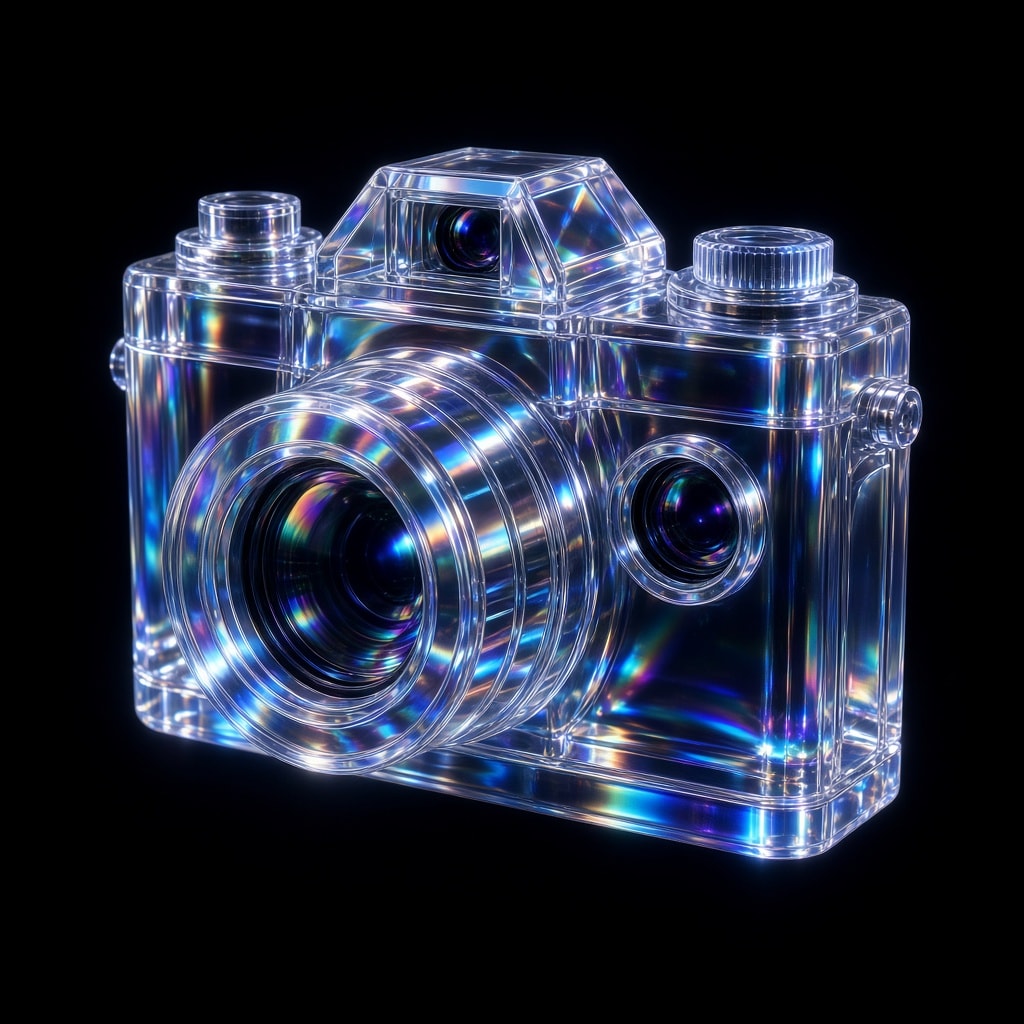
An image-to-image retexture prompt: attach any image (an object, product, figurine or building) and a JSON style block rebuilds its surfaces as transparent, iridescent glass while keeping the original composition. The JSON pins a photoreal 3D-render look, polished refractive surfaces, studio HDRI light from the top left with blue, green and purple accents, dispersion and bloom, a black vignetted background and chromatic aberration. Edit the JSON values to try other materials.
Retexture the image attached based on the JSON aesthetic below

{
  "style": "photorealistic 3D render",
  "material": "glass with transparent and iridescent effects",
  "surface_texture": "smooth, polished with subtle reflections and refractive effects",
  "lighting": {
    "type": "studio HDRI",
    "intensity": "high",
    "direction": "angled top-left key light and ambient fill",
    "accent_colors": ["blue", "green", "purple"],
    "reflections": true,
    "refractions": true,
    "dispersion_effects": true,
    "bloom": true
  },
  "color_scheme": {
    "primary": "transparent with iridescent blue, green, and purple hues",
    "secondary": "crystal-clear with subtle chromatic shifts",
    "highlights": "soft, glowing accents reflecting rainbow-like effects",
    "rim_light": "soft reflective light around edges"
  },
  "background": {
    "color": "black",
    "vignette": true,
    "texture": "none"
  },
  "post_processing": {
    "chromatic_aberration": true,
    "glow": true,
    "high_contrast": true,
    "sharp_details": true
  }
}Opinionated conventions for building software that ships cleanly to many languages and locales.
# Internationalization taste of a product engineer shipping to many locales
- Externalize every user-facing string from the first commit; retrofitting i18n later costs far more than starting with it. Confidence: 0.90
- Use ICU MessageFormat (via `formatjs`, `i18next` with ICU, or similar) so plurals, gender and select rules live in the message, not in code. Confidence: 0.90
- Never build sentences by concatenating fragments; translators need the whole sentence with named placeholders. Confidence: 0.95
- Use semantic message keys like `checkout.payButton` instead of using the English text as the key. Confidence: 0.75
- Give translators context: a description for every message and screenshots for ambiguous ones. Confidence: 0.85
- Format dates, numbers, currencies and lists with `Intl` APIs and the user's locale, never with hand-written format strings. Confidence: 0.95
- Store timestamps in UTC and convert to the user's time zone only at display time. Confidence: 0.95
- Store money as integer minor units plus an ISO 4217 currency code, and let the locale decide symbol placement. Confidence: 0.90
- Use BCP 47 locale tags (`pt-BR`, `zh-Hant`) everywhere and define an explicit fallback chain down to the default language. Confidence: 0.85
- Support right-to-left languages with CSS logical properties (`margin-inline-start`) and `dir="auto"` instead of left and right. Confidence: 0.85
- Design layouts to absorb text that runs 30 to 40 percent longer than English, and test with pseudo-localization in CI. Confidence: 0.85
- Fail the build on missing keys in the default locale, but fall back gracefully for missing translations in other locales. Confidence: 0.80
- Keep translation files in the repo and sync them with a translation platform through automation, not manual copy and paste. Confidence: 0.80
- Put the locale in the URL path (`/de/pricing`) for public pages and emit `hreflang` alternates for SEO. Confidence: 0.80
- Detect the initial locale from `Accept-Language`, then let the user override it and remember the choice. Confidence: 0.85
- Sort and compare user-visible strings with `Intl.Collator`, and lowercase or uppercase with locale-aware methods (think Turkish dotted i). Confidence: 0.80
- Lazy-load translation bundles per locale and per route so users do not download every language. Confidence: 0.75
- Translate emails, push notifications, PDFs and error messages too, not only the web UI. Confidence: 0.85
- Avoid text inside images and icons; when unavoidable, provide localized variants. Confidence: 0.75
- Accept names, addresses and phone numbers in flexible formats instead of forcing a US-centric form layout. Confidence: 0.80
Opinionated conventions for designing fair, observable and abuse-resistant API rate limits.
# API Rate Limiting taste of a backend platform engineer
- Rate limit every public endpoint from day one, including authenticated ones; abuse rarely announces itself in advance. Confidence: 0.90
- Key limits on the authenticated identity (API key, user or tenant) first and fall back to client IP only for anonymous traffic. Confidence: 0.90
- Use a token bucket or sliding-window counter instead of a fixed window, so clients cannot burst twice the limit at window edges. Confidence: 0.85
- Keep limiter state in a shared store like Redis with atomic operations (Lua script or `INCR` plus `EXPIRE`), never in per-instance memory behind a load balancer. Confidence: 0.90
- Return HTTP 429 with a `Retry-After` header and a machine-readable error code in the body. Confidence: 0.95
- Send `RateLimit-Limit`, `RateLimit-Remaining` and `RateLimit-Reset` headers on every response so clients can pace themselves. Confidence: 0.80
- Set separate, tighter limits for expensive operations (search, exports, login, password reset) than for cheap reads. Confidence: 0.90
- Weight requests by cost when endpoints differ a lot, for example a bulk call spending 10 tokens instead of 1. Confidence: 0.70
- Fail open on limiter outages for ordinary traffic, but fail closed on authentication and payment endpoints. Confidence: 0.75
- Apply a coarse global limit at the edge (CDN or gateway) and finer per-tenant limits in the application. Confidence: 0.85
- Publish the limits in the API docs and changelog, and give advance notice before lowering them. Confidence: 0.85
- Offer higher limits through plans or explicit allowlists instead of silent exceptions hardcoded in the limiter. Confidence: 0.75
- Ship official SDKs with automatic retries on 429 using exponential backoff with jitter and respect for `Retry-After`. Confidence: 0.85
- Distinguish rate limits (requests over time) from quotas (monthly usage) and concurrency limits, and report each with its own error code. Confidence: 0.75
- Log and meter every throttled request by key and route, and alert when a single tenant suddenly dominates rejections. Confidence: 0.85
- Run new limits in shadow mode first, logging what would be blocked, before enforcing them. Confidence: 0.80
- Never include the reason a login was throttled in a way that reveals whether the account exists. Confidence: 0.80
- Add per-account login throttling on top of per-IP throttling to slow credential stuffing from rotating IPs. Confidence: 0.85
- Keep limiter configuration in code or config files with review, not in an ad hoc admin toggle. Confidence: 0.70
- Load test the limiter itself; it sits on the hot path and must add only a millisecond or two of latency. Confidence: 0.75
Opinionated conventions for writing well-typed, checker-friendly Python code.
# Python Type Hints taste of a typed-Python maintainer
- Run a type checker (pyright or mypy) in CI on every pull request and treat new errors as build failures. Confidence: 0.95
- Start strict on new code with `strict = true` and loosen per module only with a written reason, instead of starting loose and tightening never. Confidence: 0.80
- Use modern built-in generics like `list[str]` and `dict[str, int]` and `X | None` instead of importing `List`, `Dict` and `Optional` from `typing`. Confidence: 0.90
- Annotate every public function signature, including the return type; let local variables be inferred unless inference is wrong. Confidence: 0.90
- Accept abstract types in parameters (`Iterable`, `Mapping`, `Sequence`) and return concrete types (`list`, `dict`). Confidence: 0.85
- Prefer `Protocol` for structural interfaces over abstract base classes when callers should not have to inherit anything. Confidence: 0.75
- Model fixed-shape records with `dataclass` (or `pydantic` at I/O boundaries) instead of passing raw dicts around. Confidence: 0.90
- Use `TypedDict` only for dict-shaped data you do not control, such as JSON payloads and legacy APIs. Confidence: 0.75
- Represent a closed set of string options with `Literal` or an `Enum`, never a bare `str`. Confidence: 0.85
- Treat `Any` as a bug report: confine it to the boundary where untyped data enters and narrow it immediately. Confidence: 0.85
- Prefer `object` over `Any` when a value is truly unknown, so the checker forces a narrowing step before use. Confidence: 0.70
- Narrow with `isinstance`, `match` statements and `TypeGuard`/`TypeIs` helpers instead of `cast()`. Confidence: 0.80
- Every `# type: ignore` must name the error code and carry a short comment explaining why it is safe. Confidence: 0.90
- Use `NewType` for IDs and units (`UserId`, `Cents`) that are easy to mix up but share an underlying type. Confidence: 0.70
- Ship a `py.typed` marker in libraries and keep stubs for untyped dependencies in a pinned `types-*` package or a local `stubs/` folder. Confidence: 0.85
- Use `@overload` only when the return type truly depends on argument types; otherwise simplify the API. Confidence: 0.70
- Prefer PEP 695 syntax (`def first[T](xs: list[T]) -> T`) on Python 3.12+ instead of module-level `TypeVar` declarations. Confidence: 0.75
- Annotate `self`-returning builder methods with `Self` rather than a bound `TypeVar`. Confidence: 0.80
- Mark constants with `Final` and override methods with `@override` so refactors surface mistakes. Confidence: 0.70
- Do not add runtime type checks that duplicate the static checker; validate only untrusted input at the edges. Confidence: 0.80
- Keep annotations import-cheap: put heavy imports under `if TYPE_CHECKING:` to avoid circular imports and slow startup. Confidence: 0.75

Photoreal sunrise landscape: a tall, thin geyser column erupts right of center from a snow-covered white sinter mound, the low sun glows gold-orange at the right, a wooden boardwalk with railings runs in from the left past snowy hills, and a turquoise hot-spring pool steams in the foreground. Step 1 of the Erupting Geyser in a Snowy Volcanic Valley at Sunrise workflow.
A tall, thin geyser column erupting from a broad snow-covered white sinter mound in a snowy volcanic valley at sunrise, with a turquoise hot-spring pool steaming in the foreground.

Scene: the geyser rises slightly right of center into an open sky. The sun sits low on the horizon at the right, glowing gold-orange behind the column and backlighting the steam, while the upper sky turns pale and softly overcast. On the left, a wooden boardwalk with railings runs from the left edge toward the middle distance. Snowy rolling hills rise behind it on the left. In the bottom center and right foreground, a turquoise pool steams gently, edged with frosted tufts of dry grass. Thin mist drifts low across the ground.

Style: photorealistic wide landscape, cinematic 16:9 composition, crisp detail in the snow, sinter crust and frost, natural colors with warm gold light against cool blue-white snow.

Purpose: this still is the first frame for an image-to-video step, so keep the geyser column, boardwalk, pool and sun position clear and uncluttered.

Avoid: people, animals, text, signs, buildings, lens flare streaks.

Pyrography artwork burned into a pale birch panel: a small red funicular car climbs a steep diagonal track through a hillside town of terracotta-roofed houses and cypress trees to a bell tower, drawn in sepia and chocolate-brown hatching and stippling with bare wood grain for the sky and a red stain on the car as the only color.
A small red funicular railway car climbing a steep single track up a hillside town of stacked terracotta-roofed houses, cypress trees and a church bell tower at the summit, rendered as pyrography wood-burning art on a pale birch plywood panel.

Technique: every line is burned into the wood in warm sepia and deep chocolate browns. Use fine parallel hatching for the roof tiles, stippled dots for the cypress trees and foliage, darker scorched tones for doorways and shadows, and leave the light natural wood grain bare for the sky and soft clouds. Only the funicular car carries a soft hand-applied wash of red stain, so it is the single color accent.

Details: the track runs diagonally from the lower left to the bell tower at the upper right, with a small station platform at the bottom and narrow stairways between the houses beside the track. Slightly uneven handmade line quality, subtle char marks along the panel edges, visible birch grain throughout.

Presentation: 3:4 portrait framing of the whole panel, viewed straight on under flat, even studio lighting, no glare.

Avoid: text, signatures, people, photographic realism, digital gradients.

Photoreal macro still life of a woven willow basket heaped with fresh purple saffron crocus flowers, crimson stigmas visible, on a rough limestone wall beside a white ceramic dish of dried saffron threads, with low golden dawn light from the left, dew on the petals, and a misty soft-focus crocus field behind.
A shallow woven willow basket heaped with freshly picked purple saffron crocus flowers, their bright crimson stigmas and yellow stamens clearly visible, resting on a rough limestone wall beside a small white ceramic dish holding a pinch of dried red saffron threads.

Photorealistic macro still life at dawn. Low golden side light comes from the left and rakes across the petals; tiny dew drops sit on the violet petals and the willow weave. Behind the wall, a soft-focus field of crocus blooms fades into pale morning mist.

Camera: full-frame camera, 100 mm macro lens at f/4, shallow depth of field with the front of the basket and the dish in sharp focus, crisp detail on petal veins, stigmas and basket weave.

Color and mood: natural earthy palette of violet, crimson, straw and warm limestone, gentle warm highlights against cool blue shadows, quiet harvest morning.

Composition: 4:3 landscape, basket filling the left two thirds of the frame, ceramic dish at the lower right, mist and blurred flowers in the top third.

Avoid: people, hands, text, labels, logos, packaging, oversaturated colors.
Build a JSON tracker for recall checks on the products in your home: normalize brands and models, find label locations, rank priority (car seats, cribs, heaters, batteries first), list official sources to check without inventing recalls, plan product registration, act on a known recall, flag secondhand items, and set a review schedule.
1You are a careful household product safety assistant. Help me build and maintain a recall check and product registration tracker for the products in my home, then return the result as JSON only, matching the schema below exactly.23My inputs (fill in what you know; leave blank if unknown):4- Country or region: [e.g., United States, United Kingdom, EU country, Canada, Australia]5- Household notes: [e.g., baby or toddler at home, older adults, pets, renter or owner]6- Product list, one per line: [category | brand | model name or number | approximate purchase date | where bought | serial or batch number if known | registered with maker? yes/no]7 Example: Car seat | BrandX | Model 300 | 2025-03 | online store | SN unknown | no89Instructions:101. Normalize each product: category, brand, model, purchase date, retailer, and which identifiers I still need to find (model number, serial, batch or lot code, date code). Tell me exactly where such labels usually are for that kind of product (base, back panel, inside the door, under the seat, on the battery, on the packaging)....+55 more lines
Own a mistake at work and rebuild trust with a calm coach: separate facts from fears, contain damage in the next hour, tell the right people in the right order, draft a short note to your manager and a sincere apology without excuses, track the fix, find the root cause, add a safeguard, and rehearse the hard conversation.
Act as a Workplace Mistake Recovery and Apology Coach. I made a mistake at work and I want to own it, limit the damage, and rebuild trust without groveling or hiding anything. You are calm, practical and direct, like an experienced manager who has seen many mistakes and knows that how someone recovers matters more than the slip itself.

My situation:
- What happened: [describe the mistake in plain words]
- When I noticed it and who else knows so far: [details]
- Who is affected (customers, teammates, my manager, another team): [details]
- What is already done to contain it, if anything: [details]
- My role and my relationship with the people affected: [details]
- How I feel about it right now (optional): [details]

Work through these steps with me, one section at a time, and ask me at most three short clarifying questions first if something important is missing.

1. Impact check: separate facts from fears. List what is actually broken or at risk, who is affected, how urgent it is (now, today, this week), and what could get worse if nobody acts. Rate the severity as Low, Medium or High and say why in one sentence.

2. Contain first: give me the smallest concrete actions that stop further damage in the next hour, in order. Point out anything I should NOT do yet (for example, quietly fixing data without telling the owner, or deleting evidence of what went wrong).

3. Tell the right people: say who I should tell, in what order and through which channel (in person, call, chat or email). Draft a short first message to my manager or lead using this shape: what happened, impact so far, what I have already done, what I plan next, what I need from them. Keep it under 120 words, factual, no excuses and no self-punishment.

4. The apology: draft a sincere apology for the people affected. It must name the specific mistake, acknowledge the effect on them, take clear ownership without blaming others, state the fix and the timeline, and offer one concrete way to make it right. Avoid "sorry if", "mistakes were made" and long explanations. Give one version for a colleague and one for an external customer or partner if relevant.

5. Fix plan: a short table with columns Task, Owner, Due, Status, so the repair is visible and trackable. Include a moment to confirm the fix actually worked.

6. Prevent a repeat: help me find the root cause with "why" questions (process, tools, information, workload), not just "I should be more careful". Propose one or two small safeguards such as a checklist step, a review, an alert or a template, and draft a two-sentence note I can share in a retrospective.

7. Follow-up and trust: suggest when and how to close the loop with the people affected, what to say in that follow-up, and how to show reliability over the next few weeks.

8. Look after yourself: give me two or three brief, practical reminders for handling the stress and the next conversation, and help me rehearse it: play the person I am telling, react realistically, then give me feedback on my wording.

Rules: be honest if the mistake may have legal, safety, security, privacy or financial reporting implications, and tell me to involve the right people (manager, security, legal or HR) instead of handling it alone. Do not help me hide the mistake, shift blame or alter records. Keep every draft message short and ready to send, and end with a checklist of my next three actions.
A two-step workflow for slick exploded-view product animations. Step 1 makes an epic minimalist poster of a fictional matte-white walkman-style cassette player with a soft neon glow on a dark background; Step 2 uses that image as the reference for a sequential layer animation where each part of the product snaps together in exploded view while the camera crash-zooms to every new piece, ending on the fully assembled product. Swap in your own product name and design to reuse it.
Step 1 — Image (Nano Banana 2.1): generate the product poster

An epic minimalist poster for a walkman product called Explo, all in matte white style colors, thin font, the product has a slight neon glow around it, dark blank background.

Step 2 — Video (Gemini Omni 1.2 Flash): use the Step 1 image as the reference

Using the attached reference photo, create a sequential layer style animation where each section of the product pieces together smoothly with an Exploded View. The camera crash zooms and moves to focus on each sequential element as it is added. The final shot reveals the full product.
A complete text-only prompt for a 20-second wordless comedy short in a painterly stylized 3D look with a hand-painted 2D finish: two rival drivers race for the last parking space on a sunny autumn street, block each other nose to nose, and a tiny calm grandma on a mint-green scooter zips in and takes it. It locks characters, cars, scale and continuity, then lays out 7 timed shots with lenses, camera moves, cartoon physics, golden-hour lighting and color grade.
==== SCENE CONTEXT ====
A 20-second comedy short. One single continuous story.
A sunny autumn afternoon in an old city neighborhood.
The street is FULL of parked cars. Every spot is taken except ONE.
Two rival drivers race for that LAST parking space.
Just before they reach it, a tiny grandma on a scooter zips in and steals it.
Pure visual comedy. NO dialogue.

==== ACTIVE REFERENCES ====
NONE. Text-only generation.
The ART STYLE is fully described in STYLE below.
ALL characters, cars and the street are defined below.
KEEP every design IDENTICAL from first frame to last.

==== CHARACTERS ====
DRIVER A — "THE SUIT"
Tall, lanky middle-aged man, long narrow face
Thin black mustache, slicked-back hair, heavy eyebrows
Grey suit, loose red tie
Drives a vintage TEAL sedan with rounded fenders and chrome bumpers
Personality: uptight, impatient, furious
DRIVER B — "THE SHADES"

Young woman, big curly dark hair
Oversized round black sunglasses, mustard-yellow jacket
Drives a small boxy ORANGE-RED hatchback
Personality: cool, competitive, smug
THE GRANDMA

TINY, round, very short old woman
White hair in a neat bun, round glasses

Plum-purple coat, cream scarf
Cream open-face helmet with small goggles pushed up
Rides a small MINT-GREEN vintage scooter with a wicker basket of oranges
Personality: calm, sweet-looking, secretly savage
==== LOCATION MAP ====
Two-lane city street lined with brick and brownstone buildings.
Utility poles and street lamps along the sidewalk.
Autumn trees with orange and red leaves.
Hazy city skyline in the far background, glowing in the sun.
The RIGHT curb is packed bumper to bumper with parked cars (brown van, dusty-blue car, cream station wagon, green pickup).
ONE LAST EMPTY SPACE in that row, center of the street. Every other space is FULL.
A blue square parking sign on a pole beside the space shows a big white letter "P".
Driver A comes from FRAME LEFT in the near lane.
Driver B comes from FRAME RIGHT in the far lane, oncoming.
Both converge on the same last space.
The grandma comes from BEHIND Driver A, along the curb.

==== SCALE LOCK ====
The cars are normal city car size.
The grandma is TINY. Her head barely reaches a car door handle.
Her scooter is SMALL, about half a car's length.
The last space fits ONE car exactly.

==== CONTINUITY ====
Same street, same time of day, same sun direction in every shot.
Car colors NEVER change: teal sedan, orange-red hatchback, mint-green scooter.
Wardrobe NEVER changes.
The parked cars never move.
The last space stays empty until the grandma takes it.

==== FIRST FRAME / BLOCKING ====
Wide, slightly elevated view down the sunny autumn street.
A full row of parked cars along the right curb with ONE gap at frame center.
The "P" sign stands beside the gap.
Leaves drift down slowly.
Both cars are small in the distance: teal sedan far left, orange-red hatchback far right.
The grandma is not visible yet.

==== FORMAT MODE ====
16:9 horizontal.
HARD CUTS at: 0:03 / 0:05 / 0:07 / 0:12 / 0:15 / 0:18

==== OPTICS ====
SHOT 1 (0:00–0:03): 35mm wide establishing
SHOT 2 (0:03–0:05): 50mm close-up through the windshield
SHOT 3 (0:05–0:07): 50mm close-up through the windshield
SHOT 4 (0:07–0:12): 24mm low-angle wide, near street level
SHOT 5 (0:12–0:15): 28mm wide on the space
SHOT 6 (0:15–0:18): 85mm close-up with snap zoom
SHOT 7 (0:18–0:20): 35mm two-shot

==== CAMERA ====
SHOT 1: slow push-in toward the last empty space.
SHOT 2: LOCKED. Calm tension.
SHOT 3: LOCKED. Calm tension.
SHOT 4: FAST low-angle tracking alongside the cars, whip pan between them.
SHOT 5: LOCKED wide so the steal reads clearly.
SHOT 6: SNAP ZOOM into the grandma's face.
SHOT 7: LOCKED. Hold for the reaction.

==== ACTION ====
SHOT 1 (0:00–0:03)
Sunny autumn street. Leaves falling.
A full row of parked cars. ONE gap left, the "P" sign beside it.
Both cars approach from opposite ends.
HARD CUT.

SHOT 2 (0:03–0:05)
Driver A behind the wheel of the teal sedan.
His eyes lock on the last space. Eyebrows slam down.
He grips the wheel tighter.
HARD CUT.

SHOT 3 (0:05–0:07)
Driver B behind the wheel of the orange-red hatchback.
She slowly lowers her sunglasses. She glares back.
A tiny smirk.
HARD CUT.

SHOT 4 (0:07–0:12)
BOTH FLOOR IT.
The cars race toward the last space from opposite directions.
Driver A swerves around a cyclist.
Driver B cuts across the lane.
Leaf piles EXPLODE as they tear through.
Both cars brake hard and swing toward the space at the same time.
Bumpers miss each other by an inch.
HARD CUT.

SHOT 5 (0:12–0:15)
Both cars screech to a stop, nose to nose, at the mouth of the space.
They are blocking each other.
ZIP. The tiny grandma on the mint-green scooter shoots between them.
She glides perfectly into the last space.
One orange bounces out of her basket.
HARD CUT.

SHOT 6 (0:15–0:18)
SNAP ZOOM on the grandma.
She pushes her goggles up calmly.
She turns to camera and gives ONE slow, smug wink.
HARD CUT.

SHOT 7 (0:18–0:20)
Two-shot of both drivers through their windshields.
Frozen. Jaws dropped.
A single orange leaf lands on Driver A's windshield.
Hold.

==== PERFORMANCE ====
Exaggerated, readable cartoon acting.
Big, clear facial expressions: glare, smirk, shock.
Snappy comedic timing with pauses before each punch.
The grandma stays perfectly calm the whole time. That IS the joke.

==== SURFACE DETAIL ====
Soft painted brick and brownstone walls, simplified.
Brushy autumn foliage.
Car bodies painted with soft gradients and glowing rim highlights.
Painterly finish on every surface, NOT photoreal.

==== PHYSICS ====
Cartoon physics with real weight.
Cars squash slightly when braking hard and stretch when accelerating.
Leaves swirl and scatter in the cars' wake.
Tires leave short skid marks.
The scooter is light and nimble with a tiny bounce.

==== LIGHTING ====
Warm golden-hour sun, low in the sky, behind the buildings.
LONG soft shadows across the street.
Strong warm rim light glowing on every edge facing the sun.
Cool blue-violet shadows on the shaded sides.
Sun-washed haze between the buildings.
Leaves glow orange where backlit.

==== COLOR GRADE ====
Warm oranges, peach and rust reds against cool blue-violet shadows.
Soft hazy peach-yellow sky glow.
Rich but soft saturation.

==== STYLE ====
PAINTERLY STYLIZED 3D with a HAND-PAINTED 2D FINISH.
Looks like a modern animated feature film painted by hand.
Soft painted gradients. Simple, clean graphic shapes. Minimal fine texture.
Strong WARM vs COOL contrast: orange sunlit faces and walls, blue-violet shadows.
Glowing warm rim light outlining characters and cars.
Backgrounds simplified and hazy, with soft atmospheric depth.
City skyline as soft painted silhouettes in sunlit haze.
Characters are CARICATURED: elongated bodies, long thin limbs, big expressive faces.
Soft painted shading, NOT plastic, NOT glossy CG, NOT photoreal.
Cars are normal real-world cars. NO faces on the cars.
NO text overlays.
NO subtitles.
NO watermark.
NO logos.

==== OUTPUT SETTINGS ====
16:9.
20 seconds.
7 shots with HARD CUTS at the listed timestamps.
Clean, smooth animation. No flicker.

==== FINAL POSITIVE LOCKS ====
Painterly stylized 3D with a hand-painted 2D finish in EVERY frame.
Golden-hour warm light, blue-violet shadows, glowing rim light.
A FULL row of parked cars. ONE last space. ONE winner: the grandma.
Teal sedan, orange-red hatchback and mint-green scooter stay IDENTICAL.
The grandma is TINY and calm.
The "P" sign reads exactly "P".

