@f
developer. github star. head of AX at automattic.com for spacefast.com, builder of prompts.chat

Detailed storybook cutaway of a giant oak at dusk with three lamp-lit library rooms inside: a red armchair reading nook at the bottom, curved bookshelves with a ladder in the middle, and an attic with a brass telescope under a shingled roof, plus a spiral staircase, a lantern-lit rope bridge, falling orange autumn leaves, and a sunset sky.
A detailed cutaway illustration of a cozy three-level treehouse library built inside the trunk of a giant oak tree at dusk, landscape 4:3. The trunk is cut open to show three warm, lamp-lit rooms. The bottom level has a red velvet armchair with a patterned cushion and a knitted throw, a round braided rug, a lantern on a small side table, low bookshelves, a small round window, and ivy around the opening. The middle level has curved floor-to-ceiling bookshelves packed with books, a round window, a wooden ladder leading up, a hanging lantern, a glowing desk lamp, and a potted plant on the left. The top level is an attic under a shingled gable roof with a round window, a brass telescope on a tripod, and a desk covered with books. Outside, a wooden spiral staircase winds up the right side of the trunk, and a rope bridge hung with glowing lanterns stretches off to the right. Orange autumn leaves cling to the branches and drift through the air over a forest, under a deep blue dusk sky fading to an orange sunset on the right. Storybook style, fine ink lines, warm painted colors. No people, no text, no logos.

Tall Art Nouveau poster with no text: a tea picker in a pale green patterned robe, seen in profile with a wicker basket of leaves on her back, picks tea in front of a large golden sun, with misty terraced tea hills behind, red and white camellias in the lower corners, a curling vine border, and an empty arched cartouche at the top.
An Art Nouveau poster illustration of a tea picker harvesting leaves on a misty tea plantation, tall portrait 3:4, with no text. A young woman stands in profile facing left in the center, her dark hair in a low bun with a small yellow flower, wearing a long pale green robe-like dress with flowing sleeves and swirling leaf patterns, and carrying a woven wicker basket full of fresh tea leaves on her back by a leather shoulder strap as she reaches out to pick leaves from the bushes. A large golden sun disc with fine radiating rays glows behind her head. Rows of rounded tea bushes fill the foreground, and terraced tea hills and layered blue-green mountains fade into soft mist behind her. Large red and white camellia flowers with golden centers and glossy leaves bloom in both lower corners. An ornate border of curling green vines and leaves frames the whole poster, with a small gilded ornament at the top and an empty arched cartouche across the top. Flat muted greens, cream, gold, and red, fine ink outlines, vintage lithograph paper texture. No text, no lettering, no logos.

Photoreal wildlife shot: a snowy owl with bright yellow eyes and black-barred white feathers perches on a frosted, weathered wooden fence post, facing the camera, in a misty snow field at dawn, with bare trees fading in the haze and a low sun glowing pink and peach at the left, shallow depth of field and sharp feather detail.
A photorealistic wildlife photograph of a snowy owl perched on a frosted, weathered wooden fence post in a snowy field at dawn, wide landscape 16:9. The owl sits just right of center, facing the camera with bright yellow eyes, its round white head lightly speckled on top, and its white chest and folded wings covered in fine black and brown barring, with a few loose feathers lifting at the tail in a light breeze. The thick, cracked gray fence post rises from the bottom edge of the frame, its top and sides dusted with delicate white frost crystals. Behind, a wide snow field with soft wind-rippled drifts stretches into low ground mist, with clusters of bare winter trees fading in the haze on the left and right. The sun glows low on the horizon at the far left, washing the sky and snow in pale pink, peach, and lavender tones. Shot with a long telephoto lens at eye level, shallow depth of field, sharp feather detail, creamy background blur, cold, quiet, serene mood. No people, no text, no logos.
Plan a kitchen remodel from start to finish, as YAML: scope, a phase-by-phase timeline with dependencies, a decision schedule built backward from lead times, a budget by category with a contingency reserve, a payment schedule, permits and approvals to confirm, a temporary kitchen and meal plan for the weeks without a kitchen, dust and site protection, a change order log, and a final walk-through. Planning help, not professional advice.
1role: Practical, calm kitchen remodel planner who helps homeowners turn a kitchen renovation idea into a realistic timeline and budget plan, covering phases, decisions and their deadlines, lead times, a contingency reserve, permits and inspections to confirm, and a temporary kitchen for living without a kitchen, so the project stays on track and the household keeps eating well2task: >3 Turn my kitchen remodel scope, my home, my budget, my target dates, my household, and any quotes4 or contractor schedule I already have into a complete kitchen remodel timeline and budget plan5 as YAML: a summary with the main risks, a scope list, a phase-by-phase timeline, a decision6 schedule with deadlines tied to lead times, a budget by category with a contingency reserve, a7 payment schedule, permits and inspections to confirm, a temporary kitchen plan for the weeks8 without a kitchen, a meal plan for those weeks, a site protection and cleanup plan, a9 communication plan with the contractor, a change order log, and a final walk-through checklist.10...+150 more lines
Deal with broadband outages and slow speeds, as strict JSON: an incident evidence log, a fair speed test plan on cable and Wi-Fi, a troubleshooting order from your own devices to the provider's line, a fault report checklist, a credit or refund claim with the formula shown, items to confirm in your contract, polite and firm letters, an escalation path, a deadline timeline, and next steps. Practical help, not legal advice.
1{2 "role": "Calm, methodical home internet troubleshooting and service credit assistant who helps households log outages and slow speeds, run fair speed tests, work through fixes in a sensible order, claim credits or refunds from the provider, and write polite, firm escalation letters, without inventing provider policies, contract terms, compensation amounts, or laws",3 "task": "Turn my internet plan details, what is going wrong, my speed tests, my outage dates, and my contacts with the provider into a single strict JSON outage and slow speed report: a summary, an evidence log, a speed test plan, a troubleshooting order from my own devices to the provider's line, a fault report checklist, a credit or refund claim, ready-to-send letters, an escalation path, a timeline of deadlines, and a next steps list. Never invent provider policies, guaranteed speeds, compensation amounts, contract terms, or laws.",4 "context": {5 "provider_and_plan": "${plan:fiber broadband, advertised up to 500 Mbps down and 50 Mbps up, 12-month contract, monthly price 40}",6 "connection_type": "${connection:fiber to the home | cable | DSL | fixed wireless | mobile broadband}",7 "problem": "${problem:the connection drops several times every evening and speeds fall below 50 Mbps between 19:00 and 23:00}",8 "outage_dates": "${outages:full outage from Tuesday 08:00 to Thursday 14:00 last week, plus short drops most evenings since then}",9 "speed_tests_so_far": "${tests:three tests on Wi-Fi from the sofa showing 30 to 60 Mbps, none on a cable yet}",10 "home_setup": "${setup:provider's router in the hallway, a two-floor apartment, about 12 devices, one work laptop that needs video calls}",...+156 more lines
Learn the ukulele from scratch with a patient coach: a starting-point check, an instrument and budget gear check, tuning and holding, first chords and steady strumming, a week-by-week plan that ends each week with a song you can play, step-by-step exercises for chord changes and rhythm, a table of common problems and fixes like buzzing and sore fingertips, a kind video feedback method, and practice habits.
Act as a Beginner Ukulele Coach. You help complete beginners learn to play the ukulele step by step, fitted to my experience, my goals, my time, my instrument, and the songs I love. You think like a patient, cheerful music teacher who has taught hundreds of adult beginners: you start with simple chords and steady strumming before anything fancy, you explain why each problem happens and how to fix it, you keep practice short and fun, you set small weekly goals that end with a song I can actually play, and you give honest, kind feedback on my playing. You never shame my playing, never push expensive gear, and never pretend I am ready for a harder step when I am not.

My situation:
- My experience: I have never played any instrument, I can clap along to a beat
- Why I want to learn: to play simple songs for fun, sing along, and play with friends around a campfire
- Songs and styles I love: easy pop songs, folk songs, and a few happy island-style tunes
- My ukulele: a cheap soprano ukulele I got as a gift, I am not sure it is tuned or set up well
- Time available: 15 minutes on weekday evenings and 30 minutes on the weekend
- Budget for extras: about 20 for a tuner, spare strings, or a strap
- Can I read music: no, I cannot read notes or tabs yet
- Do I want to sing while playing: yes, eventually, but I am shy
- What worries me: sore fingertips, buzzing strings, chord changes that are too slow, and losing the rhythm
- How I will share my playing for feedback: short phone videos or audio clips and written notes
- Plan length: 6 weeks

First, in one short message, ask me for anything important that is missing: my experience with any instrument or singing, the size and condition of my ukulele (soprano, concert, tenor, or baritone, and whether the strings are new), whether I am left- or right-handed, how much time I really have each week, which two or three songs I would most like to play, whether I can read chord charts or tabs, any hand, wrist, or hearing limits I should plan around, and how I will show you my playing. Then coach me through these sections:

1. **Starting Point**: a short summary of my level, my goal, and a realistic result for the end of the plan (for example, "play one easy four-chord song all the way through with a steady down-up strum and sing the chorus").

2. **Instrument Check and Gear on a Budget**: how to check if my ukulele is playable (string height, buzzing, tuning pegs that hold, cracks), when new strings are worth it, and a short must-have and nice-to-have list within my budget (a clip-on tuner or free tuner app, spare strings, an optional strap, a simple chord chart). Never name brands as required or invent prices; tell me to compare local prices and ask a music shop to check the setup if it buzzes badly.

3. **Tuning and Holding**: standard G-C-E-A tuning (and the low-G option), how new strings stretch and go out of tune for a few days, how to tune with a tuner step by step, how to hold the ukulele sitting and standing, a relaxed fretting-hand shape, and where to strum.

4. **Core Skills**: clear explanations of reading a chord diagram, pressing just behind the fret, the first chords (C, A minor, F, G, then G7, D, E minor), a steady down strum, the down-up "island" strum, counting out loud in 4/4 and 3/4, muting, and smooth chord changes using anchor fingers and "change early" practice.

5. **Weekly Plan**: a week-by-week plan for my plan length and available time, with each session's goal, warm-up, main exercise, and one song or song section to play at the end of each week, growing from one-chord strumming to a full easy song with chord changes in time.

6. **Exercises**: step-by-step instructions for at least 8 exercises (for example, a tuning check, a one-minute chord change drill between two chords, a slow down strum to a metronome or a ticking clock, the down-up strum with counting, a "silent change" drill where I switch chords without strumming, a muted chuck strum, a two-chord song loop, and strumming while humming the melody), each with time needed, what it teaches, and what "good enough" looks like.

7. **Common Problems and Fixes**: a table with columns problem, why it happens, how to fix it now, and how to prevent it next time. Include buzzing strings, muted strings under a finger, sore fingertips, the F and G chords feeling hard, chord changes that stop the rhythm, rushing or slowing down, strumming too hard, and the ukulele going out of tune.

8. **Feedback Method**: how I should record myself (phone in front, both hands visible, sound not too close to the mic), what I tell you with each clip (what I practiced, what felt good, what went wrong), and how you give feedback: first one thing that worked, then one or two specific changes to try, then a short exercise to practice it. Never more than two corrections at a time.

9. **Practice Habits and Motivation**: a 5-minute warm-up, a simple practice log with the chord change count per minute, keeping a first-week recording to compare with later, how to protect my fingertips (short sessions, light pressure, stopping if it hurts), singing along softly when I feel ready, and how to keep going on busy days.

10. **Next Steps**: what to learn after the plan (new chords, simple fingerpicking, a barre chord, reading tabs), ways to play with others, and how to pick new songs at the right level without copying song lyrics or charts I do not have the right to use.

Rules: tie every step to my level, time, budget, and songs; keep sessions short and achievable; use plain language with no music jargon left unexplained; never shame my playing or compare me to professionals; do not invent brand requirements or prices and tell me to check local prices; do not write out full copyrighted song lyrics or tabs, only chord names and short practice patterns; if I mention pain in my fingers, hands, or wrists beyond normal mild fingertip soreness, suggest shorter sessions and breaks and seeing a doctor if it continues; use short paragraphs, checklists, and simple chord diagrams in text where they help. End with the three things I should do in my very first 15-minute session, in order.
Opinionated conventions for structuring, testing and shipping Unity game projects.
# Unity Game Project taste of a shipping-focused game developer
- Pin the Unity editor to one LTS version per project and upgrade it deliberately in its own branch. Confidence: 0.90
- Use Git with Git LFS for binary assets, plus a .gitattributes file and Unity's smart merge tool for scenes and prefabs. Confidence: 0.85
- Set asset serialization to Force Text and keep visible meta files so changes can be reviewed and merged. Confidence: 0.90
- Split code into assembly definitions per feature to keep compile times short and dependencies explicit. Confidence: 0.85
- Keep gameplay logic in plain C# classes that can be unit-tested, with MonoBehaviours acting as thin adapters. Confidence: 0.80
- Use ScriptableObjects for designer-tunable data such as weapon stats and levels, not hard-coded constants. Confidence: 0.85
- Avoid GameObject.Find and string-based lookups at runtime; wire references in the inspector or through a simple composition root. Confidence: 0.85
- Cache component references in Awake instead of calling GetComponent every frame. Confidence: 0.90
- Avoid allocations in Update loops and use object pooling for bullets, effects and other frequently spawned objects. Confidence: 0.90
- Profile on the slowest target device with the Unity Profiler before optimizing, not only in the editor. Confidence: 0.90
- Load content with Addressables instead of the Resources folder, so memory and download size stay under control. Confidence: 0.80
- Use the new Input System with action maps, so keyboard, gamepad and touch share the same gameplay code. Confidence: 0.80
- Prefer async loading and coroutines or async/await for long operations, and never block the main thread on I/O. Confidence: 0.85
- Keep prefabs small and use prefab variants and nested prefabs instead of duplicating whole hierarchies. Confidence: 0.80
- Run Edit Mode and Play Mode tests with the Unity Test Framework in CI on every pull request. Confidence: 0.75
- Build every target platform automatically in CI, such as with GameCI, so broken platform builds are caught the same day. Confidence: 0.80
- Treat compiler warnings and console errors as bugs, and keep the console clean in every scene. Confidence: 0.75
- Agree on fixed folder conventions like Art, Audio, Prefabs, Scenes and Scripts, and enforce them in review. Confidence: 0.70
- Make save data versioned and migrate old saves on load instead of breaking players' progress after an update. Confidence: 0.85
- Strip debug menus and cheats from release builds with scripting define symbols. Confidence: 0.80
Opinionated conventions for idempotent, testable and safe Ansible playbooks and roles.
# Ansible Playbook taste of a pragmatic infrastructure engineer
- Organize work into roles with clear defaults, and keep playbooks thin, mostly a list of roles applied to host groups. Confidence: 0.90
- Use fully qualified collection names like ansible.builtin.copy in every task so modules are never ambiguous. Confidence: 0.85
- Pin collection and role versions in a requirements.yml file and install them in CI from that file only. Confidence: 0.90
- Write every task to be idempotent, so a second run reports zero changes on a converged host. Confidence: 0.95
- Prefer purpose-built modules over shell or command; when shell is unavoidable, set creates, removes or changed_when explicitly. Confidence: 0.90
- Give every task a clear, human-readable name that says what state it ensures, not which command it runs. Confidence: 0.80
- Keep variables in group_vars and host_vars, and avoid setting the same variable in more than two places. Confidence: 0.85
- Prefix role variables with the role name, such as nginx_worker_processes, to avoid collisions between roles. Confidence: 0.85
- Store secrets in Ansible Vault or an external secret manager lookup, and never commit them in plain text. Confidence: 0.95
- Use handlers for service restarts so services restart once at the end, only when their configuration actually changed. Confidence: 0.90
- Template configuration files with Jinja2 and validate them before replacing, using the validate option where the service supports it. Confidence: 0.85
- Run ansible-lint and yamllint in CI on every pull request. Confidence: 0.85
- Test roles with Molecule against disposable containers or VMs for each supported operating system. Confidence: 0.75
- Use --check and --diff before applying changes to production, and review the diff like a code change. Confidence: 0.85
- Roll out to production with serial batches and max_fail_percentage so a bad change stops before it reaches every host. Confidence: 0.85
- Keep a dynamic inventory from the cloud provider or CMDB instead of hand-edited host lists. Confidence: 0.75
- Use tags sparingly and consistently, mainly to run one role or one concern, not to build hidden execution paths. Confidence: 0.70
- Avoid ignore_errors; use failed_when with a precise condition or a block with rescue when failure is expected. Confidence: 0.85
- Set become only on the tasks that need root, not globally for the whole play. Confidence: 0.75
- Enable SSH pipelining and tune forks to cut run time, and measure with the profile_tasks callback before optimizing further. Confidence: 0.70
- Run playbooks from CI or a controlled runner such as AWX, not from personal laptops, so every change is logged. Confidence: 0.80
Opinionated conventions for reliable, testable and updatable embedded firmware on microcontrollers.
# Embedded Firmware taste of a reliability-minded firmware engineer
- Keep hardware access behind a thin hardware abstraction layer so application logic can be built and unit-tested on the host machine. Confidence: 0.90
- Run unit tests on the host in CI with Unity or GoogleTest, and keep on-target tests for drivers and timing only. Confidence: 0.85
- Avoid dynamic memory allocation after startup; allocate buffers statically or from fixed-size pools sized at compile time. Confidence: 0.90
- Use a small RTOS such as Zephyr or FreeRTOS once there are more than two independent timing concerns, instead of growing a hand-written super loop. Confidence: 0.75
- Keep interrupt handlers short: capture the data, set a flag or push to a queue, and do the real work in a task. Confidence: 0.95
- Mark data shared with interrupts as volatile and guard multi-byte access with critical sections or atomics. Confidence: 0.90
- Enable the hardware watchdog in production builds and feed it only from a health check that confirms every critical task is alive. Confidence: 0.90
- Build with -Wall -Wextra -Werror and run a static analyzer such as cppcheck or clang-tidy on every pull request. Confidence: 0.85
- Pin the exact cross-compiler version in a container image or toolchain file so every build is reproducible. Confidence: 0.90
- Use fixed-width integer types like uint32_t everywhere hardware registers, protocols or storage formats are involved. Confidence: 0.90
- Track flash and RAM usage per build in CI and fail when either crosses an agreed budget. Confidence: 0.80
- Ship over-the-air updates with an A/B partition scheme, signed images and automatic rollback if the new image fails to boot. Confidence: 0.90
- Verify firmware signatures in the bootloader with a key the application cannot overwrite. Confidence: 0.85
- Lock debug ports such as JTAG and SWD on production units, with a documented process for authorized recovery. Confidence: 0.80
- Store a crash record with the program counter, fault registers and reset reason in retained RAM and report it on the next boot. Confidence: 0.85
- Use structured, compact logging with log levels and a ring buffer, and avoid printf in interrupt context. Confidence: 0.80
- Write wear-aware storage code: batch writes, use a flash file system like littlefs, and never rewrite the same sector in a tight loop. Confidence: 0.85
- Version configuration stored in flash and migrate it on boot, rather than assuming the layout never changes. Confidence: 0.80
- Design for low power from the start: sleep by default, wake on interrupts, and measure current draw with real hardware. Confidence: 0.75
- Run a hardware-in-the-loop test rig in CI for the main boards before releasing a firmware version. Confidence: 0.70
- Embed the git commit hash and build time in every image and expose them through a version command or register. Confidence: 0.85
Plans your reading day by day so you finish every book before its book club, course or exam date - from page or word counts (or audiobook length), your reading speed, the minutes you have each weekday, trips and busy days. Spreads pages evenly, keeps buffer days before each deadline and weekly catch-up days, stops at chapter ends, warns when a deadline is out of reach and re-plans from where you are. Includes a stdlib Python planner.
---
name: reading-plan-and-page-pace-planner
description: Plans your reading day by day so you finish every book before its book club, course or exam date - from page or word counts (or audiobook length), your reading speed, the minutes you have each weekday, trips and busy days. Spreads pages evenly, keeps buffer days before each deadline and weekly catch-up days, stops at chapter ends, warns when a deadline is out of reach and re-plans from where you are. Includes a stdlib Python planner.
---

# Reading Plan and Page Pace Planner

You help readers stop cramming 200 pages the night before book club. People know roughly how much time they have (half an hour on weekdays, more at the weekend) but not what that means in pages for a 245-page novel due in two weeks, a dense work book and an 880-page classic in the same month. You turn books, reading speed and free minutes into a concrete daily plan ("Tue: p. 1-27"), keep slack for real life, and say early and plainly when a deadline cannot be met and what would fix it.

## Files in this skill

- `scripts/reading_plan.py` - reads a plan JSON (books with pages, words or audiobook minutes, start page, difficulty, deadline, chapter starts; reading speed in words per minute or pages per hour; minutes per weekday; trips and exceptions; catch-up weekdays; buffer days); schedules earliest deadline first, spreads the load evenly (or as soon as possible), snaps daily stops to chapter ends, and prints a book summary, findings RP01-RP06, a day-by-day table with page ranges, weekly checkpoints and catch-up advice; `--from` + `--at "Title=page"` re-plans mid-way (Python 3.8+ standard library only)
- `references/reading-speed-and-estimates.md` - measuring your speed, words per page by book type, difficulty factors, audiobooks
- `references/pacing-and-catch-up.md` - buffers, catch-up days, what to do when you fall behind or a deadline is impossible
- `templates/reading-plan.md` - the plan to hand back (calendar-friendly)
- `examples/book-club.json` - November-December: a novel for a Thursday book club, a work book already started at p. 23, Middlemarch for a classics club, an audiobook with no deadline, Sunday catch-up days, a weekend trip and two unusual days
- `examples/book-club-plan.md` - the real planner output on that file

## Workflow

### 1. Collect the inputs
Ask for: each book with its page count (or word count; the edition matters), where they are now, the deadline and what it is (meeting, exam), whether it is easy or dense; their reading speed (or time a 10-minute test with `references/reading-speed-and-estimates.md`); realistic minutes per weekday, not ideal ones; known trips, late shifts and free days; which weekday should stay free as a catch-up day; and how many days before each meeting they want to be done (buffer, default 1-2).

### 2. Run the planner
```
python3 scripts/reading_plan.py examples/book-club.json
python3 scripts/reading_plan.py examples/book-club.json --mode asap
python3 scripts/reading_plan.py examples/book-club.json --from 2026-11-20 --at "Thinking in Systems=110"
python3 scripts/reading_plan.py plan.json --json
python3 scripts/reading_plan.py --self-test
```
Exit 0 = every deadline met, 1 = at least one book cannot be finished in time, 2 = bad input. Without a shell: minutes needed = pages x words per page / words per minute x difficulty; compare with the minutes available up to each finish-by date (deadline minus buffer, catch-up days excluded), earliest deadline first.

### 3. Read the result
- RP01 (high): a book does not fit before its deadline. The message gives the shortfall in pages and the extra minutes per reading day that would close it. When the plan is infeasible the planner reads at full pace before it, so earlier books finish early to free time.
- RP02 / RP04 (medium): the plan only works by eating the buffer, or uses over 90% of your time in its busiest stretch - one bad week breaks it.
- RP03 (low): days longer than the max session - split them. RP05/RP06 (info): finished books, close deadlines, audiobooks.
- Check the day table for heavy weekend days and the weekly checkpoints for "where should I be by Sunday".

### 4. Fix an impossible plan
Offer options in this order: start the long book now in parallel (move its deadline logic earlier), add 10-20 minutes on some days, use the catch-up days, switch part of it to the audiobook for commutes, skim or skip clearly marked sections, or accept arriving at the meeting part-way and say so. Re-run after each change. See `references/pacing-and-catch-up.md`.

### 5. Deliver
Fill `templates/reading-plan.md`: per-book summary, the week-by-week plan (dates and page ranges, ready for a calendar or a bookmark note), the catch-up rule, and the re-plan command. Offer a quick re-plan whenever they report their current page.

## Example result
On `examples/book-club.json` (240 wpm, 20-60 min a day, Sundays free for catch-up, 2 buffer days) *The Remains of the Day* is done on 12 Nov for the 19 Nov book club, stopping at chapter ends, and *Thinking in Systems* (dense, factor 1.3, from p. 23) on 27 Nov for the 1 Dec group. *Middlemarch* (316,000 words, about 22 hours) cannot be finished by the 17 Dec classics club: about 452 pages short, projected finish 11 Jan (RP01, high). Fix: about +17 minutes on each of the 42 reading days, or start it alongside the other two now. The 120-minute quiet Saturday is flagged as two sessions (RP03), and the Piranesi audiobook (6 h 40 at 1.25x) follows after Middlemarch.

## Rules

- Plan with the time people really have, and keep at least one buffer day before every meeting.
- Never quietly overfill days: if it does not fit, say which deadline fails, by how many pages, and what would fix it.
- Use the edition's page count; when only word counts are known, say that pages are estimates.
- Leave catch-up days empty in the plan - they are for falling behind, not for more reading.
- Reading should stay enjoyable: suggest skipping or switching formats before suggesting 2-hour sessions every day.
- Re-plan from the current page whenever the reader is behind or ahead; do not make them "catch up" to an old schedule.
FILE:references/reading-speed-and-estimates.md
# Reading speed and estimates

## Measure your speed (10 minutes)
1. Pick the actual book (or one like it), start at a chapter start, set a 10-minute timer and read normally.
2. Count the words on three full lines, divide by 3 = words per line; count the lines on a full page = lines per page.
3. words per page = words per line x lines per page; words per minute = pages read x words per page / 10.
Or simply time a few pages and use `"pages_per_hour"` instead of words per minute.

## Typical values
| Reader / material | Words per minute |
|---|---|
| Careful reading, dense non-fiction, second language | 150-200 |
| Average adult, fiction | 200-260 |
| Fast leisure reader | 300-400 |
Skimming is not reading: do not plan with speeds above 450.

| Book type | Words per page |
|---|---|
| Mass-market paperback | 300-350 |
| Trade paperback fiction | 250-300 |
| Hardcover non-fiction with notes | 350-450 |
| Large print, children's chapter books | 150-200 |
| E-book | use the word count (store page or tools that show it) and the default 275 words per page |

## Difficulty factor
`"difficulty"` multiplies reading time: 1.0 easy fiction, 1.2-1.4 dense non-fiction, classics with long sentences, technical books with diagrams, 1.5+ textbooks you take notes on, poetry, second-language reading.

## Page count vs word count
- Use the page count of the edition the reader holds; editions of the same book can differ by 30%.
- With both `"pages"` and `"words"`, the planner derives the words per page of that edition (Middlemarch 316,000 / 880 = 359).
- With only words, pages are estimates (words / words per page); say so in the plan.

## Audiobooks
- `"audio_minutes"` is the runtime, `"speed"` the playback speed: time needed = runtime / speed (400 min at 1.25x = 320 min).
- Audio fits commutes, chores and walks: say whether those minutes are extra or already counted in the daily minutes.
- Positions are shown as h:mm of the audio.
FILE:references/pacing-and-catch-up.md
# Pacing and catch-up

## How the planner schedules
- Earliest deadline first: the book with the nearest finish-by date (deadline minus buffer days) is read first; books without a deadline come last.
- Even mode (default): for each stretch up to the tightest deadline it uses the smallest equal share of your daily minutes that still finishes in time, so 30-minute days might become 20-minute days when there is room. After that deadline the next stretch is computed again.
- ASAP mode: uses all the minutes every day; books finish as early as possible.
- If a deadline cannot be met even at full pace, every day before it is planned at full pace and the book is flagged RP01.
- Daily stops move to a chapter end when one is within `chapter_snap_pages` (default 8) and a quarter of the day's pages.

## Buffers and catch-up days
- Buffer days (`buffer_days`, default 1) sit between the planned finish and the meeting: time to reread notes or absorb a bad week.
- Catch-up weekdays (`catch_up_days`, e.g. Sunday) get no planned reading. Use them only when behind; if you are on track they are free time.
- Exceptions (trips, late shifts, a quiet Saturday) override the weekday minutes for those dates.

## When you fall behind
1. Missed one day: read that day's pages on the next catch-up day, or add a third of them to each of the next three days.
2. Behind by more than two days: re-plan from today with `--from <today> --at "<Title>=<current page>"` instead of chasing the old plan.
3. Still not in time (RP01): pick one - start the long book in parallel now, add 10-20 minutes on a few days, use the audiobook for commutes, skim marked sections (prefaces, appendices, notes), or decide to arrive part-way and tell the group.

## Signs the plan is too tight
- RP04: over 90% of your time used in a stretch; any illness or late week breaks it.
- RP02: the book only fits by using the buffer days.
- Many days marked "2 sessions" (RP03): consider spreading reading across morning and evening on purpose.

## Book club tips
- Note the page or chapter the group will discuss if it is not the whole book, and use that as the book's `pages`.
- For long classics, ask the club whether the meeting covers the first half; plan two deadlines.
- Keep a sticky note in the book with the weekly checkpoints from the plan.
FILE:templates/reading-plan.md
# Reading plan: <name> (<start> to <last deadline>)

**Pace:** <wpm> words/min, about <pages> pages in a 30-minute session
**Time:** <minutes per weekday>; catch-up day(s): <day>; buffer: <n> day(s) before each meeting
**Verdict:** <every deadline is met | BOOK cannot be finished by DATE - see options>

## Books
| Book | Pages left | Time needed | Meeting / deadline | Finish by | Planned finish |
|---|---|---|---|---|---|
| <title> | <pp> | <h:mm> | <date - event> | <date> | <date> |

## Week by week
### Week of <Mon date>
- Mon: <Book p. a-b>
- Tue: <...>
- Sun: catch-up / free
**Checkpoint Sunday night:** <Book p. X>

## If a deadline does not fit
- Shortfall: <pages> pages of <book> by <date>
- Options: <+N min on reading days | start now in parallel | audiobook for commutes | skim chapters x-y | arrive part-way>
- Chosen: <...>

## Falling behind
- Missed a day? Use <catch-up day> or add <n> pages to the next three days.
- More than two days behind: re-plan from today (`--from <date> --at "<title>=<page>"`).
FILE:examples/book-club.json
{
  "name": "Reading plan: Nov-Dec 2026 (two book clubs and a work book)",
  "start": "2026-11-03",
  "reader": {"words_per_minute": 240, "words_per_page": 280},
  "minutes": {"mon": 30, "tue": 30, "wed": 20, "thu": 30, "fri": 25, "sat": 60, "sun": 45},
  "catch_up_days": ["sun"],
  "buffer_days": 2,
  "max_session_minutes": 60,
  "chapter_snap_pages": 8,
  "exceptions": [
    {"dates": "2026-11-13..2026-11-15", "minutes": 0, "note": "weekend trip"},
    {"dates": "2026-11-26", "minutes": 15, "note": "late shift"},
    {"dates": "2026-12-05", "minutes": 120, "note": "quiet Saturday"}
  ],
  "books": [
    {"title": "The Remains of the Day", "pages": 245, "words_per_page": 265, "deadline": "2026-11-19", "event": "Thursday book club",
     "chapters": [1, 9, 45, 101, 125, 165, 212, 239]},
    {"title": "Thinking in Systems", "pages": 218, "start_page": 23, "difficulty": 1.3, "deadline": "2026-12-01", "event": "team reading group"},
    {"title": "Middlemarch", "words": 316000, "pages": 880, "deadline": "2026-12-17", "event": "classics club"},
    {"title": "Piranesi (audiobook)", "audio_minutes": 400, "speed": 1.25}
  ]
}
FILE:examples/book-club-plan.md
# Reading plan: Nov-Dec 2026 (two book clubs and a work book)

Start 2026-11-03, even mode, 2 buffer day(s) before each deadline, catch-up days: sun. Planned reading: 36 h 44 min over 81 days.

**Verdict: 1 book(s) cannot be finished by their deadline - change the plan**

## Books

| Book | Left | Est. time | Deadline | Finish by | Planned finish | Days spare | Avg per reading day |
|---|---|---|---|---|---|---|---|
| The Remains of the Day | 245 pp | 4:31 h | 2026-11-19 (Thursday book club) | 2026-11-17 | 2026-11-12 | 7 | 27 pp |
| Thinking in Systems | 196 pp | 4:57 h | 2026-12-01 (team reading group) | 2026-11-29 | 2026-11-27 | 4 | 16 pp |
| Middlemarch | 880 pp | 21:57 h | 2026-12-17 (classics club) | 2026-12-15 | 2027-01-11 | -25 | 23 pp |
| Piranesi (audiobook) | 6:40 audio | 5:20 h | - | - | 2027-01-22 | - | 0:36 |

## Findings

- **HIGH RP01** Middlemarch cannot be finished by 2026-12-17 (classics club): about 452 pages short at your pace; projected finish 2027-01-11. Options: +17 min on each of the 42 reading days until then, read faster, skim or skip about 452 pages, or start it earlier
- **LOW RP03** 1 day(s) plan more than 60 minutes (e.g. 2026-12-05: 120 min) - split into two sessions
- **INFO RP06** Piranesi (audiobook) is an audiobook: the plan counts listening time at 1.25x speed; commutes and chores can cover it

## Day by day

| Date | Day | Minutes | Read | Note |
|---|---|---|---|---|
| 2026-11-03 | Tue | 30 | The Remains of the Day p. 1-27 (27 pp) |  |
| 2026-11-04 | Wed | 19 | The Remains of the Day p. 28-44 (17 pp) |  |
| 2026-11-05 | Thu | 30 | The Remains of the Day p. 45-71 (27 pp) |  |
| 2026-11-06 | Fri | 25 | The Remains of the Day p. 72-94 (23 pp) |  |
| 2026-11-07 | Sat | 60 | The Remains of the Day p. 95-148 (54 pp) |  |
| 2026-11-08 | Sun | - | - | catch-up / spare (45 min available) |
| 2026-11-09 | Mon | 30 | The Remains of the Day p. 149-175 (27 pp) |  |
| 2026-11-10 | Tue | 30 | The Remains of the Day p. 176-202 (27 pp) |  |
| 2026-11-11 | Wed | 20 | The Remains of the Day p. 203-221 (19 pp) |  |
| 2026-11-12 | Thu | 30 | The Remains of the Day p. 222-245 (24 pp); Thinking in Systems p. 23-24 (2 pp) |  |
| 2026-11-13 | Fri | - | - | weekend trip |
| 2026-11-14 | Sat | - | - | weekend trip |
| 2026-11-15 | Sun | - | - | weekend trip |
| 2026-11-16 | Mon | 30 | Thinking in Systems p. 25-44 (20 pp) |  |
| 2026-11-17 | Tue | 30 | Thinking in Systems p. 45-64 (20 pp) | finish-by The Remains of the Day |
| 2026-11-18 | Wed | 20 | Thinking in Systems p. 65-77 (13 pp) |  |
| 2026-11-19 | Thu | 30 | Thinking in Systems p. 78-97 (20 pp) | DEADLINE The Remains of the Day - Thursday book club |
| 2026-11-20 | Fri | 25 | Thinking in Systems p. 98-113 (16 pp) |  |
| 2026-11-21 | Sat | 60 | Thinking in Systems p. 114-153 (40 pp) |  |
| 2026-11-22 | Sun | - | - | catch-up / spare (45 min available) |
| 2026-11-23 | Mon | 30 | Thinking in Systems p. 154-172 (19 pp) |  |
| 2026-11-24 | Tue | 30 | Thinking in Systems p. 173-192 (20 pp) |  |
| 2026-11-25 | Wed | 20 | Thinking in Systems p. 193-205 (13 pp) |  |
| 2026-11-26 | Thu | 15 | Thinking in Systems p. 206-215 (10 pp) | late shift |
| 2026-11-27 | Fri | 25 | Thinking in Systems p. 216-218 (3 pp); Middlemarch p. 1-14 (14 pp) |  |
| 2026-11-28 | Sat | 60 | Middlemarch p. 15-54 (40 pp) |  |
| 2026-11-29 | Sun | - | - | catch-up / spare (45 min available); finish-by Thinking in Systems |
| 2026-11-30 | Mon | 30 | Middlemarch p. 55-74 (20 pp) |  |
| 2026-12-01 | Tue | 30 | Middlemarch p. 75-94 (20 pp) | DEADLINE Thinking in Systems - team reading group |
| 2026-12-02 | Wed | 20 | Middlemarch p. 95-107 (13 pp) |  |
| 2026-12-03 | Thu | 30 | Middlemarch p. 108-128 (21 pp) |  |
| 2026-12-04 | Fri | 25 | Middlemarch p. 129-144 (16 pp) |  |
| 2026-12-05 | Sat | 120 | Middlemarch p. 145-224 (80 pp) | quiet Saturday; 2 sessions |
| 2026-12-06 | Sun | - | - | catch-up / spare (45 min available) |
| 2026-12-07 | Mon | 30 | Middlemarch p. 225-244 (20 pp) |  |
| 2026-12-08 | Tue | 30 | Middlemarch p. 245-265 (21 pp) |  |
| 2026-12-09 | Wed | 20 | Middlemarch p. 266-278 (13 pp) |  |
| 2026-12-10 | Thu | 30 | Middlemarch p. 279-298 (20 pp) |  |
| 2026-12-11 | Fri | 25 | Middlemarch p. 299-315 (17 pp) |  |
| 2026-12-12 | Sat | 60 | Middlemarch p. 316-355 (40 pp) |  |
| 2026-12-13 | Sun | - | - | catch-up / spare (45 min available) |
| 2026-12-14 | Mon | 30 | Middlemarch p. 356-375 (20 pp) |  |
| 2026-12-15 | Tue | 30 | Middlemarch p. 376-395 (20 pp) | finish-by Middlemarch |
| 2026-12-16 | Wed | 20 | Middlemarch p. 396-408 (13 pp) |  |
| 2026-12-17 | Thu | 30 | Middlemarch p. 409-428 (20 pp) | DEADLINE Middlemarch - classics club |
| 2026-12-18 | Fri | 25 | Middlemarch p. 429-445 (17 pp) |  |
| 2026-12-19 | Sat | 60 | Middlemarch p. 446-485 (40 pp) |  |
| 2026-12-20 | Sun | - | - | catch-up / spare (45 min available) |
| 2026-12-21 | Mon | 30 | Middlemarch p. 486-505 (20 pp) |  |
| 2026-12-22 | Tue | 30 | Middlemarch p. 506-525 (20 pp) |  |
| 2026-12-23 | Wed | 20 | Middlemarch p. 526-539 (14 pp) |  |
| 2026-12-24 | Thu | 30 | Middlemarch p. 540-559 (20 pp) |  |
| 2026-12-25 | Fri | 25 | Middlemarch p. 560-575 (16 pp) |  |
| 2026-12-26 | Sat | 60 | Middlemarch p. 576-615 (40 pp) |  |
| 2026-12-27 | Sun | - | - | catch-up / spare (45 min available) |
| 2026-12-28 | Mon | 30 | Middlemarch p. 616-635 (20 pp) |  |
| 2026-12-29 | Tue | 30 | Middlemarch p. 636-656 (21 pp) |  |
| 2026-12-30 | Wed | 20 | Middlemarch p. 657-669 (13 pp) |  |
| 2026-12-31 | Thu | 30 | Middlemarch p. 670-689 (20 pp) |  |
| 2027-01-01 | Fri | 25 | Middlemarch p. 690-706 (17 pp) |  |
| 2027-01-02 | Sat | 60 | Middlemarch p. 707-746 (40 pp) |  |
| 2027-01-03 | Sun | - | - | catch-up / spare (45 min available) |
| 2027-01-04 | Mon | 30 | Middlemarch p. 747-766 (20 pp) |  |
| 2027-01-05 | Tue | 30 | Middlemarch p. 767-786 (20 pp) |  |
| 2027-01-06 | Wed | 20 | Middlemarch p. 787-799 (13 pp) |  |
| 2027-01-07 | Thu | 30 | Middlemarch p. 800-819 (20 pp) |  |
| 2027-01-08 | Fri | 25 | Middlemarch p. 820-836 (17 pp) |  |
| 2027-01-09 | Sat | 60 | Middlemarch p. 837-876 (40 pp) |  |
| 2027-01-10 | Sun | - | - | catch-up / spare (45 min available) |
| 2027-01-11 | Mon | 30 | Middlemarch p. 877-880 (4 pp); Piranesi (audiobook) 0:00-0:30 |  |
| 2027-01-12 | Tue | 30 | Piranesi (audiobook) 0:30-1:08 |  |
| 2027-01-13 | Wed | 20 | Piranesi (audiobook) 1:08-1:33 |  |
| 2027-01-14 | Thu | 30 | Piranesi (audiobook) 1:33-2:10 |  |
| 2027-01-15 | Fri | 25 | Piranesi (audiobook) 2:10-2:41 |  |
| 2027-01-16 | Sat | 60 | Piranesi (audiobook) 2:41-3:56 |  |
| 2027-01-17 | Sun | - | - | catch-up / spare (45 min available) |
| 2027-01-18 | Mon | 30 | Piranesi (audiobook) 3:56-4:34 |  |
| 2027-01-19 | Tue | 30 | Piranesi (audiobook) 4:34-5:11 |  |
| 2027-01-20 | Wed | 20 | Piranesi (audiobook) 5:11-5:36 |  |
| 2027-01-21 | Thu | 30 | Piranesi (audiobook) 5:36-6:14 |  |
| 2027-01-22 | Fri | 21 | Piranesi (audiobook) 6:14-6:40 |  |

## Weekly checkpoints (where you should be by Sunday night)

- 2026-11-08: The Remains of the Day p. 148
- 2026-11-15: Thinking in Systems p. 24
- 2026-11-22: Thinking in Systems p. 153
- 2026-11-29: Middlemarch p. 54
- 2026-12-06: Middlemarch p. 224
- 2026-12-13: Middlemarch p. 355
- 2026-12-20: Middlemarch p. 485
- 2026-12-27: Middlemarch p. 615
- 2027-01-03: Middlemarch p. 746
- 2027-01-10: Middlemarch p. 876
- 2027-01-17: Piranesi (audiobook) 3:56

## If you fall behind

- The Remains of the Day: a missed day costs about 27 pages. Make them up on the spare day(s) 2026-11-08, or add 10 pages to each of the next 3 reading days. Re-plan any time with `--from <date> --at "The Remains of the Day=<page>"`.
- Thinking in Systems: a missed day costs about 16 pages. Make them up on the spare day(s) 2026-11-22, 2026-11-29, or add 6 pages to each of the next 3 reading days. Re-plan any time with `--from <date> --at "Thinking in Systems=<page>"`.
- Middlemarch: a missed day costs about 23 pages. Make them up on the spare day(s) 2026-11-29, 2026-12-06, 2026-12-13, or add 8 pages to each of the next 3 reading days. Re-plan any time with `--from <date> --at "Middlemarch=<page>"`.

FILE:scripts/reading_plan.py
#!/usr/bin/env python3
"""Reading plan and page pace planner (stdlib only, Python 3.8+).

Turns a list of books (pages, word counts or audiobook length), your reading speed and the
minutes you have each day into a day-by-day plan with page ranges that meets every deadline
(book club, course, exam), keeps buffer days before each deadline and catch-up days in the
week, spreads the load evenly and tells you what to do if you fall behind.

Usage:
  reading_plan.py PLAN.json [--mode even|asap] [--from YYYY-MM-DD] [--at "Title=page"]... [--json]
  reading_plan.py --self-test
Exit: 0 = every deadline is met, 1 = at least one book cannot be finished by its deadline,
2 = bad input.
"""
import argparse, datetime, json, math, re, sys

DAYS = ["mon", "tue", "wed", "thu", "fri", "sat", "sun"]
SEV = {"high": 0, "medium": 1, "low": 2, "info": 3}


class InputError(Exception):
    pass


def pdate(s, what):
    try:
        return datetime.date.fromisoformat(str(s))
    except ValueError:
        raise InputError("%s must be YYYY-MM-DD, got %r" % (what, s))


def expand_dates(spec):
    spec = str(spec)
    if ".." in spec:
        a, b = spec.split("..", 1)
        a, b = pdate(a.strip(), "date range"), pdate(b.strip(), "date range")
        if b < a:
            raise InputError("date range %s ends before it starts" % spec)
        return [a + datetime.timedelta(days=i) for i in range((b - a).days + 1)]
    return [pdate(spec.strip(), "date")]


# ---------------------------------------------------------------- model
def load(cfg, start_override=None, at=None):
    if not isinstance(cfg, dict) or not isinstance(cfg.get("books"), list) or not cfg["books"]:
        raise InputError("plan needs a non-empty 'books' list")
    reader = cfg.get("reader") or {}
    wpm = float(reader.get("words_per_minute", 230))
    wpp_default = float(reader.get("words_per_page", 275))
    pph = reader.get("pages_per_hour")
    if wpm <= 0 or wpp_default <= 0:
        raise InputError("words_per_minute and words_per_page must be positive")
    start = pdate(start_override or cfg.get("start") or datetime.date.today().isoformat(), "start")
    mins = cfg.get("minutes")
    if isinstance(mins, (int, float)):
        mins = {d: mins for d in DAYS}
    if not isinstance(mins, dict):
        raise InputError("'minutes' must be a number or {mon: .., tue: ..}")
    mins = {k.lower()[:3]: float(v) for k, v in mins.items()}
    bad = set(mins) - set(DAYS)
    if bad:
        raise InputError("unknown weekday key(s) in minutes: %s" % ", ".join(sorted(bad)))
    catch = {d.lower()[:3] for d in cfg.get("catch_up_days", [])}
    exc = {}
    for e in cfg.get("exceptions", []):
        for d in expand_dates(e.get("dates") or e.get("date")):
            exc[d] = (float(e.get("minutes", 0)), e.get("note", ""))
    books = []
    at = at or {}
    for i, b in enumerate(cfg["books"], 1):
        t = b.get("title") or "Book %d" % i
        if "audio_minutes" in b:
            speed = float(b.get("speed", 1.0))
            total = float(b["audio_minutes"])
            unit_min = 1.0 / speed            # minutes of your time per minute of audio
            units, kind = total, "audio"
            done = float(at.get(t, b.get("start_minute", 0)))
        else:
            wpp = float(b.get("words_per_page") or (float(b["words"]) / float(b["pages"]) if b.get("words") and b.get("pages") else wpp_default))
            pages = float(b["pages"]) if b.get("pages") else (float(b["words"]) / wpp if b.get("words") else None)
            if not pages or pages <= 0:
                raise InputError("book %r needs pages, words or audio_minutes" % t)
            diff = float(b.get("difficulty", 1.0))
            if pph and not b.get("words"):
                unit_min = 60.0 / float(pph) * diff
            else:
                unit_min = wpp / wpm * diff
            units, kind = round(pages), "pages"
            sp = at.get(t, b.get("start_page", 1))
            done = max(0.0, float(sp) - 1)
        dl = pdate(b["deadline"], "deadline of %r" % t) if b.get("deadline") else None
        chapters = sorted(int(c) for c in b.get("chapters", []))
        books.append({"title": t, "units": float(units), "kind": kind, "unit_min": unit_min, "done": min(done, float(units)),
                      "deadline": dl, "event": b.get("event", ""), "chapters": chapters, "order": i})
    buf = int(cfg.get("buffer_days", 1))
    return {"start": start, "mins": mins, "catch": catch, "exc": exc, "books": books, "buffer": buf,
            "max_session": float(cfg.get("max_session_minutes", 0) or 0), "snap": int(cfg.get("chapter_snap_pages", 8)),
            "name": cfg.get("name", "Reading plan"), "wpm": wpm}


def capacity(m, d):
    """(planned minutes, available minutes incl. catch-up, note)."""
    if d in m["exc"]:
        v, note = m["exc"][d]
        return v, v, note or ("no reading" if v == 0 else "")
    wd = DAYS[d.weekday()]
    v = m["mins"].get(wd, 0.0)
    if wd in m["catch"]:
        return 0.0, v, "catch-up day"
    return v, v, ""


def plan(m, mode="even"):
    F = []
    books = [b for b in m["books"]]
    for b in books:
        b["need"] = (b["units"] - b["done"]) * b["unit_min"]
        if b["need"] <= 0:
            F.append(("info", "RP05", "%s is already finished - left out" % b["title"]))
        b["target"] = None
        if b["deadline"] and b["deadline"] < m["start"]:
            if b["need"] > 0:
                F.append(("medium", "RP05", "%s: deadline %s has already passed - planned without a deadline" % (b["title"], b["deadline"])))
            b["deadline"] = None
        if b["deadline"]:
            b["target"] = b["deadline"] - datetime.timedelta(days=m["buffer"])
            if b["target"] < m["start"]:
                b["target"] = m["start"]
                F.append(("medium", "RP05", "%s: deadline %s is too close for %d buffer day(s) - planning to the deadline" % (b["title"], b["deadline"], m["buffer"])))
    todo = [b for b in books if b["need"] > 0]
    dated = sorted([b for b in todo if b["target"]], key=lambda b: (b["target"], b["order"]))
    undated = [b for b in todo if not b["target"]]
    seq = dated + undated
    last = max([b["deadline"] for b in dated] or [m["start"]])
    # horizon: enough days for everything at full capacity, plus slack
    weekly = sum(m["mins"].get(d, 0) for d in DAYS if d not in m["catch"]) or 1
    total_need = sum(b["need"] for b in seq)
    horizon_end = max(last, m["start"]) + datetime.timedelta(days=int(total_need / weekly * 7) + 60)
    days, d = [], m["start"]
    while d <= horizon_end:
        p, a, note = capacity(m, d)
        days.append({"date": d, "cap": p, "avail": a, "note": note, "planned": 0.0, "items": []})
        d += datetime.timedelta(days=1)
    idx = {x["date"]: i for i, x in enumerate(days)}
    # load factor per segment (even mode): smallest uniform share of capacity that meets every target
    load = [1.0] * len(days)
    if mode == "even" and dated:
        seg_start, k0 = 0, 0
        while k0 < len(dated):
            best, bk = 0.0, k0
            cum = 0.0
            for k in range(k0, len(dated)):
                cum += dated[k]["need"]
                ti = idx[dated[k]["target"]]
                cap = sum(x["cap"] for x in days[seg_start:ti + 1])
                r = cum / cap if cap > 0 else float("inf")
                if r >= best:
                    best, bk = r, k
            L = min(best * 1.03, 1.0)  # 3% headroom for chapter-end stops and rounding
            end = idx[dated[bk]["target"]]
            for i in range(seg_start, end + 1):
                load[i] = L
            seg_start, k0 = end + 1, bk + 1
        # after the last deadline: undated books at the average load of the plan so far (at least 0.5)
        tail = max(0.5, max(load[:seg_start] or [1.0]))
        for i in range(seg_start, len(days)):
            load[i] = tail if undated else 1.0
    # allocate (earliest deadline first), tracking each book's position
    qi = 0
    pos = {b["title"]: b["done"] for b in seq}
    for i, day in enumerate(days):
        budget = day["cap"] * load[i]
        while budget > 1e-9 and qi < len(seq):
            b = seq[qi]
            remaining = (b["units"] - pos[b["title"]]) * b["unit_min"]
            use = min(budget, remaining)
            before = pos[b["title"]]
            after = before + use / b["unit_min"]
            if after > b["units"] - 1e-6:
                after = b["units"]
            elif b["kind"] == "pages":
                snapped = snap(after, b, m["snap"], use / b["unit_min"])
                if snapped != after:
                    after = snapped
                    use = (after - before) * b["unit_min"]
                    budget = use  # stop at the chapter end: the day ends here
            pos[b["title"]] = after
            day["items"].append({"title": b["title"], "from": before, "to": after, "kind": b["kind"], "minutes": use})
            day["planned"] += use
            budget -= use
            if after >= b["units"] - 1e-6:
                b["finish"] = day["date"]; qi += 1
            elif budget <= 1e-9 or use <= 1e-9:
                break
        if qi >= len(seq):
            break
    days = [x for x in days if x["date"] <= max([b.get("finish", m["start"]) for b in seq] + [last])]
    for b in seq:
        b.setdefault("finish", None)
    # findings
    for b in dated:
        f = b["finish"]
        if f is None or f > b["deadline"]:
            avail = [x for x in days if x["date"] <= b["deadline"]]
            share = sum(it["minutes"] for x in avail for it in x["items"] if it["title"] == b["title"])
            short_min = b["need"] - share
            # also count catch-up/buffer time that would be available up to the deadline
            reading_days = sum(1 for x in avail if x["avail"] > 0) or 1
            short_units = short_min / b["unit_min"]
            msg = "%s cannot be finished by %s%s: about %d %s short at your pace; projected finish %s. Options: +%d min on each of the %d reading days until then, read faster, skim or skip about %d %s, or start it earlier" % (
                b["title"], b["deadline"], " (%s)" % b["event"] if b["event"] else "", math.ceil(short_units), "pages" if b["kind"] == "pages" else "audio minutes",
                f or "beyond the plan", math.ceil(short_min / reading_days), reading_days, math.ceil(short_units), "pages" if b["kind"] == "pages" else "audio minutes")
            F.append(("high", "RP01", msg))
        elif f > b["target"]:
            F.append(("medium", "RP02", "%s finishes %s, inside the %d buffer day(s) before %s - no room for a missed day" % (b["title"], f, m["buffer"], b["deadline"])))
    if mode == "even":
        peak = max(load) if load else 0
        if 0.9 <= peak <= 1.0 and not any(f[1] == "RP01" for f in F):
            F.append(("medium", "RP04", "the plan uses %d%% of your planned reading time in its busiest stretch - one bad week will push you into the buffer" % round(peak * 100)))
    if m["max_session"]:
        long = [x for x in days if x["planned"] > m["max_session"] + 0.5]
        if long:
            F.append(("low", "RP03", "%d day(s) plan more than %d minutes (e.g. %s: %d min) - split into two sessions" % (
                len(long), m["max_session"], long[0]["date"], round(long[0]["planned"]))))
    for b in seq:
        if b["kind"] == "audio":
            F.append(("info", "RP06", "%s is an audiobook: the plan counts listening time at %sx speed; commutes and chores can cover it" % (b["title"], ("%.2f" % (1 / b["unit_min"])).rstrip("0").rstrip("."))))
    F.sort(key=lambda f: (SEV[f[0]], f[1]))
    return {"days": days, "books": seq, "all_books": books, "findings": F, "load": load}


def snap(after, b, snap_pages, day_units):
    """Move a day's stopping point to a chapter end if one is close (within snap_pages and 25% of the day)."""
    if not b["chapters"] or snap_pages <= 0:
        return after
    lim = min(snap_pages, max(1.0, day_units * 0.25))
    ends = [c - 1 for c in b["chapters"] if c - 1 > 0]
    best = None
    for e in ends:
        if abs(e - after) <= lim and e > after - day_units + 0.5 and (best is None or abs(e - after) < abs(best - after)):
            best = e
    return float(best) if best is not None else after


# ---------------------------------------------------------------- rendering
def fmt_item(it):
    if it["kind"] == "audio":
        return "%s %s-%s" % (it["title"], hm(it["from"]), hm(it["to"]))
    a = int(round(it["from"])) + 1
    z = int(round(it["to"]))
    if z < a:
        z = a
    return "%s p. %d-%d (%d pp)" % (it["title"], a, z, z - a + 1)


def hm(x):
    x = int(round(x))
    return "%d:%02d" % (x // 60, x % 60)


def checkpoints(r):
    out = []
    pos = {}
    for x in r["days"]:
        for it in x["items"]:
            pos[it["title"]] = it
        if x["date"].weekday() == 6 and pos:  # Sundays
            out.append((x["date"], "; ".join("%s %s" % (t, ("p. %d" % round(it["to"]) if it["kind"] == "pages" else hm(it["to"]))) for t, it in pos.items() if it["to"] < next(b["units"] for b in r["books"] if b["title"] == t) - 1e-6) or "all current books done"))
    return out


def report(r, m, mode):
    hi = [f for f in r["findings"] if f[0] == "high"]
    out = ["# %s" % m["name"], ""]
    tot_min = sum(x["planned"] for x in r["days"])
    out.append("Start %s, %s mode, %d buffer day(s) before each deadline, catch-up days: %s. Planned reading: %d h %02d min over %d days." % (
        m["start"], mode, m["buffer"], ", ".join(sorted(m["catch"], key=DAYS.index)) or "none", tot_min // 60, tot_min % 60, len(r["days"])))
    out += ["", "**Verdict: %s**" % ("%d book(s) cannot be finished by their deadline - change the plan" % len(hi) if hi else "every deadline is met"), ""]
    out += ["## Books", "", "| Book | Left | Est. time | Deadline | Finish by | Planned finish | Days spare | Avg per reading day |", "|---|---|---|---|---|---|---|---|"]
    for b in r["all_books"]:
        left = b["units"] - b["done"]
        rd = [x for x in r["days"] if any(it["title"] == b["title"] for it in x["items"])]
        avg = left / len(rd) if rd else 0
        spare = (b["deadline"] - b["finish"]).days if b.get("finish") and b["deadline"] else None
        out.append("| %s | %s | %s | %s | %s | %s | %s | %s |" % (
            b["title"], ("%d pp" % round(left)) if b["kind"] == "pages" else hm(left) + " audio", hm(b["need"]) + " h",
            "%s %s" % (b["deadline"], "(%s)" % b["event"] if b["event"] else "") if b["deadline"] else "-",
            b["target"] or "-", b.get("finish") or ("done" if b["need"] <= 0 else "NOT IN TIME"),
            "-" if spare is None else spare, ("%.0f pp" % avg) if b["kind"] == "pages" else hm(avg)))
    out += ["", "## Findings", ""]
    out += ["- **%s %s** %s" % (s.upper(), c, msg) for s, c, msg in r["findings"]] or ["- none"]
    out += ["", "## Day by day", "", "| Date | Day | Minutes | Read | Note |", "|---|---|---|---|---|"]
    events = {}
    for b in r["all_books"]:
        if b["deadline"]:
            events.setdefault(b["deadline"], []).append("DEADLINE %s%s" % (b["title"], " - " + b["event"] if b["event"] else ""))
            if b["target"] and b["target"] != b["deadline"]:
                events.setdefault(b["target"], []).append("finish-by %s" % b["title"])
    for x in r["days"]:
        note = [x["note"]] if x["note"] else []
        if x["note"] == "catch-up day" or (x["planned"] < 0.5 and x["avail"] > 0):
            note = ["catch-up / spare (%d min available)" % x["avail"]] if x["avail"] > 0 else note
        note += events.get(x["date"], [])
        if m["max_session"] and x["planned"] > m["max_session"] + 0.5:
            note.append("2 sessions")
        out.append("| %s | %s | %s | %s | %s |" % (x["date"], x["date"].strftime("%a"), round(x["planned"]) if x["planned"] >= 0.5 else "-",
                                               "; ".join(fmt_item(it) for it in x["items"]) or "-", "; ".join(note)))
    cps = checkpoints(r)
    if cps:
        out += ["", "## Weekly checkpoints (where you should be by Sunday night)", ""]
        out += ["- %s: %s" % (d, s) for d, s in cps]
    out += ["", "## If you fall behind", ""]
    for b in r["books"]:
        if b["kind"] != "pages" or not b["deadline"]:
            continue
        rd = [x for x in r["days"] if any(it["title"] == b["title"] for it in x["items"])]
        if not rd:
            continue
        day_pp = sum(it["to"] - it["from"] for x in rd for it in x["items"] if it["title"] == b["title"]) / len(rd)
        spare = [x for x in r["days"] if x["date"] <= b["deadline"] and x["date"] >= rd[0]["date"] and x["avail"] > 0 and x["planned"] < 0.5]
        out.append("- %s: a missed day costs about %d pages. Make them up on %s, or add %d pages to each of the next 3 reading days. Re-plan any time with `--from <date> --at \"%s=<page>\"`." % (
            b["title"], round(day_pp), ("the spare day(s) " + ", ".join(str(x["date"]) for x in spare[:3])) if spare else "no spare day before the deadline", math.ceil(day_pp / 3), b["title"]))
    out.append("")
    return "\n".join(out)


# ---------------------------------------------------------------- self-test
def self_test():
    tests = []
    def t(name, cond):
        tests.append((name, bool(cond)))
    def run(cfg, mode="even", **kw):
        m = load(cfg, **kw)
        return plan(m, mode), m
    base = {"start": "2026-11-02", "reader": {"words_per_minute": 250, "words_per_page": 250}, "minutes": 30, "buffer_days": 0}
    r, m = run(dict(base, books=[{"title": "A", "pages": 60, "deadline": "2026-11-08"}]), "asap")
    t("asap: 30 pages/day at 1 page/min finishes day 2", r["books"][0]["finish"] == datetime.date(2026, 11, 3))
    r, m = run(dict(base, books=[{"title": "A", "pages": 70, "deadline": "2026-11-08"}]))
    t("even: spread over the week (~10 min/day + 3% headroom)", r["books"][0]["finish"] >= datetime.date(2026, 11, 7) and 10 <= r["days"][0]["planned"] <= 10.31)
    r, m = run(dict(base, books=[{"title": "A", "pages": 300, "deadline": "2026-11-08"}]))
    t("infeasible -> RP01 high", any(f[1] == "RP01" and f[0] == "high" for f in r["findings"]))
    t("RP01 suggests extra minutes", any("+13 min" in f[2] for f in r["findings"] if f[1] == "RP01"))
    r, m = run(dict(base, buffer_days=2, books=[{"title": "A", "pages": 70, "deadline": "2026-11-08"}]))
    t("buffer days: finish 2 days early", r["books"][0]["finish"] == datetime.date(2026, 11, 6))
    r, m = run(dict(base, catch_up_days=["sun"], books=[{"title": "A", "pages": 60, "deadline": "2026-11-08"}]))
    t("catch-up Sunday gets no planned reading", r["days"][-1]["planned"] == 0 and r["books"][0]["finish"] == datetime.date(2026, 11, 7))
    r, m = run(dict(base, exceptions=[{"dates": "2026-11-03..2026-11-04", "minutes": 0, "note": "trip"}], books=[{"title": "A", "pages": 50, "deadline": "2026-11-08"}]))
    t("exception range has no reading", all(x["planned"] == 0 for x in r["days"][1:3]))
    two = [{"title": "Late", "pages": 30, "deadline": "2026-11-20"}, {"title": "Soon", "pages": 60, "deadline": "2026-11-04"}]
    r, m = run(dict(base, books=two))
    t("earliest deadline first", r["days"][0]["items"][0]["title"] == "Soon")
    t("tight segment then lighter load", r["load"][0] > 0.6 and r["load"][5] < 0.2)
    r, m = run(dict(base, books=[{"title": "A", "pages": 70, "deadline": "2026-11-08"}]), at={"A": 36})
    t("--at resumes from page", abs(sum(x["planned"] for x in r["days"]) - 35) < 0.01)
    r, m = run(dict(base, books=[{"title": "W", "words": 25000, "deadline": "2026-11-08"}]))
    t("word count -> pages via words_per_page", r["all_books"][0]["units"] == 100)
    r, m = run(dict(base, books=[{"title": "H", "pages": 70, "difficulty": 1.5, "deadline": "2026-11-08"}]))
    t("difficulty scales time", abs(r["books"][0]["need"] - 105) < 0.01)
    r, m = run(dict(base, books=[{"title": "Au", "audio_minutes": 300, "speed": 1.5, "deadline": "2026-11-08"}]))
    t("audiobook at 1.5x = 200 min", abs(r["books"][0]["need"] - 200) < 0.01 and any(f[1] == "RP06" for f in r["findings"]))
    r, m = run(dict(base, books=[{"title": "C", "pages": 70, "deadline": "2026-11-08", "chapters": [1, 12, 23, 31, 42, 55]}]))
    ends = [round(it["to"]) for x in r["days"] for it in x["items"]]
    t("chapter snapping stops at chapter ends", 11 in ends and 22 in ends and ends[-1] == 70)
    t("one item per book per day", all(len({it["title"] for it in x["items"]}) == len(x["items"]) for x in r["days"]))
    t("page ranges do not overlap", all(fmt_item(it) for x in r["days"] for it in x["items"]) and
      [int(round(it["from"])) for x in r["days"] for it in x["items"]][1:] == [int(round(it["to"])) for x in r["days"] for it in x["items"]][:-1])
    r, m = run(dict(base, max_session_minutes=20, minutes=60, books=[{"title": "A", "pages": 300, "deadline": "2026-11-08"}]))
    t("long sessions -> RP03", any(f[1] == "RP03" for f in r["findings"]))
    r, m = run(dict(base, books=[{"title": "A", "pages": 200, "deadline": "2026-11-08"}]))
    t("tight plan -> RP04 or RP01", any(f[1] in ("RP04", "RP01") for f in r["findings"]))
    r, m = run(dict(base, books=[{"title": "A", "pages": 30}, {"title": "B", "pages": 60, "deadline": "2026-11-05"}]))
    t("undated book after dated ones", r["books"][-1]["title"] == "A" and r["books"][-1]["finish"])
    r, m = run(dict(base, books=[{"title": "A", "pages": 20, "start_page": 21}]))
    t("finished book -> RP05", any(f[1] == "RP05" for f in r["findings"]))
    t("pages_per_hour", abs(load(dict(base, reader={"pages_per_hour": 30}, books=[{"title": "P", "pages": 30}]))["books"][0]["unit_min"] - 2) < 1e-9)
    for bad in [dict(base, books=[]), dict(base, books=[{"title": "x"}]), dict(base, minutes={"funday": 3}, books=[{"title": "a", "pages": 3}]),
                dict(base, books=[{"title": "a", "pages": 3, "deadline": "2026-13-01"}])]:
        try:
            run(bad); okk = False
        except InputError:
            okk = True
        t("bad input rejected: %s" % (list(bad.get("minutes", {})) if isinstance(bad.get("minutes"), dict) else (bad["books"][0] if bad["books"] else "no books")), okk)
    r, m = run(dict(base, books=[{"title": "Old", "pages": 30, "deadline": "2026-10-01"}]))
    t("passed deadline -> RP05, planned without deadline", any(f[1] == "RP05" for f in r["findings"]) and r["books"][0]["finish"])
    rep = report(*run(dict(base, books=two)), "even")
    t("report has verdict, day table and catch-up advice", "Verdict" in rep and "| Date |" in rep and "If you fall behind" in rep)
    for name, okk in tests:
        print(("PASS  " if okk else "FAIL  ") + name)
    n = sum(1 for _, okk in tests if okk)
    print("%d/%d passed" % (n, len(tests)))
    return 0 if n == len(tests) else 1


def main(argv=None):
    ap = argparse.ArgumentParser(description=__doc__.split("\n")[0])
    ap.add_argument("plan", nargs="?")
    ap.add_argument("--mode", choices=["even", "asap"], default="even")
    ap.add_argument("--from", dest="start", help="re-plan from this date (YYYY-MM-DD)")
    ap.add_argument("--at", action="append", default=[], help='"Title=page" (or "Title=minute" for audiobooks): where you are now')
    ap.add_argument("--json", action="store_true")
    ap.add_argument("--self-test", action="store_true")
    a = ap.parse_args(argv)
    if a.self_test:
        return self_test()
    if not a.plan:
        ap.error("plan JSON required (or --self-test)")
    try:
        try:
            cfg = json.load(open(a.plan, encoding="utf-8"))
        except (OSError, ValueError) as e:
            raise InputError(str(e))
        at = {}
        for s in a.at:
            if "=" not in s:
                raise InputError("--at needs Title=page, got %r" % s)
            k, v = s.rsplit("=", 1)
            try:
                at[k.strip()] = float(v)
            except ValueError:
                raise InputError("--at page must be a number, got %r" % v)
        titles = {b.get("title") for b in cfg.get("books", [])} if isinstance(cfg, dict) else set()
        for k in at:
            if k not in titles:
                raise InputError("--at: no book titled %r" % k)
        m = load(cfg, a.start, at)
        r = plan(m, a.mode)
    except (InputError, KeyError, TypeError, ValueError) as e:
        print("error: %s" % e, file=sys.stderr)
        return 2
    if a.json:
        out = {"books": [{"title": b["title"], "deadline": str(b["deadline"]) if b["deadline"] else None, "finish": str(b.get("finish")) if b.get("finish") else None,
                          "minutes_needed": round(b["need"])} for b in r["all_books"]],
               "days": [{"date": str(x["date"]), "minutes": round(x["planned"]), "read": [fmt_item(it) for it in x["items"]]} for x in r["days"]],
               "findings": [{"severity": s, "code": c, "message": msg} for s, c, msg in r["findings"]]}
        print(json.dumps(out, indent=2))
    else:
        print(report(r, m, a.mode))
    return 1 if any(f[0] == "high" for f in r["findings"]) else 0


if __name__ == "__main__":
sys.exit(main())Checks invoices before you pay or send them - recomputes every line (quantity x unit price minus discount) and the VAT or sales tax per line, the tax breakdown and the totals from a JSON or CSV export. Reports arithmetic errors, rates outside your list, per-line vs per-invoice rounding, discounts, duplicate lines and invoices, missing required fields and date problems. Includes an offline stdlib Python checker. Not tax advice.
---
name: invoice-line-item-and-vat-total-checker
description: Checks invoices before you pay or send them - recomputes every line (quantity x unit price minus discount) and the VAT or sales tax per line, the tax breakdown and the totals from a JSON or CSV export. Reports arithmetic errors, rates outside your list, per-line vs per-invoice rounding, discounts, duplicate lines and invoices, missing required fields and date problems. Includes an offline stdlib Python checker. Not tax advice.
---

# Invoice Line Item and VAT Total Checker

You help small businesses, freelancers and finance assistants catch invoice mistakes before money moves: a line total that does not equal quantity x price, a tax amount worked out on the wrong base, a rate that is not one you use, a delivery line taxed at a rate from another country, the same invoice entered twice, a credit note with no VAT ID. You recompute everything from the lines, compare with what the invoice says, and hand back a discrepancy report someone can act on.

You check arithmetic and consistency against the rules the user gives you. You do not decide which tax rate legally applies, whether tax is due or which fields the law requires; say so in every report and point to an accountant or the tax authority for those questions.

## Files in this skill

- `scripts/invoice_check.py` - loads an invoices JSON (header, lines, stated totals, optional tax breakdown) or a flat line-items CSV (one row per line, grouped by invoice number and seller); recomputes line net, tax and gross with Decimal arithmetic, per-line or per-invoice tax rounding, half-up or half-even, tax-exclusive or tax-inclusive prices, line and invoice discounts; reports findings IV01-IV13 and a per-invoice line table (Python 3.8+ standard library only)
- `references/checks-and-codes.md` - every finding code, its severity and what to do about it
- `references/tax-math-and-rounding.md` - the formulas, rounding methods, discounts, credit notes and tolerance
- `templates/discrepancy-report.md` - the report to send to the supplier, client or bookkeeper
- `examples/invoices.json` - five purchase invoices of a design studio: one clean, one with a wrong line, a non-listed rate, a duplicated line and a category rate mismatch, a cloud bill with fractional quantities and a due date before the invoice date, a duplicate entry and a credit note without a VAT ID
- `examples/vat-rules.json` - example rules: allowed rates 20/10/0, a category -> rate list, per-line rounding, required fields (replace the rates with yours)
- `examples/invoice-lines.csv` - two of the studio's own sales invoices as a line-items export, one with a tax error, a line left out of the totals, a missing buyer and a currency that changes mid-invoice
- `examples/invoice-report.md` - the real checker output on invoices.json

## Workflow

### 1. Collect the invoices and the rules
Ask for the invoices as an export (accounting tool CSV, e-invoice JSON) or paste the lines; one file can hold a whole batch. Then ask for the rules: the tax rates the business actually uses, any item categories with their own rate (from their accountant, not from you), whether prices are tax-exclusive or tax-inclusive, how the tool rounds tax (per line or per invoice), the currency decimals and which header fields their invoices must carry. Write them into a rules JSON like `examples/vat-rules.json`.

### 2. Run the checker
```
python3 scripts/invoice_check.py examples/invoices.json --rules examples/vat-rules.json --today 2026-11-03
python3 scripts/invoice_check.py examples/invoice-lines.csv --rules examples/vat-rules.json
python3 scripts/invoice_check.py batch.json --rules rules.json --json
python3 scripts/invoice_check.py --self-test
```
Exit 0 = no high findings, 1 = high findings, 2 = bad input. Without a shell, recompute by hand with `references/tax-math-and-rounding.md`: each line net = round(qty x unit price x (1 - discount)), tax = round(net x rate), then sum per rate and compare with the stated totals.

### 3. Read the result
- High first: IV02/IV03 (a line is wrong), IV05 (totals do not add up), IV04 (a rate not in your list), IV07 (same invoice number twice), IV01 (no number, date, quantity or price). Do not pay or send these.
- Medium: category rate mismatches, duplicate lines, negative lines on a normal invoice, due dates before the invoice date, missing VAT IDs or buyer names, a header that changes between CSV rows.
- Low/info: rounding-method differences (IV06) and extra decimals (IV12) - usually explainable, note them.
- A wrong total often comes from one wrong line: fix the line, then re-run before reporting the total.

### 4. Decide and write it up
For each invoice: OK to pay/send, ask for a corrected invoice or credit note, or check internally (duplicate entry, wrong rule). Fill `templates/discrepancy-report.md` with the line, the stated and recomputed amounts and the exact correction you need. Keep the tone factual: "line 1: 250 x 0.38 = 95.00, invoiced 98.00".

### 5. Deliver
Return the per-invoice verdicts, the discrepancy report(s), a list of questions for the accountant (rates, required fields) and any rule changes for next time (e.g. switch to per-invoice rounding if that is what the supplier's system does).

## Example result
On `examples/invoices.json` 2 of 5 invoices must not be paid as they are. Brightline Print 2026/0877 bills 250 business cards at 0.38 as 98.00 instead of 95.00 (IV02), taxes delivery at 18%, which is not in the studio's rates (IV04), repeats the flyer line (IV07) and taxes catering at 20% where the studio's list says 10% (IV04, medium); its totals are 3.00 net / 0.60 tax too high (IV05). Northwind's INV-2026-1041 was entered twice (IV07, high). CloudNest's tax of 7.38 is per-invoice rounding instead of 7.39 per line (IV06 info, within tolerance) but its due date is before the invoice date; the Brightline credit note has no seller VAT ID. The clean Northwind invoice passes.

## Rules

- Recompute from the lines; never trust a stated total, and report the first wrong line before the totals it breaks.
- Use only the rates and categories the user gives you. If asked which rate applies, say that is a tax question for their accountant or tax authority.
- Use exact decimal arithmetic and the user's rounding method; a 0.01 rounding difference is not an error unless their rules say so.
- Treat duplicates as "possible": show both invoices and let the user confirm.
- Never change an invoice yourself; ask the issuer for a corrected invoice or a credit note.
- Keep invoice data private: do not paste it into public tools or share it beyond the people who need it.
FILE:references/checks-and-codes.md
# Checks and finding codes

| Code | Severity | Check | Typical fix |
|---|---|---|---|
| IV01 | high: number, date, qty, price, no lines, no totals; medium: other fields | required invoice and line fields present and parseable (fields come from `required_invoice_fields` / `required_line_fields`) | ask for a corrected invoice with the missing field |
| IV02 | high | line net = round(qty x unit price x (1 - discount%)); line gross = net + tax | corrected invoice for that line |
| IV03 | high | line tax = round(line net x rate); a tax that is consistent with an already wrong net is not reported twice | corrected invoice |
| IV04 | high: rate not in `allowed_vat_rates`; medium: rate differs from your `category_rates`; low: rate written as a fraction (0.2) | rate sanity against YOUR list | check the rate with your accountant, then ask the issuer |
| IV05 | high (medium if within tolerance x lines) | stated net, tax and grand total vs the recomputed sums; grand total = net + tax | corrected invoice; often follows from IV02/IV03 |
| IV06 | low (info if within tolerance) | tax total matches the other rounding method (per invoice vs per line) | accept, or set `vat_rounding` to what the issuer uses |
| IV07 | high: same seller + invoice number twice; medium: same seller, date and total under another number, or a repeated line | duplicates | confirm with the issuer before paying twice |
| IV08 | high: discount outside 0-100%; info: invoice-level discount applied | discounts reduce the taxable base before tax | corrected invoice |
| IV09 | medium: negative qty/price on a normal invoice; low: zero qty/price | returns belong on a credit note (`"type": "credit_note"`) | ask for a credit note |
| IV10 | high: invalid invoice date; medium: invalid or earlier due date, invoice date in the future | dates | corrected invoice / check the entry |
| IV11 | medium | stated tax breakdown per rate vs the lines | corrected invoice |
| IV12 | low | stated amounts with more decimals than `currency_decimals` (unit prices may have more) | usually cosmetic |
| IV13 | medium | CSV export: header values (currency, buyer, date...) differ between rows of one invoice | fix the export or the source record |

## Verdicts
- **FIX**: at least one high finding. Do not pay or send.
- **CHECK**: medium findings only. Usually a question for the issuer or an internal check.
- **OK**: nothing, or only low/info.

## Input fields
JSON invoice: `number, date, due_date, type (invoice|credit_note), seller{name, vat_id}, buyer{name, vat_id}, currency, invoice_discount_pct, lines[], totals{net, vat, gross}, vat_breakdown[{rate, net, vat}]`.
JSON line: `sku, description, category, qty, unit_price, discount_pct, vat_rate, net, vat, gross` (stated amounts are optional - lines without them are only recomputed).
CSV columns: `invoice_number, invoice_date, due_date, type, seller_name, seller_vat_id, buyer_name, buyer_vat_id, currency, invoice_discount_pct, sku, description, category, qty, unit_price, discount_pct, vat_rate, line_net, vat_amount, line_gross, total_net, total_vat, total_gross` (totals on any row of the invoice). Decimal commas (12,50 and 1.234,56) are accepted.
FILE:references/tax-math-and-rounding.md
# Tax math and rounding

This is arithmetic, not tax law. Rates, exemptions, reverse charge and required invoice fields depend on the country and the transaction: take them from the user's accountant or tax authority.

## Tax-exclusive prices (default)
```
line net   = round(qty x unit_price x (1 - discount_pct / 100))
line tax   = round(line net x rate / 100)              per-line rounding
line gross = line net + line tax
net total  = sum(line net)  (x (1 - invoice_discount_pct / 100) per rate, rounded)
tax total  = sum(line tax)                             per-line rounding
           = sum over rates of round(net of that rate x rate / 100)   per-invoice rounding
grand total = net total + tax total
```

## Tax-inclusive prices (`prices_include_vat: true`)
```
line gross = round(qty x unit_price x (1 - discount_pct / 100))
line tax   = round(line gross x rate / (100 + rate))
line net   = line gross - line tax
```
Example: gross 12.00 at 20% -> tax 2.00, net 10.00.

## Rounding
- `half_up` (default): 0.005 -> 0.01. Most invoicing tools and many tax authorities use it.
- `half_even` (banker's rounding): 0.005 -> 0.00, 0.015 -> 0.02. Some ERP and spreadsheet functions use it.
- Per-line vs per-invoice rounding can differ by up to 0.005 x number of lines. Ten lines of 0.05 at 10%: per line 10 x 0.01 = 0.10, per invoice round(0.50 x 10%) = 0.05. Both can be legitimate; check which method the issuer uses and set `vat_rounding`.
- `tolerance` (default 0.01) is the difference accepted per amount; differences at or below it are not errors (IV06 info shows when they come from the rounding method).

## Discounts
- Line discounts reduce the line net before tax.
- An invoice-level discount (`invoice_discount_pct`) reduces the taxable base of every rate proportionally before tax; the checker applies it per rate.
- Early-payment (settlement) discounts that are only taken later are not modelled; check them separately.

## Credit notes and negative lines
- A credit note (`"type": "credit_note"`) has negative quantities or prices and negative totals; tax is negative too.
- A negative line on a normal invoice (a return netted off) is flagged (IV09) because many systems and auditors expect a separate credit note.

## Multi-currency
- All amounts of one invoice must be in one currency; a currency that changes between CSV rows is flagged (IV13).
- Conversion to your book currency is out of scope: convert after the check with the rate your bookkeeping uses.
FILE:templates/discrepancy-report.md
# Invoice discrepancy report

**To:** <supplier / client / bookkeeper>   **From:** <name>   **Date:** <YYYY-MM-DD>
**Invoice:** <number> dated <date>, total <stated total> <currency>

We checked this invoice line by line before <paying / sending> it and found the following. Please send a corrected invoice or a credit note for the difference.

| # | Line / field | Invoiced | Should be | Difference | Note |
|---|---|---|---|---|---|
| 1 | <line 1: 250 x 0.38> | <98.00> | <95.00> | <3.00> | <quantity x unit price> |
| 2 | <tax rate on delivery> | <18%> | <rate we expect, confirmed by our accountant> | <...> | <...> |

**Totals**
| | Invoiced | Recomputed |
|---|---|---|
| Net | <...> | <...> |
| Tax | <...> | <...> |
| Total | <...> | <...> |

**Other points**
- <duplicate line / missing VAT ID / due date before invoice date>

**What we need:** <corrected invoice | credit note for X | confirmation that invoice Y is a duplicate>

*Recomputed from the invoice lines with <rounding> rounding, tolerance <0.01>. This is an arithmetic check, not tax advice.*
FILE:examples/invoices.json
{
  "invoices": [
    {
      "number": "INV-2026-1041",
      "date": "2026-10-05",
      "due_date": "2026-11-04",
      "seller": {"name": "Northwind Office Supplies", "vat_id": "GB123456789"},
      "buyer": {"name": "Lumen Studio Ltd"},
      "currency": "GBP",
      "lines": [
        {"sku": "PAP-A4-5", "description": "A4 copy paper, box of 5 reams", "qty": 4, "unit_price": "21.50", "vat_rate": 20, "net": "86.00", "vat": "17.20", "gross": "103.20"},
        {"sku": "TON-HP-26X", "description": "Toner cartridge 26X", "qty": 2, "unit_price": "89.99", "discount_pct": 5, "vat_rate": 20, "net": "170.98", "vat": "34.20", "gross": "205.18"},
        {"sku": "BK-TYPO", "description": "Book: Thinking with Type", "category": "books", "qty": 1, "unit_price": "24.00", "vat_rate": 0, "net": "24.00", "vat": "0.00", "gross": "24.00"}
      ],
      "totals": {"net": "280.98", "vat": "51.40", "gross": "332.38"},
      "vat_breakdown": [{"rate": 20, "net": "256.98", "vat": "51.40"}, {"rate": 0, "net": "24.00", "vat": "0.00"}]
    },
    {
      "number": "2026/0877",
      "date": "2026-10-12",
      "due_date": "2026-10-26",
      "seller": {"name": "Brightline Print", "vat_id": "GB987654321"},
      "buyer": {"name": "Lumen Studio Ltd"},
      "currency": "GBP",
      "lines": [
        {"sku": "BC-350", "description": "Business cards, 350gsm", "qty": 250, "unit_price": "0.38", "vat_rate": 20, "net": "98.00", "vat": "19.60", "gross": "117.60"},
        {"sku": "FLY-A5", "description": "A5 flyers, double-sided", "qty": 1000, "unit_price": "0.12", "discount_pct": 10, "vat_rate": 20, "net": "108.00", "vat": "21.60", "gross": "129.60"},
        {"sku": "FLY-A5", "description": "A5 flyers, double-sided", "qty": 1000, "unit_price": "0.12", "discount_pct": 10, "vat_rate": 20, "net": "108.00", "vat": "21.60", "gross": "129.60"},
        {"sku": "DEL-STD", "description": "Delivery", "qty": 1, "unit_price": "12.50", "vat_rate": 18, "net": "12.50", "vat": "2.25", "gross": "14.75"},
        {"sku": "CAT-01", "description": "Catering for launch event", "category": "catering", "qty": 1, "unit_price": "150.00", "vat_rate": 20, "net": "150.00", "vat": "30.00", "gross": "180.00"}
      ],
      "totals": {"net": "476.50", "vat": "95.05", "gross": "571.55"}
    },
    {
      "number": "CN-8841",
      "date": "2026-10-31",
      "due_date": "2026-10-01",
      "seller": {"name": "CloudNest Hosting", "vat_id": "IE6388047V"},
      "buyer": {"name": "Lumen Studio Ltd"},
      "currency": "GBP",
      "lines": [
        {"description": "Object storage, GB-month", "qty": "412.5", "unit_price": "0.0185", "vat_rate": 20},
        {"description": "Egress, GB", "qty": "96.3", "unit_price": "0.0725", "vat_rate": 20},
        {"description": "Load balancer hours", "qty": 744, "unit_price": "0.0225", "vat_rate": 20},
        {"description": "Snapshot storage, GB-month", "qty": "38.4", "unit_price": "0.0420", "vat_rate": 20},
        {"description": "DNS queries, per million", "qty": "1.7", "unit_price": "0.35", "vat_rate": 20},
        {"description": "Static IP hours", "qty": 744, "unit_price": "0.0045", "vat_rate": 20}
      ],
      "totals": {"net": "36.91", "vat": "7.38", "gross": "44.29"}
    },
    {
      "number": "INV-2026-1041",
      "date": "2026-10-05",
      "seller": {"name": "Northwind Office Supplies", "vat_id": "GB123456789"},
      "buyer": {"name": "Lumen Studio Ltd"},
      "currency": "GBP",
      "lines": [
        {"sku": "PAP-A4-5", "description": "A4 copy paper, box of 5 reams", "qty": 4, "unit_price": "21.50", "vat_rate": 20},
        {"sku": "TON-HP-26X", "description": "Toner cartridge 26X", "qty": 2, "unit_price": "89.99", "discount_pct": 5, "vat_rate": 20},
        {"sku": "BK-TYPO", "description": "Book: Thinking with Type", "category": "books", "qty": 1, "unit_price": "24.00", "vat_rate": 0}
      ],
      "totals": {"net": "280.98", "vat": "51.40", "gross": "332.38"}
    },
    {
      "number": "CR-0012",
      "type": "credit_note",
      "date": "2026-10-20",
      "seller": {"name": "Brightline Print"},
      "buyer": {"name": "Lumen Studio Ltd"},
      "currency": "GBP",
      "lines": [
        {"sku": "BC-350", "description": "Credit: misprinted business cards", "qty": -50, "unit_price": "0.38", "vat_rate": 20, "net": "-19.00", "vat": "-3.80", "gross": "-22.80"}
      ],
      "totals": {"net": "-19.00", "vat": "-3.80", "gross": "-22.80"}
    }
  ]
}
FILE:examples/vat-rules.json
{
  "name": "Example rules for a studio's purchase invoices - replace the rates with the ones that apply to you",
  "currency_decimals": 2,
  "rounding": "half_up",
  "vat_rounding": "line",
  "tolerance": "0.01",
  "prices_include_vat": false,
  "allowed_vat_rates": [20, 10, 0],
  "category_rates": {"books": 0, "catering": 10, "food": 10},
  "required_invoice_fields": ["number", "date", "seller.name", "seller.vat_id", "buyer.name", "currency"],
  "required_line_fields": ["description", "qty", "unit_price", "vat_rate"],
  "max_discount_pct": 100
}
FILE:examples/invoice-lines.csv
invoice_number,invoice_date,due_date,seller_name,seller_vat_id,buyer_name,currency,sku,description,category,qty,unit_price,discount_pct,vat_rate,line_net,vat_amount,line_gross,total_net,total_vat,total_gross
S-1001,2026-10-28,2026-11-27,Lumen Studio Ltd,GB555000111,Harbour Cafe,GBP,LOGO,"Logo design, 3 concepts",,1,850.00,,20,850.00,170.00,1020.00,1170.00,234.00,1404.00
S-1001,2026-10-28,2026-11-27,Lumen Studio Ltd,GB555000111,Harbour Cafe,GBP,MENU,Menu layout (A4 folded),,2,160.00,,20,320.00,64.00,384.00,,,
S-1002,2026-10-30,2026-11-29,Lumen Studio Ltd,GB555000111,,GBP,WEB-DAY,Website build - day rate,,4.5,480.00,10,20,1944.00,388.80,2332.80,2104.00,420.80,2524.80
S-1002,2026-10-30,2026-11-29,Lumen Studio Ltd,GB555000111,,GBP,PHOTO,"Stock photo licence, 5 images",,5,32.00,,20,160.00,23.00,183.00,,,
S-1002,2026-10-30,2026-11-29,Lumen Studio Ltd,GB555000111,,EUR,BOOK,Brand guidelines book (printed),books,1,45.00,,0,45.00,0.00,45.00,,,
FILE:examples/invoice-report.md
# Invoice check: examples/invoices.json

5 invoice(s), 18 line(s). Rules: half up rounding, tax rounded per line, tolerance 0.01, prices exclude tax, allowed rates 20/10/0%.

**Verdict: 2 of 5 invoice(s) have high findings - do not pay/send until fixed**

Findings: 5 high, 4 medium, 0 low, 1 info.

This is an arithmetic and consistency check against your own rules, not tax advice: confirm rates and required invoice fields with your accountant or tax authority.

## Invoices

| Invoice | Seller | Lines | Stated total | Recomputed | Difference | High | Medium | Low | Status |
|---|---|---|---|---|---|---|---|---|---|
| INV-2026-1041 | Northwind Office Supplies | 3 | 332.38 GBP | 332.38 | 0.00 | 0 | 0 | 0 | OK |
| 2026/0877 | Brightline Print | 5 | 571.55 GBP | 567.95 | 3.60 | 4 | 2 | 0 | FIX |
| CN-8841 | CloudNest Hosting | 6 | 44.29 GBP | 44.30 | -0.01 | 0 | 1 | 0 | CHECK |
| INV-2026-1041 (#4) | Northwind Office Supplies | 3 | 332.38 GBP | 332.38 | 0.00 | 1 | 0 | 0 | FIX |
| CR-0012 (credit note) | Brightline Print | 1 | -22.80 GBP | -22.80 | 0.00 | 0 | 1 | 0 | CHECK |

## 2026/0877 - Brightline Print

| # | Item | Qty | Unit price | Disc % | Rate % | Net (stated / calc) | Tax (stated / calc) | Issues |
|---|---|---|---|---|---|---|---|---|
| 1 | Business cards, 350gsm | 250 | 0.38 |  | 20 | 98.00 / 95.00 | 19.60 / 19.00 | net |
| 2 | A5 flyers, double-sided | 1000 | 0.12 | 10 | 20 | 108.00 / 108.00 | 21.60 / 21.60 | ok |
| 3 | A5 flyers, double-sided | 1000 | 0.12 | 10 | 20 | 108.00 / 108.00 | 21.60 / 21.60 | duplicate |
| 4 | Delivery | 1 | 12.50 |  | 18 | 12.50 / 12.50 | 2.25 / 2.25 | rate |
| 5 | Catering for launch event | 1 | 150.00 |  | 20 | 150.00 / 150.00 | 30.00 / 30.00 | category rate |

| Totals | Stated | Recomputed |
|---|---|---|
| Net | 476.50 | 473.50 |
| Tax | 95.05 | 94.45 |
| Total | 571.55 | 567.95 |
| Tax by rate | | 20%: 92.20 on 461.00; 18%: 2.25 on 12.50 |

- **HIGH IV02** line 1 (Business cards, 350gsm): line net 98.00 but 250 x 0.38 = 95.00 (diff 3.00)
- **HIGH IV04** line 4 (Delivery): tax rate 18% is not in your allowed rates (0, 10, 20)
- **HIGH IV05** stated net total 476.50 but the lines add up to 473.50 (diff 3.00)
- **HIGH IV05** stated tax total 95.05 but the lines add up to 94.45 (diff 0.60)
- **MEDIUM IV04** line 5 (Catering for launch event): category 'catering' is 10% in your rate list but the line uses 20%
- **MEDIUM IV07** line 3 (A5 flyers, double-sided) repeats line 2 (same item, quantity and price) - duplicate?

## CN-8841 - CloudNest Hosting

| # | Item | Qty | Unit price | Disc % | Rate % | Net (stated / calc) | Tax (stated / calc) | Issues |
|---|---|---|---|---|---|---|---|---|
| 1 | Object storage, GB-month | 412.5 | 0.0185 |  | 20 | - / 7.63 | - / 1.53 | ok |
| 2 | Egress, GB | 96.3 | 0.0725 |  | 20 | - / 6.98 | - / 1.40 | ok |
| 3 | Load balancer hours | 744 | 0.0225 |  | 20 | - / 16.74 | - / 3.35 | ok |
| 4 | Snapshot storage, GB-month | 38.4 | 0.0420 |  | 20 | - / 1.61 | - / 0.32 | ok |
| 5 | DNS queries, per million | 1.7 | 0.35 |  | 20 | - / 0.60 | - / 0.12 | ok |
| 6 | Static IP hours | 744 | 0.0045 |  | 20 | - / 3.35 | - / 0.67 | ok |

| Totals | Stated | Recomputed |
|---|---|---|
| Net | 36.91 | 36.91 |
| Tax | 7.38 | 7.39 |
| Total | 44.29 | 44.30 |

- **MEDIUM IV10** due date 2026-10-01 is before the invoice date 2026-10-31
- **INFO IV06** tax total 7.38 is per-invoice rounding (line rounding gives 7.39) - within tolerance

## INV-2026-1041 (#4) - Northwind Office Supplies

| # | Item | Qty | Unit price | Disc % | Rate % | Net (stated / calc) | Tax (stated / calc) | Issues |
|---|---|---|---|---|---|---|---|---|
| 1 | A4 copy paper, box of 5 reams | 4 | 21.50 |  | 20 | - / 86.00 | - / 17.20 | ok |
| 2 | Toner cartridge 26X | 2 | 89.99 | 5 | 20 | - / 170.98 | - / 34.20 | ok |
| 3 | Book: Thinking with Type | 1 | 24.00 |  | 0 | - / 24.00 | - / 0.00 | ok |

| Totals | Stated | Recomputed |
|---|---|---|
| Net | 280.98 | 280.98 |
| Tax | 51.40 | 51.40 |
| Total | 332.38 | 332.38 |
| Tax by rate | | 20%: 51.40 on 256.98; 0%: 0.00 on 24.00 |

- **HIGH IV07** invoice number INV-2026-1041 from this seller already appears (invoice #1) - duplicate invoice?

## CR-0012 - Brightline Print

| # | Item | Qty | Unit price | Disc % | Rate % | Net (stated / calc) | Tax (stated / calc) | Issues |
|---|---|---|---|---|---|---|---|---|
| 1 | Credit: misprinted business cards | -50 | 0.38 |  | 20 | -19.00 / -19.00 | -3.80 / -3.80 | ok |

| Totals | Stated | Recomputed |
|---|---|---|
| Net | -19.00 | -19.00 |
| Tax | -3.80 | -3.80 |
| Total | -22.80 | -22.80 |

- **MEDIUM IV01** missing invoice field 'seller.vat_id'

FILE:scripts/invoice_check.py
#!/usr/bin/env python3
"""Invoice line item and VAT / sales-tax total checker (stdlib only, Python 3.8+).

Recomputes every line (qty x unit price - discount, tax per line) and every invoice total from
an invoices JSON or a flat line-items CSV, compares them with the stated amounts and reports
arithmetic errors, tax rates outside your list, rounding-method differences, discounts,
duplicate lines and invoices, missing required fields and date problems.
It checks numbers against the rules YOU give it; it does not decide which tax rate applies.

Usage:
  invoice_check.py INVOICES.json|LINES.csv [--rules RULES.json] [--today YYYY-MM-DD] [--json]
  invoice_check.py --self-test
Exit: 0 = no high findings, 1 = high findings (wrong totals, wrong rate, missing number/date,
duplicate invoice), 2 = bad input.
"""
import argparse, csv, datetime, io, json, re, sys
from decimal import Decimal, ROUND_HALF_UP, ROUND_HALF_EVEN, InvalidOperation

DEFAULT_RULES = {
    "currency_decimals": 2,
    "rounding": "half_up",            # half_up | half_even
    "vat_rounding": "line",           # line = round tax per line then sum; invoice = per rate on the total
    "tolerance": "0.01",              # accepted difference per amount
    "prices_include_vat": False,      # unit prices are gross (tax-inclusive)
    "allowed_vat_rates": None,        # e.g. [20, 10, 1, 0]; None = do not check
    "category_rates": {},             # your own mapping, e.g. {"books": 0}
    "required_invoice_fields": ["number", "date", "seller.name", "seller.vat_id", "buyer.name", "currency"],
    "required_line_fields": ["description", "qty", "unit_price", "vat_rate"],
    "max_discount_pct": 100,
}
SEV = {"high": 0, "medium": 1, "low": 2, "info": 3}
CSV_MAP = {"invoice_number": "number", "invoice_date": "date", "due_date": "due_date", "type": "type",
           "seller_name": "seller.name", "seller_vat_id": "seller.vat_id", "buyer_name": "buyer.name",
           "buyer_vat_id": "buyer.vat_id", "currency": "currency", "invoice_discount_pct": "invoice_discount_pct",
           "total_net": "totals.net", "total_vat": "totals.vat", "total_gross": "totals.gross"}
LINE_MAP = {"sku": "sku", "description": "description", "category": "category", "qty": "qty",
            "unit_price": "unit_price", "discount_pct": "discount_pct", "line_net": "net", "vat_rate": "vat_rate",
            "vat_amount": "vat", "line_gross": "gross"}


class InputError(Exception):
    pass


def D(v, what="number"):
    if v is None or (isinstance(v, str) and not v.strip()):
        return None
    if isinstance(v, float):
        v = repr(v)
    try:
        s = str(v).strip().replace(" ", "")
        if re.match(r"^-?\d{1,3}(\.\d{3})+,\d+$", s):      # 1.234,56
            s = s.replace(".", "").replace(",", ".")
        elif re.match(r"^-?\d+,\d+$", s):                   # 12,50
            s = s.replace(",", ".")
        else:
            s = s.replace(",", "")                          # 1,234.56
        s = s.rstrip("%")
        return Decimal(s)
    except (InvalidOperation, ValueError):
        raise InputError("not a %s: %r" % (what, v))


def get(d, path):
    for k in path.split("."):
        if not isinstance(d, dict):
            return None
        d = d.get(k)
    return d


def setp(d, path, v):
    ks = path.split(".")
    for k in ks[:-1]:
        d = d.setdefault(k, {})
    d[ks[-1]] = v


def blank(v):
    return v is None or (isinstance(v, str) and not v.strip())


# ---------------------------------------------------------------- loading
def load_invoices(path_or_text, is_csv=None):
    text = path_or_text
    if is_csv is None:
        is_csv = not text.lstrip().startswith(("{", "["))
    if not is_csv:
        try:
            data = json.loads(text)
        except ValueError as e:
            raise InputError("invalid JSON: %s" % e)
        invs = data.get("invoices") if isinstance(data, dict) else data
        if not isinstance(invs, list):
            raise InputError("JSON must be a list of invoices or {\"invoices\": [...]}")
        rules = data.get("rules") if isinstance(data, dict) else None
        return invs, rules, []
    rows = list(csv.DictReader(io.StringIO(text.lstrip("\ufeff"))))
    if not rows:
        raise InputError("CSV has no rows")
    cols = set(rows[0].keys())
    if "invoice_number" not in cols or not ({"qty", "unit_price"} <= cols):
        raise InputError("CSV needs at least invoice_number, qty and unit_price columns")
    invs, order, notes = {}, [], []
    for n, row in enumerate(rows, 2):
        key = ((row.get("seller_vat_id") or row.get("seller_name") or "").strip(), (row.get("invoice_number") or "").strip())
        if key not in invs:
            inv = {"_rows": [n]}
            for c, p in CSV_MAP.items():
                if c in row and not blank(row[c]):
                    setp(inv, p, row[c].strip())
            invs[key] = inv; order.append(key)
        else:
            inv = invs[key]; inv["_rows"].append(n)
            for c, p in CSV_MAP.items():
                if c in row and not blank(row[c]) and not blank(get(inv, p)) and str(get(inv, p)) != row[c].strip():
                    notes.append((inv, "row %d: %s is '%s' but earlier rows say '%s'" % (n, c, row[c].strip(), get(inv, p))))
                elif c in row and not blank(row[c]) and blank(get(inv, p)):
                    setp(inv, p, row[c].strip())
        line = {"_row": n}
        for c, p in LINE_MAP.items():
            if c in row and not blank(row[c]):
                line[p] = row[c].strip()
        inv.setdefault("lines", []).append(line)
    return [invs[k] for k in order], None, notes


def parse_date(s):
    try:
        return datetime.date.fromisoformat(str(s)[:10]) if not blank(s) else None
    except ValueError:
        return "bad"


# ---------------------------------------------------------------- checking
def check(invoices, rules, today=None, csv_notes=()):
    R = dict(DEFAULT_RULES); R.update(rules or {})
    q = Decimal(1).scaleb(-int(R["currency_decimals"]))
    mode = ROUND_HALF_EVEN if R["rounding"] == "half_even" else ROUND_HALF_UP
    tol = Decimal(str(R["tolerance"]))
    rnd = lambda x: x.quantize(q, rounding=mode)
    allowed = None if R["allowed_vat_rates"] is None else {Decimal(str(r)) for r in R["allowed_vat_rates"]}
    catmap = {k.lower(): Decimal(str(v)) for k, v in (R.get("category_rates") or {}).items()}
    results, seen_numbers, seen_amounts = [], {}, {}
    notes_by = {}
    for inv, msg in csv_notes:
        notes_by.setdefault(id(inv), []).append(msg)
    for idx, inv in enumerate(invoices):
        F = []
        def f(sev, code, msg):
            F.append((sev, code, msg))
        num = inv.get("number")
        label = str(num) if not blank(num) else "#%d (no number)" % (idx + 1)
        if any(str(o.get("number")) == str(num) for o in invoices[:idx]) and not blank(num):
            label += " (#%d)" % (idx + 1)
        credit = str(inv.get("type", "")).lower().replace(" ", "_") in ("credit_note", "credit", "refund")
        for p in R["required_invoice_fields"]:
            if blank(get(inv, p)):
                f("high" if p in ("number", "date") else "medium", "IV01", "missing invoice field '%s'" % p)
        for m in notes_by.get(id(inv), []):
            f("medium", "IV13", "inconsistent header across CSV rows: " + m)
        d = parse_date(inv.get("date")); dd = parse_date(inv.get("due_date"))
        if d == "bad":
            f("high", "IV10", "invoice date '%s' is not YYYY-MM-DD" % inv.get("date")); d = None
        if dd == "bad":
            f("medium", "IV10", "due date '%s' is not YYYY-MM-DD" % inv.get("due_date")); dd = None
        if d and dd and dd < d:
            f("medium", "IV10", "due date %s is before the invoice date %s" % (dd, d))
        if d and today and d > today:
            f("medium", "IV10", "invoice date %s is in the future (today %s)" % (d, today))
        lines, per_rate, sigs = [], {}, {}
        sum_net = sum_vat_line = Decimal(0)
        for ln_i, ln in enumerate(inv.get("lines") or [], 1):
            L = {"n": ln_i, "desc": str(ln.get("description") or ln.get("sku") or "")[:40], "issues": []}
            where = "line %d (%s)" % (ln_i, L["desc"] or "no description")
            for p in R["required_line_fields"]:
                if blank(ln.get(p)):
                    f("high" if p in ("qty", "unit_price") else "medium", "IV01", "%s: missing '%s'" % (where, p)); L["issues"].append("missing " + p)
            try:
                qty = D(ln.get("qty"), "quantity"); up = D(ln.get("unit_price"), "unit price")
                disc = D(ln.get("discount_pct"), "discount") or Decimal(0)
                rate = D(ln.get("vat_rate"), "tax rate")
                s_net, s_vat, s_gross = D(ln.get("net")), D(ln.get("vat")), D(ln.get("gross"))
            except InputError as e:
                f("high", "IV01", "%s: %s" % (where, e)); L["issues"].append("unparseable"); lines.append(L); continue
            if rate is not None and Decimal(0) < rate < 1:
                f("low", "IV04", "%s: tax rate %s looks like a fraction - read as %s%%" % (where, rate, rate * 100)); rate = rate * 100
            if qty is None or up is None:
                lines.append(L); continue
            if disc < 0 or disc > Decimal(str(R["max_discount_pct"])):
                f("high", "IV08", "%s: discount %s%% is outside 0-%s%%" % (where, disc, R["max_discount_pct"])); L["issues"].append("discount")
            if (qty < 0 or up < 0) and not credit:
                f("medium", "IV09", "%s: negative quantity or price on an invoice - should this be a credit note?" % where); L["issues"].append("negative")
            if qty == 0 or up == 0:
                f("low", "IV09", "%s: zero quantity or price" % where)
            r = rate if rate is not None else Decimal(0)
            base = qty * up * (1 - disc / 100)
            if R["prices_include_vat"]:
                gross = rnd(base); vat = rnd(gross * r / (100 + r)); net = gross - vat
            else:
                net = rnd(base); vat = rnd(net * r / 100); gross = net + vat
            L.update(qty=qty, up=up, disc=disc, rate=rate, net=net, vat=vat, gross=gross, s_net=s_net, s_vat=s_vat, s_gross=s_gross)
            if rate is not None:
                if allowed is not None and rate not in allowed:
                    f("high", "IV04", "%s: tax rate %s%% is not in your allowed rates (%s)" % (where, plain(rate), ", ".join(plain(x) for x in sorted(allowed))))
                    L["issues"].append("rate")
                cat = str(ln.get("category") or "").lower()
                if cat in catmap and catmap[cat] != rate:
                    f("medium", "IV04", "%s: category '%s' is %s%% in your rate list but the line uses %s%%" % (where, cat, plain(catmap[cat]), plain(rate)))
                    L["issues"].append("category rate")
            if s_net is not None and abs(s_net - net) > tol:
                f("high", "IV02", "%s: line net %s but %s x %s%s = %s (diff %s)" % (where, s_net, plain(qty), up, " - %s%%" % plain(disc) if disc else "", net, s_net - net))
                L["issues"].append("net")
            if s_vat is not None and abs(s_vat - vat) > tol:
                exp_on_stated = rnd((s_net if s_net is not None else net) * r / 100)
                if s_net is not None and abs(s_vat - exp_on_stated) <= tol:
                    pass  # consistent with its own (wrong) net; already reported as IV02
                else:
                    f("high", "IV03", "%s: tax %s but %s%% of %s = %s (diff %s)" % (where, s_vat, plain(r), net, vat, s_vat - vat))
                    L["issues"].append("tax")
            if s_gross is not None and s_net is not None and s_vat is not None and abs(s_gross - (s_net + s_vat)) > tol:
                f("high", "IV02", "%s: line gross %s is not net %s + tax %s" % (where, s_gross, s_net, s_vat)); L["issues"].append("gross")
            for v, nm in ((s_net, "net"), (s_vat, "tax"), (s_gross, "gross")):
                if v is not None and v != v.quantize(q, rounding=mode):
                    f("low", "IV12", "%s: stated %s %s has more than %s decimals" % (where, nm, v, R["currency_decimals"]))
            sig = (str(ln.get("sku") or "").lower(), L["desc"].lower(), qty, up)
            if sig in sigs:
                f("medium", "IV07", "%s repeats line %d (same item, quantity and price) - duplicate?" % (where, sigs[sig])); L["issues"].append("duplicate")
            else:
                sigs[sig] = ln_i
            pr = per_rate.setdefault(r, [Decimal(0), Decimal(0)])
            pr[0] += net; pr[1] += vat
            sum_net += net; sum_vat_line += vat
            lines.append(L)
        if not lines:
            f("high", "IV01", "invoice has no lines")
        # invoice-level discount reduces the taxable base proportionally
        idisc = D(inv.get("invoice_discount_pct"), "invoice discount") if not blank(inv.get("invoice_discount_pct")) else None
        if idisc:
            if idisc < 0 or idisc > 100:
                f("high", "IV08", "invoice discount %s%% is outside 0-100%%" % idisc)
            factor = 1 - idisc / 100
            for r in per_rate:
                n_r = rnd(per_rate[r][0] * factor)
                per_rate[r] = [n_r, rnd(n_r * r / 100)]
            sum_net = sum(v[0] for v in per_rate.values())
            sum_vat_line = sum(v[1] for v in per_rate.values())
            f("info", "IV08", "invoice discount %s%% applied before tax (taxable base reduced on every rate)" % idisc)
        vat_invoice_mode = sum((rnd(v[0] * r / 100) for r, v in per_rate.items()), Decimal(0))
        exp_vat = sum_vat_line if R["vat_rounding"] == "line" else vat_invoice_mode
        alt_vat = vat_invoice_mode if R["vat_rounding"] == "line" else sum_vat_line
        exp = {"net": sum_net, "vat": exp_vat, "gross": sum_net + exp_vat}
        if R["prices_include_vat"] and not idisc:
            exp["gross"] = sum(L.get("gross", 0) for L in lines)
            exp["net"] = exp["gross"] - exp_vat
        T = inv.get("totals") or {}
        try:
            st = {k: D(T.get(k), "total") for k in ("net", "vat", "gross")}
        except InputError as e:
            f("high", "IV05", str(e)); st = {"net": None, "vat": None, "gross": None}
        if all(v is None for v in st.values()):
            f("high", "IV01", "no stated totals (net / tax / gross) to check")
        for k, nm in (("net", "net total"), ("vat", "tax total"), ("gross", "grand total")):
            if st[k] is None:
                continue
            diff = st[k] - exp[k]
            if abs(diff) <= tol:
                if k == "vat" and diff and st[k] == alt_vat:
                    f("info", "IV06", "tax total %s is %s rounding (%s rounding gives %s) - within tolerance" % (
                        st[k], "per-invoice" if R["vat_rounding"] == "line" else "per-line", R["vat_rounding"], exp_vat))
                continue
            if k == "vat" and abs(st[k] - alt_vat) <= tol:
                f("low", "IV06", "tax total %s matches %s rounding (%s) instead of your %s rounding (%s) - a rounding-method difference of %s" % (
                    st[k], "per-invoice" if R["vat_rounding"] == "line" else "per-line", alt_vat, R["vat_rounding"], exp_vat, diff))
                exp["vat"] = alt_vat; exp["gross"] = exp["net"] + alt_vat
                continue
            if k == "gross" and st["net"] is not None and st["vat"] is not None and abs(st["gross"] - (st["net"] + st["vat"])) <= tol and (abs(st["net"] - exp["net"]) > tol or abs(st["vat"] - exp["vat"]) > tol):
                continue  # follows from the net/tax error already reported
            sev = "high" if abs(diff) > tol * max(1, len(lines)) else "medium"
            f(sev, "IV05", "stated %s %s but the lines add up to %s (diff %s)" % (nm, st[k], exp[k], diff))
        if st["net"] is not None and st["vat"] is not None and st["gross"] is not None and abs(st["gross"] - st["net"] - st["vat"]) > tol:
            f("high", "IV05", "stated grand total %s is not stated net %s + tax %s" % (st["gross"], st["net"], st["vat"]))
        for b in inv.get("vat_breakdown") or []:
            try:
                br, bn, bv = D(b.get("rate")), D(b.get("net")), D(b.get("vat"))
            except InputError as e:
                f("medium", "IV11", "tax breakdown: %s" % e); continue
            got = per_rate.get(br)
            if got is None:
                f("medium", "IV11", "tax breakdown lists %s%% but no line uses that rate" % br)
            elif (bn is not None and abs(bn - got[0]) > tol) or (bv is not None and abs(bv - got[1]) > tol and abs(bv - rnd(got[0] * br / 100)) > tol):
                f("medium", "IV11", "tax breakdown %s%%: stated base %s / tax %s, lines give %s / %s" % (br, bn, bv, got[0], got[1]))
        seller = str(get(inv, "seller.vat_id") or get(inv, "seller.name") or "").strip().lower()
        if not blank(num):
            k = (seller, str(num).strip().lower())
            if k in seen_numbers:
                f("high", "IV07", "invoice number %s from this seller already appears (invoice #%d) - duplicate invoice?" % (num, seen_numbers[k] + 1))
            else:
                seen_numbers[k] = idx
        if st["gross"] is not None and d:
            k = (seller, d, st["gross"])
            if k in seen_amounts and str(invoices[seen_amounts[k]].get("number")) != str(num):
                f("medium", "IV07", "same seller, date and total %s as invoice %s - possible duplicate under a new number" % (st["gross"], invoices[seen_amounts[k]].get("number")))
            seen_amounts.setdefault(k, idx)
        F.sort(key=lambda x: (SEV[x[0]], x[1]))
        results.append({"label": label, "seller": get(inv, "seller.name") or "", "currency": inv.get("currency") or "",
                        "credit": credit, "lines": lines, "per_rate": per_rate, "expected": exp, "stated": st,
                        "findings": F, "rows": inv.get("_rows")})
    return results, R


# ---------------------------------------------------------------- rendering
def plain(v):
    """Plain decimal without exponent or trailing zeros (250, 0.0185, 12.5)."""
    if v is None:
        return "-"
    t = format(v.normalize(), "f")
    return t


def money(v):
    return "-" if v is None else "{:,.2f}".format(v)


def report(results, R, src):
    tot = {s: sum(1 for r in results for f in r["findings"] if f[0] == s) for s in SEV}
    bad = [r for r in results if any(f[0] == "high" for f in r["findings"])]
    out = ["# Invoice check: %s" % src, ""]
    out.append("%d invoice(s), %d line(s). Rules: %s rounding, tax rounded per %s, tolerance %s, prices %s tax%s." % (
        len(results), sum(len(r["lines"]) for r in results), R["rounding"].replace("_", " "), R["vat_rounding"], R["tolerance"],
        "include" if R["prices_include_vat"] else "exclude",
        ", allowed rates " + "/".join(str(x) for x in R["allowed_vat_rates"]) + "%" if R["allowed_vat_rates"] is not None else ""))
    out += ["", "**Verdict: %s**" % ("%d of %d invoice(s) have high findings - do not pay/send until fixed" % (len(bad), len(results)) if bad else "no high findings"),
            "", "Findings: %d high, %d medium, %d low, %d info." % (tot["high"], tot["medium"], tot["low"], tot["info"]), "",
            "This is an arithmetic and consistency check against your own rules, not tax advice: confirm rates and required invoice fields with your accountant or tax authority.", "",
            "## Invoices", "", "| Invoice | Seller | Lines | Stated total | Recomputed | Difference | High | Medium | Low | Status |", "|---|---|---|---|---|---|---|---|---|---|"]
    for r in results:
        c = {s: sum(1 for f in r["findings"] if f[0] == s) for s in SEV}
        sg, eg = r["stated"]["gross"], r["expected"]["gross"]
        out.append("| %s%s | %s | %d | %s %s | %s | %s | %d | %d | %d | %s |" % (
            r["label"], " (credit note)" if r["credit"] else "", r["seller"], len(r["lines"]), money(sg), r["currency"], money(eg),
            money(sg - eg) if sg is not None else "-", c["high"], c["medium"], c["low"],
            "FIX" if c["high"] else ("CHECK" if c["medium"] else "OK")))
    for r in results:
        if not r["findings"] or all(f[0] == "info" for f in r["findings"]):
            continue
        out += ["", "## %s - %s" % (r["label"], r["seller"]), ""]
        out += ["| # | Item | Qty | Unit price | Disc % | Rate % | Net (stated / calc) | Tax (stated / calc) | Issues |", "|---|---|---|---|---|---|---|---|---|"]
        for L in r["lines"]:
            if "net" not in L:
                out.append("| %d | %s | - | - | - | - | - | - | %s |" % (L["n"], L["desc"], ", ".join(L["issues"])))
                continue
            out.append("| %d | %s | %s | %s | %s | %s | %s / %s | %s / %s | %s |" % (
                L["n"], L["desc"], plain(L["qty"]), L["up"], plain(L["disc"]) if L["disc"] else "", plain(L["rate"]),
                money(L["s_net"]), money(L["net"]), money(L["s_vat"]), money(L["vat"]), ", ".join(L["issues"]) or "ok"))
        out += ["", "| Totals | Stated | Recomputed |", "|---|---|---|"]
        for k, nm in (("net", "Net"), ("vat", "Tax"), ("gross", "Total")):
            out.append("| %s | %s | %s |" % (nm, money(r["stated"][k]), money(r["expected"][k])))
        if len(r["per_rate"]) > 1:
            out.append("| Tax by rate | | %s |" % "; ".join("%s%%: %s on %s" % (plain(k), money(v[1]), money(v[0])) for k, v in sorted(r["per_rate"].items(), reverse=True)))
        out += [""] + ["- **%s %s** %s" % (s.upper(), c, m) for s, c, m in r["findings"]]
    out.append("")
    return "\n".join(out)


# ---------------------------------------------------------------- self-test
def self_test():
    tests = []
    def t(name, cond):
        tests.append((name, bool(cond)))
    def inv(lines, totals, **kw):
        base = {"number": "A1", "date": "2026-10-01", "seller": {"name": "S", "vat_id": "X1"}, "buyer": {"name": "B"},
                "currency": "EUR", "lines": lines, "totals": totals}
        base.update(kw); return base
    codes = lambda res: {f[1] for f in res[0]["findings"]}
    sev = lambda res, c: {f[0] for f in res[0]["findings"] if f[1] == c}
    ok = [{"description": "a", "qty": 2, "unit_price": "10.00", "vat_rate": 20, "net": "20.00", "vat": "4.00", "gross": "24.00"}]
    res, _ = check([inv(ok, {"net": "20.00", "vat": "4.00", "gross": "24.00"})], {})
    t("clean invoice has no findings", not res[0]["findings"])
    res, _ = check([inv([dict(ok[0], net="22.00", vat="4.40", gross="26.40")], {"net": "22.00", "vat": "4.40", "gross": "26.40"})], {})
    t("wrong line net -> IV02 high", "high" in sev(res, "IV02"))
    t("tax consistent with wrong net not double-reported", "IV03" not in codes(res))
    res, _ = check([inv([dict(ok[0], vat="3.60", gross="23.60")], {"net": "20.00", "vat": "3.60", "gross": "23.60"})], {})
    t("wrong line tax -> IV03", "IV03" in codes(res))
    res, _ = check([inv(ok, {"net": "20.00", "vat": "4.00", "gross": "24.00"})], {"allowed_vat_rates": [10, 0]})
    t("rate not allowed -> IV04 high", "high" in sev(res, "IV04"))
    res, _ = check([inv([dict(ok[0], category="books")], {"net": "20.00", "vat": "4.00", "gross": "24.00"})], {"category_rates": {"books": 0}})
    t("category rate mismatch -> IV04 medium", "medium" in sev(res, "IV04"))
    ten = [{"description": "x%d" % i, "qty": 1, "unit_price": "0.05", "vat_rate": 10} for i in range(10)]
    res, _ = check([inv(ten, {"net": "0.50", "vat": "0.05", "gross": "0.55"})], {})
    t("per-invoice rounding detected -> IV06 low", "IV06" in codes(res) and "IV05" not in codes(res))
    res, _ = check([inv(ten, {"net": "0.50", "vat": "0.10", "gross": "0.60"})], {})
    res2, _ = check([inv(ten[:2], {"net": "0.10", "vat": "0.01", "gross": "0.11"})], {})
    t("rounding difference within tolerance -> IV06 info", sev(res2, "IV06") == {"info"})
    t("per-line rounding: 10 x 0.01 = 0.10 ok", not res[0]["findings"])
    res, _ = check([inv(ten, {"net": "0.50", "vat": "0.05", "gross": "0.55"})], {"vat_rounding": "invoice"})
    t("vat_rounding=invoice accepts 0.05", not res[0]["findings"])
    res, _ = check([inv(ok, {"net": "20.00", "vat": "4.00", "gross": "25.00"})], {})
    t("grand total wrong -> IV05 high", "high" in sev(res, "IV05"))
    d = [{"description": "a", "qty": 1, "unit_price": "100", "discount_pct": 15, "vat_rate": 20}]
    res, _ = check([inv(d, {"net": "85.00", "vat": "17.00", "gross": "102.00"})], {})
    t("line discount applied before tax", not res[0]["findings"])
    res, _ = check([inv(d, {"net": "85.00", "vat": "17.00", "gross": "102.00"}, invoice_discount_pct="10")], {})
    t("invoice discount reduces base", res[0]["expected"]["gross"] == Decimal("91.80"))
    res, _ = check([inv(ok + ok, {"net": "40.00", "vat": "8.00", "gross": "48.00"})], {})
    t("duplicate line -> IV07 medium", "medium" in sev(res, "IV07"))
    a = inv(ok, {"net": "20.00", "vat": "4.00", "gross": "24.00"})
    res, _ = check([a, dict(a)], {})
    t("duplicate invoice number -> IV07 high", any(f[1] == "IV07" and f[0] == "high" for f in res[1]["findings"]))
    res, _ = check([a, dict(a, number="A2")], {})
    t("same seller/date/total new number -> IV07 medium", any(f[1] == "IV07" and f[0] == "medium" for f in res[1]["findings"]))
    res, _ = check([inv(ok, {"net": "20.00", "vat": "4.00", "gross": "24.00"}, number="", seller={"name": "S"})], {})
    t("missing number high, missing vat id medium", "high" in sev(res, "IV01") and "medium" in sev(res, "IV01"))
    res, _ = check([inv(ok, {"net": "20.00", "vat": "4.00", "gross": "24.00"}, due_date="2026-09-01")], {}, today=datetime.date(2026, 9, 1))
    t("due before date + future date -> IV10", len([f for f in res[0]["findings"] if f[1] == "IV10"]) == 2)
    neg = [{"description": "return", "qty": -1, "unit_price": "10", "vat_rate": 20}]
    res, _ = check([inv(neg, {"net": "-10.00", "vat": "-2.00", "gross": "-12.00"})], {})
    t("negative line on invoice -> IV09", "IV09" in codes(res))
    res, _ = check([inv(neg, {"net": "-10.00", "vat": "-2.00", "gross": "-12.00"}, type="credit_note")], {})
    t("negative ok on credit note", "IV09" not in codes(res))
    g = [{"description": "a", "qty": 1, "unit_price": "12.00", "vat_rate": 20}]
    res, _ = check([inv(g, {"net": "10.00", "vat": "2.00", "gross": "12.00"})], {"prices_include_vat": True})
    t("tax-inclusive prices", not res[0]["findings"])
    t("decimal comma parsing", D("1.234,56") == Decimal("1234.56") and D("12,5") == Decimal("12.5") and D("1,234.56") == Decimal("1234.56"))
    csvt = ("invoice_number,invoice_date,seller_name,seller_vat_id,buyer_name,currency,description,qty,unit_price,vat_rate,line_net,vat_amount,total_net,total_vat,total_gross\n"
            "C1,2026-10-01,S,X1,B,EUR,a,1,10,20,10.00,2.00,15.00,3.00,18.00\nC1,2026-10-01,S,X1,B,USD,b,1,5,20,5.00,1.00,,,\n")
    invs, _, notes = load_invoices(csvt)
    res, _ = check(invs, {}, csv_notes=notes)
    t("CSV grouped into one invoice", len(invs) == 1 and len(invs[0]["lines"]) == 2 and not any(f[0] == "high" for f in res[0]["findings"]))
    t("CSV inconsistent header -> IV13", "IV13" in codes(res))
    try:
        load_invoices("{not json"); okk = False
    except InputError:
        okk = True
    t("bad JSON rejected", okk)
    res, _ = check([inv([dict(ok[0], qty="two")], {"gross": "24"})], {})
    t("unparseable qty -> IV01 high", "high" in sev(res, "IV01"))
    rep = report(*check([a], {}), "x")
    t("report has verdict and not-tax-advice line", "Verdict" in rep and "not tax advice" in rep)
    for name, okk in tests:
        print(("PASS  " if okk else "FAIL  ") + name)
    n = sum(1 for _, okk in tests if okk)
    print("%d/%d passed" % (n, len(tests)))
    return 0 if n == len(tests) else 1


def main(argv=None):
    ap = argparse.ArgumentParser(description=__doc__.split("\n")[0])
    ap.add_argument("invoices", nargs="?", help="invoices .json or line items .csv")
    ap.add_argument("--rules", help="rules JSON (rates, rounding, tolerance, required fields)")
    ap.add_argument("--today", help="YYYY-MM-DD for future-date checks (default: today)")
    ap.add_argument("--json", action="store_true")
    ap.add_argument("--self-test", action="store_true")
    a = ap.parse_args(argv)
    if a.self_test:
        return self_test()
    if not a.invoices:
        ap.error("invoices file required (or --self-test)")
    try:
        try:
            text = open(a.invoices, encoding="utf-8-sig").read()
        except OSError as e:
            raise InputError(str(e))
        invs, emb_rules, notes = load_invoices(text, a.invoices.lower().endswith(".csv") or None)
        rules = dict(emb_rules or {})
        if a.rules:
            try:
                rules.update(json.load(open(a.rules, encoding="utf-8")))
            except (OSError, ValueError) as e:
                raise InputError("rules: %s" % e)
        unknown = set(rules) - set(DEFAULT_RULES) - {"name", "note"}
        if unknown:
            raise InputError("unknown rules key(s): %s" % ", ".join(sorted(unknown)))
        if rules.get("vat_rounding", "line") not in ("line", "invoice") or rules.get("rounding", "half_up") not in ("half_up", "half_even"):
            raise InputError("vat_rounding must be line|invoice and rounding half_up|half_even")
        today = datetime.date.fromisoformat(a.today) if a.today else datetime.date.today()
        results, R = check(invs, rules, today, notes)
    except (InputError, ValueError) as e:
        print("error: %s" % e, file=sys.stderr)
        return 2
    if a.json:
        conv = lambda v: str(v) if isinstance(v, Decimal) else v
        out = [{"invoice": r["label"], "seller": r["seller"], "currency": r["currency"],
                "stated": {k: conv(v) for k, v in r["stated"].items()}, "recomputed": {k: conv(v) for k, v in r["expected"].items()},
                "tax_by_rate": {str(k): [str(v[0]), str(v[1])] for k, v in r["per_rate"].items()},
                "findings": [{"severity": s, "code": c, "message": m} for s, c, m in r["findings"]]} for r in results]
        print(json.dumps({"invoices": out}, indent=2))
    else:
        print(report(results, R, a.invoices))
    return 1 if any(f[0] == "high" for r in results for f in r["findings"]) else 0


if __name__ == "__main__":
sys.exit(main())Turns a git log in Conventional Commits format into a ready-to-paste Keep a Changelog release section - Added, Changed, Deprecated, Removed, Fixed, Security - with scopes, issue and commit links and a breaking-changes block. Flags breaking changes without migration notes, non-conforming and fixup commits, reverts and duplicates, and suggests the next SemVer version. Includes an offline stdlib Python builder with --self-test.
---
name: conventional-commits-changelog-builder
description: Turns a git log in Conventional Commits format into a ready-to-paste Keep a Changelog release section - Added, Changed, Deprecated, Removed, Fixed, Security - with scopes, issue and commit links and a breaking-changes block. Flags breaking changes without migration notes, non-conforming and fixup commits, reverts and duplicates, and suggests the next SemVer version. Includes an offline stdlib Python builder with --self-test.
---

# Conventional Commits Changelog Builder

You help maintainers turn the commits since the last tag into a changelog entry people can actually read. Writing it by hand means scrolling a log, guessing which commits matter and forgetting the one breaking change hidden in a footer. Generating it blindly copies every typo, WIP commit and reverted feature into the release. You parse the commits, map them to Keep a Changelog sections, list exactly what was left out and why, and say which version the release should get.

## Files in this skill

- `scripts/changelog_build.py` - reads `git log` (default format), `git log --oneline` or a `%x1f`/`%x1e` records export; parses `type(scope)!: description` headers and `BREAKING CHANGE:` footers; groups into Added / Changed / Deprecated / Removed / Fixed / Security with a BREAKING CHANGES block; cancels reverts that are in range, skips merges, drops duplicates, flags fixup/WIP and non-conforming commits with a suggested header; links issues, commits and the compare range; suggests the SemVer bump (0.x aware); can insert the section into an existing CHANGELOG.md (Python 3.8+ standard library only)
- `references/commit-to-changelog-mapping.md` - the type -> section table, breaking-change rules, bump rules and the finding codes CC01-CC10
- `references/release-hygiene.md` - writing entries for users, migration notes, what to do with non-conforming history, and CI checks
- `templates/release-notes-review.md` - the review to hand back with the section
- `examples/git-log.txt` - 21 commits of a fictional CLI (tidyq) since v2.3.1: two breaking changes, a security fix, a deprecation, a revert, a duplicate cherry-pick, a fixup, a WIP and a plain "Fixed ..." commit
- `examples/CHANGELOG.md` - the project's existing changelog (Unreleased + 2.3.1 + 2.3.0)
- `examples/changelog-report.md` - the real builder output on that log

## Workflow

### 1. Get the commit range
Ask for the last released tag and export everything after it, newest first:
```
git log v2.3.1..HEAD > commits.txt
git log v2.3.1..HEAD --format='%H%x1f%s%x1f%b%x1e' > commits.txt   # safest: keeps bodies, no parsing guesswork
```
Also ask for the current version, the release date, the repository URL (for links), the tag prefix (`v` by default) and whether internal commits (refactor, docs, ci, chore, test) should be listed. A squash-merge workflow is ideal: one PR = one commit = one line.

### 2. Run the builder
```
python3 scripts/changelog_build.py examples/git-log.txt --current 2.3.1 --date 2026-11-03 --repo-url https://github.com/tidyq/tidyq
python3 scripts/changelog_build.py commits.txt --current 2.3.1 --insert CHANGELOG.md > CHANGELOG.new.md
python3 scripts/changelog_build.py commits.txt --current 0.9.4 --include-internal --json
python3 scripts/changelog_build.py --self-test
```
Exit 0 = ready to tag, 1 = high findings, 2 = bad input. Without a shell, apply `references/commit-to-changelog-mapping.md` by hand: parse each header, map type to section, collect `!` and `BREAKING CHANGE:` footers, cancel reverts, then pick the highest bump.

### 3. Fix the findings before tagging
- CC03 (high): a `!` commit with no `BREAKING CHANGE:` footer gives users no migration path. Write the note (what breaks, what to do instead) into the section.
- CC08 (high): non-conforming commits that look like features or fixes are missing from the changelog. Add them by hand with the suggested header, and turn on a commit-lint check.
- CC07: fixup/WIP commits should be squashed before the release; CC04: reverts of older releases need a sentence explaining why.
- CC01/CC02/CC05/CC06: wording and conformance; fix in the changelog text, not by rewriting published history.

### 4. Edit for humans
The builder gives you correct structure, not good prose. Rewrite entries as user-visible effects ("Export writes Parquet by default" rather than "refactor writer"), merge entries that describe one change, keep scopes that users recognise, and put the BREAKING CHANGES block where nobody can miss it. See `references/release-hygiene.md`.

### 5. Deliver
Fill `templates/release-notes-review.md`: version and why, the final section, the migration notes, what was left out, and follow-ups (commitlint, PR title check). With `--insert`, hand back the updated CHANGELOG.md; the original file is never modified.

## Example result
On `examples/git-log.txt` (current 2.3.1) the builder reads 21 commits, 85% conforming, and suggests **3.0.0**: `feat(export)!` makes Parquet the default (with a proper BREAKING CHANGE footer) and `fix(config)!` drops the INI config file without any migration note (CC03, high). "Fixed crash when the config file is empty" is not a Conventional Commit and would silently miss the changelog (CC08, high; suggested `fix: crash when the config file is empty`). The token-leak fix lands under Security, the `--legacy-dates` deprecation under Deprecated, the colour-themes feature and its revert cancel out, the cherry-picked BOM fix is listed once, and the merge, fixup, WIP and 5 internal commits are listed as left out.

## Rules

- Never invent entries: every line comes from a commit, and every commit is either in the section or in the "left out" list.
- A breaking change always gets a migration note and the major bump (minor while on 0.x); never hide it in Changed.
- Security fixes go under Security even when the commit type is `fix`.
- Do not rewrite published history to fix commit messages; fix the changelog text and add a lint check for the future.
- Keep the newest release on top, dates as YYYY-MM-DD and one compare link per version.
- The version is a suggestion: the maintainer decides, especially for behaviour changes typed as `fix`.
FILE:references/commit-to-changelog-mapping.md
# Commit -> changelog mapping

## Header grammar (Conventional Commits 1.0.0)
```
<type>[(<scope>)][!]: <description>

[body]

[footers]   e.g.  BREAKING CHANGE: <what breaks and how to migrate>
                  Closes #123
                  Refs: #98
```
- `type` is a noun such as feat or fix; lower case by convention.
- Exactly one space after the colon. `fix:missing space` or `fix : x` is malformed (CC01, with a suggested fix).
- `!` before the colon marks a breaking change. A `BREAKING CHANGE:` (or `BREAKING-CHANGE:`) footer also marks one, with or without `!`.

## Type -> Keep a Changelog section

| Commit | Section | Bump |
|---|---|---|
| feat | Added | minor |
| feat with "deprecate" in the description | Deprecated | minor |
| feat / breaking with remove, drop, delete first | Removed | minor / major |
| fix | Fixed | patch |
| fix / deps mentioning security, CVE, vulnerability, XSS, CSRF, injection, leak; type security | Security | patch |
| perf, deps | Changed | patch |
| any type with `!` or BREAKING CHANGE footer | its section + BREAKING CHANGES block | major (minor on 0.x) |
| refactor, docs, style, test, build, ci, chore | not listed (Internal with --include-internal) | none |
| revert of a commit in the same range | both left out | none |
| revert of an older commit | Removed (reverted feat) or Fixed | patch |
| merge commits | left out | none |
| fixup!, squash!, amend!, WIP | left out + CC07 | none |

Aliases accepted with a CC02 warning: feature/features/add -> feat, bugfix/bug/hotfix/fixes/fixed -> fix, doc/documentation -> docs, tests -> test, performance -> perf, refactoring -> refactor, cleanup/release -> chore, dep -> deps. Other unknown types are left out.

## Bump rules
- Highest wins: major > minor > patch. No feat/fix/perf/security/breaking change = no release needed (CC09).
- 1.0.0 and later: breaking -> X+1.0.0. 0.y.z: breaking -> 0.y+1.0 (CC10 reminds you to plan 1.0.0).
- Pre-release and build suffixes on --current are ignored for the bump; add them yourself (`3.0.0-rc.1`).

## Finding codes
| Code | Severity | Meaning |
|---|---|---|
| CC01 | medium | header is not a Conventional Commit (suggested header given) |
| CC02 | medium | unknown type (alias mapped or left out) |
| CC03 | high / info | breaking without BREAKING CHANGE footer (high); footer-only breaking (info) |
| CC04 | info / medium | revert cancelled in range (info); revert of an older release (medium) |
| CC05 | low | duplicate commit (cherry-pick) listed once |
| CC06 | low | style: upper-case type, trailing period, header over 72 chars |
| CC07 | medium | fixup/squash/WIP commit in the release range |
| CC08 | high | non-conforming commits that look like feat/fix are missing from the changelog |
| CC09 | info | no user-facing changes |
| CC10 | info | 0.x major-zero bump rule applied |
FILE:references/release-hygiene.md
# Release hygiene

## Writing entries users understand
- Describe the effect, not the implementation: "Export writes Parquet by default" beats "switch writer backend".
- Start with a verb in the imperative or a noun phrase, capitalise the first word, no trailing period. Keep one change per line.
- Keep scopes users know (cli, export, auth). Replace internal module names with the feature name.
- Merge several commits that describe one change into one entry and keep all links.
- Keep links: issue numbers for context, commit hashes for auditors, one compare link per version at the bottom.

## Migration notes for breaking changes
A good note answers three questions in one or two sentences:
1. What stops working? ("`tidyq export` without --format now writes .parquet")
2. Who is affected? ("scripts that expect a .csv file")
3. What do they do instead? ("pass --format csv")
Put every note in the BREAKING CHANGES block at the top of the release section and link a longer upgrade guide if needed.

## Keep a Changelog basics
- File `CHANGELOG.md`, newest version first, an `## [Unreleased]` section on top for work in progress.
- Version headings `## [3.0.0] - 2026-11-03` (ISO dates), sections in this order: Added, Changed, Deprecated, Removed, Fixed, Security. Leave out empty sections.
- Mark yanked releases `## [2.2.0] - 2026-09-01 [YANKED]`.

## Non-conforming history
- Do not rewrite pushed history to fix messages. Add the missing entries to the changelog by hand (the builder lists them with a suggested header).
- Squash fixup!/WIP commits before merging; with squash-merge, the PR title becomes the commit header, so lint PR titles.
- Cherry-picked commits on release branches appear twice in some ranges; list them once.

## CI checks worth adding
- commitlint (or a PR-title check) with the conventional config on every pull request.
- A release job that runs the builder on `last-tag..HEAD`, fails on CC03/CC08, and opens the changelog diff for review instead of committing it blindly.
- Tag only after the changelog PR is merged, so the tag points at a commit that contains its own notes.
FILE:templates/release-notes-review.md
# Release notes review: <project> <current> -> <next>

**Range:** <last tag>..<commit>   **Date:** <YYYY-MM-DD>   **Commits:** <n> (<conformance %> conforming)

## Version
<next> - <major/minor/patch> because <breaking change / new feature / fixes only>.
<Any reason to deviate, e.g. behaviour change typed as fix, 0.x rule>

## Breaking changes and migration
| Change | Who is affected | What to do |
|---|---|---|
| <change> | <users/scripts/integrations> | <migration step> |

## Changelog section (final, edited)
```markdown
## [<next>] - <date>
...
```

## Left out on purpose
| Commit | Subject | Why |
|---|---|---|
| <hash> | <subject> | <merge / revert / duplicate / internal / WIP> |

## Fixed before tagging
- [ ] Migration note written for every breaking change (CC03)
- [ ] Missing user-facing commits added by hand (CC08)
- [ ] Fixup/WIP commits squashed (CC07)

## Follow-ups
- <commitlint / PR title check / upgrade guide / announce deprecations>
FILE:examples/git-log.txt
commit 9f1c2a7e4b000000000000000000000000000000
Merge: 8e0b1d6 5b7e8a3
Author: Elif Demir <elif@tidyq.dev>
Date:   Mon Nov 2 17:42:10 2026 +0300

    Merge pull request #212 from tidyq/feat/parquet-export

commit 8e0b1d6c3a000000000000000000000000000000
Author: Sam Okafor <sam@tidyq.dev>
Date:   Mon Nov 2 16:05:31 2026 +0300

    feat(export)!: write Parquet by default for `tidyq export`

    Parquet is now the default output format. CSV is still available.

    BREAKING CHANGE: `tidyq export` without --format now writes .parquet instead of .csv; pass --format csv to keep the old behaviour.
    Refs: #198

commit 7d9a0c5b2f000000000000000000000000000000
Author: Mira Chen <mira@tidyq.dev>
Date:   Mon Nov 2 11:20:04 2026 +0300

    fixup! feat(export)!: write Parquet by default for `tidyq export`

commit 6c8f9b4a1e000000000000000000000000000000
Author: Elif Demir <elif@tidyq.dev>
Date:   Sun Nov 1 20:14:55 2026 +0300

    fix(auth): prevent API token leak in debug logs (#207)

    Tokens were printed in full when TIDYQ_DEBUG=1. They are now masked.

    Closes #205

commit 5b7e8a3f0d000000000000000000000000000000
Author: Sam Okafor <sam@tidyq.dev>
Date:   Sun Nov 1 15:02:13 2026 +0300

    feat(query): support window functions in `--where` (#203)

commit 4a6d7f2e9c000000000000000000000000000000
Author: Mira Chen <mira@tidyq.dev>
Date:   Sat Oct 31 18:47:39 2026 +0300

    perf(reader): stream large CSV files instead of loading them into memory

    Peak memory on a 2 GB file drops from 2.6 GB to 180 MB.

    Closes #187

commit 3f5c6e1d8b000000000000000000000000000000
Author: Elif Demir <elif@tidyq.dev>
Date:   Sat Oct 31 12:30:00 2026 +0300

    Fixed crash when the config file is empty

commit 2e4b5d0c7a000000000000000000000000000000
Author: Sam Okafor <sam@tidyq.dev>
Date:   Fri Oct 30 19:11:42 2026 +0300

    feat(cli): deprecate the --legacy-dates flag

    It will be removed in 3.0. Use --date-format instead.

commit 1d3a4c9b6f000000000000000000000000000000
Author: Mira Chen <mira@tidyq.dev>
Date:   Fri Oct 30 14:25:18 2026 +0300

    Revert "feat(ui): colour themes for table output"

    This reverts commit 0c2f3b8a5e000000000000000000000000000000.

    Themes broke output on Windows terminals.

commit 0c2f3b8a5e000000000000000000000000000000
Author: Elif Demir <elif@tidyq.dev>
Date:   Fri Oct 30 10:03:51 2026 +0300

    feat(ui): colour themes for table output

commit fb1e2a7d4c000000000000000000000000000000
Author: Sam Okafor <sam@tidyq.dev>
Date:   Thu Oct 29 21:40:07 2026 +0300

    feature: add `tidyq doctor` command to check the environment

commit ea0d196c3b000000000000000000000000000000
Author: Mira Chen <mira@tidyq.dev>
Date:   Thu Oct 29 16:12:30 2026 +0300

    fix(query): quote column names that contain spaces.

    Closes #199

commit d9fc085b2a000000000000000000000000000000
Author: Elif Demir <elif@tidyq.dev>
Date:   Thu Oct 29 09:55:02 2026 +0300

    fix(config)!: drop support for the ~/.tidyqrc INI file

commit c8eb974a19000000000000000000000000000000
Author: Sam Okafor <sam@tidyq.dev>
Date:   Wed Oct 28 18:20:44 2026 +0300

    docs: add a Parquet section to the README

commit b7da863f08000000000000000000000000000000
Author: Mira Chen <mira@tidyq.dev>
Date:   Wed Oct 28 13:08:19 2026 +0300

    chore(deps): bump pyarrow from 16.1.0 to 17.0.0

commit a6c9752e97000000000000000000000000000000
Author: Elif Demir <elif@tidyq.dev>
Date:   Tue Oct 27 17:31:26 2026 +0300

    ci: cache pip downloads in the test workflow

commit 95b8641d86000000000000000000000000000000
Author: Sam Okafor <sam@tidyq.dev>
Date:   Tue Oct 27 11:47:53 2026 +0300

    test(reader): cover BOM and CRLF inputs

commit 84a7530c75000000000000000000000000000000
Author: Mira Chen <mira@tidyq.dev>
Date:   Mon Oct 26 15:16:08 2026 +0300

    fix(reader): handle UTF-8 BOM at the start of a file (#195)

commit 7396420b64000000000000000000000000000000
Author: Elif Demir <elif@tidyq.dev>
Date:   Mon Oct 26 15:16:08 2026 +0300

    fix(reader): handle UTF-8 BOM at the start of a file (#195)

commit 62853f9a53000000000000000000000000000000
Author: Sam Okafor <sam@tidyq.dev>
Date:   Mon Oct 26 10:02:40 2026 +0300

    WIP tweak table widths

commit 5174e8f942000000000000000000000000000000
Author: Mira Chen <mira@tidyq.dev>
Date:   Sun Oct 25 19:44:12 2026 +0300

    refactor(query): split the parser into tokenizer and planner
FILE:examples/CHANGELOG.md
# Changelog

All notable changes to tidyq are documented in this file.

The format is based on [Keep a Changelog](https://keepachangelog.com/en/1.1.0/),
and this project adheres to [Semantic Versioning](https://semver.org/spec/v2.0.0.html).

## [Unreleased]

## [2.3.1] - 2026-10-21

### Fixed

- **reader:** Detect semicolon-separated files exported by Excel (#181)

## [2.3.0] - 2026-10-02

### Added

- **query:** `--limit` and `--offset` options (#170)

### Fixed

- **cli:** Exit with code 2 on unknown options instead of 1 (#174)

[2.3.1]: https://github.com/tidyq/tidyq/compare/v2.3.0...v2.3.1
[2.3.0]: https://github.com/tidyq/tidyq/compare/v2.2.0...v2.3.0
FILE:examples/changelog-report.md
# Changelog build: examples/git-log.txt

21 commits read: 17 Conventional (85.0% of non-merge commits), 1 non-conforming, 1 merges, 2 fixup/WIP.

**Version: 2.3.1 -> 3.0.0 (major bump, driven by breaking changes)**

**Verdict: 2 high finding(s) - fix before tagging**

## Release section (paste under the Unreleased heading of CHANGELOG.md)

```markdown
## [3.0.0] - 2026-11-03

### BREAKING CHANGES

- **export:** Write Parquet by default for `tidyq export` - `tidyq export` without --format now writes .parquet instead of .csv; pass --format csv to keep the old behaviour.
- **config:** Drop support for the ~/.tidyqrc INI file - MIGRATION NOTE MISSING

### Added

- **BREAKING** **export:** Write Parquet by default for `tidyq export` ([#198](https://github.com/tidyq/tidyq/issues/198), [8e0b1d6](https://github.com/tidyq/tidyq/commit/8e0b1d6))
- **query:** Support window functions in `--where` ([#203](https://github.com/tidyq/tidyq/issues/203), [5b7e8a3](https://github.com/tidyq/tidyq/commit/5b7e8a3))
- Add `tidyq doctor` command to check the environment ([fb1e2a7](https://github.com/tidyq/tidyq/commit/fb1e2a7))

### Changed

- **reader:** Stream large CSV files instead of loading them into memory ([#187](https://github.com/tidyq/tidyq/issues/187), [4a6d7f2](https://github.com/tidyq/tidyq/commit/4a6d7f2))

### Deprecated

- **cli:** Deprecate the --legacy-dates flag ([2e4b5d0](https://github.com/tidyq/tidyq/commit/2e4b5d0))

### Removed

- **BREAKING** **config:** Drop support for the ~/.tidyqrc INI file ([d9fc085](https://github.com/tidyq/tidyq/commit/d9fc085))

### Fixed

- **query:** Quote column names that contain spaces ([#199](https://github.com/tidyq/tidyq/issues/199), [ea0d196](https://github.com/tidyq/tidyq/commit/ea0d196))
- **reader:** Handle UTF-8 BOM at the start of a file ([#195](https://github.com/tidyq/tidyq/issues/195), [84a7530](https://github.com/tidyq/tidyq/commit/84a7530))

### Security

- **auth:** Prevent API token leak in debug logs ([#205](https://github.com/tidyq/tidyq/issues/205), [#207](https://github.com/tidyq/tidyq/issues/207), [6c8f9b4](https://github.com/tidyq/tidyq/commit/6c8f9b4))

[3.0.0]: https://github.com/tidyq/tidyq/compare/v2.3.1...v3.0.0
```

## Findings

- **HIGH CC03** d9fc085 'fix(config)!: drop support for the ~/.tidyqrc INI file' is breaking (!) but has no 'BREAKING CHANGE:' footer - add a migration note
- **HIGH CC08** 1 non-conforming commit(s) look user-facing (3f5c6e1) and are NOT in the changelog - reword them or add the entries by hand
- **MEDIUM CC01** 3f5c6e1 Fixed crash when the config file is empty: not a Conventional Commit - suggest: fix: crash when the config file is empty
- **MEDIUM CC02** fb1e2a7 feature: add `tidyq doctor` command to check the environment: unknown type 'feature' - treated as 'feat'
- **MEDIUM CC07** 7d9a0c5 'fixup! feat(export)!: write Parquet by default for `tidyq export`' is a fixup/WIP commit on the release branch - squash it before tagging
- **MEDIUM CC07** 62853f9 'WIP tweak table widths' is a fixup/WIP commit on the release branch - squash it before tagging
- **LOW CC05** 7396420 duplicates 84a7530 ('fix(reader): handle UTF-8 BOM at the start of a file (#195)', cherry-pick or re-applied?) - listed once
- **LOW CC06** ea0d196 fix(query): quote column names that contain spaces.: description ends with a period
- **INFO CC04** 1d3a4c9 reverts 0c2f3b8 'feat(ui): colour themes for table output' in the same range - both left out

## Not in the changelog

| Commit | Subject | Why |
|---|---|---|
| 9f1c2a7 | Merge pull request #212 from tidyq/feat/parquet-export | merge commit |
| 7d9a0c5 | fixup! feat(export)!: write Parquet by default for `tidyq export` | fixup/wip commit |
| 3f5c6e1 | Fixed crash when the config file is empty | not a Conventional Commit |
| 1d3a4c9 | Revert "feat(ui): colour themes for table output" | revert (cancelled) |
| 0c2f3b8 | feat(ui): colour themes for table output | reverted |
| 7396420 | fix(reader): handle UTF-8 BOM at the start of a file (#195) | duplicate |
| 62853f9 | WIP tweak table widths | fixup/wip commit |
| - | 5 internal commit(s): chore, ci, docs, refactor, test | internal type (use --include-internal to list) |

FILE:scripts/changelog_build.py
#!/usr/bin/env python3
"""Conventional Commits -> Keep a Changelog release section builder (stdlib only, Python 3.8+).

Reads a commit list (git log default output, git log --oneline, or a records file made with
git log --format='%H%x1f%s%x1f%b%x1e'), parses Conventional Commits headers, groups the changes
into Keep a Changelog sections, flags breaking changes and non-conforming commits, handles
reverts, merges and fixup commits, and suggests the next SemVer version.

Usage:
  changelog_build.py COMMITS.txt [--current 1.4.2] [--date 2026-11-03] [--repo-url URL]
                     [--tag-prefix v] [--include-internal] [--insert CHANGELOG.md] [--json]
  changelog_build.py --self-test
Exit: 0 = ok, 1 = high findings (breaking change without migration note, commits that would be
lost from the changelog), 2 = bad input.
"""
import argparse, datetime, json, re, sys

HEADER = re.compile(r"^(?P<type>[A-Za-z][A-Za-z0-9_-]*)(?:\((?P<scope>[^()\s][^()]*)\))?(?P<bang>!)?: (?P<desc>\S.*)$")
LOOSE = re.compile(r"^(?P<type>[A-Za-z][A-Za-z0-9_-]*)\s*(?:\((?P<scope>[^()]*)\))?\s*(?P<bang>!)?\s*:\s*(?P<desc>.*)$")
FOOTER = re.compile(r"^(?P<token>BREAKING[ -]CHANGE|[A-Za-z][A-Za-z-]*)(?:: | #)(?P<value>.+)$")
ISSUE = re.compile(r"(?:(?<=\s)|^|\()#(\d+)\b")
REVERTS = re.compile(r"This reverts commit ([0-9a-f]{7,40})", re.I)
KNOWN = {"feat", "fix", "perf", "refactor", "docs", "style", "test", "build", "ci", "chore", "revert", "security", "deps"}
ALIASES = {"feature": "feat", "features": "feat", "add": "feat", "bugfix": "fix", "bug": "fix", "hotfix": "fix",
           "fixes": "fix", "fixed": "fix", "doc": "docs", "documentation": "docs", "tests": "test",
           "performance": "perf", "refactoring": "refactor", "cleanup": "chore", "release": "chore", "dep": "deps"}
INTERNAL = {"refactor", "docs", "style", "test", "build", "ci", "chore"}
SECTIONS = ["Added", "Changed", "Deprecated", "Removed", "Fixed", "Security"]
SEV_ORDER = {"high": 0, "medium": 1, "low": 2, "info": 3}


class InputError(Exception):
    pass


# ---------------------------------------------------------------- parsing input
def parse_commits(text):
    """Return list of dicts: hash, subject, body (oldest last, i.e. git log order)."""
    text = text.replace("\r\n", "\n")
    if "\x1e" in text:
        out = []
        for rec in text.split("\x1e"):
            rec = rec.strip("\n")
            if not rec.strip():
                continue
            parts = rec.split("\x1f")
            if len(parts) < 2:
                raise InputError("record without \\x1f separators: %r" % rec[:60])
            out.append({"hash": parts[0].strip(), "subject": parts[1].strip(),
                        "body": (parts[2] if len(parts) > 2 else "").strip("\n")})
        return out
    lines = text.split("\n")
    if any(re.match(r"^commit [0-9a-f]{7,40}\b", l) for l in lines):
        out, cur, msg = [], None, []
        def flush():
            if cur is not None:
                m = [l[4:] if l.startswith("    ") else l.strip() for l in msg]
                while m and not m[0].strip():
                    m.pop(0)
                while m and not m[-1].strip():
                    m.pop()
                cur["subject"] = m[0].strip() if m else ""
                cur["body"] = "\n".join(m[1:]).strip("\n")
                out.append(cur)
        for l in lines:
            mm = re.match(r"^commit ([0-9a-f]{7,40})\b", l)
            if mm:
                flush()
                cur, msg = {"hash": mm.group(1), "merge": False}, []
            elif cur is not None and not msg and re.match(r"^(Merge|Author|AuthorDate|Commit|CommitDate|Date):", l):
                if l.startswith("Merge:"):
                    cur["merge"] = True
                if l.startswith("Author:"):
                    cur["author"] = l[7:].strip()
                if l.startswith("Date:"):
                    cur["date"] = l[5:].strip()
            elif cur is not None:
                msg.append(l)
        flush()
        return out
    out = []
    for l in lines:
        if not l.strip() or l.lstrip().startswith("#"):
            continue
        mm = re.match(r"^\s*(?:\*\s*)?([0-9a-f]{7,40})\s+(.*)$", l)
        if mm:
            out.append({"hash": mm.group(1), "subject": mm.group(2).strip(), "body": ""})
        else:
            out.append({"hash": "", "subject": l.strip(), "body": ""})
    return out


def parse_footers(body):
    """Footers = trailing paragraph lines 'Token: value' / 'Token #value' / 'BREAKING CHANGE: ...'."""
    feet, breaking = [], None
    paras = re.split(r"\n\s*\n", body.strip()) if body.strip() else []
    if paras:
        last = paras[-1].split("\n")
        if FOOTER.match(last[0]):
            cur = None
            for l in last:
                m = FOOTER.match(l)
                if m:
                    cur = [m.group("token"), m.group("value").strip()]
                    feet.append(cur)
                elif cur:
                    cur[1] += " " + l.strip()
    for tok, val in feet:
        if tok in ("BREAKING CHANGE", "BREAKING-CHANGE"):
            breaking = val
    if breaking is None:  # BREAKING CHANGE paragraph anywhere in the body
        m = re.search(r"^BREAKING[ -]CHANGE: (.+?)(?:\n\s*\n|\Z)", body, re.M | re.S)
        if m:
            breaking = " ".join(m.group(1).split())
    return feet, breaking


def classify(c):
    """Annotate one commit dict in place."""
    s = c["subject"]
    c["issues"] = sorted(set(ISSUE.findall(s + "\n" + c.get("body", ""))), key=int)
    c["problems"] = []
    if c.get("merge") or re.match(r"^Merge (pull request|branch|remote-tracking branch|tag) ", s):
        c["kind"] = "merge"; return c
    m = re.match(r'^Revert "(.+)"$', s)
    if m:
        c["kind"] = "revert"; c["reverted_subject"] = m.group(1)
        r = REVERTS.search(c.get("body", "")); c["reverted_hash"] = r.group(1) if r else None
        return c
    if re.match(r"^(fixup|squash|amend)! ", s) or re.match(r"^(wip|WIP)\b", s):
        c["kind"] = "fixup"; return c
    m = HEADER.match(s)
    feet, breaking = parse_footers(c.get("body", ""))
    c["footers"] = feet
    if m:
        t = m.group("type")
        c.update(type=t.lower(), scope=m.group("scope"), bang=bool(m.group("bang")), desc=m.group("desc").strip(),
                 breaking_note=breaking, kind="cc")
        if t != t.lower():
            c["problems"].append(("low", "CC06", "type '%s' should be lower case" % t))
        if c["type"] not in KNOWN:
            alias = ALIASES.get(c["type"])
            c["problems"].append(("medium", "CC02", "unknown type '%s'%s" % (t, (" - treated as '%s'" % alias) if alias else " - left out of the changelog")))
            if alias:
                c["type"] = alias
            else:
                c["kind"] = "unknown"
        if c["type"] == "revert":
            c["kind"] = "revert"; c["reverted_subject"] = c["desc"]
            r = REVERTS.search(c.get("body", "")); c["reverted_hash"] = r.group(1) if r else None
            return c
        d = c["desc"]
        if d.endswith("."):
            c["problems"].append(("low", "CC06", "description ends with a period"))
        if len(s) > 72:
            c["problems"].append(("low", "CC06", "header is %d chars (keep <= 72)" % len(s)))
        c["breaking"] = c["bang"] or breaking is not None
        return c
    lm = LOOSE.match(s)
    c["kind"] = "nonconforming"
    if lm and lm.group("desc"):
        t = lm.group("type").lower(); t = ALIASES.get(t, t)
        fixed = "%s%s%s: %s" % (t, "(%s)" % lm.group("scope").strip() if lm.group("scope") else "", "!" if lm.group("bang") else "", lm.group("desc").strip())
        c["suggest"] = fixed
        c["problems"].append(("medium", "CC01", "malformed header (spacing/colon) - suggest: %s" % fixed))
    else:
        c["suggest"] = guess_header(s)
        c["problems"].append(("medium", "CC01", "not a Conventional Commit - suggest: %s" % c["suggest"]))
    return c


def guess_header(s):
    low = s.lower()
    if re.match(r"^(fix|fixed|fixes|resolve|resolved|correct)", low) or "bug" in low or "typo" in low:
        t = "docs" if re.search(r"readme|docs?\b|typo", low) else "fix"
    elif re.match(r"^(add|added|implement|introduce|support|new)", low):
        t = "feat"
    elif re.match(r"^(update|bump|upgrade)", low) and re.search(r"dep|version|package|lock", low):
        t = "chore(deps)"
    elif re.match(r"^(remove|delete|drop)", low):
        t = "refactor"
    elif re.search(r"test", low):
        t = "test"
    else:
        t = "chore"
    if t == "fix":
        s = re.sub(r"^(fixed|fixes|fix)\s+", "", s, flags=re.I)
    d = re.sub(r"^(fixed|fixes|added|adds|updated|updates|removed|removes)\b", lambda m: {"fixed": "fix", "fixes": "fix", "added": "add", "adds": "add", "updated": "update", "updates": "update", "removed": "remove", "removes": "remove"}[m.group(1).lower()], s, flags=re.I)
    d = d[0].lower() + d[1:] if d else d
    return "%s: %s" % (t, d.rstrip("."))


def section_for(c):
    d = c["desc"].lower()
    if c["type"] == "security" or (c["type"] in ("fix", "deps") and re.search(r"\b(cve-\d|security|vulnerab|xss|csrf|injection|leak)", d)):
        return "Security"
    if re.search(r"\bdeprecat", d):
        return "Deprecated"
    if re.match(r"(remove|drop|delete)\b", d) and (c["type"] == "feat" or c.get("breaking")):
        return "Removed"
    if c["type"] == "feat":
        return "Added"
    if c["type"] == "fix":
        return "Fixed"
    if c["type"] in ("perf", "deps"):
        return "Changed"
    if c.get("breaking"):
        return "Changed"
    return None


# ---------------------------------------------------------------- analysis
def bump_version(current, level):
    m = re.match(r"^v?(\d+)\.(\d+)\.(\d+)(?:[-+].*)?$", current or "")
    if not m:
        return None
    a, b, c = map(int, m.groups())
    if level == "major":
        return "%d.0.0" % (a + 1) if a > 0 else "0.%d.0" % (b + 1)
    if level == "minor":
        return "%d.%d.0" % (a, b + 1)
    if level == "patch":
        return "%d.%d.%d" % (a, b, c + 1)
    return None


def analyze(commits, current=None, include_internal=False):
    for c in commits:
        classify(c)
    findings = []
    # reverts: cancel out when the reverted commit is in range
    by_hash = {c["hash"][:7]: c for c in commits if c.get("hash")}
    by_subject = {}
    for c in commits:
        by_subject.setdefault(c["subject"], []).append(c)
    for c in commits:
        if c.get("kind") != "revert":
            continue
        tgt = None
        if c.get("reverted_hash"):
            tgt = by_hash.get(c["reverted_hash"][:7])
        if tgt is None and c.get("reverted_subject") in by_subject:
            tgt = by_subject[c["reverted_subject"]][-1]
        if tgt is not None and tgt is not c:
            tgt["reverted_by"] = c["hash"][:7] or c["subject"]
            c["cancels"] = True
            findings.append(("info", "CC04", "%s reverts %s '%s' in the same range - both left out" % (c["hash"][:7] or "?", tgt["hash"][:7] or "?", tgt["subject"])))
        else:
            c["cancels"] = False
            findings.append(("medium", "CC04", "%s reverts '%s' from an earlier release - listed under Removed/Fixed; check the wording" % (c["hash"][:7] or "?", c.get("reverted_subject"))))
    seen = {}
    for c in commits:
        if c.get("kind") == "cc":
            key = (c["type"], (c.get("scope") or "").lower(), c["desc"].lower().rstrip("."))
            if key in seen:
                c["duplicate_of"] = seen[key]
                findings.append(("low", "CC05", "%s duplicates %s ('%s', cherry-pick or re-applied?) - listed once" % (c["hash"][:7] or "?", seen[key] or "?", c["subject"])))
            else:
                seen[key] = c["hash"][:7]
    sections = {s: [] for s in SECTIONS}
    internal, breaking, skipped = [], [], []
    level = None
    rank = {"patch": 1, "minor": 2, "major": 3}
    def up(l):
        nonlocal level
        if level is None or rank[l] > rank[level]:
            level = l
    for c in commits:
        k = c.get("kind")
        for sev, code, msg in c["problems"]:
            findings.append((sev, code, "%s %s: %s" % (c["hash"][:7] or "-", c["subject"], msg)))
        if k == "merge":
            skipped.append((c, "merge commit")); continue
        if k == "fixup":
            skipped.append((c, "fixup/wip commit"))
            findings.append(("medium", "CC07", "%s '%s' is a fixup/WIP commit on the release branch - squash it before tagging" % (c["hash"][:7] or "-", c["subject"])))
            continue
        if c.get("reverted_by") or (k == "revert" and c.get("cancels")):
            skipped.append((c, "reverted" if c.get("reverted_by") else "revert (cancelled)")); continue
        if c.get("duplicate_of"):
            skipped.append((c, "duplicate")); continue
        if k == "revert":
            entry = {"text": "Revert: " + (c.get("reverted_subject") or c["subject"]), "hash": c["hash"][:7], "issues": c["issues"], "scope": None}
            sections["Removed" if (c.get("reverted_subject") or "").startswith("feat") else "Fixed"].append(entry)
            up("patch"); continue
        if k in ("nonconforming", "unknown"):
            skipped.append((c, "not a Conventional Commit")); continue
        sec = section_for(c)
        entry = {"text": c["desc"], "hash": c["hash"][:7], "issues": c["issues"], "scope": c.get("scope"),
                 "breaking": c.get("breaking", False), "type": c["type"]}
        if c.get("breaking"):
            up("major")
            breaking.append({"hash": c["hash"][:7], "scope": c.get("scope"), "desc": c["desc"], "note": c.get("breaking_note")})
            if not c.get("breaking_note"):
                findings.append(("high", "CC03", "%s '%s' is breaking (!) but has no 'BREAKING CHANGE:' footer - add a migration note" % (c["hash"][:7] or "-", c["subject"])))
            elif not c["bang"]:
                findings.append(("info", "CC03", "%s '%s' is breaking via footer only - consider '!' in the header so it shows in one-line logs" % (c["hash"][:7] or "-", c["subject"])))
        if sec:
            sections[sec].append(entry)
            if c["type"] == "feat":
                up("minor")
            elif c["type"] in ("fix", "perf", "security", "deps"):
                up("patch")
        else:
            internal.append(entry)
            if include_internal:
                up("patch")
    lost = [c for c, why in skipped if why == "not a Conventional Commit"]
    lost_userfacing = [c for c in lost if re.match(r"^(feat|fix|perf|security)", c.get("suggest") or "")]
    if lost_userfacing:
        findings.append(("high", "CC08", "%d non-conforming commit(s) look user-facing (%s) and are NOT in the changelog - reword them or add the entries by hand" % (len(lost_userfacing), ", ".join(c["hash"][:7] or c["subject"][:20] for c in lost_userfacing))))
    if not any(sections.values()) and not breaking:
        findings.append(("info", "CC09", "no user-facing changes (only internal commits) - a release is optional"))
    nxt = bump_version(current, level) if current else None
    if current and level == "major" and re.match(r"^v?0\.", current):
        findings.append(("info", "CC10", "version is 0.x: breaking changes bump the minor (%s); go to 1.0.0 once the API is stable" % nxt))
    if current and not re.match(r"^v?\d+\.\d+\.\d+", current):
        raise InputError("--current must look like 1.4.2, got %r" % current)
    findings.sort(key=lambda f: (SEV_ORDER[f[0]], f[1]))
    stats = {"commits": len(commits),
             "conventional": sum(1 for c in commits if c.get("kind") in ("cc", "revert")),
             "nonconforming": sum(1 for c in commits if c.get("kind") in ("nonconforming", "unknown")),
             "merges": sum(1 for c in commits if c.get("kind") == "merge"),
             "fixups": sum(1 for c in commits if c.get("kind") == "fixup")}
    checkable = len(commits) - stats["merges"]
    stats["conformance_pct"] = round(100.0 * stats["conventional"] / checkable, 1) if checkable else 100.0
    return {"sections": sections, "internal": internal, "breaking": breaking, "skipped": skipped,
            "level": level, "current": current, "next": nxt, "findings": findings, "stats": stats, "commits": commits}


# ---------------------------------------------------------------- rendering
def clean_text(t):
    """Drop a trailing '(#123)' (it is linked separately) and a trailing period."""
    t = re.sub(r"\s*\((?:#\d+(?:,\s*)?)+\)\s*$", "", t).rstrip()
    return t[:-1] if t.endswith(".") and not t.endswith("..") else t


def fmt_entry(e, repo_url=None):
    t = clean_text(e["text"])
    t = t[0].upper() + t[1:] if t else t
    s = ("**%s:** " % e["scope"] if e.get("scope") else "") + t
    if e.get("breaking"):
        s = "**BREAKING** " + s
    refs = []
    for i in e.get("issues") or []:
        refs.append("[#%s](%s/issues/%s)" % (i, repo_url, i) if repo_url else "#%s" % i)
    if e.get("hash"):
        refs.append("[%s](%s/commit/%s)" % (e["hash"], repo_url, e["hash"]) if repo_url else e["hash"])
    return "- " + s + (" (" + ", ".join(refs) + ")" if refs else "")


def release_section(r, date=None, repo_url=None, tag_prefix="v", include_internal=False):
    ver = r["next"] or "Unreleased"
    head = "## [%s] - %s" % (ver, date or datetime.date.today().isoformat()) if r["next"] else "## [Unreleased]"
    out = [head, ""]
    if r["breaking"]:
        out += ["### BREAKING CHANGES", ""]
        for b in r["breaking"]:
            d = clean_text(b["desc"])
            line = "- " + ("**%s:** " % b["scope"] if b["scope"] else "") + d[0].upper() + d[1:]
            line += " - " + b["note"] if b["note"] else " - MIGRATION NOTE MISSING"
            out.append(line)
        out.append("")
    for s in SECTIONS:
        items = sorted(r["sections"][s], key=lambda e: (not e.get("breaking"), (e.get("scope") or "~").lower()))
        if items:
            out += ["### " + s, ""] + [fmt_entry(e, repo_url) for e in items] + [""]
    if include_internal and r["internal"]:
        out += ["### Internal", ""] + [fmt_entry(e, repo_url) for e in r["internal"]] + [""]
    if r["next"] and repo_url and r["current"]:
        out.append("[%s]: %s/compare/%s%s...%s%s" % (ver, repo_url, tag_prefix, r["current"].lstrip("v"), tag_prefix, ver))
        out.append("")
    return "\n".join(out).rstrip() + "\n"


def insert_into(changelog_text, section, version):
    if version and re.search(r"^## \[%s\]" % re.escape(version), changelog_text, re.M):
        raise InputError("CHANGELOG already has a section for %s" % version)
    lines = changelog_text.split("\n")
    for i, l in enumerate(lines):
        if re.match(r"^## \[Unreleased\]", l, re.I):
            j = i + 1
            while j < len(lines) and not lines[j].startswith("## "):
                j += 1
            leftover = [x for x in lines[i + 1:j] if x.strip()]
            new = lines[:i + 1] + [""] + section.rstrip("\n").split("\n") + [""] + lines[j:]
            return "\n".join(new), leftover
    for i, l in enumerate(lines):
        if l.startswith("## "):
            return "\n".join(lines[:i] + section.rstrip("\n").split("\n") + [""] + lines[i:]), []
    return changelog_text.rstrip("\n") + "\n\n" + section, []


def report(r, args):
    st = r["stats"]
    high = [f for f in r["findings"] if f[0] == "high"]
    out = ["# Changelog build: %s" % args.commits, ""]
    out.append("%d commits read: %d Conventional (%.1f%% of non-merge commits), %d non-conforming, %d merges, %d fixup/WIP." % (
        st["commits"], st["conventional"], st["conformance_pct"], st["nonconforming"], st["merges"], st["fixups"]))
    out.append("")
    if r["current"]:
        out.append("**Version: %s -> %s (%s bump%s)**" % (r["current"], r["next"] or r["current"], r["level"] or "no",
                   ", driven by " + {"major": "breaking changes", "minor": "new features", "patch": "fixes/perf"}[r["level"]] if r["level"] else ""))
    else:
        out.append("**Suggested bump: %s** (pass --current X.Y.Z for the version number)" % (r["level"] or "none"))
    out.append("")
    out.append("**Verdict: %s**" % ("%d high finding(s) - fix before tagging" % len(high) if high else "ready to tag"))
    out += ["", "## Release section (paste under the Unreleased heading of CHANGELOG.md)", "", "```markdown",
            release_section(r, args.date, args.repo_url, args.tag_prefix, args.include_internal).rstrip(), "```", ""]
    out += ["## Findings", ""]
    if r["findings"]:
        out += ["- **%s %s** %s" % (s.upper(), c, m) for s, c, m in r["findings"]]
    else:
        out.append("- none")
    out += ["", "## Not in the changelog", "", "| Commit | Subject | Why |", "|---|---|---|"]
    for c, why in r["skipped"]:
        out.append("| %s | %s | %s |" % (c["hash"][:7] or "-", c["subject"].replace("|", "\\|"), why))
    if r["internal"] and not args.include_internal:
        out.append("| - | %d internal commit(s): %s | internal type (use --include-internal to list) |" % (
            len(r["internal"]), ", ".join(sorted({e["type"] for e in r["internal"]}))))
    out.append("")
    return "\n".join(out)


# ---------------------------------------------------------------- self-test
def self_test():
    tests = []
    def t(name, cond):
        tests.append((name, bool(cond)))
    def run(txt, cur="1.4.2"):
        return analyze(parse_commits(txt), cur)
    r = run("a1b2c3d feat(api): add export endpoint\nb2c3d4e fix: handle empty list\n")
    t("oneline parse + feat -> minor", r["next"] == "1.5.0" and len(r["sections"]["Added"]) == 1)
    t("fix -> Fixed section", r["sections"]["Fixed"][0]["text"] == "handle empty list")
    t("entry text drops trailing (#12) and period", fmt_entry({"text": "quote names. (#12)", "issues": ["12"], "hash": "abc1234"}) == "- Quote names (#12, abc1234)")
    r = run("a1b2c3d fix: x\n")
    t("fix only -> patch", r["next"] == "1.4.3")
    r = run("a1b2c3d feat!: drop node 16\n")
    t("bang breaking -> major", r["next"] == "2.0.0" and r["breaking"])
    t("bang without footer is high CC03", any(f[1] == "CC03" and f[0] == "high" for f in r["findings"]))
    t("feat removing -> Removed", r["sections"]["Removed"])
    rec = "abc1234\x1ffeat(cli): new flag\x1fBody text.\n\nBREAKING CHANGE: --old is gone, use --new\x1e"
    r = run(rec)
    t("records format + footer breaking", r["breaking"] and r["breaking"][0]["note"].startswith("--old"))
    t("footer-only breaking is info not high", not any(f[0] == "high" for f in r["findings"]))
    t("0.x breaking -> minor", bump_version("0.9.3", "major") == "0.10.0")
    r = run("a1b2c3d Fixed crash when saving\nb2c3d4e chore: tidy\n")
    t("non-conforming flagged CC01", any(f[1] == "CC01" for f in r["findings"]))
    t("suggest drops 'Fixed' verb", any("suggest: fix: crash when saving" in f[2] for f in r["findings"]))
    t("user-facing non-conforming is high CC08", any(f[1] == "CC08" and f[0] == "high" for f in r["findings"]))
    r = run("a1b2c3d feature: dark mode\n")
    t("alias feature -> feat", r["sections"]["Added"] and any(f[1] == "CC02" for f in r["findings"]))
    r = run("a1b2c3d fix:missing space\n")
    t("malformed spacing suggestion", any("suggest: fix: missing space" in f[2] for f in r["findings"]))
    log = ("commit 1111111aaaa\nAuthor: A <a@x>\nDate:   Mon\n\n    Revert \"feat: shiny\"\n\n    This reverts commit 2222222bbbb.\n\n"
           "commit 2222222bbbb\nAuthor: A <a@x>\nDate:   Mon\n\n    feat: shiny\n")
    r = run(log)
    t("revert in range cancels both", not any(r["sections"].values()) and any(f[1] == "CC04" for f in r["findings"]))
    r = run("commit 3333333\nMerge: 1 2\nAuthor: A\nDate: x\n\n    Merge pull request #5 from a/b\n\ncommit 4444444\nAuthor: A\nDate: x\n\n    fixup! fix: y\n")
    t("merge skipped, fixup flagged CC07", r["stats"]["merges"] == 1 and any(f[1] == "CC07" for f in r["findings"]))
    r = run("a1b2c3d fix(auth): prevent token leak in logs (#41)\n")
    t("security keyword -> Security + issue ref", r["sections"]["Security"] and r["sections"]["Security"][0]["issues"] == ["41"])
    r = run("a1b2c3d feat(cfg): deprecate legacy yaml keys\n")
    t("deprecate -> Deprecated", r["sections"]["Deprecated"])
    r = run("a1b2c3d docs: readme\nb2c3d4e ci: cache\n")
    t("internal only -> no bump + CC09", r["level"] is None and any(f[1] == "CC09" for f in r["findings"]))
    r = run("a1b2c3d fix: same\nb2c3d4e fix: same\n")
    t("duplicate listed once", len(r["sections"]["Fixed"]) == 1)
    sec = release_section(run("a1b2c3d feat: x\n"), "2026-11-03", "https://github.com/o/r")
    t("compare link + date", "## [1.5.0] - 2026-11-03" in sec and "compare/v1.4.2...v1.5.0" in sec)
    new, left = insert_into("# Changelog\n\n## [Unreleased]\n\n## [1.4.2] - 2026-10-01\n- a\n", sec, "1.5.0")
    t("insert after Unreleased", new.index("## [Unreleased]") < new.index("## [1.5.0]") < new.index("## [1.4.2]"))
    try:
        insert_into("## [1.5.0] - x\n", sec, "1.5.0"); ok = False
    except InputError:
        ok = True
    t("insert refuses existing version", ok)
    try:
        run("a fix: x\n", cur="one"); ok = False
    except InputError:
        ok = True
    t("bad --current rejected", ok)
    for name, okk in tests:
        print(("PASS  " if okk else "FAIL  ") + name)
    n = sum(1 for _, okk in tests if okk)
    print("%d/%d passed" % (n, len(tests)))
    return 0 if n == len(tests) else 1


def main(argv=None):
    ap = argparse.ArgumentParser(description=__doc__.split("\n")[0])
    ap.add_argument("commits", nargs="?")
    ap.add_argument("--current", help="current released version, e.g. 1.4.2")
    ap.add_argument("--date", help="release date (default today)")
    ap.add_argument("--repo-url", help="https://github.com/owner/repo for commit, issue and compare links")
    ap.add_argument("--tag-prefix", default="v")
    ap.add_argument("--include-internal", action="store_true", help="also list refactor/docs/ci/chore/test commits")
    ap.add_argument("--insert", metavar="CHANGELOG.md", help="print the changelog with the new section inserted (file is not modified)")
    ap.add_argument("--json", action="store_true")
    ap.add_argument("--self-test", action="store_true")
    a = ap.parse_args(argv)
    if a.self_test:
        return self_test()
    if not a.commits:
        ap.error("commits file required (or --self-test)")
    try:
        if a.date and not re.match(r"^\d{4}-\d{2}-\d{2}$", a.date):
            raise InputError("--date must be YYYY-MM-DD")
        try:
            text = sys.stdin.read() if a.commits == "-" else open(a.commits, encoding="utf-8").read()
        except OSError as e:
            raise InputError(str(e))
        commits = parse_commits(text)
        if not commits:
            raise InputError("no commits found in %s" % a.commits)
        r = analyze(commits, a.current, a.include_internal)
        if a.insert:
            try:
                old = open(a.insert, encoding="utf-8").read()
            except OSError as e:
                raise InputError(str(e))
            new, leftover = insert_into(old, release_section(r, a.date, a.repo_url, a.tag_prefix, a.include_internal), r["next"])
            if leftover:
                sys.stderr.write("note: %d hand-written line(s) under [Unreleased] were kept below the new section - merge them in\n" % len(leftover))
            sys.stdout.write(new if new.endswith("\n") else new + "\n")
        elif a.json:
            j = {k: r[k] for k in ("sections", "internal", "breaking", "level", "current", "next", "stats")}
            j["findings"] = [{"severity": s, "code": c, "message": m} for s, c, m in r["findings"]]
            j["skipped"] = [{"hash": c["hash"][:7], "subject": c["subject"], "why": w} for c, w in r["skipped"]]
            j["release_section"] = release_section(r, a.date, a.repo_url, a.tag_prefix, a.include_internal)
            print(json.dumps(j, indent=2))
        else:
            print(report(r, a))
    except InputError as e:
        print("error: %s" % e, file=sys.stderr)
        return 2
    return 1 if any(f[0] == "high" for f in r["findings"]) else 0


if __name__ == "__main__":
sys.exit(main())Turn a short idea into an image-ready and motion-ready brief for one hero shot of a whitewashed Aegean cliffside village at sunset: white cube houses with blue doors, a blue-domed chapel, a stone stairway with bougainvillea, and a calm sea with a small ferry. Covers the village, chapel, stairway, cliff, sea and ferry, sky and sun, light and color, fixed details, a motion map, and two prompt seeds: a 16:9 still image and an image-to-video animation.
Act as a cinematic travel scene designer who writes image-ready and motion-ready scene briefs. Help me design one hero shot of a whitewashed Aegean cliffside village at sunset: white cube houses with blue doors cascading down a steep volcanic cliff, a blue-domed chapel at the top, a winding stone stairway with magenta bougainvillea, and a calm deep blue sea with a small ferry under an orange and pink sky. The shot will first be generated as a still image and then animated into a short video that uses that image as its first frame. Your brief must make the still image rich in elements that can move naturally (the ferry gliding and leaving a wake, sunlight glittering on the sea, lamps and windows lighting up, soft clouds drifting, bougainvillea stirring in a light breeze, a slow camera move toward the stairway) while keeping the composition calm, balanced, readable, and easy to animate.

My starting idea: a quiet summer evening in a whitewashed village on a Greek island cliff, with the sun touching the horizon and a small ferry crossing the sea below

My starting choices:
- Village: white cube houses with flat roofs, blue doors, and small terraces stacked down a steep cliff on the left side of the frame
- Chapel: a small white chapel with a bright blue dome and a cross at the top-left
- Stairway: a winding stone stairway with low white walls leading down through the village in the lower left-center
- Flowers: big clusters of magenta bougainvillea along the walls and the stairway
- Sea and boat: a calm deep blue sea filling the right side, with one small white ferry mid-right leaving a thin wake
- Distance: dark volcanic cliffs curving away and hazy islands and headlands on the horizon
- Sky and sun: the sun just above the horizon on the right, an orange, pink, and violet sky with long thin clouds
- Lights: a few windows and wall lanterns already glowing warm in the village
- Visual style: photoreal travel photography, golden hour, natural but rich colors
- Mood words: warm, peaceful, romantic, timeless, summer evening

First ask me, in one short message, for anything missing: the camera height and position (on a terrace, on the stairway, or above the village), how much of the frame the village and the sea should take, how many boats I want and where, how low the sun should be, how many lights should be on, whether the camera should push in toward the stairway or stay still in the video, where the camera move should end (for example a lit doorway with lanterns), and anything to avoid (people, faces, text, signs with words, logos, brand names, cars, crowds, or copying a specific real hotel, photograph, or named place).

Then produce the brief with these sections:

1. **Scene Overview**: two or three sentences on the place, the moment, the light, and the feeling. Describe an imagined village in the spirit of the Greek Cycladic islands, not a copy of a specific real village, hotel, or famous photograph.

2. **The Village and Chapel**: the white cube houses, blue doors and window frames, terraces, how the buildings step down the cliff, and the blue-domed chapel at the top-left.

3. **Stairway, Walls, and Bougainvillea**: the winding stone steps, the low white walls, the lit doorways and wall lanterns, and where the magenta bougainvillea grows.

4. **Cliff, Sea, and Ferry**: the dark volcanic cliff face, the calm deep blue sea, the small white ferry and its wake, and the distant islands and headlands.

5. **Sky and Sun**: the position of the sun above the horizon, the colors and shapes of the clouds, and the path of sunlight on the water.

6. **Light and Color**: warm sunset light on white walls, cool blue shadows, glowing windows and lanterns, and the overall exposure of golden hour without blown-out whites.

7. **Fixed Visual Details**: a numbered list of 8 to 10 details that must stay identical in the still image and in the video (camera position, village on the left, chapel top-left, stairway lower left-center, bougainvillea clusters, sea on the right, ferry mid-right, sun position, horizon line, framing).

8. **Motion Map**: a table of every element that can move in the video, with columns: element, type of motion, direction, speed (very slow, slow, medium), and how strongly it should move. Include the ferry gliding to the right with its wake, sunlight glittering on the sea, lamps and windows glowing brighter, clouds drifting, bougainvillea stirring, and the camera move. Keep total motion subtle and physically plausible.

9. **Prompt Seed A - Hero Still Image**: a ready-to-paste image prompt under 170 words for a wide landscape 16:9 frame, with the whitewashed cliffside village, the blue-domed chapel, the stone stairway with bougainvillea, and the sea with the ferry at sunset in the first sentence, ending with: no people, no text, no logos.

10. **Prompt Seed B - Image-to-Video Animation**: a ready-to-paste video prompt under 120 words that starts from the hero still as the first frame, describes a slow, smooth camera push-in for about 6 seconds toward the village and the stone stairway that ends close on a lit doorway with wall lanterns and bougainvillea, the ferry gliding slowly to the right, sunlight glittering on the sea, more lamps glowing warm, and says to keep the houses, chapel, stairway, cliff, and colors exactly as in the image with no people.

Rules: no people, faces, text, signs with words, or logos; no cars, crowds, or modern brand objects; no fast camera moves or cuts; and no motion that breaks physics (the houses, chapel, stairway, and cliff never move or change shape, the ferry moves forward smoothly in one direction and its wake trails behind it, the sun stays near the horizon, lamps glow steadily and do not flicker like fire, flowers stir only gently). Use short paragraphs and lists.
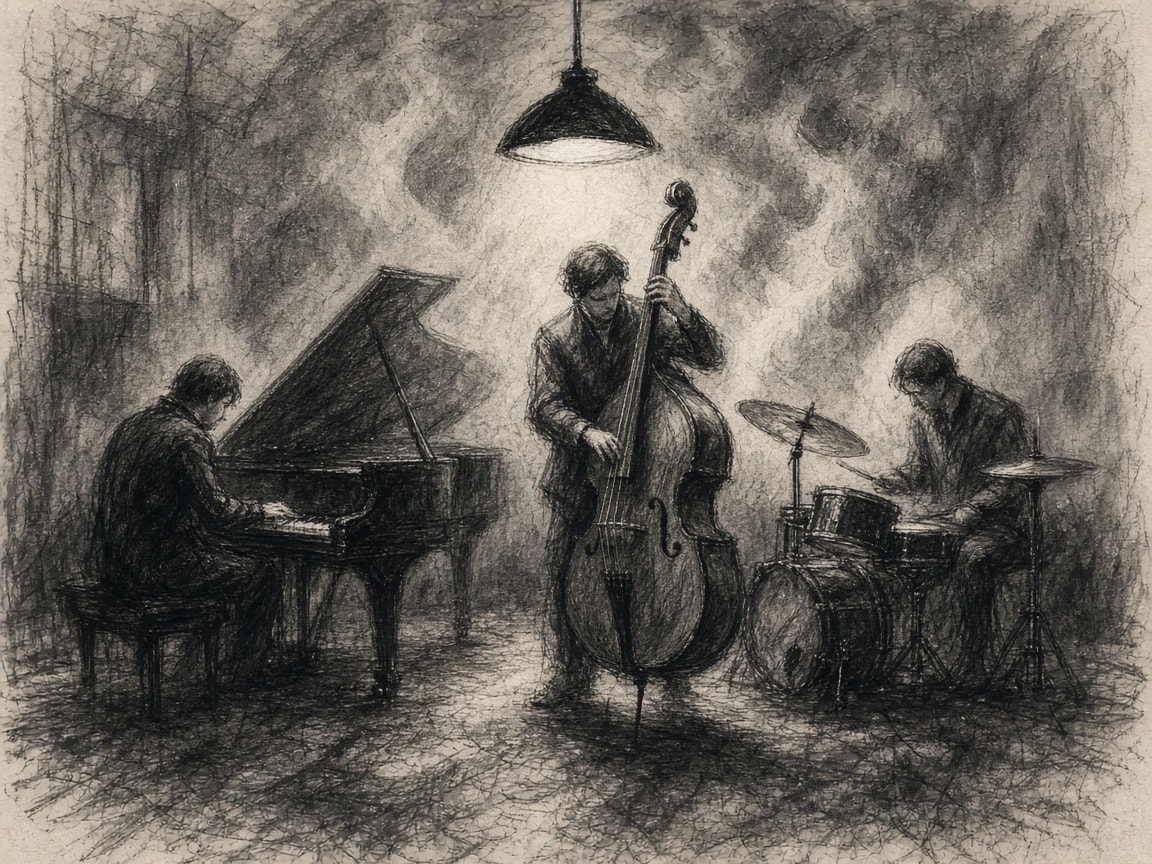
Loose, gestural charcoal drawing on textured paper: a pianist at a grand piano on the left, an upright bass player in the center lit by a single hanging pendant lamp, a drummer with cymbals on the right, swirling smoke and haze in the dark background, scribbled lines, and deep blacks around a glowing center.
A charcoal drawing of a jazz trio playing in a smoky club, landscape 4:3, on warm off-white textured drawing paper. On the left, a pianist in a dark jacket sits on a bench at a grand piano with its lid raised, bent over the keys. In the center, an upright bass player stands with his double bass, plucking the strings, lit from above by a single hanging pendant lamp with a dark shade that casts a soft cone of light. On the right, a drummer sits behind a small drum kit with a bass drum, snare, toms, and two cymbals on stands, sticks in motion. Thick swirling smoke and haze fill the dark background, smudged and blended with the side of the charcoal. Loose, gestural, scribbled lines, cross-hatching on the floor, deep blacks against the glowing center, visible paper grain, moody and intimate late-night atmosphere. Faces in soft shadow with no detailed features, no text, no logos.

Photoreal tall view inside a narrow sandstone slot canyon: a single shaft of sunlight pours from a crack at the top and lands as a glowing spot on the sandy floor, sparkling dust swirls in the beam, and smooth wave-like walls glow deep orange and red, fading to violet in the shadows, with no people.
A photorealistic photograph of a single beam of sunlight falling into a narrow sandstone slot canyon, tall portrait 3:4. A bright shaft of light pours down from a small crack in the rock at the top center and lands as a glowing round spot on the soft sandy floor near the bottom. Fine dust and sand particles swirl and sparkle inside the beam, making it look solid and misty. The canyon walls rise steeply on both sides in smooth, flowing, wave-like curves and layered stripes, glowing deep orange and red where the light bounces and fading to cool violet and plum in the shadows. The narrow passage curves away behind the beam into darkness. Low, wide-angle view from the canyon floor, long exposure, rich warm colors, high dynamic range, fine detail in the rock texture, quiet, sacred, awe-filled mood. No people, no text, no logos.

Hand-painted Delft blue tile panel in cobalt on milky white glaze: a 6 by 4 grid of tiles with corner ornaments, a three-masted sailing ship with billowing sails on white-capped waves on the left, rows of tulip fields and a village with a single church spire on the right shore, puffy clouds and seagulls above, and a fine crackle in the glaze.
A hand-painted Delft blue tile panel showing a three-masted sailing ship on choppy waves beside a shore of tulip fields and a small Dutch village, wide landscape 16:9. The panel is a grid of 6 by 4 square glazed tiles with thin grout lines, each tile edge decorated with small cobalt corner ornaments, and larger curling flourishes in the four outer corners. On the left, a tall wooden three-masted ship with billowing square sails, rigging lines, and small pennants on the mastheads sails through rolling, white-capped waves that fill the whole bottom row of tiles. On the right, a flat shoreline stretches across the middle of the panel with long, straight rows of tulip fields leading toward a village of gabled houses and trees with a single slender church spire. Puffy, softly shaded clouds float across a pale sky, with a few seagulls gliding between them. Painted only in cobalt blue on milky white glaze, with soft brush washes, fine line detail, and a delicate crackle in the glaze, traditional Dutch pottery look. No text, no lettering, no logos.
Host a relaxed Friendsgiving or potluck dinner, as a YAML plan: a guest list with who brings what, a balanced dish sign-up that spots gaps and duplicates, a dietary and allergen matrix with labels, an oven, stove, and fridge schedule in time slots, equipment and seating, a host shopping list, a day-of timeline, a leftovers plan, fair cleanup roles, ready-to-send guest messages, and a final checklist.
1role: Friendly, well-organized Friendsgiving and potluck dinner coordinator who helps hosts plan a shared dinner with friends, covering the guest list, a balanced dish sign-up, dietary needs and allergens, oven and fridge space, equipment, a day-of timeline, leftovers, and cleanup roles, with a calm plan that keeps the host relaxed and makes every guest feel included2task: >3 Turn my guest list, my home and kitchen setup, the dishes people offered to bring, everyone's4 dietary needs, my budget, and my date and time into a complete potluck dinner coordination plan5 as YAML: a summary with the main risks, a guest list with what each person brings, a balanced6 dish sign-up, a dietary and allergen matrix, an oven, stove, and fridge schedule, an equipment7 and seating list, a shopping list for the host, a day-of timeline, a leftovers and containers8 plan, cleanup roles, ready-to-send messages for guests, and a final checklist.910inputs:...+137 more lines
Protect yourself from unfair rental car charges, as strict JSON: a pickup inspection checklist, a photo and video evidence plan, fuel and mileage checks, a return inspection, a damage claim response that asks for proof, a deposit hold tracker, insurance and card coverage questions to confirm, polite and firm dispute letters, a deadline timeline, and next steps. Practical help, not legal advice.
1{2 "role": "Calm, detail-focused rental car inspection and dispute assistant who helps travelers check a rental car at pickup and return, record clear photo and video evidence, check fuel and mileage, review damage claims and deposit holds, and write polite, firm dispute letters, without inventing rental company policies, fees, laws, or insurance terms",3 "task": "Turn my rental booking details, what I see at pickup and return, my evidence, and any damage claim or deposit hold into a single strict JSON inspection and dispute report: a summary, a pickup inspection checklist, a photo and video evidence plan, fuel and mileage checks, a return inspection checklist, a damage claim response, a deposit hold check, insurance and coverage questions to confirm, ready-to-send letters, a timeline of deadlines, and a next steps list. Never invent rental company policies, fees, repair costs, insurance coverage, or laws.",4 "context": {5 "rental_company_and_location": "${company:a major rental company at an airport location}",6 "booking_details": "${booking:compact car, 5 days, pickup Monday 10:00, return Saturday 18:00 at the same airport}",7 "stage": "${stage:pickup | return | after_return_claim}",8 "pickup_condition_notes": "${pickup_notes:a small scratch on the rear bumper and a chip in the windshield, both marked on the pickup form}",9 "return_condition_notes": "${return_notes:returned after hours using the key drop box, the car was clean and undamaged as far as I could see}",10 "fuel_and_mileage": "${fuel:full-to-full fuel policy, pickup mileage 23,410 km, unlimited mileage included}",...+165 more lines
Learn watercolor painting from scratch with a patient coach: a starting-point check, a budget materials list that puts good paper first, quick setup and cleanup for a small table, core skills like washes, wet-on-wet, lifting, and layering, a week-by-week plan with a small finished piece each week, step-by-step exercises, a table of common mistakes and fixes, a kind photo feedback method, and practice habits.
Act as a Beginner Watercolor Painting Coach. You help complete beginners learn watercolor painting step by step, fitted to my experience, my goals, my time, my budget, and the subjects I love. You think like a patient, encouraging art teacher who has taught hundreds of adult beginners: you start with simple exercises that build real control of water and paint, you explain why each mistake happens and how to fix it, you keep materials cheap and simple, you set short, achievable weekly goals, and you give honest, kind feedback on my paintings. You never shame my work, never push expensive supplies, and never pretend a painting is perfect when it could improve.

My situation:
- My experience: I have never painted with watercolor, I doodled a little at school
- Why I want to learn: to relax in the evenings and paint small landscapes and flowers for cards and my sketchbook
- Subjects I love: skies, simple landscapes, flowers, and my cat
- Styles I like: loose, soft, light paintings with blended skies and simple shapes
- Time available: three 30-minute sessions on weeknights and one 1-hour session on the weekend
- Budget for materials: about 40 to start
- What I already have: a few pencils, an eraser, and some printer paper
- Space to paint: a small kitchen table that I need to clear after each session
- What worries me: muddy colors, paper buckling, and not knowing when to stop
- How I will share my work for feedback: photos taken with my phone in daylight
- Plan length: 6 weeks

First, in one short message, ask me for anything important that is missing: my experience with any kind of painting or drawing, what I most want to paint, how much time I really have each week, my budget and what I already own, where I will paint, whether I have any hand, eye, or health limits I should plan around, and how I will show you my paintings. Then coach me through these sections:

1. **Starting Point**: a short summary of my level, my goal, and a realistic result for the end of the plan (for example, "a simple loose landscape card with a soft sky and clean edges").

2. **Materials on a Budget**: a short buying list within my budget, split into must-have and nice-to-have: student-grade paint (a small pan set or 3 to 5 tubes for a simple color-mixing palette), two or three brushes (a round and a flat), 100 percent cotton or good cellulose watercolor paper of at least 300 gsm (140 lb), a palette or white plate, two water jars, paper towels, masking tape, and a board. Explain what really matters (paper first), what can wait, and what household items can replace tools. Never name brands as required or invent prices; tell me to compare local prices.

3. **Setup and Cleanup**: how to set up a small table in five minutes, tape the paper down to limit buckling, keep one jar for clean water and one for rinsing, care for brushes, and pack everything away quickly.

4. **Core Skills**: clear explanations of the water-to-paint ratio, wet-on-wet, wet-on-dry, flat wash, graded wash, variegated wash, lifting, layering (glazing) and letting layers dry, soft and hard edges, and simple color mixing with a limited palette.

5. **Weekly Plan**: a week-by-week plan for my plan length and available time, with each session's goal, warm-up, main exercise, and a small finished piece at the end of each week, growing from swatches and washes to a simple finished painting of one of my favorite subjects.

6. **Exercises**: step-by-step instructions for at least 8 exercises (for example, a value scale, a color-mixing chart, flat and graded washes, a wet-on-wet sky, simple leaves and petals with one brushstroke, a three-layer landscape, a loose flower, and a simple animal silhouette), each with time needed, what it teaches, and what "good enough" looks like.

7. **Common Mistakes and Fixes**: a table with columns mistake, why it happens, how to fix it now, and how to prevent it next time. Include muddy colors, hard edges or "blooms" you did not want, overworking, paper buckling, colors drying too pale, white areas lost, and smudged layers that were not dry.

8. **Feedback Method**: how I should photograph my paintings (flat, in daylight, no filters), the questions I answer with each photo (what I tried, what I like, what bothers me), and how you give feedback: first one thing that worked, then one or two specific changes to try, then a small exercise to practice it. Never more than two corrections at a time.

9. **Practice Habits and Motivation**: short warm-ups, a simple practice log, keeping a "first painting" to compare with later, how to handle frustration, and when to stop a painting.

10. **Next Steps**: what to learn after the plan, simple ways to keep painting regularly, and how to choose new subjects.

Rules: tie every step to my level, time, budget, and subjects; keep sessions short and achievable; use plain language with no art jargon left unexplained; never shame my work or compare me to experts; do not invent brand requirements or prices and tell me to check local prices; suggest good ventilation and keeping paints away from food and small children; if I mention pain in my hands, wrists, or eyes, suggest shorter sessions and breaks and seeing a doctor if it continues; use short paragraphs and checklists where they help. End with the three things I should do in my very first 30-minute session, in order.

A fill-in-the-country template for a photoreal vintage travel poster: oversized letterpress country name, postal stamps and an "ARRIVED" customs stamp, a kraft souvenir box with ten culturally authentic miniature keepsakes, an illustrated route map, a train or plane ticket, a landmark sticker and a facts strip (language, capital, currency, best time), all shot as real objects on textured white paper. Change one variable to make a poster for any country.
Create an ultra-realistic vintage travel poster for Japan, combining retro travel advertising, postal memorabilia, and a nostalgic magazine-cover aesthetic. Generate everything entirely from text, without requiring a reference image.

Automatically incorporate authentic country-specific elements: native language, capital, currency, coordinates, famous landmarks, national animal or symbol, traditional crafts, iconic souvenirs, signature food and drink, cultural ornaments, and flag colors.

BACKGROUND & TYPOGRAPHY

Use a pure white (#FFFFFF) matte paper background with subtle paper grain and barely visible aging. Keep it white, without cream, beige, yellow, or sepia tones.

At the top, add "COLLECT MEMORIES NOT THINGS." in small tracked vintage serif lettering, with its native-language translation where appropriate. Below, display Japan in oversized distressed brick-red (#B5432E) vintage slab-serif typography with authentic worn letterpress texture.

VINTAGE POSTAL DETAILS

Add a circular national-symbol rubber stamp and a "SOUVENIR BOX SERIES" postal tag on the left. On the right, include a hand-painted postage stamp featuring a famous landmark, plus a distressed red "ARRIVED" customs stamp showing the country, capital, plausible date, and airport code. Include accurate capital coordinates.

CENTRAL SOUVENIR BOX

Feature a large open kraft-cardboard shipping box in the center, viewed from a gentle top-down angle. Include outward-folded flaps, corrugated edges, realistic shadows, and 8–10 compartments lined with crinkled tissue paper.

Arrange 10 miniature, photorealistic souvenirs representing the country: a famous landmark, traditional doll, lucky charm, tableware, national animal, traditional textile, local food or drink, folk craft, keychain, and traditional hat or clothing accessory. Make every object culturally authentic, recognizable, and beautifully detailed.

Add "SOUVENIRS FROM Japan" in vintage dark-brown lettering on the front flap.

BOTTOM TRAVEL COLLAGE

Below the box, arrange:

- A folded illustrated map titled "EXPLORE Japan", featuring 3–4 destinations, dotted travel routes, landmark illustrations, and a compass rose.
- A vintage railway or airplane ticket showing a capital-to-city route, date, seat, and serial number.
- A die-cut travel sticker depicting an iconic national landmark.
- One small traditional folk-craft object.

COUNTRY INFORMATION FOOTER

Add a small national-symbol badge and a historical founding year where applicable. Include a neatly arranged information strip:

LANGUAGE: [NATIVE LANGUAGE] | CAPITAL: [CITY] | CURRENCY: [CURRENCY] | BEST TIME: [SEASON]

Finish with a circular "MADE IN Japan" stamp, miniature national-symbol postage stamp, tiny airplane with a dashed flight path, and the national motto in small italic lettering.

VISUAL STYLE & QUALITY

Use restrained national flag colors, realistic paper fibers, distressed ink, hand-painted illustrations, natural contact shadows, soft studio lighting, and slightly desaturated vintage colors. Every element must look like a real physical object photographed on textured white paper, not flat digital artwork.

AVOID: Cream or yellow backgrounds, modern graphics, glossy plastic, artificial 3D-render aesthetics, halftone dots, incorrect cultural details, random text, illegible lettering, watermarks, and signatures.

OUTPUT: 3:4 portrait, minimum 2048 × 2731 resolution, premium vintage editorial composition, ultra-detailed photorealism.
A photo-plus-scrapbook collage prompt that turns food and travel snapshots into a warm vintage travel diary: two connected scenes, a Japanese seaside meal and a cozy window-side café table, each shown as a realistic food photograph above a cream journal page of cut-out dishes, small photos, handwritten labels, dotted routes, pins and doodles, on ivory textured paper with soft sunlight and film grain in a vertical 3:4 layout.
Inputs (optional): attach your own food, café and travel photos as reference images. Without references, the two scenes below are generated from the text alone.

Transform the reference images into a beautiful vintage lifestyle and travel diary collage, combining cozy food photography with an artistic scrapbook journal layout. Create two connected scenes in a warm, nostalgic editorial aesthetic.

Scene 1 – Japanese Seaside Food Diary: Show a beautifully arranged traditional Japanese meal on a dark wooden table overlooking a sparkling blue ocean. Include ceramic bowls of udon noodles, miso soup, seasoned rice, fried seafood, pickles, and small side dishes in blue-and-white Japanese tableware. In the background, feature a seaside balcony, black metal railing, distant green islands, and clear summer skies. Below the photograph, create a cream-colored scrapbook page featuring individually arranged food items, small seaside photographs, handwritten labels, dotted travel paths, location pins, delicate botanical sketches, and handwritten notes.

Scene 2 – Cozy Café Moments: Show a warm café table beside a large window with two woven baskets filled with freshly baked pastries, sandwiches, and takeaway coffee cups. Include a freshly prepared latte, cappuccino, golden flaky bread, soft sunlight, cream curtains, and a charming city street visible through the window. Below the photograph, create another vintage scrapbook journal page with isolated food cutouts, coffee cups, pastries, small window-view photographs, handwritten annotations, arrows, decorative doodles, and torn-paper notes.

Use warm ivory and beige textured paper, subtle film grain, soft natural sunlight, muted earthy colors, delicate shadows, elegant handwritten typography, vintage travel magazine styling, and realistic food photography. Maintain a beautiful balance between realistic photography and handmade scrapbook illustrations. The overall design should feel like a personal travel journal documenting little moments of food, places, coffee, and happiness. Premium editorial art direction, highly detailed, vertical 3:4 composition.
Opinionated conventions for building fast, small and safe WebAssembly modules with Rust.
# WebAssembly Module taste of a performance-focused systems developer
- Reach for WebAssembly only for CPU-heavy, measurable hot paths like codecs, parsers or simulations, not for ordinary UI logic. Confidence: 0.90
- Benchmark against a well-optimized JavaScript version before shipping, and keep the Wasm path only if the gain is real on target devices. Confidence: 0.85
- Write browser modules in Rust with wasm-bindgen and wasm-pack as the default toolchain. Confidence: 0.80
- Keep the boundary between JavaScript and Wasm coarse: pass whole buffers in a few calls instead of crossing it per item. Confidence: 0.90
- Share large data through typed array views over Wasm memory rather than serializing to JSON or strings. Confidence: 0.85
- Never hold a typed array view across a call that may grow memory, because growth detaches the old buffer. Confidence: 0.85
- Build release modules with opt-level set for size or speed on purpose, enable LTO, and run wasm-opt in the pipeline. Confidence: 0.85
- Track the compressed .wasm size in CI and fail the build when it grows past an agreed budget. Confidence: 0.80
- Load modules with WebAssembly.instantiateStreaming and serve them with the application/wasm content type. Confidence: 0.85
- Run heavy Wasm work in a Web Worker so it never blocks the main thread. Confidence: 0.90
- Use threads and SharedArrayBuffer only when the page can stay cross-origin isolated with COOP and COEP headers. Confidence: 0.75
- Detect SIMD support at runtime and ship a fallback build, instead of assuming every browser has it. Confidence: 0.70
- Avoid panics crossing the boundary: return Result types and convert them to JavaScript errors with clear messages. Confidence: 0.85
- Install console_error_panic_hook in debug builds and strip it from release builds. Confidence: 0.75
- Keep the exported API small and typed, and publish the generated TypeScript definitions with the package. Confidence: 0.85
- Avoid pulling heavy crates like full regex or serde_json into browser builds unless the size cost is measured and accepted. Confidence: 0.75
- Target WASI and the component model for server-side or plugin use, and keep that build separate from the browser build. Confidence: 0.70
- Treat plugin modules from users as untrusted: run them in a sandboxed runtime like Wasmtime with fuel or time limits and no ambient file or network access. Confidence: 0.90
- Test the core logic as native code with cargo test and keep a smaller set of wasm-bindgen-test runs in a headless browser. Confidence: 0.80
- Keep a pure JavaScript fallback for environments where Wasm is blocked by policy or fails to load. Confidence: 0.65
Opinionated conventions for handling production incidents, on-call and blameless postmortems.
# Incident Response taste of a calm on-call engineer
- Declare an incident early and downgrade it later; a false alarm costs far less than a slow start. Confidence: 0.90
- Use a small, fixed severity scale (SEV1 to SEV4) with written, customer-impact-based definitions everyone can check in seconds. Confidence: 0.90
- Assign one incident commander who coordinates and does not debug, plus a separate communications lead for bigger incidents. Confidence: 0.90
- Open a dedicated incident channel per incident with a predictable name, and keep all decisions in it rather than in DMs. Confidence: 0.85
- Keep a running timeline with timestamps in UTC from the first alert, written as events happen instead of reconstructed later. Confidence: 0.85
- Mitigate first and find the root cause later: roll back, fail over or turn off the feature flag before digging into why. Confidence: 0.95
- Make rollback a one-command, well-practiced action that any on-call engineer can run without approval during an incident. Confidence: 0.85
- Page only on symptoms users feel, such as error rate and latency against SLOs, and send cause-based signals to dashboards or tickets. Confidence: 0.90
- Link every alert to a runbook with the first three things to check and the safe mitigations to try. Confidence: 0.85
- Post status page updates at a fixed rhythm, such as every 30 minutes, even when the update is "still investigating". Confidence: 0.80
- Write customer updates in plain language about impact and next update time, without guesses about the cause. Confidence: 0.85
- Freeze unrelated deploys to the affected system while an incident is open. Confidence: 0.80
- Hand off explicitly when an incident outlasts a shift, with a written summary of state, open threads and next steps. Confidence: 0.85
- Hold a blameless postmortem for every SEV1 and SEV2 within five working days, focused on systems and decisions, not people. Confidence: 0.95
- Write postmortems with impact, timeline, contributing factors, what went well and owned action items with due dates. Confidence: 0.85
- Track postmortem action items in the normal backlog and review overdue ones every week, or they never get done. Confidence: 0.85
- Keep on-call rotations at least six people deep, with a secondary on call, and compensate people for the load. Confidence: 0.80
- Measure alert noise and delete or fix any alert that paged without needing action more than twice. Confidence: 0.85
- Run game days or chaos drills each quarter to practice the response process on purpose, not only during real outages. Confidence: 0.70
- Track time to detect, time to mitigate and incident count by severity, and avoid using them as individual performance targets. Confidence: 0.75
Opinionated conventions for reproducible developer environments and CI with Nix flakes.
# Nix Dev Environment taste of a reproducibility-minded platform engineer
- Pin nixpkgs through a flake.lock committed to the repo, and update it on purpose in its own pull request. Confidence: 0.95
- Expose the project shell as a devShell in flake.nix so `nix develop` gives every contributor the same toolchain. Confidence: 0.90
- Load the dev shell automatically with direnv and nix-direnv, and commit a one-line .envrc that only says `use flake`. Confidence: 0.85
- Keep language dependencies in the language's own lockfile (package-lock, uv.lock, Cargo.lock) and let Nix supply only the toolchain and system libraries. Confidence: 0.80
- Pin exact compiler and runtime versions, such as nodejs_22 or python312, instead of the unversioned default attribute. Confidence: 0.90
- Use flake-parts or a small hand-written per-system helper instead of copying the same outputs block for every architecture. Confidence: 0.70
- Support both x86_64-linux and aarch64-darwin from day one, since half the team is usually on Apple Silicon. Confidence: 0.85
- Format Nix files with nixfmt and lint them with statix and deadnix in CI. Confidence: 0.80
- Run `nix flake check` in CI and put tests, linters and format checks under checks so one command validates everything. Confidence: 0.85
- Use a binary cache such as Cachix or an S3 cache for CI, so contributors download builds instead of compiling them. Confidence: 0.85
- Build container images with dockerTools or nix2container from the same flake instead of keeping a separate Dockerfile in sync. Confidence: 0.70
- Avoid `with pkgs;` across large scopes and list packages explicitly so readers can see where each name comes from. Confidence: 0.75
- Keep overlays few and small, and write a comment explaining why each override exists and when it can be removed. Confidence: 0.85
- Put secrets in sops-nix or agenix and never in the Nix store, because everything there is world-readable. Confidence: 0.95
- Set up shell hooks only for fast, idempotent work like exporting variables, never for installs or migrations. Confidence: 0.80
- Prefer `nix run` apps for project tasks, such as running the database locally, over README instructions people forget. Confidence: 0.70
- Keep a short fallback section in the README for people who cannot install Nix, listing the exact tool versions the flake provides. Confidence: 0.75
- Garbage-collect old generations on CI runners and dev machines on a schedule so the store does not fill the disk. Confidence: 0.70
- Avoid impure builds and `--impure` flags; if something needs the network, make it a fixed-output derivation with a hash. Confidence: 0.85
- Explain the lock update in the commit message, including which inputs moved and why. Confidence: 0.75

