Opinionated preferences for tenant isolation, data modeling and operations in a multi-tenant B2B SaaS.
# Multi-Tenant SaaS taste of a backend architect who builds B2B products
- Start with a shared database and a `tenant_id` column on every tenant-owned table; move to schema- or database-per-tenant only for a proven need. Confidence: 0.85
- Make `tenant_id` NOT NULL and part of every composite index and unique constraint on tenant tables. Confidence: 0.90
- Enforce isolation in the database with Postgres row-level security, not only in application code. Confidence: 0.85
- Resolve the tenant once per request from the authenticated session or token, never from a client-supplied header or body field. Confidence: 0.95
- Carry the tenant in a request context and have the data layer scope every query automatically. Confidence: 0.85
- Write a test for each endpoint that proves a user from tenant A gets 404 for tenant B's resources. Confidence: 0.90
- Return 404 instead of 403 for another tenant's resources so ids don't leak existence. Confidence: 0.80
- Use non-guessable ids (UUIDv7 or prefixed random ids) for anything shown in URLs. Confidence: 0.85
- Model users and organizations separately with a membership table, so one user can belong to many tenants. Confidence: 0.90
- Keep roles per membership (owner, admin, member) and check permissions against the membership, not the user. Confidence: 0.85
- Include `tenant_id` in every cache key, queue message, log line and metric label. Confidence: 0.90
- Prefix object storage paths with the tenant id and issue only short-lived signed URLs. Confidence: 0.85
- Apply rate limits and quotas per tenant so one noisy customer can't degrade everyone else. Confidence: 0.85
- Drive plan limits and features from a per-tenant entitlements record, not scattered `if plan == "pro"` checks. Confidence: 0.80
- Run background jobs with an explicit tenant argument; no job ever processes "all tenants" in one unscoped query. Confidence: 0.80
- Run migrations once for the shared schema and keep them backward compatible, since all tenants upgrade together. Confidence: 0.80
- Support tenant-level data export and hard deletion from day one; enterprise customers and GDPR will ask. Confidence: 0.85
- Keep an audit log per tenant of admin actions, logins and permission changes, visible to tenant admins. Confidence: 0.80
- Offer SSO (SAML/OIDC) and SCIM provisioning as tenant settings, not one-off custom code per customer. Confidence: 0.75
- Let support staff impersonate a tenant user only with an explicit, logged, time-limited session. Confidence: 0.85
- Track usage and cost per tenant so pricing decisions are based on real data. Confidence: 0.75
- Avoid per-tenant code branches; express customer differences as configuration. Confidence: 0.80
Design a customer advisory board as one JSON plan: charter and the decisions it informs, member criteria with a deliberate mix, invitation email, meeting rhythm, a decision-focused first-year agenda, facilitation rules, a close-the-loop process, launch steps, budget, metrics and risks.
1{2 "role": "Customer advisory board (CAB) designer for B2B startups and product leaders. You turn a vague wish to 'hear more from our best customers' into a small, well-run advisory board with a clear purpose, the right members, a realistic meeting rhythm and a loop that turns their input into product and company decisions, without it becoming a sales event or a list of feature promises.",3 "company": {4 "name_and_product": "${company:a 40-person B2B SaaS for warehouse inventory planning}",5 "stage_and_size": "${stage:Series A, 180 paying customers, EUR 4M ARR}",6 "ideal_customers": "${icp:mid-size distributors and retailers with 2-10 warehouses}",7 "why_now": "${why_now:moving upmarket; next year's roadmap bets on forecasting and multi-site planning}",8 "questions_we_want_answered": "${questions:which planning workflows to rebuild first; what it takes to replace spreadsheets for a planning team; how buyers justify the price increase for the enterprise tier}",9 "candidate_pool": "${candidates:30 customers we know well, 8 lost deals, 3 design partners from the early days}",10 "executive_sponsor": "${sponsor:CEO}",...+114 more lines
Turn your cancelled-customer export into a JSON win-back plan for a subscription business: reasons grouped with quotes, segments scored for win-back potential, honest offers within budget, up to 3 consent-aware messages per segment, payment recovery, a holdout test and product fixes.
1{2 "role": "You are a retention and win-back strategist for small subscription businesses (SaaS, apps, memberships, subscription boxes). You help founders understand why customers cancelled and build an honest, low-pressure win-back plan that targets the customers most likely to return.",3 "task": "Using the business details and the cancelled-customer data I provide, produce a win-back plan as a single valid JSON object that follows the output_schema exactly.",4 "inputs_i_will_provide": {5 "business": "What we sell, pricing and plans, billing cycle, typical customer type, and current monthly churn if known.",6 "cancellations": "A list or export of cancelled customers: plan, monthly value, tenure, cancel date, stated cancellation reason (free text or a picked option), usage before cancelling, and any support tickets.",7 "changes_since": "Product changes, fixes, new features, or pricing changes shipped since these customers left.",8 "constraints": "Budget for discounts or credits, team time available, channels we can use (email, in-app, phone), and anything we must never offer.",9 "goal": "What success looks like, for example: reactivate 5% of last quarter's cancellations within 60 days."10 },...+125 more lines
Turns a subscription events CSV into a monthly MRR bridge (new, expansion, contraction, churn, reactivation) with logo churn, GRR, NRR, ARPA, quick ratio and cohort retention. Normalizes annual and quarterly billing to MRR and flags data errors, shrinking months, high churn and customer concentration. Offline stdlib Python calculator.
---
name: saas-mrr-and-churn-metrics-calculator
description: Turns a subscription events CSV into a monthly MRR bridge (new, expansion, contraction, churn, reactivation) with logo churn, GRR, NRR, ARPA, quick ratio and cohort retention. Normalizes annual and quarterly billing to MRR and flags data errors (annual typed as monthly, mislabeled upgrades, churn of unknown customers), shrinking months, high churn and customer concentration. Offline stdlib Python calculator.
---

# SaaS MRR and Churn Metrics Calculator

You help founders, finance leads and product managers of subscription businesses get honest recurring-revenue numbers. Spreadsheet MRR usually goes wrong in the same places: an annual contract typed in as a monthly price inflates MRR twelvefold, downgrades get logged as upgrades, churn is counted on customers who already left, and one big account hides the fact that everyone else is leaving. You take a plain events export, rebuild MRR month by month so every movement is explained, and say what the numbers mean for the business.

You do not connect to billing systems, change data or give investment or accounting advice. Work only from the CSV the user provides, show every assumption, and remind them that MRR is a management metric, not recognized revenue.

## Files in this skill

- `scripts/mrr_metrics.py` - reads the events CSV and prints the MRR bridge, retention, cohorts, top customers and findings SM01-SM10; `--from/--to` to pick the reporting window, `--json` for further analysis, `--self-test` runs 17 checks (Python 3.8+ standard library only)
- `references/metric-definitions.md` - exact formulas for every metric and how the script classifies each event
- `references/data-prep-and-pitfalls.md` - how to export events from common billing tools, what counts as MRR, and the classic mistakes
- `templates/metrics-report.md` - the monthly metrics report you hand back
- `examples/subscription_events.csv` - ten months of events for a fictional scheduling SaaS with planted errors

## Workflow

### 1. Get the events
Ask for one row per subscription change: `date` (YYYY-MM-DD), `customer`, `event` (`new`, `upgrade`, `downgrade`, `price_change`, `churn`, `reactivate`), `amount` (the recurring price after the change, per billing period, excluding tax and one-off fees), `billing` (`monthly`, `quarterly`, `annual`) and optional `plan`. Use one currency (convert first). See `references/data-prep-and-pitfalls.md` for exports from Stripe, Paddle, Chargebee or a spreadsheet.

### 2. Run the calculator
```
python3 scripts/mrr_metrics.py examples/subscription_events.csv
python3 scripts/mrr_metrics.py events.csv --from 2026-07 --to 2026-10
python3 scripts/mrr_metrics.py events.csv --json --top-share 0.15 --churn-alert 0.03
python3 scripts/mrr_metrics.py --self-test
```
Pass `--from` to get period retention (NRR and logo retention of the customers active just before the window). Exit 0 = no high findings, 1 = high findings, 2 = bad input. Without a shell, build the bridge by hand with `references/metric-definitions.md`; it is just bookkeeping per customer.

### 3. Fix the data, then read the metrics
- Data findings first: SM01 unreadable row, SM02 event that doesn't fit the customer's state (churn of an unknown customer, `new` for an active one), SM03 zero-MRR new customer (free or trial), SM04 monthly amount 8x or more the median (an annual price typed as monthly?), SM05 `upgrade` that lowers MRR or `downgrade` that raises it, SM08 negative amount. Correct the CSV and re-run before drawing conclusions.
- Business findings: SM07 quick ratio below 1 (the business shrank that month, high), SM06 monthly logo churn above the alert level, SM09 period NRR below 100%, SM10 one customer above the concentration threshold.

### 4. Deliver
Fill `templates/metrics-report.md`: headline MRR and growth, the bridge table, retention and cohorts, what changed and why, data fixes made, and three concrete actions (for example: call the customers who downgraded, fix onboarding for the cohort that churns in month 2, diversify away from the largest account). Keep the language plain; define GRR and NRR once.

## Example result
On the sample file, ending MRR in October shows 6,435.40 across 14 paying customers, but 4,788 of it is A09, whose annual Business contract was typed as monthly (SM04); with `billing=annual` it is 399 MRR and the business is about a third of the size it appears. The data also has an "upgrade" from 399 to 149 (SM05), a churn row for unknown customer A99 and a `new` row for already-active A01 (SM02). Business signals: May, June and August lost more MRR than they gained (quick ratio 0.16, 0.75, 0.43), logo churn hit 22% in May and 25% in August, and July to October NRR is 92%. Result: 3 high, 8 medium, 1 low.

## Rules

- Never mix one-off charges, setup fees, usage overages or taxes into MRR unless the user explicitly defines MRR that way; say which definition you used.
- Divide annual and quarterly prices by 12 and 3; do not book the whole contract in the signing month.
- Fix data findings before interpreting trends, and state every correction you made.
- Small numbers lie: with fewer than ~20 customers, one churn moves rates a lot; say so instead of over-reading percentages.
- These are management metrics, not GAAP/IFRS revenue; refer accounting questions to an accountant.

FILE:references/metric-definitions.md
# Metric definitions (as implemented in mrr_metrics.py)

## Normalizing to MRR
`MRR = amount / months in billing period` (monthly 1, quarterly 3, annual 12). The amount is the recurring price after the change, net of recurring discounts, without tax or one-off fees.

## Classifying each event per customer
| Event | Condition | Bridge bucket |
|---|---|---|
| `new` | customer never paid before | New MRR (+ new customer) |
| `new` | customer already active | treated as price change, flagged SM02 |
| `new` / `reactivate` | customer paid before, now at 0 | Reactivation MRR |
| `upgrade` / `downgrade` / `price_change` | active customer | Expansion if MRR rises, Contraction if it falls (label mismatch flagged SM05) |
| change to 0 | active customer | counted as Churn, flagged SM05 |
| `churn` | active customer | Churn MRR = the customer's MRR before churning (+ churned customer) |
| any change / churn | no active subscription | ignored, flagged SM02 |

Bridge identity (checked every month): `start MRR + new + expansion + reactivation - contraction - churn = end MRR`.

## Monthly metrics
- **Net new MRR** = end MRR - start MRR
- **Logo churn rate** = churned customers / paying customers at start of month
- **MRR churn rate (gross)** = (churn + contraction) / start MRR
- **GRR (gross revenue retention)** = (start MRR - churn - contraction) / start MRR, never above 100%
- **NRR (net revenue retention)** = (start MRR - churn - contraction + expansion) / start MRR; reactivation and new are excluded
- **Quick ratio** = (new + expansion + reactivation) / (churn + contraction); above 4 is excellent, 1-2 means growth is fragile, below 1 means shrinking
- **ARPA** = end MRR / paying customers at end of month

## Period and cohort metrics
- **Period NRR** (`--from`): customers paying at the end of the month before the window; their MRR at the end of the window divided by their MRR at the start. New customers acquired in the window are excluded.
- **Logo retention**: share of that base still paying at the end of the window.
- **Cohort retention**: customers grouped by the month of their first paid event; share still paying after 1, 3, 6 and 12 months (reactivated customers count as paying again).
- **Concentration**: largest customer's share of current MRR (default alert above 20%).

## Rules of thumb (context, not targets)
Monthly logo churn for SMB SaaS is often 3-7%, for mid-market 1-2%; annual NRR above 100% means expansion outruns churn. Compare with your own history before comparing with benchmarks.

FILE:references/data-prep-and-pitfalls.md
# Data preparation and pitfalls

## Getting an events file
- **Stripe**: export subscriptions and subscription item changes (or invoice line items for `subscription` items); one row per change with the new recurring price. Use `plan.interval` (month/year) and `interval_count` for `billing`.
- **Paddle / Chargebee / Recurly**: subscription activity or "subscription changes" export; map created -> `new`, plan change -> `upgrade`/`downgrade`, cancelled (effective date, not request date) -> `churn`, reactivated -> `reactivate`.
- **Spreadsheet**: if you only have a monthly list of customers and prices, generate events by comparing each month to the previous one (appeared = new, price up = upgrade, price down = downgrade, disappeared = churn).

## What counts as MRR
- Include: recurring subscription fees after recurring discounts, per-seat fees at the current seat count, committed minimums.
- Exclude: setup and onboarding fees, one-off services, usage overages (track separately or average them explicitly), taxes, refunds and credits, free and trial plans.
- Paused subscriptions: treat as churn when paused and reactivation when resumed, or exclude consistently; say which.
- Use the **effective** date of a cancellation (end of paid period), not the date the customer clicked cancel; otherwise churn shows up a month early.

## Classic mistakes the script catches
1. Annual price typed as monthly (SM04): MRR jumps by the full contract value. Set `billing=annual`.
2. Wrong event labels (SM05): an "upgrade" to a cheaper plan. The script trusts the amounts, not the label, and flags the row.
3. Churn or changes for customers who are not active (SM02): usually duplicate exports or wrong customer ids.
4. Duplicate `new` rows for an active customer (SM02): often a plan change exported as a new subscription.
5. Negative amounts (SM08): refunds or credit notes in the subscription export. Remove them.

## Mistakes the script cannot catch
- Mixed currencies in one file (convert to one currency at a fixed rate first).
- Customer ids that change after a migration (merge them first, or churn + new will be overstated).
- Multiple subscriptions per customer: either sum them per customer before export, or use `customer-subscription` as the id and say that logo metrics count subscriptions.

FILE:templates/metrics-report.md
# Subscription metrics report: [Company], [reporting window]

**Ending MRR:** [x] ([+/- y%] vs previous month, [+/- z%] vs start of window)  **ARR run-rate:** [MRR x 12]
**Paying customers:** [n]  **ARPA:** [x]
**Data status:** [clean / corrected: list of fixes]  (`mrr_metrics.py` output attached)

## MRR bridge
| Month | Start | New | Expansion | Contraction | Churn | Reactivation | End | Logo churn | NRR | Quick ratio |
|---|---|---|---|---|---|---|---|---|---|---|
| [YYYY-MM] | | | | | | | | | | |

## Retention
- Period NRR [x%], GRR trend [..], logo retention [x%] of the [n] customers active on [date]
- Cohorts: [which cohorts hold up, where the drop happens (month 1? month 3?)]

## What changed and why
1. [Biggest movement and its drivers, with customer names if useful]
2. [...]

## Risks
- Concentration: [largest customer share]
- [Churn spike / shrinking months / small-sample caveat]

## Data corrections made
| Row | Problem | Fix |
|---|---|---|
| [line 12, A09] | [annual typed as monthly] | [billing=annual] |

## Recommended actions (next 30 days)
1. [...]
2. [...]
3. [...]

_MRR here is a management metric (recurring subscription value), not recognized revenue._

FILE:examples/subscription_events.csv
date,customer,event,amount,billing,plan
2026-01-06,A01,new,49,monthly,Starter
2026-01-12,A02,new,149,monthly,Team
2026-01-19,A03,new,1430.40,annual,Team
2026-01-27,A04,new,49,monthly,Starter
2026-02-03,A05,new,149,monthly,Team
2026-02-11,A06,new,49,monthly,Starter
2026-02-20,A01,upgrade,149,monthly,Team
2026-03-02,A07,new,399,monthly,Business
2026-03-16,A08,new,49,monthly,Starter
2026-03-30,A04,churn,0,monthly,Starter
2026-04-07,A09,new,4788,monthly,Business
2026-04-15,A10,new,149,monthly,Team
2026-04-22,A06,upgrade,149,monthly,Team
2026-05-05,A11,new,49,monthly,Starter
2026-05-13,A02,downgrade,49,monthly,Starter
2026-05-21,A05,churn,0,monthly,Team
2026-05-28,A08,churn,0,monthly,Starter
2026-06-04,A12,new,149,monthly,Team
2026-06-10,A13,new,470.40,annual,Starter
2026-06-24,A07,upgrade,149,monthly,Team
2026-07-01,A14,new,49,monthly,Starter
2026-07-09,A04,reactivate,149,monthly,Team
2026-07-15,A15,new,0,monthly,Free
2026-07-23,A99,churn,0,monthly,Team
2026-08-04,A16,new,149,monthly,Team
2026-08-12,A10,churn,0,monthly,Team
2026-08-19,A11,churn,0,monthly,Starter
2026-08-26,A12,churn,0,monthly,Team
2026-09-02,A17,new,399,monthly,Business
2026-09-09,A18,new,49,monthly,Starter
2026-09-17,A14,upgrade,149,monthly,Team
2026-10-06,A19,new,149,monthly,Team
2026-10-14,A20,new,49,monthly,Starter
2026-10-20,A06,downgrade,49,monthly,Starter
2026-10-27,A01,new,149,monthly,Team

FILE:scripts/mrr_metrics.py
#!/usr/bin/env python3
"""SaaS MRR and churn metrics calculator (offline, Python 3.8+ standard library only).

Reads a subscription events CSV (date, customer, event, amount, billing, plan), normalizes
annual and quarterly amounts to MRR, builds a month-by-month MRR bridge (new, expansion,
contraction, churn, reactivation), computes logo churn, GRR, NRR, ARPA and quick ratio, and
flags data problems and business warning signs.

Usage:
  mrr_metrics.py events.csv [--from 2026-01] [--to 2026-10] [--json] [--top-share 0.2]
  mrr_metrics.py --self-test
Exit codes: 0 = no high findings, 1 = high findings, 2 = bad input.
"""
import argparse, csv, json, statistics, sys
from collections import Counter, OrderedDict
from datetime import date

EVENTS = {"new", "upgrade", "downgrade", "churn", "reactivate", "price_change"}
BILLING_MONTHS = {"monthly": 1, "quarterly": 3, "annual": 12, "yearly": 12}
SEV = {"high": 0, "medium": 1, "low": 2}


def month_key(s):
    y, m = int(s[:4]), int(s[5:7])
    if not (1 <= m <= 12):
        raise ValueError("bad month in %r" % s)
    return "%04d-%02d" % (y, m)


def next_month(k):
    y, m = int(k[:4]), int(k[5:7])
    return "%04d-%02d" % (y + (m == 12), 1 if m == 12 else m + 1)


def month_range(a, b):
    out = [a]
    while out[-1] < b:
        out.append(next_month(out[-1]))
    return out


def load(path):
    with open(path, newline="", encoding="utf-8-sig") as fh:
        rows = list(csv.DictReader(fh))
    need = {"date", "customer", "event", "amount"}
    if not rows or not need <= set(k.strip() for k in rows[0].keys()):
        raise ValueError("CSV needs columns: date, customer, event, amount (optional: billing, plan)")
    return [{k.strip(): (v or "").strip() for k, v in r.items()} for r in rows]


def compute(rows, start=None, end=None, top_share=0.2, churn_alert=0.05):
    findings = []
    def add(code, sev, msg, month=None, customer=None):
        findings.append({"code": code, "severity": sev, "month": month, "customer": customer, "message": msg})
    events = []
    for i, r in enumerate(rows, start=2):
        try:
            d = date.fromisoformat(r["date"][:10])
        except ValueError:
            add("SM01", "high", "line %d: bad date %r" % (i, r["date"])); continue
        ev = r["event"].lower()
        if ev not in EVENTS:
            add("SM01", "high", "line %d: unknown event %r (use %s)" % (i, r["event"], ", ".join(sorted(EVENTS)))); continue
        billing = (r.get("billing") or "monthly").lower()
        if billing not in BILLING_MONTHS:
            add("SM01", "high", "line %d: unknown billing %r" % (i, billing)); continue
        try:
            amount = float(r["amount"] or 0)
        except ValueError:
            add("SM01", "high", "line %d: amount %r is not a number" % (i, r["amount"])); continue
        if amount < 0:
            add("SM08", "high", "line %d: negative amount %.2f (refunds and credits are not MRR)" % (i, amount), customer=r["customer"]); continue
        events.append({"line": i, "date": d, "month": d.strftime("%Y-%m"), "customer": r["customer"], "event": ev,
                       "mrr": round(amount / BILLING_MONTHS[billing], 2), "billing": billing, "amount": amount, "plan": r.get("plan", "")})
    if not events:
        raise ValueError("no usable events")
    events.sort(key=lambda e: (e["date"], e["line"]))
    # SM04: monthly-billed amounts that look like annual totals typed as monthly
    monthly_amounts = [e["mrr"] for e in events if e["billing"] == "monthly" and e["mrr"] > 0]
    med = statistics.median(monthly_amounts) if monthly_amounts else 0
    for e in events:
        if med and e["billing"] == "monthly" and e["mrr"] >= 8 * med and e["mrr"] > 0:
            add("SM04", "medium", "line %d: monthly amount %.2f is %.0fx the median monthly price: an annual contract entered as monthly? (set billing=annual)" % (e["line"], e["mrr"], e["mrr"] / med), e["month"], e["customer"])
    first = start or events[0]["month"]
    last = end or events[-1]["month"]
    months = month_range(min(first, events[0]["month"]), last)
    state = {}            # customer -> current MRR (0 = churned)
    ever = set()
    bridge = OrderedDict()
    by_month = {}
    for e in events:
        by_month.setdefault(e["month"], []).append(e)
    cohort_start = {}
    active_by_month = {}
    snaps = {}
    for m in months:
        start_mrr = round(sum(state.values()), 2)
        start_logos = sum(1 for v in state.values() if v > 0)
        b = {"month": m, "start_mrr": start_mrr, "new": 0.0, "expansion": 0.0, "contraction": 0.0, "churn": 0.0, "reactivation": 0.0,
             "start_customers": start_logos, "new_customers": 0, "churned_customers": 0, "reactivated_customers": 0}
        for e in by_month.get(m, []):
            c, ev, new = e["customer"], e["event"], e["mrr"]
            cur = state.get(c)
            if ev == "new":
                if cur is not None and cur > 0:
                    add("SM02", "medium", "line %d: 'new' for a customer who is already active (%.2f MRR); treated as a price change" % (e["line"], cur), m, c)
                    ev = "price_change"
                elif cur is not None and cur == 0 and c in ever:
                    add("SM02", "low", "line %d: 'new' for a returning customer; counted as reactivation" % e["line"], m, c)
                    ev = "reactivate"
            if ev == "new":
                state[c] = new; b["new"] += new
                if new == 0:
                    add("SM03", "low", "line %d: new customer with 0 MRR (free plan or trial?) not counted in paid metrics" % e["line"], m, c)
                else:
                    b["new_customers"] += 1; cohort_start[c] = m; ever.add(c)
            elif ev == "churn":
                if not cur:
                    add("SM02", "medium", "line %d: churn for a customer who is not active; ignored" % e["line"], m, c); continue
                b["churn"] += cur; b["churned_customers"] += 1; state[c] = 0.0
            elif ev == "reactivate":
                if cur:
                    add("SM02", "medium", "line %d: reactivate for an active customer; treated as a price change" % e["line"], m, c)
                    ev = "price_change"
                else:
                    if c not in ever:
                        add("SM02", "low", "line %d: reactivate for an unknown customer; counted as new" % e["line"], m, c)
                        b["new"] += new; b["new_customers"] += 1; ever.add(c); cohort_start[c] = m
                    else:
                        b["reactivation"] += new; b["reactivated_customers"] += 1
                    state[c] = new
            if ev in ("upgrade", "downgrade", "price_change"):
                if cur is None or cur == 0:
                    add("SM02", "medium", "line %d: %s for a customer with no active subscription; ignored" % (e["line"], e["event"]), m, c); continue
                delta = round(new - cur, 2)
                if e["event"] == "upgrade" and delta < 0:
                    add("SM05", "medium", "line %d: 'upgrade' lowers MRR %.2f -> %.2f; check the event type" % (e["line"], cur, new), m, c)
                if e["event"] == "downgrade" and delta > 0:
                    add("SM05", "medium", "line %d: 'downgrade' raises MRR %.2f -> %.2f; check the event type" % (e["line"], cur, new), m, c)
                if new == 0:
                    add("SM05", "medium", "line %d: change to 0 MRR; record it as churn instead" % e["line"], m, c)
                    b["churn"] += cur; b["churned_customers"] += 1; state[c] = 0.0; continue
                if delta > 0: b["expansion"] += delta
                else: b["contraction"] += -delta
                state[c] = new
        end_mrr = round(sum(state.values()), 2)
        for k in ("new", "expansion", "contraction", "churn", "reactivation"):
            b[k] = round(b[k], 2)
        b["end_mrr"] = end_mrr
        b["net_new_mrr"] = round(end_mrr - start_mrr, 2)
        b["end_customers"] = sum(1 for v in state.values() if v > 0)
        b["arpa"] = round(end_mrr / b["end_customers"], 2) if b["end_customers"] else 0.0
        if start_mrr:
            b["grr"] = round((start_mrr - b["churn"] - b["contraction"]) / start_mrr, 4)
            b["nrr"] = round((start_mrr - b["churn"] - b["contraction"] + b["expansion"]) / start_mrr, 4)
            b["mrr_churn_rate"] = round((b["churn"] + b["contraction"]) / start_mrr, 4)
        else:
            b["grr"] = b["nrr"] = b["mrr_churn_rate"] = None
        b["logo_churn_rate"] = round(b["churned_customers"] / start_logos, 4) if start_logos else None
        lost = b["churn"] + b["contraction"]
        b["quick_ratio"] = round((b["new"] + b["expansion"] + b["reactivation"]) / lost, 2) if lost else None
        assert abs(start_mrr + b["new"] + b["expansion"] + b["reactivation"] - b["contraction"] - b["churn"] - end_mrr) < 0.05, m
        active_by_month[m] = {c for c, v in state.items() if v > 0}
        snaps[m] = dict(state)
        bridge[m] = b
    report_months = [m for m in months if m >= first]
    rows_out = [bridge[m] for m in report_months]
    for b in rows_out:
        m = b["month"]
        if b["logo_churn_rate"] is not None and b["logo_churn_rate"] > churn_alert and b["start_customers"] >= 5:
            add("SM06", "medium", "logo churn %.1f%% in %s (alert above %.1f%%)" % (100 * b["logo_churn_rate"], m, 100 * churn_alert), m)
        if b["quick_ratio"] is not None and b["quick_ratio"] < 1:
            add("SM07", "high", "quick ratio %.2f in %s: lost MRR exceeded gained MRR (shrinking)" % (b["quick_ratio"], m), m)
    # trailing NRR over the reported period (cohort of customers active at period start)
    base_month = report_months[0]
    prev = None
    for m in months:
        if m == base_month: break
        prev = m
    period = {}
    if prev and snaps[prev]:
        base = {c: v for c, v in snaps[prev].items() if v > 0}
        now = snaps[report_months[-1]]
        start_sum = sum(base.values()); end_sum = sum(now.get(c, 0) for c in base)
        kept = sum(1 for c in base if now.get(c, 0) > 0)
        period = {"base_month": prev, "base_customers": len(base), "base_mrr": round(start_sum, 2),
                  "same_customers_mrr_now": round(end_sum, 2), "period_nrr": round(end_sum / start_sum, 4) if start_sum else None,
                  "logo_retention": round(kept / len(base), 4) if base else None}
        if period["period_nrr"] is not None and period["period_nrr"] < 1:
            add("SM09", "medium", "net revenue retention over %s..%s is %.1f%% (<100%%): existing customers shrink" % (report_months[0], report_months[-1], 100 * period["period_nrr"]))
    final = {c: v for c, v in state.items() if v > 0}
    total = sum(final.values())
    if total:
        top = sorted(final.items(), key=lambda x: -x[1])[:3]
        if top[0][1] / total > top_share:
            add("SM10", "medium", "largest customer %s is %.0f%% of MRR (threshold %.0f%%): concentration risk" % (top[0][0], 100 * top[0][1] / total, 100 * top_share), customer=top[0][0])
    # cohorts: logo retention by start month
    cohorts = OrderedDict()
    for c, m in sorted(cohort_start.items(), key=lambda x: x[1]):
        cohorts.setdefault(m, []).append(c)
    cohort_table = []
    for m, cs in cohorts.items():
        row = {"cohort": m, "customers": len(cs)}
        k = m
        for i in range(0, 13):
            if k > last: break
            if i in (1, 3, 6, 12):
                row["m%d" % i] = round(sum(1 for c in cs if c in active_by_month[k]) / len(cs), 2)
            k = next_month(k)
        cohort_table.append(row)
    findings.sort(key=lambda f: (SEV[f["severity"]], f["code"], f["month"] or ""))
    s = Counter(f["severity"] for f in findings)
    return {"months": rows_out, "period": period, "cohorts": cohort_table,
            "top_customers": [{"customer": c, "mrr": v, "share": round(v / total, 3)} for c, v in sorted(final.items(), key=lambda x: -x[1])[:5]] if total else [],
            "findings": findings, "summary": {k: s.get(k, 0) for k in ("high", "medium", "low")}}


def pct(x):
    return "   -  " if x is None else "%5.1f%%" % (100 * x)


def print_text(rep):
    print("MRR bridge")
    print("month    start_mrr      new  expans  contr    churn  react   end_mrr  cust  logo_ch   GRR     NRR    QR    ARPA")
    for b in rep["months"]:
        print("%s %10.2f %8.2f %7.2f %6.2f %8.2f %6.2f %9.2f %5d %s %s %s %5s %7.2f" % (
            b["month"], b["start_mrr"], b["new"], b["expansion"], b["contraction"], b["churn"], b["reactivation"],
            b["end_mrr"], b["end_customers"], pct(b["logo_churn_rate"]), pct(b["grr"]), pct(b["nrr"]),
            "-" if b["quick_ratio"] is None else "%.2f" % b["quick_ratio"], b["arpa"]))
    p = rep["period"]
    if p:
        print("\nPeriod retention (customers active at end of %s: %d, %.2f MRR): NRR %s, logo retention %s" % (
            p["base_month"], p["base_customers"], p["base_mrr"], pct(p["period_nrr"]), pct(p["logo_retention"])))
    if rep["cohorts"]:
        print("\nCohort logo retention (share still paying after N months)")
        for c in rep["cohorts"]:
            print("  %s  n=%-3d m1=%s m3=%s m6=%s" % (c["cohort"], c["customers"], c.get("m1", "-"), c.get("m3", "-"), c.get("m6", "-")))
    print("\nTop customers: " + ", ".join("%s %.2f (%.0f%%)" % (t["customer"], t["mrr"], 100 * t["share"]) for t in rep["top_customers"]))
    print("\nFindings: %(high)d high, %(medium)d medium, %(low)d low" % rep["summary"])
    for f in rep["findings"]:
        print("  [%s] %s %s%s: %s" % (f["severity"].upper(), f["code"], f["month"] or "", (" " + f["customer"]) if f["customer"] else "", f["message"]))


def self_test():
    ok = total = 0
    def t(name, cond):
        nonlocal ok, total
        total += 1; ok += bool(cond)
        print(("PASS  " if cond else "FAIL  ") + name)
    def R(*lines):
        return [dict(zip(["date", "customer", "event", "amount", "billing"], l.split(","))) for l in lines]
    r = compute(R("2026-01-05,a,new,100,monthly", "2026-01-09,b,new,1200,annual", "2026-02-03,a,upgrade,150,monthly",
                  "2026-02-10,b,churn,0,annual", "2026-03-01,b,reactivate,50,monthly", "2026-03-15,c,new,200,monthly"))
    m = {b["month"]: b for b in r["months"]}
    t("annual normalized to MRR", m["2026-01"]["end_mrr"] == 200)
    t("expansion counted", m["2026-02"]["expansion"] == 50)
    t("churn counted at prior MRR", m["2026-02"]["churn"] == 100 and m["2026-02"]["churned_customers"] == 1)
    t("reactivation separate from new", m["2026-03"]["reactivation"] == 50 and m["2026-03"]["new"] == 200)
    t("bridge closes", all(abs(b["start_mrr"] + b["new"] + b["expansion"] + b["reactivation"] - b["contraction"] - b["churn"] - b["end_mrr"]) < 0.01 for b in r["months"]))
    t("NRR feb = (200-100+50)/200", m["2026-02"]["nrr"] == 0.75 and m["2026-02"]["grr"] == 0.5)
    t("SM07 quick ratio < 1 in feb", any(f["code"] == "SM07" and f["month"] == "2026-02" for f in r["findings"]))
    r = compute(R("2026-01-01,a,new,50,monthly", "2026-01-01,b,new,50,monthly", "2026-01-01,c,new,55,monthly", "2026-01-02,d,new,1200,monthly"))
    t("SM04 annual typed as monthly", any(f["code"] == "SM04" and f["customer"] == "d" for f in r["findings"]))
    t("SM10 concentration", any(f["code"] == "SM10" for f in r["findings"]))
    r = compute(R("2026-01-01,a,new,50,monthly", "2026-02-01,a,upgrade,40,monthly", "2026-02-02,z,churn,0,monthly", "2026-02-03,a,new,60,monthly"))
    codes = Counter(f["code"] for f in r["findings"])
    t("SM05 upgrade lowering MRR", codes["SM05"] == 1)
    t("SM02 churn of unknown + new for active", codes["SM02"] == 2)
    t("contraction from mislabeled upgrade", r["months"][1]["contraction"] == 10 and r["months"][1]["expansion"] == 20)
    rows = R(*["2026-01-0%d,c%d,new,100,monthly" % (1 + i % 9, i) for i in range(20)] + ["2026-02-05,c%d,churn,0,monthly" % i for i in range(3)])
    r = compute(rows)
    t("SM06 logo churn alert (15%)", any(f["code"] == "SM06" for f in r["findings"]) and r["months"][1]["logo_churn_rate"] == 0.15)
    r = compute(R("2026-01-01,a,new,100,monthly", "2026-01-01,b,new,100,monthly", "2026-02-01,a,downgrade,60,monthly", "2026-03-01,c,new,500,monthly"), start="2026-02")
    t("period NRR for base cohort excludes new logos", r["period"]["period_nrr"] == 0.8 and r["period"]["base_customers"] == 2)
    t("SM09 NRR < 100%", any(f["code"] == "SM09" for f in r["findings"]))
    r = compute(R("2026-01-01,f,new,0,monthly", "2026-02-01,f,new,49,monthly"))
    t("free-to-paid conversion counted as new", r["months"][1]["new"] == 49 and r["months"][1]["new_customers"] == 1 and r["months"][0]["new_customers"] == 0)
    try:
        compute(R("2026-13-01,a,new,1,monthly")); t("bad date reported", False)
    except ValueError:
        t("bad date -> no usable events error", True)
    print("%d/%d passed" % (ok, total))
    return 0 if ok == total else 1


def main():
    ap = argparse.ArgumentParser(description=__doc__, formatter_class=argparse.RawDescriptionHelpFormatter)
    ap.add_argument("file", nargs="?"); ap.add_argument("--from", dest="start"); ap.add_argument("--to", dest="end")
    ap.add_argument("--json", action="store_true"); ap.add_argument("--top-share", type=float, default=0.2)
    ap.add_argument("--churn-alert", type=float, default=0.05); ap.add_argument("--self-test", action="store_true")
    a = ap.parse_args()
    if a.self_test:
        return self_test()
    if not a.file:
        ap.print_help(); return 2
    try:
        rep = compute(load(a.file), a.start and month_key(a.start), a.end and month_key(a.end), a.top_share, a.churn_alert)
    except (OSError, ValueError) as e:
        print("bad input: %s" % e, file=sys.stderr); return 2
    if a.json:
        print(json.dumps(rep, indent=2))
    else:
        print_text(rep)
    return 1 if rep["summary"]["high"] else 0


if __name__ == "__main__":
    sys.exit(main())
Turn one incoming GDPR or CCPA access, deletion or correction request into a strict JSON handling plan for a small SaaS team: deadline, proportionate identity check, scope and exemptions, a data map across systems and vendors, action steps, export and deletion details, ready-to-send messages and record keeping.
1You are a privacy operations lead at a small SaaS startup who has handled many customer personal data requests under laws such as the GDPR, UK GDPR and CCPA/CPRA. Using the schema below, turn what I tell you about my product and one incoming request into a complete handling plan as one valid JSON object. Ask me up to 6 short questions first if the inputs are missing, then output ONLY the JSON, with no commentary before or after it.23My inputs:4- The request as received (paste the email, form entry or ticket), the date it arrived and the channel:5- Product, what personal data we store about users and customers, and where (database, analytics, email tool, CRM, support desk, payments, backups, logs):6- Our role for this data (we decide how it is used, or we process it for a business customer who decides) and our main users' countries:7- Vendors that hold personal data for us:8- Who on the team can work on this and how we can export or delete data today (admin panel, scripts, manual):9- Anything special: legal hold, unpaid invoices, an open dispute, an account shared by a team, the requester is a child or acting for someone else:10...+87 more lines
Turn what your startup really does about security into a reusable YAML answer pack for customer security questionnaires: infrastructure, data protection, access, app security, incidents, continuity, subprocessors, privacy, 15+ honest standard answers with evidence, gaps with interim answers, and open questions.
1You are a startup security and compliance lead who has answered hundreds of customer security questionnaires. Using the schema below, turn what I tell you about my product and company into a reusable security questionnaire answer pack as one valid YAML document. Ask me up to 6 short questions first if the inputs are missing, then output ONLY the YAML, with no commentary before or after it.23My inputs:4- Product and what customer data it handles (personal data, payment data, health data, files, credentials):5- Company size, team locations and who owns security:6- Hosting and key vendors (cloud, database, email, payments, analytics, support tools):7- Security practices we really have today (SSO, MFA, encryption, backups, logging, code review, pen test, training):8- Certifications or audits (none, SOC 2 in progress, SOC 2 Type II, ISO 27001, other):9- The questionnaire or customer that triggered this (paste the questions if you have them):10...+88 more lines
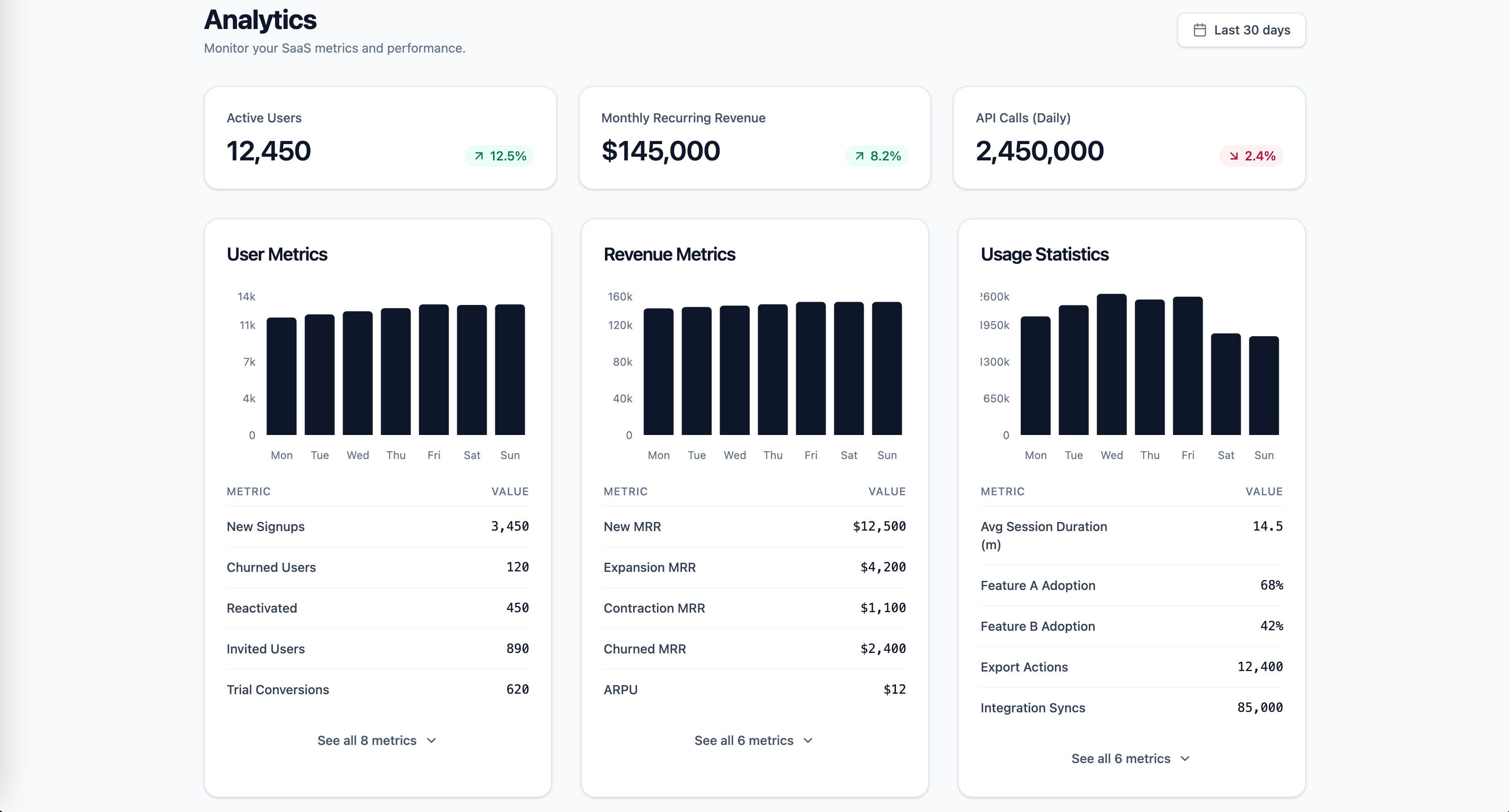
Research-backed prompt for building a SaaS analytics dashboard with user metrics, revenue, and usage statistics. Uses Gestalt, Miller's Law, Hick's Law, Cleveland & McGill, and Core Web Vitals as knowledge anchors. Generated by prompt-forge.
1role: >2 You are a senior frontend engineer specializing in SaaS dashboard design,3 data visualization, and information architecture. You have deep expertise...+73 more lines
Structured security audit prompt for SaaS dashboard projects. Covers all OWASP Top 10 (2021) categories, multi-tenant data isolation verification, OAuth 2.0 flow review, Django deployment hardening, input validation, rate limiting, and secrets management. Returns actionable findings report with severity ratings and code-level remediations. Stack-agnostic via configurable variables.
1title: SaaS Dashboard Security Audit - Knowledge-Anchored Backend Prompt2domain: backend3anchors:...+120 more lines

